The Definitive Guide to Artificial Intelligence in Retail (2026)
Discover how artificial intelligence in retail is transforming the industry. Explore the top AI use cases, core benefits, and step-by-step strategies to drive ROI in 2026.

.avif)
For most of its history, retail ran on a single loop: stock what sold last season, discount what didn't, and trust an experienced buyer's instinct to fill the gaps. That loop is breaking. Artificial intelligence has moved the center of gravity in retail from reactive intuition to predictive — and increasingly autonomous — decision-making. The question facing most retail and consumer-goods leaders in 2026 is no longer whether to adopt AI, but which decisions to hand it first and how to measure what it gives back.
Key Takeaways
- AI in retail has crossed from pilot to production. Roughly 89–91% of retail and CPG companies are now using or assessing AI, and active deployment reached 58% in 2026 — up 16 points in a single year (NVIDIA 2026 State of AI in Retail survey).
- The value is concentrated, not diffuse. Demand forecasting, personalization, inventory replenishment, and trade-spend optimization account for most of the measurable return. McKinsey puts the personalization uplift alone at 10–15% of revenue.
- The hard part is data, not algorithms. Data silos, legacy integration, and governance — not model quality — are the main reasons retail AI programs stall.
- Sequencing beats ambition. Retailers seeing returns six times faster start with high-impact, low-friction use cases and build outward rather than attempting a full transformation at once.
What is Artificial Intelligence in Retail?
Artificial intelligence in retail is the use of machine learning, predictive analytics, computer vision, and natural language processing to forecast demand, automate operational decisions, and personalize the commercial experience across every channel. In practice, it replaces rules and human estimates with systems that learn from data and improve as more data arrives.
The shift underneath the buzzword is technological. First-generation retail systems ran on heuristics — fixed reorder points, last-year-plus-ten forecasting, segment-level promotions. These were deterministic: a human wrote the rule, and the system followed it. Modern retail AI is probabilistic. Machine-learning models read thousands of signals at once — weather, local events, search behaviour, price elasticity, sell-through velocity — and produce a forecast or a recommendation that no analyst could assemble by hand at SKU-by-outlet granularity.
The most recent layer is agentic AI. Agentic AI systems go a step further and act, executing routine commercial decisions inside a retailer's stack with a human approving rather than authoring the plan. The trajectory is clear: from systems that report, to systems that recommend, to systems that decide.
The Current State of AI in Retail (Data & Market Trends)
The retail AI market is now measured in the tens of billions of dollars and growing at roughly a third per year, with adoption shifting decisively from experimentation to deployment. The headline figures below are drawn from 2025–2026 industry research and should be verified against the original reports before client-facing or published use.
- Market size. Estimates for 2026 cluster around USD 18 billion (Coherent Market Insights, Mordor Intelligence), with longer-range projections reaching roughly USD 130 billion by 2033 at a CAGR near 32% (Coherent Market Insights). Fortune Business Insights gives a more conservative path — USD 16.5 billion in 2026 to USD 105.9 billion by 2034.
- Adoption. Around 89–91% of retail and CPG companies are actively using or assessing AI, and active deployment hit 58% in 2026, up from 42% the prior year (NVIDIA 2026 State of AI in Retail and CPG survey).
- Budgets. Roughly 90% of retailers plan to raise AI spending in 2026, with about half planning increases of 10% or more (NVIDIA).
- Where the spend goes. Personalization is the single largest line item; inventory and demand forecasting is the second, accounting for roughly 23% of retail AI spend (Mordor Intelligence). Machine learning carries the bulk of spend because it runs the highest-value use cases; generative AI is the fastest-growing segment.
- The implementation gap. While ~89% are testing, only around 33% have full implementation — most retailers still run AI in one or two functions, usually marketing or recommendations. The opportunity sits in the gap.
The pattern across the data is consistent: the technology has matured, budgets are committed, and the competitive separation is now between retailers who have operationalised AI and those still treating it as a project.
16 Transformative Use Cases of AI in Retail
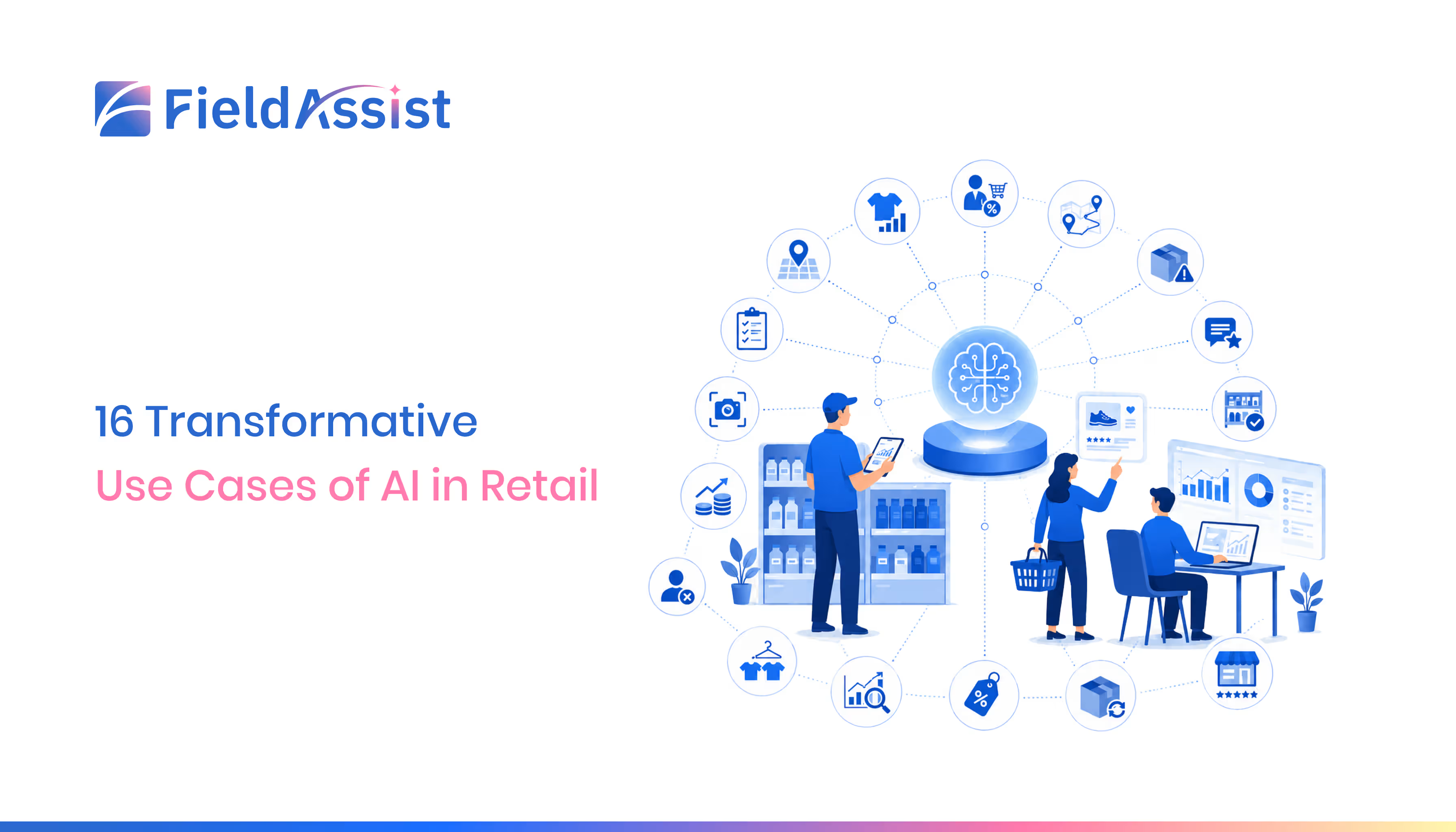
The use cases below span both physical and digital retail and, deliberately, both the shopper-facing and the field-and-supply-chain sides of the business — where much of the durable ROI now sits.
1. Enhance Merchandise Planning and Forecasting
AI improves merchandise forecasting by reading demand signals that spreadsheets cannot — weather, local events, price moves, promotions, and live search trends — and resolving them down to the SKU and store. Models are trained on historical sell-through and continuously corrected against actuals, so accuracy compounds over time. The business outcome is direct: McKinsey research links AI-driven demand sensing to 20–50% reductions in forecast error, which translates into fewer markdowns, leaner opening buys, and less capital trapped in slow-moving stock.
2. Deliver Personalized Retailer Offers
AI tailors offers, schemes, and pricing to each outlet or shopper based on purchase history, basket composition, and responsiveness, rather than applying one blanket promotion. Product recommendation models predict what a given retailer or customer is most likely to accept next, then trigger the offer at the right moment. The payoff is the most consistently documented in retail AI: McKinsey attributes a 10–15% average revenue uplift to personalization, with fast-growing retailers drawing a disproportionate share of revenue from it.
3. Optimise Sales Route Planning
AI builds the most productive beat plan by sequencing outlet visits against travel time, call frequency, and each outlet's revenue potential. Instead of static routes set once a quarter, the system re-optimises as priorities shift — a launch to push, a scheme to fix, a slipping account to recover. The result is more effective calls per day, lower cost-to-serve per visit, and coverage that follows revenue rather than geography alone.
4. Predict Stockouts Before They Happen
AI forecasts when a SKU will run dry at a specific outlet or distribution centre by combining sell-through velocity, replenishment cadence, and supplier lead times. Rather than reacting to an empty shelf, the system flags the risk days ahead and prompts a corrective order. On-shelf availability is one of the most expensive problems in retail — every out-of-stock is a sale handed to a competitor — and predictive replenishment has been associated with sharp reductions in stockout frequency alongside lower buffer inventory.
5. Recommend Next Best Actions for Sales Reps (Nudges)
AI surfaces the single highest-value action a rep should take at each outlet — introduce a new SKU, correct a lapsed scheme, fix an under-sized order — rather than leaving prioritisation to memory. The model weighs each outlet's history, current gaps, and comparable-store performance, then delivers one clear nudge in the field app. Reps spend less time deciding what to do and more time selling, which lifts strike rate and average drop size without adding headcount.
6. Improve Retail Shelf Compliance
AI checks whether the physical shelf matches the agreed planogram and flags every gap — missing facings, wrong placement, lost share of shelf — in near real time. By comparing observed conditions against the intended layout, it converts a subjective spot-check into an objective, repeatable audit. Better compliance protects the visibility a brand has paid for and shortens the time between a problem appearing on shelf and someone correcting it.
7. Identify High-Potential Stores and Territories
AI scores outlets and territories by untapped revenue, using lookalike modeling to find stores that resemble top performers but under-trade. It exposes white space that gut feel and revenue rankings miss — an outlet buying the base range but none of the premium SKUs its neighbors sell well. Commercial teams use these scores to redesign territories, set fairer targets, and direct effort toward the accounts with the most realistic upside.
8. Optimize Inventory Replenishment
AI sets reorder points and order quantities automatically for each SKU at each location, balancing service level against carrying cost. It learns demand variability per product and tunes safety stock accordingly, rather than applying a flat rule across a catalogue of thousands. Retailers running AI-driven replenishment report roughly 35% lower inventory levels alongside meaningful cuts in forecast error — a combination that frees working capital while protecting availability.
9. Improve Promotion Effectiveness
AI predicts which promotions and schemes drive genuinely incremental sales rather than subsidising demand that would have happened anyway. By modelling baseline versus promoted sell-through, it separates lift from leakage and recommends the mechanics, depth, and timing most likely to pay back. CPG and retail teams applying this report promotional-effectiveness gains in the region of 15–25%, with the largest savings coming from cutting promotions that never moved incremental volume.
10. Generate Actionable Retail Insights from Market Data
Natural language processing and generative AI turn unstructured market data — reviews, field notes, syndicated reports, competitor activity — into a ranked list of actions a manager can act on the same day. Instead of an analyst spending a week summarising, the system reads everything and returns the signal: which category is softening, which competitor is gaining, which complaint is recurring. The outcome is faster, better-evidenced decisions and analyst time redirected from collation to judgement.
11. Improve Assortment Planning by Store
AI tailors the right range to each store or store cluster based on local demand patterns, demographics, and observed sell-through, rather than shipping a single national assortment everywhere. It identifies the SKUs that earn their shelf space in a given location and the ones quietly losing money. Sharper assortment strategy lifts sales per square foot and cuts the dead stock and markdowns that a one-size-fits-all range inevitably creates.
12. Predict Churn Among Retailers and Distributors
AI flags outlets and distributors whose ordering is quietly decaying — falling order frequency, shrinking basket, lengthening gaps — well before they go dormant. The model recognises the early pattern of a partner drifting away and routes the account to someone who can intervene while the relationship is still recoverable. Because re-acquiring a lapsed retailer costs far more than retaining an active one, early churn signals directly protect secondary sales and route stability.
13. Optimise Trade Spend and Incentives
AI allocates trade spend and incentives to the accounts and schemes with the highest incremental return, rather than spreading budget evenly or by habit. It models the marginal return of each rupee or dollar of spend and reallocates away from saturation and toward genuine upside. Trade spend is among the largest and least-measured line items in consumer goods; tightening its allocation reduces leakage and raises return on a budget that often runs to double-digit percentages of revenue.
14. Analyse Shelf Images for Execution Compliance (Computer Vision)
Computer vision reads a single phone photo of the shelf and auto-audits facings, share of shelf, pricing, and out-of-stocks in seconds. A rep photographs the fixture; the model returns an objective execution score without manual counting. This collapses a shelf audit from several minutes of subjective tallying to a few seconds of consistent, comparable data — and produces a clean dataset that feeds every other execution decision downstream.
15. Prioritise Store Visits Based on Revenue Opportunity
AI ranks the day's outlets by revenue opportunity so a rep spends time where it pays rather than where the route happens to lead. It weighs each call's likely return — a recoverable account, an outlet ready for a range extension, a slipping scheme — and orders the day accordingly. The effect is a measurable lift in revenue per visit, since the same number of calls is now pointed at the highest-value work.
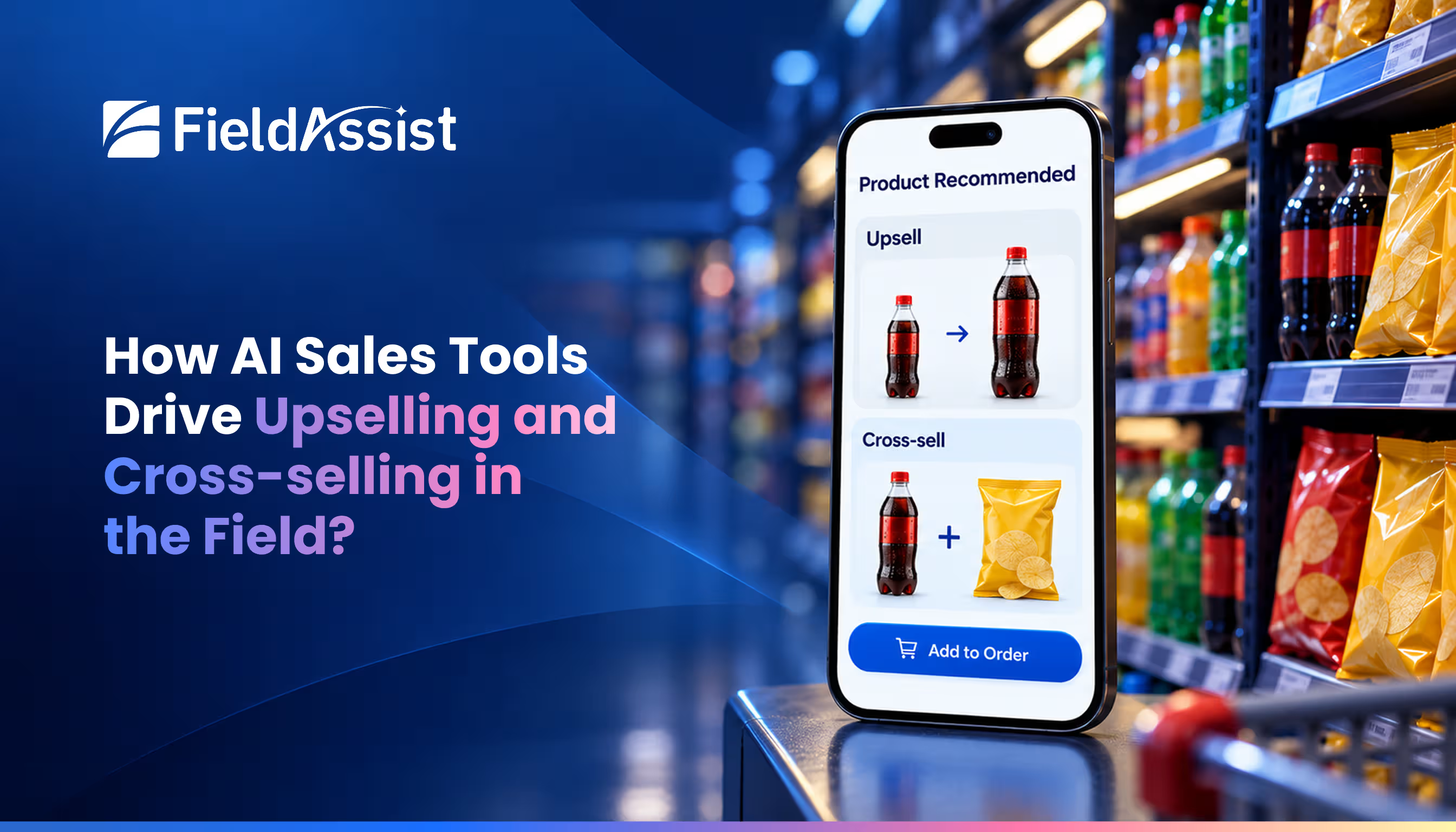
16. Identify Cross-Sell and Upsell Opportunities
AI spots which adjacent SKUs an outlet or shopper is most likely to buy next, based on what comparable buyers already purchase. Association and propensity models surface the natural extension — the line an outlet stocks everything around but doesn't yet carry. Acting on these recommendations raises basket size and average order value, and at the shopper level, personalized recommendations are among the most reliable levers for lifting order value that retail AI offers.
Core Benefits of Implementing AI in Retail Operations
The benefits of AI in retail fall into three measurable pillars: faster revenue, lower cost, and operational agility — the ability to decide and act at a speed and granularity that manual operations cannot match. The clearest way to see the shift is to compare how a traditional retail operation and an AI-driven one handle the same core decisions.
Other aspects include:
Revenue acceleration. Personalization, sharper assortment, and better recommendations convert more demand into sales. The most-cited figure — a 10–15% personalisation uplift (McKinsey) — sits alongside gains in basket size, promotion efficiency, and on-shelf availability that compound across a network.
Cost reduction. Leaner inventory, less waste from markdowns and stockouts, tighter trade spend, and automation of routine analysis all lower the cost of running the business. Reductions of roughly a third in inventory levels and a fifth to a half in forecast error remove the cost that previously looked structural.
Operational agility. The least visible benefit is often the most strategic: an AI-driven operation can replan a beat, reforecast a category, or reallocate spend the same day a signal appears, rather than waiting for the next planning cycle. In a market where demand moves on weather and social trends, that responsiveness is itself a competitive position.
Overcoming the Challenges of Retail AI Adoption
The main barriers to retail AI are organizational and data-related, not technical — most stalled programs fail on data quality, integration, and governance long before model performance becomes the issue. Naming these honestly is what separates a durable program from an expensive pilot.
- Data silos and data hygiene. Retail data is fragmented across e-commerce platforms, point-of-sale, distributor systems, field apps, and supply chain — often in incompatible formats. An AI model is only as good as the data feeding it; inconsistent SKU codes, missing outlet records, and unreconciled sales figures will produce confident, wrong answers. The unglamorous work of cleaning and unifying data is usually the longest part of any serious deployment.
- Legacy system integration. Many retailers run on systems that predate the AI they now want to layer on. Connecting modern models to an established ERP, DMS, or warehouse-management system without disrupting live operations is a real constraint, and it is where build-versus-buy decisions are won or lost. The pragmatic path is integration at the decision layer rather than wholesale replacement.
- Consumer data privacy and governance. Personalization depends on data that is increasingly regulated. Retailers operating across markets must reconcile what is commercially useful with what is legally and ethically permissible, which means consent management, clear data lineage, and governance over how models are trained and used. Treating governance as a foundation rather than an afterthought is what keeps a personalization program defensible.
None of these is a reason to wait. They are the reason to sequence carefully — start where the data is cleanest and the integration lightest, prove the return, and extend.
How to Implement AI in Your Retail Strategy (A Step-by-Step Framework)
A retail AI strategy succeeds when it is sequenced — audit the data, prioritise high-return and low-friction use cases, choose build or buy deliberately, then close the feedback loop so the system improves in production. The four steps below are deliberately ordered; skipping the first is the most common reason later steps disappoint.
Step 1: Audit data infrastructure
Begin with an honest inventory of what data exists, where it lives, how clean it is, and how easily it can be unified. This audit determines what is realistically possible in year one and surfaces the silos and quality gaps that would otherwise derail a deployment mid-flight. Data readiness, not ambition, sets the starting line.
Step 2: Prioritize high-impact, low-friction use cases
Map candidate use cases on two axes: business impact and implementation friction. The early wins live in the top-left — high return, low friction — typically demand forecasting, replenishment, or personalization, where the data is available and the ROI is well-documented. Retailers that report returns six times faster tend to be the ones who resisted the urge to transform everything at once.
Step 3: Evaluate build versus buy technology partners
Decide deliberately where to build proprietary capability and where to adopt a proven platform. Building makes sense for genuine differentiation; buying makes sense for capabilities that are mature, undifferentiated, and faster to deploy than to engineer. The right answer is usually a portfolio of both, judged use case by use case rather than as a single doctrine.
Step 4: Establish continuous feedback loops
AI is not a one-off install; its value comes from improvement in production. Put in place the measurement, retraining cadence, and human review that let models learn from their own errors and adapt as conditions shift. The retailers extracting the most value are those who treat every forecast and recommendation as a test the system grades itself against, week after week.
Frequently Asked Questions (FAQs)
Q1: What is the most common use of AI in retail?
Personalization and recommendation engines are the most common applications of AI in retail, followed closely by demand forecasting and inventory optimization. Most retailers begin here because the data is readily available and the return is well-evidenced — personalization alone is linked to a 10–15% revenue uplift (McKinsey). The implementation gap remains wide, however: the majority of retailers still run AI in only one or two functions rather than across the business.
Q2: Will AI replace retail workers or sales reps?
AI is reshaping retail roles rather than eliminating them — it automates routine analysis and prioritization while shifting people toward judgment, relationships, and exceptions. A sales rep equipped with next-best-action nudges and prioritized routes does more selling and less administration, not less work. McKinsey estimates a large share of current activities across consumer functions could be automated by 2030, but the practical effect on the ground has so far been augmentation: the same people, making better-informed decisions, faster.



.avif)