On-Shelf Availability: How AI Software Improves OSA in Retail
AI-powered retail execution software helps CPG brands improve on-shelf availability by detecting stock gaps, tracking planogram compliance, and reducing out-of-stock losses in real time.

.avif)
Every CPG brand manager knows the sinking feeling: a product that cleared the warehouse and arrived at the store, only to sit in a back room while a competitor occupies your shelf space. That gap between "delivered" and "available for purchase" is exactly where brands lose revenue they never see in their reports. On-shelf availability is the metric that exposes it.
What is On-Shelf Availability (OSA)?
On-shelf availability (OSA) is a retail metric that measures the percentage of time a product is available for purchase on the shelf when a customer wants to buy it. It is one of the most direct indicators of retail execution health for any CPG brand operating across modern or general trade.
The On Shelf Availability Formula
The calculation is straightforward:
On-Shelf Availability FORMULA
OSA (%) = (Items available on shelf ÷ Total expected items on shelf) × 100
Industry benchmark for high-performing retailers: consistently above 95%. A 92% OSA means 8% of your products are invisible to the shopper, silent revenue leakage at scale.
On Shelf Availability vs. In-Stock: The Critical Difference
These two terms are used interchangeably on the floor, and that conflation costs brands real money. Let’s understand that in-stock is an inventory metric: it tells you whether a product exists somewhere in the store - backroom, transit shelf, or sales floor. On-shelf availability is a shopper metric: it tells you whether the product is where a customer can actually pick it up.
A product can register as "in-stock" in your ERP while being completely unreachable to a shopper at the fixture. This discrepancy is what the industry calls phantom inventory, and it is the most insidious driver of lost sales in on-shelf availability retail. Improving on shelf availability means closing this gap at the last mile, not just managing aggregate stock counts.
Why On Shelf Availability In Retail Matters: The Cost of the "Empty Shelf"

Poor on-shelf availability doesn't just hurt a single transaction. The downstream effects ripple through brand equity, trade investment efficiency, and field team productivity.
- Lost Sales
The aggregate cost is staggering. According to the IHL Group 2025 Inventory Distortion Report, global retail loses $1.73 trillion annually due to inventory distortion, with out-of-stocks alone accounting for $1.2 trillion of that figure, more than South Korea's entire GDP. For CPG brands stretched across hundreds of SKUs and thousands of outlets, even a fractional share of those losses is a material topline hit.
- Diminished Brand Loyalty
An empty shelf hands a trial opportunity to a competitor. Research shows that 91% of consumers who encounter an out-of-stock will not wait for a restock, and McKinsey data confirms that 43% will buy from a competing brand on the spot. Recovering that shopper later costs far more than keeping the shelf full in the first place.
- Wasted Trade Spend
CPG brands invest heavily in promotions, feature placements, and display agreements. But if the promoted product isn't on the shelf during the campaign window, due to a replenishment failure or an unexecuted planogram reset, that trade investment delivers zero return. Poor shelf execution is the most direct trigger.
- Inefficient Labor
When field reps lack real-time shelf data, they spend visits reacting, discovering problems that could have been flagged hours earlier. Manual shelf audits are slow, inconsistent, and subjective. The rep checks what they can see, in the time available, with no objective baseline. The result: labor spend that doesn't translate into measurable shelf improvement or CPG retail execution outcomes.
Common Challenges in Maintaining On shelf Availability
- Phantom Inventory
This is the OOS problem that never shows up in your system. The inventory record confirms availability; the shelf tells a different story. Phantom inventory arises from miscounts, mislocated stock, shrinkage, damage, or replenishment placed in the wrong bay. Manual cycle counts simply cannot catch this fast enough to prevent lost sales.
- Poor Replenishment Execution
Products sitting in the backroom while the shelf runs empty is a pure last-mile execution failure. It happens when replenishment triggers are misconfigured, when staff priorities shift mid-shift, or when there's no real-time alert connecting backroom stock levels to the shelf status visible to store associates. Late replenishment accounts for roughly 25% of all global OOS situations, a problem that is operationally fixable with the right shelf monitoring software.
- Inaccurate Demand Forecasting
Seasonal spikes, regional consumption patterns, and promotional uplifts are predictable, but only with the right data models. When forecasting relies on sell-in numbers rather than real-time sell-through signals, replenishment orders miss the mark. The shelf either starves during high-demand periods or carries excess slow movers that crowd out fast-moving SKUs.
- Manual Auditing Bias
A field rep under time pressure audits the most visible, accessible shelf sections. Eye-level SKUs in the main aisle get checked. The promoted item in a secondary display, or the bottom shelf in an off-location fixture, gets missed. This systematic blind spot is eliminated when AI retail execution tools capture the entire shelf objectively, every visit, every location.
How Image Recognition Software for Retail Tracks OSA?
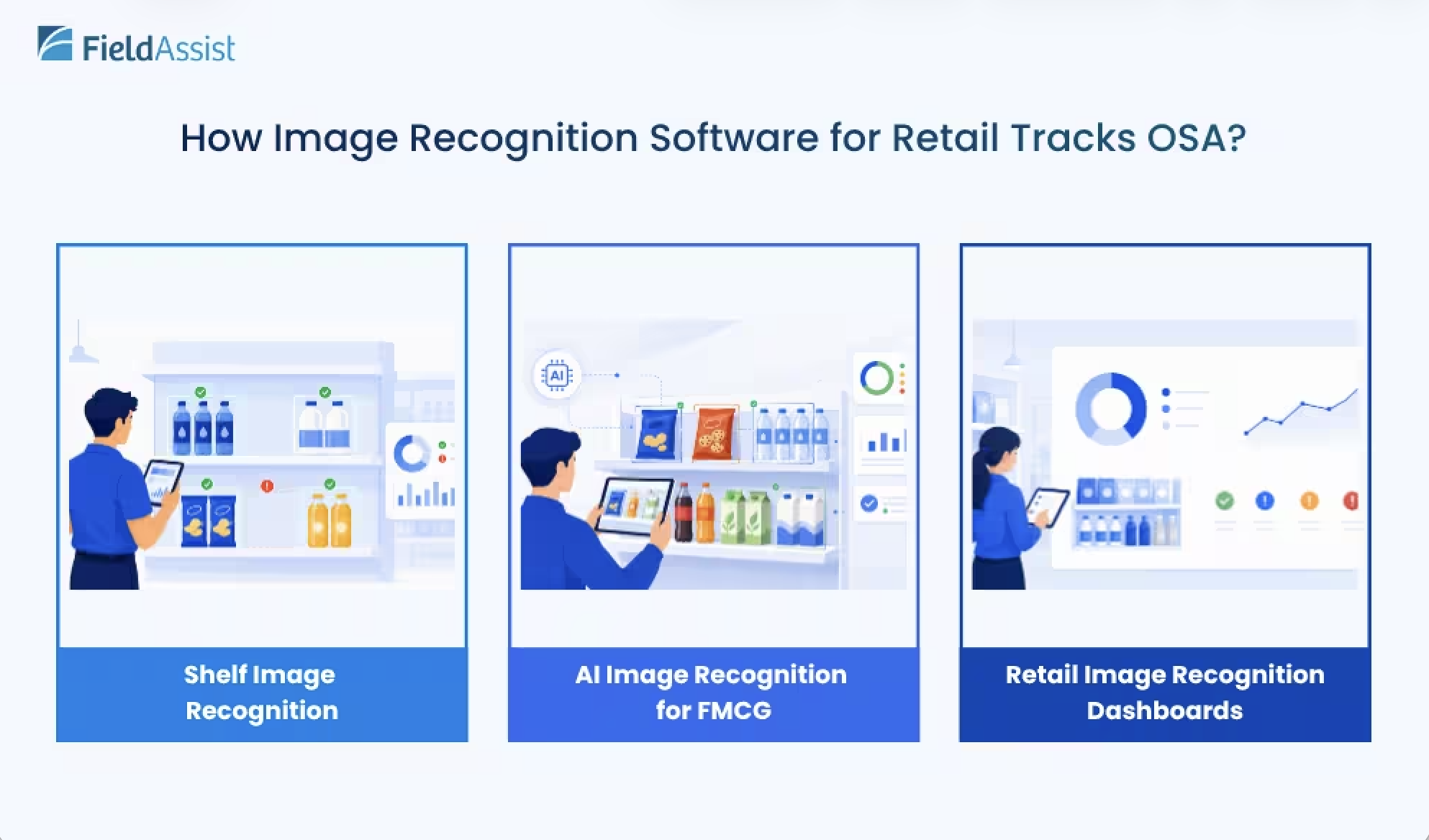
The shift from clipboard audits to AI-powered shelf execution is not incremental; it’s structural. Here’s how modern retail shelf monitoring software works in practice, featuring FieldAssist IRIS, an AI image recognition software equipped with computer vision retail analytics.
1. Shelf Image Recognition
A field rep opens the FieldAssist app, points their smartphone at the shelf, and captures an image. That single action triggers a full AI analysis via IRIS: every SKU in the frame is identified, facings are counted, empty spaces are flagged, and product positioning is checked. The current shelf state is compared against the approved planogram in seconds. This eliminates manual data entry and recall bias, providing objective shelf data tied to a precise store, date, and timestamp.
2. AI Image Recognition for FMCG
The deep learning models powering IRIS are trained on millions of shelf images across product categories, store formats, and lighting conditions. This makes the software smart enough to recognize SKUs when packaging is partially obscured, or lighting is inconsistent, real-world conditions that human auditors routinely miss.
- AI vs. manual auditing accuracy: AI-powered shelf recognition systems consistently achieve higher detection accuracy compared to the 60–70% typical of manual audits.
- Gap Resolution: This accuracy translates to 30% faster gap resolution and a 25% improvement in planogram compliance.
3. Retail Image Recognition Dashboards
Once processed, IRIS feeds data into a real-time dashboard, giving brand managers instant visibility into the "Connected Retail Execution Ecosystem."
- Out-of-Stock Alerts:
IRIS flags out-of-stocks in real time, enabling faster replenishment and reducing lost sales.
- Planogram Compliance:
Managers receive a side-by-side comparison of the actual shelf against the approved layout, pinpointing deviations and the severity of each gap.
- Share of Shelf:
The software provides retail competitive intelligence by tracking competitors' share of shelf. In high-velocity categories, a 2-point shift in share of shelf can determine category leadership.
Strategies to Improve On Shelf Availability In Retail with AI
Technology alone doesn't improve on-shelf availability. The right technology, embedded into field workflows and connected to replenishment systems, does.
1. Real-Time Out-of-Stock (OOS) Modeling
Modern shelf analytics platforms don't just report out-of-stock after the fact; they predict it. By combining historical velocity data, current inventory levels, and store-level traffic patterns, AI models surface SKUs likely to go out of stock before the next replenishment window. This transforms the field rep's role from reactive auditor to proactive executor. IHL Group's 2025 research found that retailers deploying AI and machine learning achieve sales growth 2.3× higher and profit growth 2.5× higher than competitors still on traditional approaches, a bifurcation that is reshaping CPG retail execution dynamics globally.
2. Automated Replenishment Systems
The highest-efficiency OSA improvement comes when shelf analytics data connects directly to replenishment triggers. When the image recognition system detects a low-facing count or confirmed OOS, it automatically generates a replenishment task, routed to the right associate with product, quantity, and shelf location pre-populated. This closes the detection-to-resolution loop without manual escalation and creates an auditable trail for holding field teams and retail partners accountable.
3. Enhanced Field Rep Productivity
When reps are equipped with AI-powered shelf monitoring tools, their store visits shift from data collection to execution and relationship management. Instead of manually recording shelf conditions, they act on issues the system has already surfaced before they walk in the door. In practice: more stores covered per rep per day, better secondary-display coverage, and measurable improvement in planogram compliance scores across the territory, turning the "last mile" into a genuine competitive advantage.
Conclusion: Maximizing Sales with Shelf Excellence
On-shelf availability is not a supply chain metric. It is a revenue metric, and ultimately, a brand health metric. Every time a shopper reaches for your product and finds an empty slot, you're not just losing one sale. You're handing a competitor a trial opportunity, eroding shopper confidence in your brand's reliability, and potentially losing a loyal buyer for good.
The good news: this problem is solvable, not with more reps and more clipboards, but with AI retail execution platforms that give brands real-time visibility into what's actually happening on every shelf, in every store, every day. Better shelf analytics, smarter out-of-stock modeling, and robust retail image recognition are transforming how CPG brands manage on-shelf availability retail at scale.
At FieldAssist, this is precisely the last-mile execution gap we've built our platform to close. Because a product that doesn't reach the shopper's hand hasn't reached the market, regardless of what your supply chain reports say.




.avif)