The Shelf Visibility Challenge in Africa: Why FMCG Brands Are Losing Sales
Shelf visibility challenges can lead to lost sales and wasted trade spend. Discover how AI-powered image recognition helps FMCG brands improve retail execution across Africa.

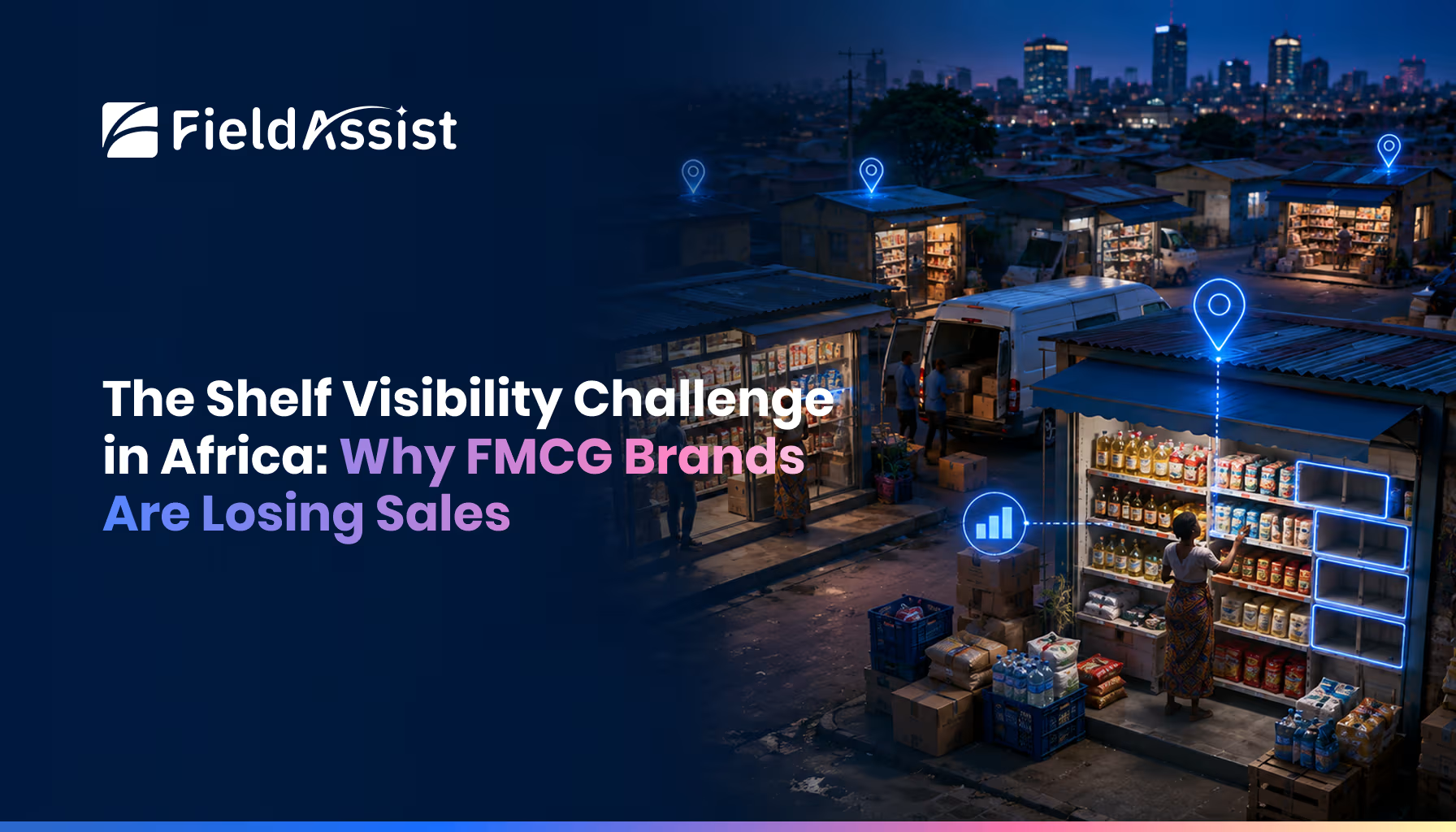
A field rep walks into a duka in Nairobi. Three SKUs from your planogram are missing from the shelf. A competitor's product has taken up the space your brand paid for in the trade promotion. The rep makes a note on a paper form, if he makes a note at all, and moves on to the next outlet. Back at headquarters, no one knows that any of this happened.
This is not an edge case. This is Tuesday in African FMCG retail.
Across Nigeria's open markets, South Africa's spaza shops, Kenya's kiosks, and Ghana's roadside retailers, shelf visibility is one of the most persistent and most expensive gaps in retail execution. For CPG brands that have invested in Africa's long-term growth story, the shelf remains the first and last moment of truth. And right now, most brands are flying blind.
The Reality of the African Retail Shelf: High Fragmentation, Low Visibility
Africa's retail landscape is not one market; it is hundreds of micro-markets operating simultaneously, in different languages, with different informal rules, under vastly different infrastructure conditions. Over 80% of consumer goods on the continent move through informal retail channels: dukas, spazas, kiosks, market stalls, and hawkers. These are not marginal touchpoints. They are the primary point of purchase for most African consumers.
According to projections from McKinsey & Company, consumer spending in Africa is expected to surpass $2 trillion, with household consumption projected to reach $2.5 trillion by 2030. That is a market too large to mismanage at the shelf level.
Yet the structural reality makes shelf monitoring extraordinarily difficult. Routes to market are layered, wholesalers, micro-distributors, commission agents, and informal retailers frequently coexist in the same neighborhood. Only one-third of Africans live within two kilometers of a paved road. Connectivity is intermittent. And the formal retail visibility tools built for European or North American markets were never designed for this terrain.
The result: FMCG brands with strong distribution strategies still lose sales every day because they lack real-time retail intelligence. They cannot see what is actually happening on the shelf in a Kampala minimart or a Lagos roadside store. They cannot confirm whether the trade promotion spent in Accra translated into actual product placement. And without image recognition for retail, they cannot scale that oversight across thousands of outlets.
Hidden Revenue Killers Ruining Your Retail Execution
Shelf visibility failures are not dramatic. They do not show up as a single catastrophic event. They bleed revenue quietly, outlet by outlet, day by day. Here are the three most common and most costly execution failures happening across Africa's retail network right now.
1. Phantom Stockouts and Delayed Replenishment
According to IHL Group's 2024 inventory distortion analysis, out-of-stocks cost the global retail industry $1.2 trillion annually. In the EMEA region, which includes Africa, inventory distortion remains a critical profitability drain.
In Africa's fragmented retail landscape, brands often struggle with phantom stockouts—products appear available in distributor records but are missing from store shelves. These gaps can go unnoticed for days, resulting in lost sales and increased competitor share.
AI-powered retail shelf monitoring closes this visibility gap. By analyzing shelf images captured during store visits, brands can identify stockouts in real time and take corrective action before revenue is lost.
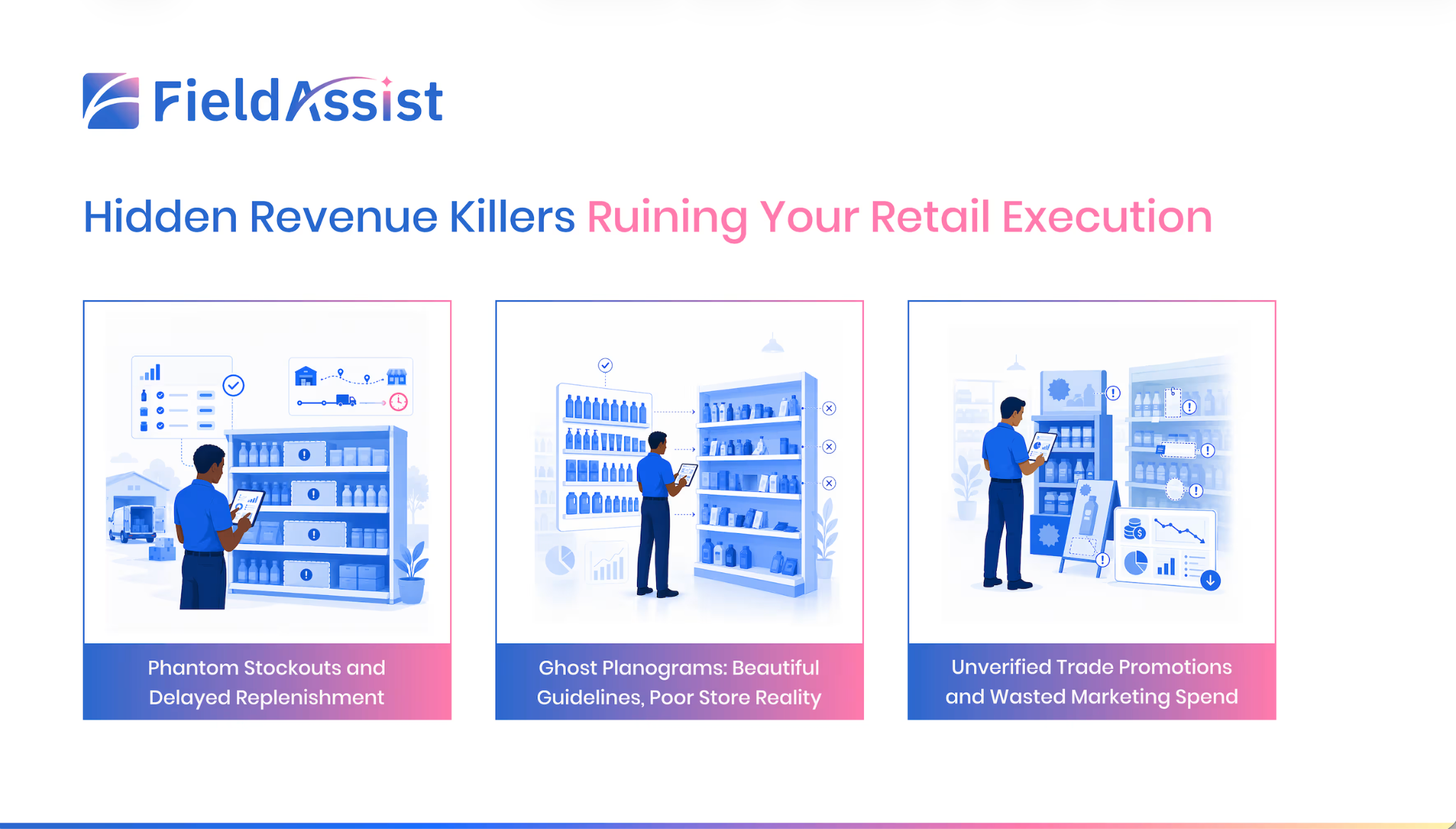
2. Ghost Planograms: Beautiful Guidelines, Poor Store Reality
Every brand has a planogram. A carefully crafted visual of where every SKU should sit, how many facings it should have, and where it should appear relative to competitors. Brand teams spend weeks building these guidelines. Trade marketing teams distribute them across the field. And then, in the overwhelming majority of African outlets, something different happens entirely.
Retailers in informal trade move products based on convenience, cash flow, and whatever arrangement they have with the most recent sales rep or wholesaler who visited. A spaza shop in Johannesburg's township belt or a kiosk outside Nairobi's CBD does not have a planogram compliance officer. The concept of share of shelf Africa teams fight for in modern trade formats simply does not transfer to these environments without active field enforcement, and field enforcement requires verification.
Without retail image recognition, Africa field teams are operating on trust rather than evidence. A rep can report compliance. But only a shelf photo, analyzed by AI, can verify it objectively, consistently, and at scale.
3. Unverified Trade Promotions and Wasted Marketing Spend
Trade promotions represent one of the largest line items in an FMCG brand's African market budget. Price packs, secondary displays, visibility premiums, and gondola end placements are investments made on the assumption that retailers will execute them as agreed.
The NielsenIQ Retail Spend Barometer for Sub-Saharan Africa consistently shows that promotional activity is a primary lever for driving volume across South African and broader African FMCG markets. But spending without verification is spending without accountability. When a brand cannot confirm whether its promotional display actually went up in a Lusaka supermarket or a Dar es Salaam wholesale outlet, it is effectively funding an honor system, one that rarely honors the brand's interests.
The absence of retail execution software Africa-wide that can verify promotion compliance in real time means that marketing budgets are partially wasted on every campaign cycle. The exact proportion varies by brand and market, but the directional reality is consistent: what gets measured gets executed. What doesn't get measured, doesn't.
Enter FAi IRIS: Smarter Retail Image Recognition for Africa
FieldAssist's FAi IRIS is purpose-built retail image recognition software for the execution realities of high-growth, high-fragmentation markets. It is not a tool designed for a European modern trade environment and adapted for Africa as an afterthought. It is engineered for markets where connectivity is unreliable, outlets vary enormously in format, and field teams need a tool that works as hard as they do.
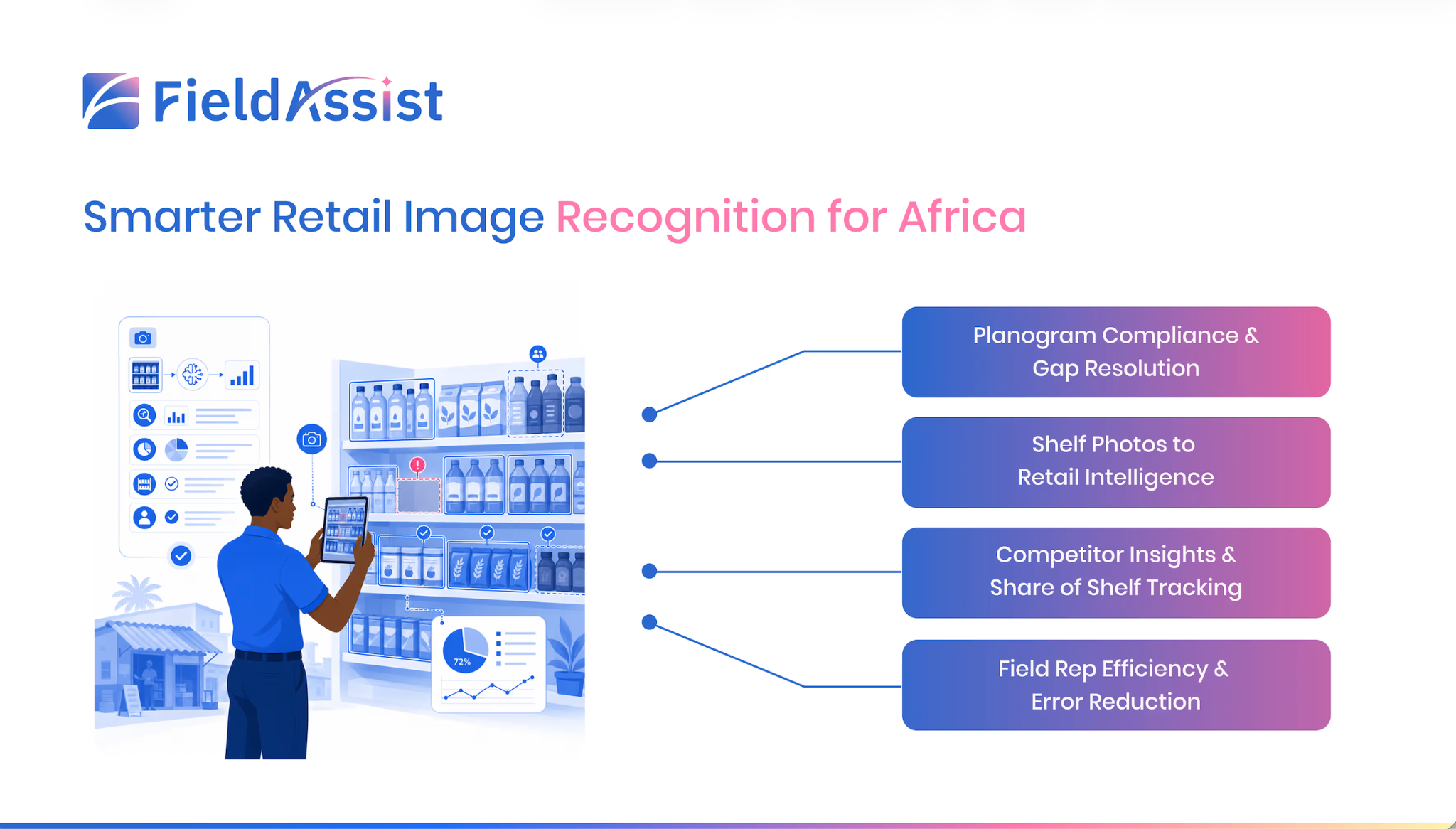
IRIS transforms shelf photos captured by field reps into structured retail intelligence, instantly, accurately, and at scale. Here is what that looks like in practice across Africa's retail landscape.




.avif)