How to Improve Share of Shelf Using AI-Powered Retail Image Recognition?
Improve share of shelf with AI-powered retail image recognition. Detect stockouts faster, improve compliance, and gain real-time shelf analytics with FieldAssist IRIS.

.avif)
In today's brutally competitive CPG landscape, winning at the point of purchase is not optional; it is existential. Yet for most FMCG brands, the retail shelf remains a black box. Products are shipped, reps make store visits, and photos are captured, but by the time the data reaches a decision-maker, the opportunity is already lost.
The gap between what brand managers plan and what actually happens on the shelf is the last-mile execution problem. And it costs the global retail industry dearly. As per industry reports, the combined cost of out-of-stocks and overstocks reached $1.7 trillion globally, with out-of-stocks alone accounting for $1.2 trillion. AI-powered retail image recognition is how leading CPG brands are finally closing this gap, transforming routine shelf photos into real-time, actionable shelf availability analytics.
What is AI-Powered Retail Image Recognition?
From Raw Store Photos to Actionable Retail Shelf Analytics
AI-powered retail image recognition is a computer vision technology that converts shelf photographs taken during store visits into structured, quantifiable data. Instead of a field rep manually counting facings or noting compliance gaps in a spreadsheet, deep learning models analyze every pixel of a shelf image, detecting SKUs, reading planogram adherence, flagging out-of-stocks, and benchmarking competitor positioning in seconds.
The output is not a photo album. It is a rich layer of retail shelf analytics, granular, store-level, SKU-level intelligence that feeds directly into dashboards, corrective workflows, and strategic planning. This is where raw field data becomes a shelf intelligence platform that drives category leadership.
How Deep Learning Identifies SKUs and Facings Under Real-World Conditions?
Real store shelves are messy. Lighting is inconsistent. Products are partially blocked. Packaging changes seasonally. New competitors appear without notice. Traditional rule-based systems fail in these conditions.
Modern AI shelf monitoring platforms use convolutional neural networks (CNNs) trained on millions of shelf images across diverse store formats, geographies, and categories. These models continuously learn, adapting to new SKUs, packaging refreshes, and store configurations, achieving recognition accuracy rates that no manual audit process can match at scale. The result is shelf visibility solutions that work as effectively in a kirana store in India as in a modern trade hypermarket in Southeast Asia.
The Core Challenge: Why Traditional Shelf Execution Falls Short
Before examining the solution, it's worth being precise about the problem. Most brands still rely on manual processes that were designed for a simpler retail era, one with fewer SKUs, fewer outlets, and fewer competitors. That era is over.
1. Book Inventory vs. Real-Time Phantom Out-of-Stocks
A phantom out-of-stock is a product that the system shows as available but is physically absent from the shelf, misplaced in the stockroom, sitting in a trolley, or simply never restocked after the last purchase. These ghosts haunt every FMCG brand's P&L. Without continuous retail shelf monitoring, the gap between book inventory and shelf reality remains invisible until a shopper walks away empty-handed.
2. Revenue Leakage from Poor Compliance
The National Association of Retail Marketing has found that planograms go out of compliance at a rate of approximately 10% per week without consistent monitoring. NielsenIQ research further found that nearly 60% of all retail execution issues stem directly from poor shelf compliance. Each deviant facing, each misplaced competitor product, each missing SKU is a direct revenue drain, compounding week over week across hundreds of outlets.
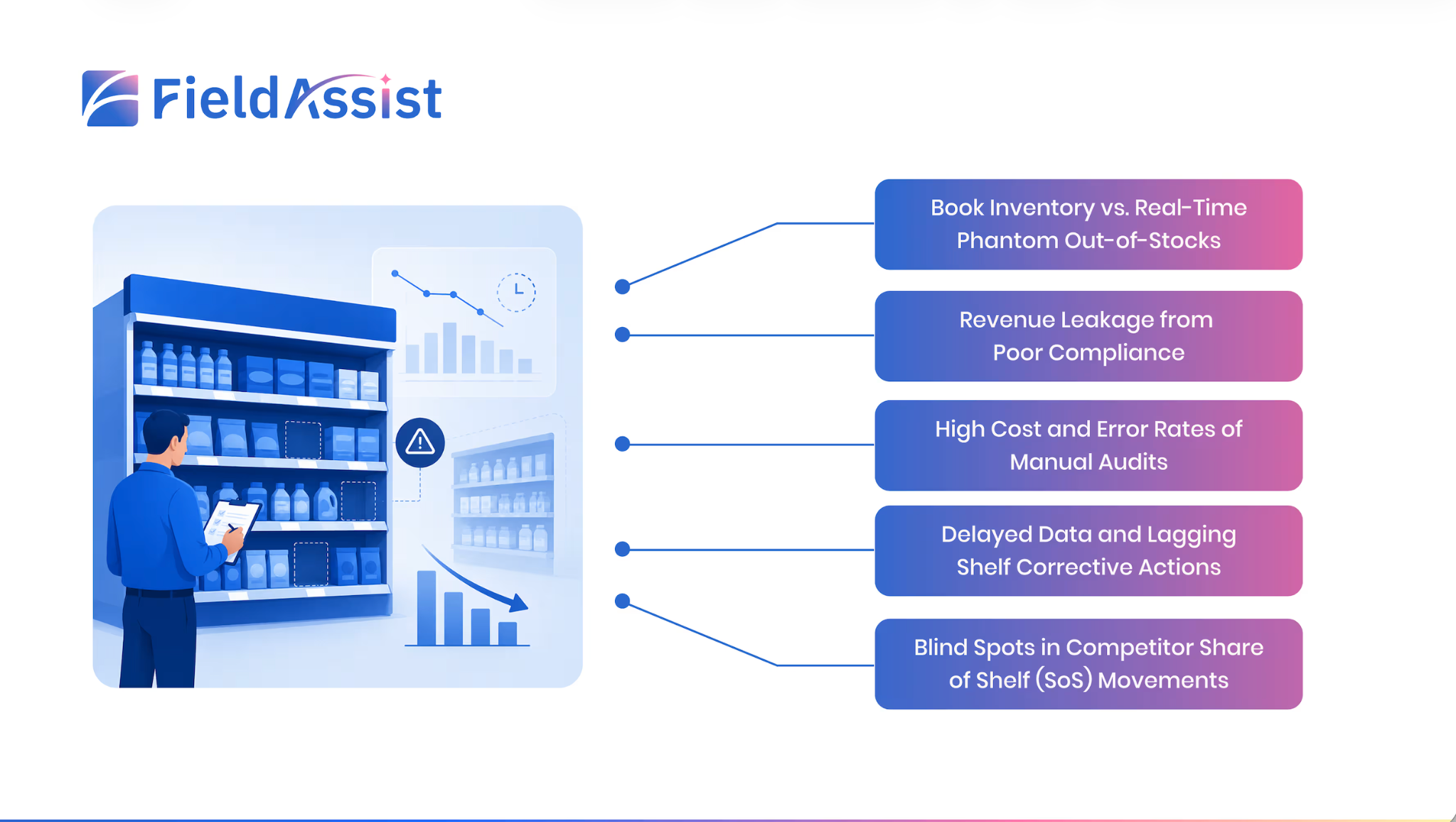
3. High Cost and Error Rates of Manual Audits
Manual shelf audits are slow, expensive, and inherently subjective. A field rep covering 15–20 stores per day cannot reliably count facings, check price tags, verify promotional displays, and log competitor movements with consistent accuracy. The data that does come back is stale before it reaches the trade marketing team. Scaling manual coverage to thousands of outlets is financially unviable for most FMCG brands, making a technology-driven shelf monitoring solution for FMCG not a luxury but a competitive necessity.
4. Delayed Data and Lagging Shelf Corrective Actions
In traditional field execution models, a planogram violation discovered on a Monday visit might generate a corrective action request by Wednesday and a store fix by Friday, if at all. In a category where a shopper makes a purchase decision in under three seconds at the shelf, a three-day lag is commercially catastrophic. Brands deploying AI shelf monitoring compress this cycle from days to hours, or even minutes.
5. Blind Spots in Competitor Share of Shelf (SoS) Movements
Manual audits capture your own brand's performance occasionally. They almost never systematically track what a competitor is doing in adjacent shelf space. When a rival brand quietly gains two additional facings across 300 outlets during a promotional period, most brands find out weeks later, through declining sales data. A purpose-built shelf intelligence platform with competitor tracking closes this blind spot in real time.
How to Maximize Share of Shelf Using an AI Shelf Intelligence Platform?
A modern shelf intelligence platform does more than capture images; it orchestrates the entire retail execution cycle, from image capture to corrective action to sales outcome. Here is how each capability directly translates to share of shelf gains.
- Automated Planogram Compliance and Verification
The most immediate ROI from AI-powered shelf execution software lies in planogram compliance automation. Every store visit photo is analyzed against the approved planogram, detecting deviations in facing count, shelf position, product sequence, and display execution. Compliance dashboards give managers an aggregate score across their entire retail network, with drill-down capability to the individual store and SKU.
Field teams receive instant alerts and guided corrective actions on their mobile devices, eliminating the manual reporting loop entirely. Leading FMCG brands using AI planogram verification have reported compliance improvements of up to 30% and measurable same-store sales uplifts of up to 9.2%.
- Utilizing Shelf Availability Analytics to Prevent Category Loss
Out-of-stocks are not just a supply chain problem; they are a shelf execution problem. Shelf availability analytics powered by AI detect empty facings, low-stock conditions, and phantom out-of-stocks in real time, triggering immediate replenishment workflows before a shopper encounters an empty shelf.
The business case is unambiguous. According to NielsenIQ, CPG retailers lost $82 Billion of sales to stockouts in 2021, a figure that retail shelf analytics and AI-driven availability monitoring directly target. The same shelf availability analytics layer can identify which stores are chronically non-compliant, enabling focused field deployment that maximizes coverage efficiency.
- Tracking Competitor Movements with Precision Data
Share of shelf is a zero-sum game. Every additional gain that a competitor has is a loss for your brand. A retail shelf analytics platform with competitor detection gives brand managers a live view of competitive shelf positioning across their entire distribution network, tracking facing counts, new product launches, promotional displays, and pricing activity.
This intelligence transforms reactive trade marketing into a proactive strategy. When a competitor launches a new SKU and gains disproportionate space in a key account, brands with shelf visibility solutions see it within hours and can direct their field teams accordingly, protecting their hard-won shelf real estate.
- Ensuring Flawless Promotion and New Launch Execution
Trade promotions represent one of the largest budget line items for most FMCG brands, and one of the most poorly measured. AI-powered shelf execution software verifies in real time whether promotional displays, secondary placements, and must-sell SKUs are executed per the trade agreement: right store, right position, right price, right time.
For new product launches, where early distribution velocity determines long-term category positioning, a shelf-monitoring solution for FMCG provides the execution visibility that makes the difference between a successful launch and a slow bleed-out of distribution.
Business Benefits: Why FMCG Brands Must Pivot to AI Shelf Monitoring

The business case for AI shelf monitoring is no longer theoretical. According to NVIDIA's 2024 State of AI in Retail and CPG report, 87% said using AI reported an increase in annual revenue, with 94% noting a decrease in operating costs. The global image recognition market in retail is projected to grow from USD 8.3 billion in 2024 to USD 17.5 billion by 2033 at a CAGR of 22.5%, a clear signal that the industry has made its verdict.
The tangible benefits for FMCG brands include:
- 30% improvement in planogram compliance through real-time visibility and faster deviation correction
- 25% faster stockout detection and resolution through AI-powered shelf availability analytics
- 20% increase in must-sell SKU visibility during key promotional periods
- Significant reduction in manual audit costs by replacing subjective field reporting with structured retail shelf analytics
- Real-time competitor intelligence that enables proactive, data-driven trade marketing decisions
- Faster new product launch execution with verifiable distribution evidence across every store visit
Beyond the metrics, the strategic value of a shelf intelligence platform lies in organizational alignment. When every field rep, regional manager, and trade marketing director is working from the same real-time shelf data, execution accountability becomes systemic rather than anecdotal.
Selecting the Right Shelf Execution Software for Your CPG Brand
Not all shelf execution software is created equal. The difference between a vendor that can demo impressively and one that delivers measurable outcomes at scale lies in a handful of critical capabilities.
Key Features: Real-Time Dashboards, Edge Processing, and ERP Integration
Insist on real-time dashboards that surface compliance scores, out-of-stock alerts, and competitor movements at the store, territory, and national level, without a 24-hour data lag. Edge processing capability (on-device image analysis) ensures the system functions reliably even in low-connectivity store environments, which is non-negotiable for brands operating in emerging markets.
ERP and SFA integration is equally critical. A shelf monitoring solution for FMCG that operates in isolation from your distribution management system (DMS) and sales force automation (SFA) platform creates data silos, undermining the very accountability the technology is designed to create. Look for a solution where shelf image data flows directly into corrective task management, replenishment triggers, and trade promotion reconciliation workflows.
Also prioritize platforms with robust retail shelf analytics reporting, granular store-level, region-level, and category-level outputs that can inform trade strategy, field deployment, and Key Account negotiations.
Scalability Across Diverse Store Formats and Categories
CPG brands operate across highly heterogeneous retail environments, from modern hypermarkets with standardized gondola layouts to traditional trade outlets with improvised shelf configurations. A credible shelf visibility solution must perform consistently across this diversity.
Evaluate the vendor's model training depth: How many SKUs are in their recognition library?
How quickly can new products be onboarded? How does the system handle regional packaging variants? A true enterprise-grade shelf monitoring solution for FMCG scales horizontally, from 500 outlets to 50,000, without degrading recognition accuracy or data latency.
Equally important is the vendor's track record with multi-category deployments. A system that handles beverages accurately but struggles with personal care or home care categories is not a shelf intelligence platform; it is a point solution with a narrow application.
Own the Retail Shelf with Intelligent Automation
The retail shelf is not a passive display surface. It is the single most powerful marketing medium a CPG brand controls, and in most organizations, it is being managed with tools that belong in a different decade.
AI-powered retail image recognition changes the rules. It transforms every store visit into a structured data collection event. It converts compliance gaps into corrective actions before shoppers experience them. It turns competitor shelf movements from a post-mortem discovery into a real-time competitive signal. And it connects field execution directly to revenue outcomes in a way no manual process ever could.
For CPG brands serious about winning the last mile, the question is no longer whether to invest in AI shelf monitoring and shelf availability analytics. It is how quickly you can deploy them, because your competitors are not waiting.
FieldAssist IRIS is a purpose-built shelf intelligence platform designed for the realities of FMCG retail execution, across modern trade, traditional trade, and everything in between. From automated planogram compliance and competitor share-of-shelf tracking to real-time retail shelf analytics and promotion verification, IRIS closes the last-mile execution gap where it matters most: on the shelf, in the store, in the moment.
See IRIS in action, and own every shelf.




.avif)