The Intelligent Shelf: Why Image Recognition is the New Standard for Retail Excellence in 2026
See how image recognition for retail cuts audit time 30% and lifts OSA 15%. Learn how AI shelf audits work in GT & MT.

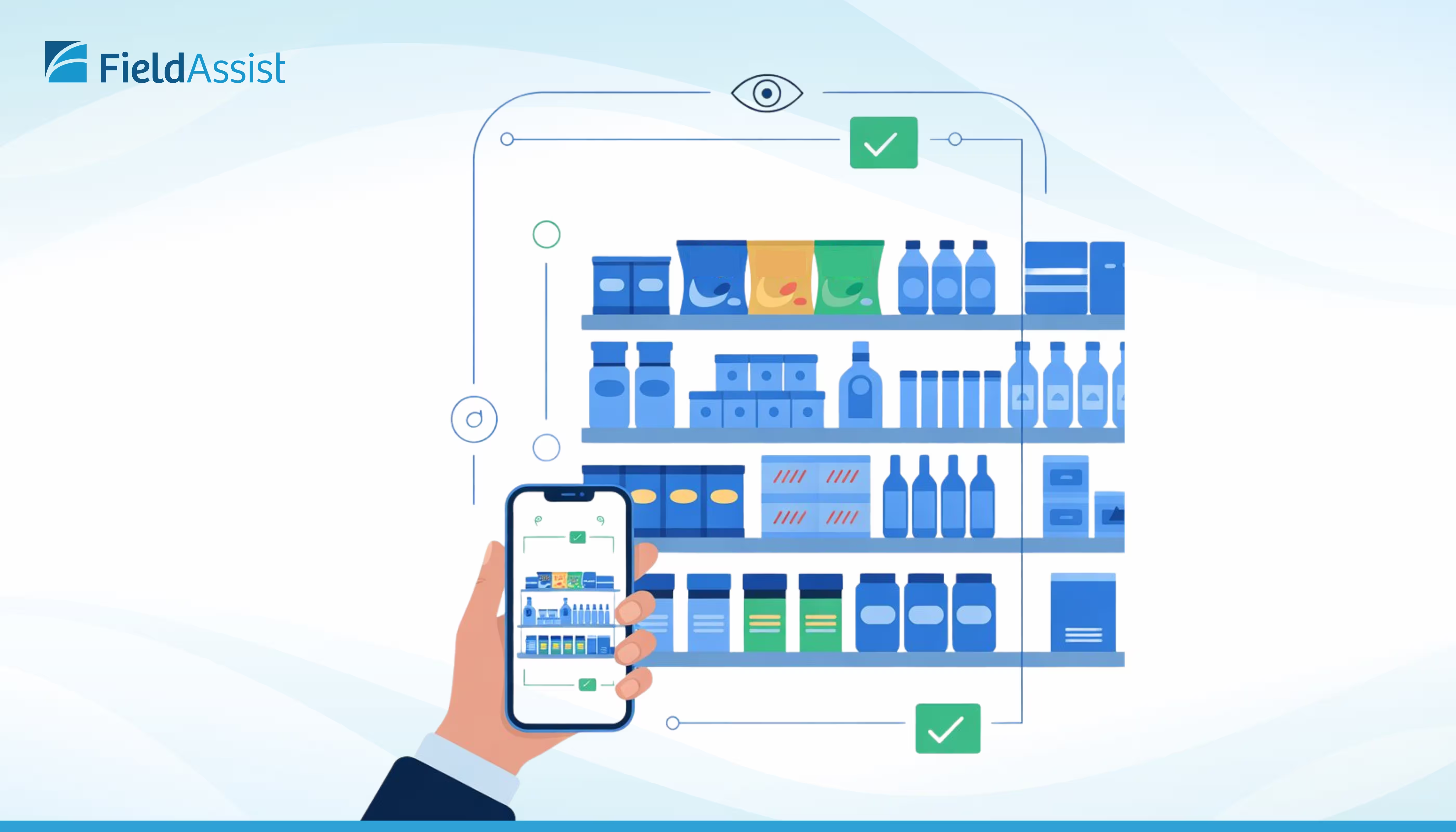
Manual audits are the invisible tax on CPG growth. Every clipboard, every handwritten checklist, every photo emailed to HQ on a Tuesday and reviewed on a Thursday—that's revenue leaking quietly out of the shelf, one outlet at a time. The math is unforgiving. A field rep covering 25 outlets a day spends 12 to 15 minutes per store on planogram audits, counting facings, logging out-of-stocks, and capturing competitor activity. By the time the data reaches the category manager, the shelf has been re-merchandised twice and three new launches have lost their visibility window.
What is Image Recognition for Retail?
Image recognition for retail is an AI technology that uses deep learning and neural networks to automatically identify, count, and analyze individual SKUs on a store shelf from a single photograph. It replaces manual audit checklists with automated SKU-level detection, returning real-time compliance data on planogram adherence, share-of-shelf, on-shelf availability, and competitor activity—typically in under 12 seconds per shelf image.
Image recognition for retail changes the audit equation. Not by replacing the rep, but by collapsing the audit cycle from 15 minutes to under 60 seconds—and turning every store visit into a real-time compliance event instead of a delayed report. This guide is for CPG leaders who treat shelf execution as a revenue lever, not a back-office function. It explains what retail image recognition technology actually does, where it works, where it breaks, and how to deploy it across General Trade and Modern Trade without losing field rep adoption along the way.
The Compliance Gap: Planogram vs. Reality
Every planogram designed at HQ tells a clean story. Hero SKU at eye level. Eight facings of the new launch. Promotional pricing visible from the aisle entry. Competitor encroachment held at zero.
Now walk into a 200 sq ft Kirana in Vijayawada at 11 AM on a Saturday. The shopkeeper has rearranged the shelf to fit a new soft drink crate. Your hero SKU is on the bottom row behind a stack of detergent. The promotional pricing tag from last quarter is still on display. A regional competitor has bought three facings of prime real estate that nobody at your HQ has seen yet.
This is the gap. And it sits between every CPG brand and the shopper, in every market, every day.
The gap is wider in the Indian and Southeast Asian markets than anywhere else, because the channel mix is fundamentally different. In a mature Modern Trade market—Tesco, Carrefour, Kroger—planograms are negotiated commercially, enforced by store staff, and merchandised by trained category teams. Compliance is a contractual conversation. In India, 85% of FMCG sales still flow through General Trade. That's roughly 13 million Kirana stores, each one run by an owner who makes 80% of merchandising decisions based on what moves that week. No central category manager. No store-staff planogram training. No visibility deal that gets enforced from the top.
This is where shelf image recognition stops being a nice-to-have and becomes the only viable measurement system. A rep with a clipboard cannot honestly audit 25 such outlets a day. The cognitive load is too high, the time per store too low, and the temptation to check the same five SKUs at every outlet too strong. Compliance scores under the manual model converge to a meaningless 85%—high enough to satisfy reviews, low enough to mask the actual leakage.
Modern Trade has its own version of the gap, and it's not smaller. It's just different. In MT, the planogram exists. The visibility deal is signed. But the secondary placements—the end-cap, the island display, the gondola front—get violated in ways that are invisible from HQ. A weekly compliance scorecard tied to specific commercial agreements is what separates brands that recover their visibility spend from brands that quietly write it off.
The compliance gap, in other words, is not one problem. It's two—and shelf image recognition is the only technology that addresses both at the same time.
Technical Deep Dive: How Retail Image Recognition Technology Actually Works

Strip away the marketing copy and retail image recognition technology is doing one thing: object detection at the SKU level, on a noisy image, fast enough to give a field rep an answer before they leave the outlet.
That sentence hides three engineering problems most platforms have not fully solved.
Object Detection at SKU Granularity—Powered by Convolutional Neural Networks
Modern shelf image recognition runs on Convolutional Neural Networks (CNNs)—the deep learning architecture purpose-built for spatial pattern recognition in images. A CNN trained on a CPG portfolio is not classifying images. It's locating and counting individual SKUs within an image, distinguishing your 200ml SKU from your 250ml SKU, your strawberry variant from your vanilla variant, your old packaging from the new launch you rolled out six weeks ago. The model has to do this for 80, 200, sometimes 500 SKUs in a single category. It has to do it accurately enough that the rep trusts the output, because the moment a rep stops trusting the system, they go back to clipboards.
The accuracy benchmark that matters is category-level recognition, not overall recognition. A platform can post a 95% overall accuracy number and still be useless on the three SKUs that drive 60% of your category revenue. Ask any vendor for accuracy data on your top 30 SKUs specifically. If they cannot produce it, the demo means nothing.
Handling Skewed Angles, Occlusions, and Field Reality
The lab-trained model works perfectly on a frontal, well-lit, unobstructed shelf photo. The field rep does not work in a lab. They work in:
- Low-lighting GT outlets where the shelf is in a corner with a single 40-watt bulb overhead
- Crowded shelves where SKUs are stacked, tilted, partially blocked by promotional materials
- Skewed angles (parallax) because the rep cannot stand directly in front of the shelf in a 200 sq ft store
- Occlusions from price tags, hanging POSM, customer hands, the shopkeeper's own merchandise
Production-grade retail image recognition technology handles all four through a combination of data augmentation during CNN training (deliberately introducing skewed, low-light, partially occluded versions of every SKU into the training set) and post-processing logic that can infer SKU presence from partial visibility. If a vendor's model only works on clean shelf images, it will fail in week three of deployment.
Edge AI: How Image Recognition Works in Low-Internet Zones
The third engineering problem is bandwidth. Large parts of the GT footprint in India, Indonesia, the Philippines, and Africa operate in 2G or no-signal conditions. An image recognition system that requires real-time cloud processing of a 4MB photo will hang for 90 seconds in those conditions, and the rep will abandon it.
The fix is Edge AI—running the CNN inference model directly on the rep's mobile device rather than in the cloud. A compressed version of the trained model executes locally on the phone's processor. The rep gets a Green/Red signal in 8 to 12 seconds, regardless of connectivity. The full image and metadata sync to the cloud whenever the device finds a stable connection, often hours later when the rep is back at the depot. AI image recognition for FMCG that does not support Edge AI is not deployable in the markets where 70% of the world's FMCG growth is happening.
The FieldAssist Advantage: Integrating Image Recognition with SFA/DMS for Closed-Loop Execution
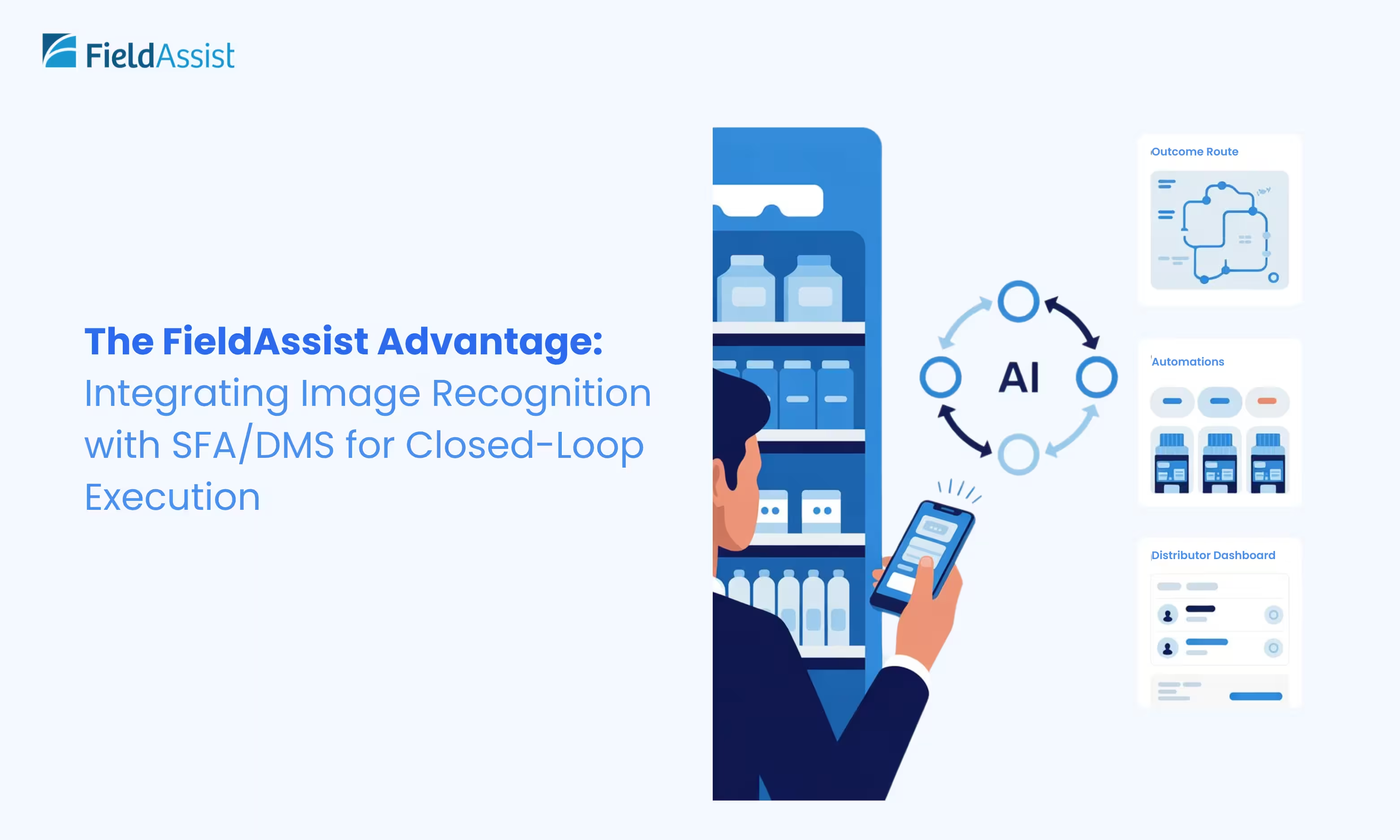
Image recognition in the CPG market has become a crowded category. ParallelDots, Trax, Infilect, and a dozen regional players all offer competent image recognition tools. They differ at the margins on accuracy, processing speed, and SKU library size. But they share a structural limitation: most of them sell image recognition as a standalone capability—a photo tool that produces a compliance dashboard.
That's not how a CPG operating model works.
A compliance dashboard that doesn't reach the rep on their next visit is a vanity metric. A shelf-share trend line that doesn't show up in the distributor's quarterly review is a slide nobody acts on. A perfect SKU-level audit that doesn't trigger a corrective action in tomorrow's beat plan is data without a workflow.
This is where FieldAssist's approach differs structurally. The product is not the camera. The product is the closed-loop: the workflow where AI image recognition for FMCG flows directly into the systems your sales organization already runs on, generating an action and feeding back into the next visit.
That closed loop has three specific connection points.
Image recognition into SFA. The compliance score from a Tuesday audit becomes Wednesday's beat plan input. If 14 outlets in a region show a hero SKU losing facings to a competitor, those 14 outlets get auto-prioritized in the next route plan with the corrective action pre-loaded onto the rep's screen. The rep doesn't open a separate app, doesn't reference a separate report. They walk into the next visit knowing exactly what to fix and why.
Image recognition into DMS. The shelf-share trend captured by image recognition gets stitched into distributor secondary sales conversations. When the distributor sees that secondary sales declined in 38 outlets where shelf-share also declined, the conversation stops being about pricing and becomes about execution. That's a different, more productive negotiation.
How to Reduce Audit Time in Tier-2 Markets
Field Note: A Nagpur Rep Recovers 20 Minutes Per Store
Ravi covers 28 outlets a day across two beats in Nagpur. Until last year, his audit routine in each store was the same: pull out the planogram printout, scan the shelf, count facings on the top 12 SKUs, jot down out-of-stocks, photograph the competitor end-cap, and update the field log. Twelve to fifteen minutes per outlet, on a good day.
When his company rolled out image recognition through their FieldAssist app, Ravi was skeptical. Three weeks in, his routine looks different. He walks in, takes one photo of the primary shelf, one of the secondary display. The app gives him a Green/Red compliance signal in under 12 seconds. The two SKUs flagged Red—both phantom stockouts where the shelf showed empty but the back-store had inventory—get fixed before he leaves the outlet.
Time per store: under 4 minutes for the audit portion. Twenty minutes saved per outlet, multiplied across his beat. He now closes his day by 5:30 PM instead of 7:15. More importantly, he's having actual conversations with shopkeepers about new launches and secondary visibility instead of staring at a clipboard. His beat compliance score has lifted 22 points in two months. He didn't get replaced by AI. He got promoted by it.
ROI Analysis: CPG Performance Benchmarks
Three numbers determine whether image recognition for retail earns its investment back. Track these and the business case writes itself.
CPG Performance Benchmarks: Manual vs. AI-Driven Audit
The financial case is straightforward when you do the math. A 1% gain in shelf-share for a top-30 SKU translates to 0.4-0.7% lift in primary sales over a quarter. A 15% lift in OSA translates to roughly 3-5% lift in category sales. The platform pays for itself in the first quarter for any brand operating at a meaningful scale. The harder question is not whether to deploy. It's how to deploy without losing field rep adoption—and the answer to that lies in framing image recognition as a productivity tool for the rep, not a surveillance tool for HQ.
The Future: Predictive Ordering Built on Image Recognition Data
The current generation of image recognition for retail measures what is happening on the shelf. The next generation predicts what will happen and pre-empts it.
The architecture is already being deployed at leading CPG brands. Image recognition data—captured visit by visit, outlet by outlet, over six to twelve months—becomes a velocity dataset that, combined with POS data, regional festival calendars, weather patterns, and competitor launch activity, can forecast SKU-level depletion three to four weeks ahead. The output is no longer a compliance score. It's a recommended order—pushed to the distributor, validated against secondary sales trends, and adjusted for the upcoming festival or promotional cycle.
This is where image recognition stops being a measurement layer and becomes the foundation of the autonomous supply chain. Phantom stockouts become impossible because the system orders before depletion. Shelf-share decisions become quantitative because the velocity-by-position data is finally available. Trade promotion ROI becomes measurable at the SKU-week-store level. The brands building this capability now will have a structural advantage by 2028.
Frequently Asked Questions
How accurate is image recognition in retail, and how does it handle parallax and occlusions?
Production-grade AI image recognition for retailer deployments operates at 92-97% category-level accuracy on the SKUs that matter most to revenue. Accuracy holds up under field conditions—including parallax (skewed shelf angles when the rep cannot stand directly in front of the shelf in a small Kirana) and occlusions (price tags, hanging POSM, customer hands, partial SKU visibility)—because the underlying CNN model is trained on data augmented with thousands of skewed, low-light, and partially blocked shelf images. Vendors quoting only "overall accuracy" are hiding the number that matters. Ask for category-level accuracy on your top 30 SKUs under field conditions, not lab benchmarks.
Can image recognition work offline?
Yes—and any AI image recognition for retailer deployment in emerging markets must support offline operation through Edge AI. Production systems run a compressed CNN inference model directly on the rep's mobile device, returning a Green/Red compliance signal in 8-12 seconds without internet connectivity. The full image and metadata sync to the cloud whenever a stable connection is available, often hours later. Vendors who require real-time cloud processing for image recognition will fail in 2G coverage areas, no-signal Kirana outlets, and rural beats, which is where the bulk of GT volume actually sits.
What's the difference between image recognition for retail and a regular planogram tool?
A regular planogram tool produces a reference image and expects the field rep to match the shelf against it manually. Image recognition for retail captures the shelf photo and automatically identifies which SKUs are present, missing, misplaced, or under-faced—at the individual SKU level—without rep judgment. The rep gets an objective compliance signal in seconds instead of subjective adherence checked by hand. The two technologies are not interchangeable. Modern retail planogram software typically combines both layers.
How long does it take to deploy image recognition software for retail at scale?
Enterprise-grade image recognition software for retail should deploy across 5,000-10,000 outlets within 60-90 days. The timeline includes SKU library training on the brand's portfolio, model accuracy validation, field rep onboarding, and integration with existing SFA and DMS systems. Implementations stretching beyond 120 days usually indicate either weak SKU library coverage by the vendor or unresolved data quality issues on the brand side. A clear 60-day milestone plan should be a contractual requirement, not a hope.
Does image recognition work for both General Trade and Modern Trade?
Yes, but the deployment configuration must differ by channel. For General Trade (Kirana), the audit should focus on must-stock SKUs and primary shelf compliance—typically 5-10 priority SKUs per category—to keep the rep's per-store time manageable. For Modern Trade, the full audit includes primary shelf, secondary displays (end-caps, islands, gondolas), promotional zones, and POSM compliance, tied to specific commercial agreements with the chain. Same image recognition technology, two different deployment models. Brands that treat GT and MT identically see adoption fail in one of the two channels within a quarter.




.avif)