The Perfect Store in SEA Is Dead. Now Perfect Moment Wins.
Explore why Southeast Asia FMCG leaders must move beyond Perfect Store execution toward intelligent, real-time route-to-market strategies.

Why Southeast Asia’s next FMCG advantage will come from intelligent route-to-market execution.
At 10:17 AM, a fast-moving SKU goes out of stock in an outlet that sells more than its neighbors. By noon, a competitor has filled the shelf. By evening, the dashboard still shows nothing unusual.
The sale is gone. The report will arrive tomorrow.
This is the paradox facing Southeast Asia’s FMCG industry: brands have never had more data about demand, yet the last mile can still operate several steps behind it.
Consumers are becoming more connected. Commerce is becoming more dynamic. AI is accelerating how quickly demand is discovered, evaluated and converted. But across millions of outlets, the physical act of converting that demand still depends on distributors, sales reps, routes, inventory, availability and execution.
The problem is no longer simply reaching the market. It is knowing where the market is moving, and moving the route-to-market with it.
SEA FMCG is entering a faster operating environment
The numbers explain why the old rhythm of planning, visiting, reporting and correcting is under pressure.
Southeast Asia’s FMCG market grew 4.1% year on year in Q1 2025. Indonesia grew 5.5%, although volume contracted, showing how value growth can mask underlying consumer pressure. At the same time, ASEAN-6 e-commerce GMV reached US$136 billion in 2024, up from US$35 billion in 2019, a 31% CAGR.
The consumer side is accelerating too. NIQ reports that around 85% of Southeast Asian shoppers already use or consider AI to help with purchase decisions. Social commerce is increasingly embedded in the region’s buying journey.
The implication for FMCG is larger than e-commerce. Demand signals are arriving faster, through more channels and in more fragmented forms. The route-to-market must therefore be able to sense and respond at the same speed.
Sources: Kantar, NIQ and HKTDC. Figures refer to the periods stated.
The real problem is delayed intelligence.
Southeast Asia’s retail market will remain structurally fragmented. Indonesia and the Philippines retain enormous traditional-trade ecosystems. Thailand combines modern trade with rapidly evolving digital channels. Vietnam is moving quickly across formats. Singapore operates with a far more modernized retail structure.
The strategic mistake is to treat fragmentation as something that must first be eliminated. It will not be.
The better question is whether a brand can operate intelligently inside that fragmentation. Can it distinguish a low-value routine visit from a high-value intervention? Can it detect an emerging stock risk before the outlet loses the sale? Can it align distributor inventory with what is actually happening in stores? Can it redirect field capacity while there is still time to change the outcome?
This is where route-to-market stops being a logistics problem and becomes an intelligence problem.
The Perfect Store was designed for a static world
The Perfect Store model remains useful. Right assortment. Right price. Right placement. Right promotion. Right stock. The weakness is not the checklist. It assumes compliance is a stable destination.
Retail is not stable.
A competitor changes price. A promotion creates an unexpected spike. A fast-moving SKU disappears from a high-value outlet. A distributor has inventory in its warehouse while the shelf is empty. A retailer quietly shifts preference. A rep spends time on an outlet with low immediate revenue potential while a more valuable outlet deteriorates.
A weekly or monthly report can describe all of this. It cannot go back in time and recover the sale.
That is why the next evolution of execution needs a different unit of measurement: not just the Perfect Store, but the Perfect Moment.
Perfect Store asks: “Is this outlet compliant?”
Perfect Moment asks: “What needs to change here before revenue is lost?”
From Perfect Store to Perfect Moment
The next RTM advantage is better decisions.
FMCG organizations have spent years digitizing the field. Paper forms became mobile applications. Sales visits became trackable. Orders became digital. Routes became optimizable. Dashboards made performance visible.
The next step is different. It is about connecting those signals so that intelligence reaches the decision-maker while the decision still matters.
That means moving from a linear operating model to a closed loop:
SENSE → PRIORITISE → ACT → LEARN → ADAPT
The objective is not to replace the field force with AI. It is to give the field force better context: which outlet matters, why it matters, what is changing, what action has the highest expected impact, and whether that action actually worked.
A new maturity model for route-to-market intelligence
The uncomfortable test is simple: ask a sales leader to identify one outlet today where revenue is at risk, explain why, recommend the next action, assign it to the right field resource and verify completion.
If that requires assembling information from multiple systems or waiting for the next reporting cycle, the organization has data. It does not yet have real-time distribution intelligence.
Three shifts will define intelligent RTM in Southeast Asia
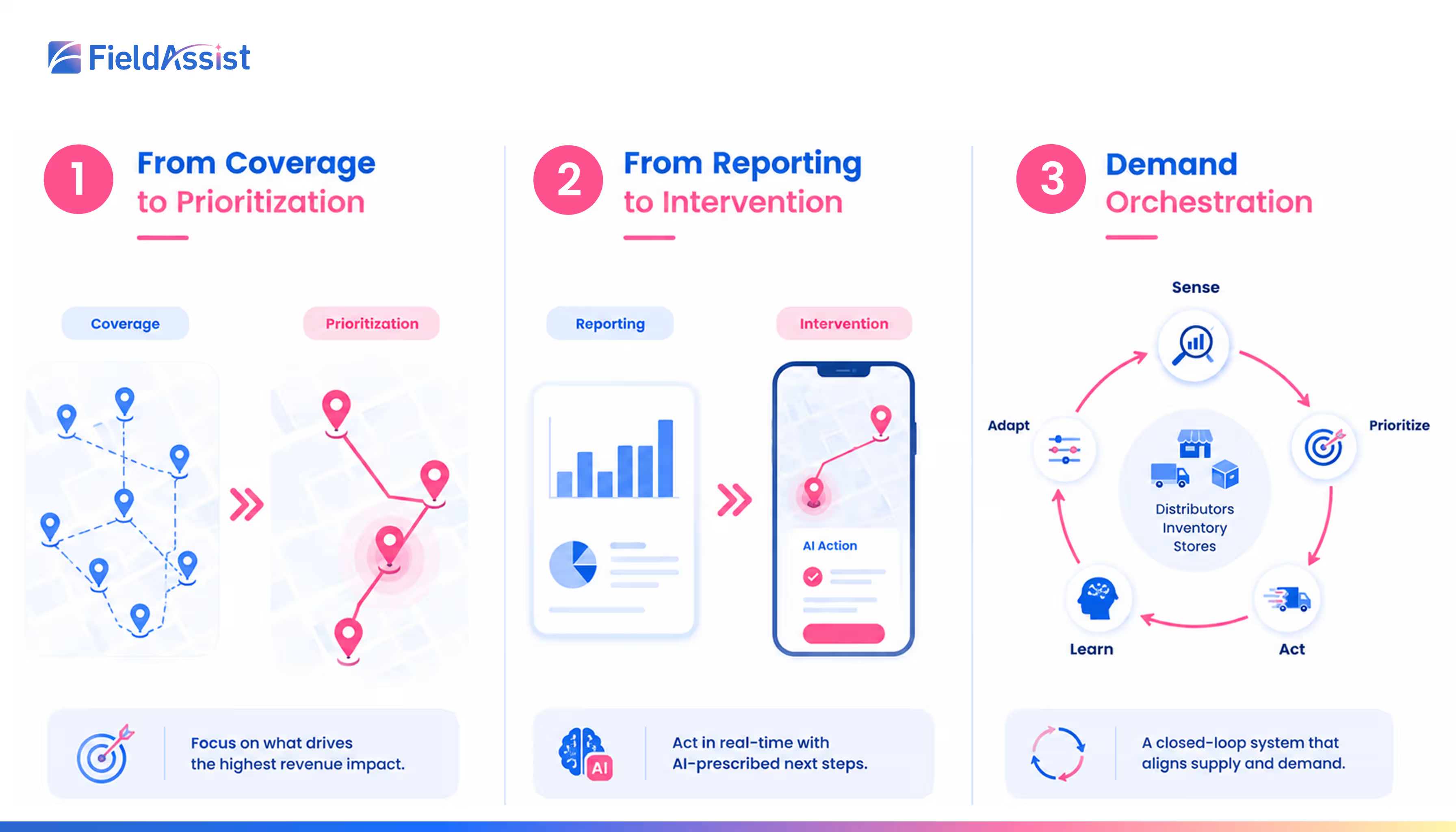
1. From coverage to prioritization
In a fragmented market, the objective cannot be to treat every outlet equally. The scarce resource is field capacity. Intelligent RTM directs that capacity toward the outlets, SKUs and interventions with the greatest expected commercial impact.
2. From reporting to intervention
A dashboard is valuable when it changes behavior. The strategic leap is from explaining yesterday to influencing today: detecting a deviation, recommending an action and closing the loop on execution.
3. From channel management to demand orchestration
The shopper does not care which internal team owns the channel. Demand can emerge digitally and be fulfilled physically, or begin in a store and end online. The operating model therefore has to connect distributors, sales teams, outlets, inventory and demand signals rather than optimize each in isolation.
What does this mean for FMCG leaders?
The next competitive advantage in Southeast Asia will not come simply from adding more outlets, more reps or more dashboards. It will come from reducing the time between signal and action.
That changes the leadership agenda.
Instead of asking only: “Are we covering the market?”
Leaders should ask: “Are we seeing the market early enough to change what happens next?”
Instead of asking: “Did the team execute the plan?” One must ask: “Did the plan adapt when the market changed?”
And instead of treating route-to-market as the final step between strategy and the shelf, treat it as the intelligence layer connecting demand to execution.
The final mile is becoming the intelligence layer
Southeast Asia does not need fewer distributors, fewer retailers, or fewer channels. It needs fewer blind spots.
The winning FMCG organization will be the one that can translate a market signal into a distributor decision, a distributor decision into a field action, and a field action into availability at the moment demand appears.
That is why the Perfect Store is no longer the finish line.
The future is the Perfect Moment: the point at which the organization knows what matters, where it matters and what to do before the revenue opportunity disappears.
In the next phase of Southeast Asian FMCG, route-to-market will not simply carry products to the market. It will carry intelligence through the market.



.avif)