How AI Sales Tools Drive Upselling and Cross-selling in the Field?
Driving Double-Digit Growth with AI Sales Tools and agentic autonomous in the Field. How CPG leaders are Automating High-Margin Cross-Selling and upselling strategies to Capitalize on Every Store Visit.

We are living in a world where consumer growth isn't achieved merely by increasing headcount, it’s unlocked by maximizing the revenue from every single physical store visit.
Relying on field forces to memorize thousands of SKUs and manually identify cross-selling opportunities leaves a massive revenue ceiling in place. This pillar blog explores how deploying AI sales tools shatters that ceiling, turning everyday order-takers into strategic, data-driven revenue generators. By weaving in advanced intelligence, CPG leaders can master how to increase sales predictably.
McKinsey data reveals, B2B organizations adopting data-driven sales practices experience a 5–10% revenue jump within just 6 to 9 months. Coupled with Gartner's finding that 69% of buyers still rely on human reps to validate AI-generated insights, the mandate is clear: AI doesn't replace your field force; it weaponizes them.
Let's dive into how the modern AI sales agent is redefining sales performance management and setting the benchmark for the next decade of FMCG dominance.
How AI Sales Tools Drive Instant ROI in Field Operations?
For a consumer brand, the value of technology is measured by its direct impact on the bottom line. Here are five ways AI fundamentally changes daily field operations to drive instant returns:
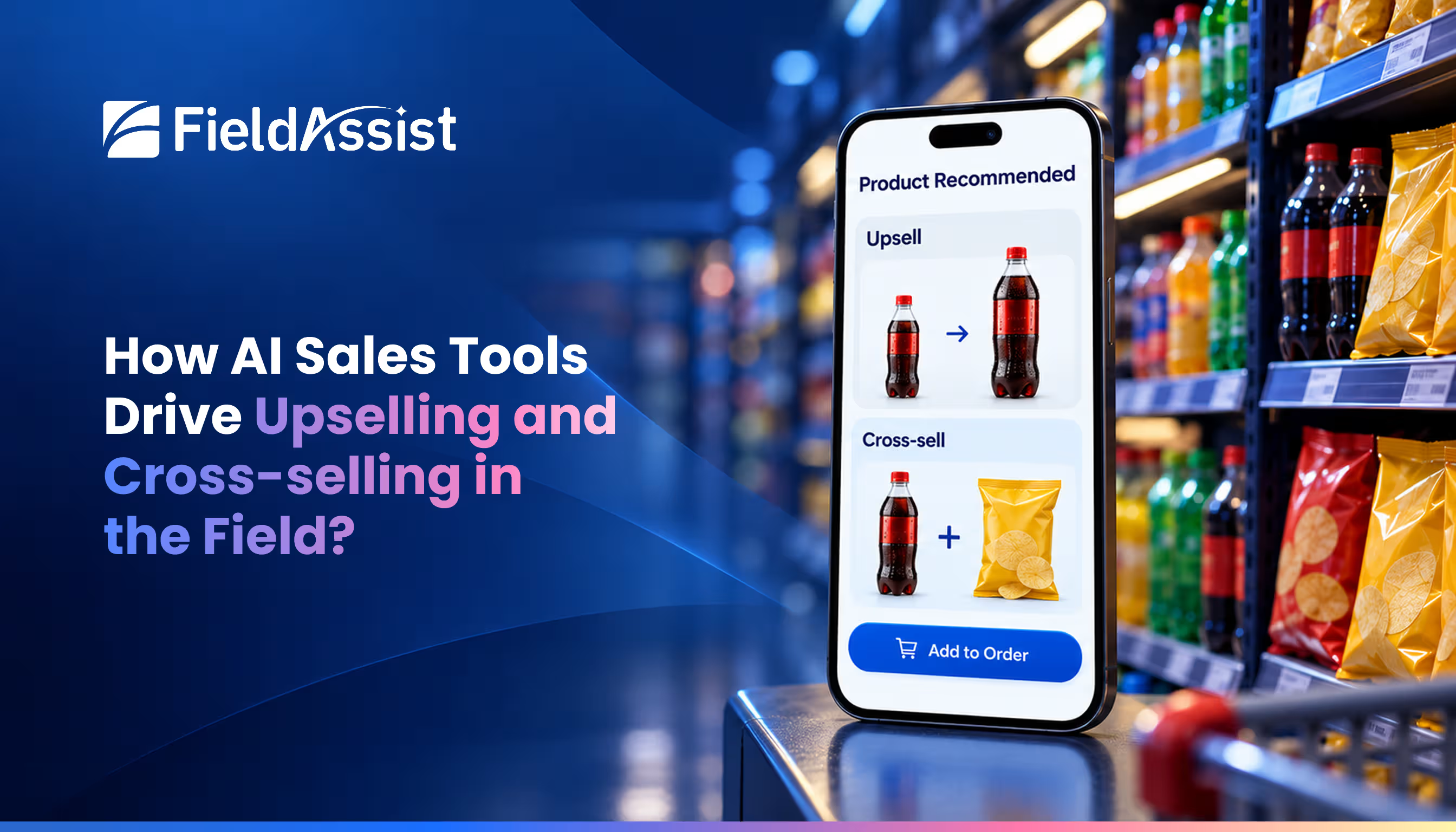
- Eliminating "Order-Taking Fatigue": Field reps suffer from cognitive overload when navigating massive product catalogs. AI removes this friction by pushing high-margin, contextually relevant cross-sell prompts to the rep exactly when they are closing the basket.
- Hyper-Local Assortment Optimization: Rather than pushing a generic regional strategy, AI predicts what a specific store needs based on micro-market clustering, bypassing standard orders to maximize the Average Order Value (AOV).
- Dynamic On-the-Spot Scheme Adjustments: Instead of relying on reps to memorize complex monthly promotions, AI auto-calculates localized schemes at the counter, incentivizing the retailer to buy one more SKU to hit a lucrative tier.
- Zero-Leakage Inventory Restocking: By integrating automated replenishment data, AI ensures that reps cross-sell based on real-time stock deficits and projected localized demand, rather than historical guesswork.
- Time-to-Market Acceleration for Niche SKUs: AI intelligently flags underperforming or highly specialized products to the specific retailers most statistically likely to buy them, accelerating ROI on trapped inventory.
To understand how industry leaders are planning for next-level growth, compare the traditional approach with the AI-driven future:
What are AI Sales Agent, and where they prove very useful?
An AI sales agent is a 24/7 autonomous intelligence layer that proactively identifies, nudges, and sustains sales opportunities. It works seamlessly alongside your human reps or bridges the gap when they aren't physically present. Here are the top five everyday use cases where these agents empower brands to sell more:
- Automated Off-Hours Order Recovery: Retailers frequently realize they are out of stock after the rep leaves. A conversational AI agent allows retailers to place immediate restock orders via WhatsApp, securing revenue on weekends or non-visit days.
- Pre-Visit Strategy Briefings: Before stepping into an outlet, the AI agent analyzes the store's previous 90-day purchasing behavior and briefs the rep on the top three specific SKUs to cross-sell today.
- Intelligent Reorder Nudges: AI agents monitor POS data, weather patterns, and seasonality to send proactive, automated alerts to retailers for must-sell SKUs right as local demand shifts.
- Smart Claim and Trade Promotion Management: The agent instantly calculates, validates, and manages trade promotions directly on the distributor’s system, eliminating manual calculation errors and margin leakages.
- Real-Time Shelf Compliance Audits: Using image recognition, the agent analyzes a quick smartphone photo of the shelf, instantly detecting share-of-shelf gaps and converting an audit into an immediate up-selling action.
How Field Team reacts to AI sales tools and how they end up using it?
Transitioning a traditional sales force to an AI-driven model requires understanding human behavior. Here is how field teams typically adapt to and ultimately leverage these tools:
- Monetizing New SKU Launches: Reps no longer face the anxiety of blindly pushing new products. AI pinpoints exactly which stores are likely to buy, ensuring higher conversion rates and protecting the rep's credibility.
- Predictable Selling Opportunities: The AI-generated basket eliminates rejection fear. By providing data-backed combinations, reps pitch with the confidence that the retailer actually needs what is being offered.
- Trusting the Algorithm Over Instinct: While initially skeptical, top performers quickly realize the AI can identify micro-trends (e.g., a specific neighborhood suddenly buying premium variants) that human observation misses.
- Faster In-Store Execution: AI cuts down the time spent scrolling through digital catalogs. With the basket practically pre-filled, reps spend less time clicking and more time building relationships.
- Gamified Target Achievement: With transparent insights into their daily trajectory, field teams use AI to track exactly how much cross-selling is required to hit their incentive tiers, drastically improving sales performance management.
- Frictionless Onboarding and Upskilling: New hires utilize in-workflow microlearning embedded directly within the AI tools, reducing time-to-productivity from months to weeks.
- Elevating the Rep's Status: Reps transition from easily replaceable order-takers into trusted business advisors, providing retailers with actionable insights on what will sell best in their specific location.
Can we use AI Sales Agent for Retail Expansion? Explained with 10 Use Cases
For a new entrant in the CPG space, aggressive expansion is a matter of survival. AI sales tools and agents are the ultimate growth hacks to penetrate saturated markets without an army of reps.
Here are 10 creative use cases for leveraging AI for retail expansion:
- Territory Hunter: Identifying high-potential retailers and geographical white spaces based on competitor gaps and demographic overlaps.
- Increase Sales Using Predictive Baskets: Entering new stores with pre-calculated, hyper-local assortments that guarantee immediate shelf movement.
- Scaling Lines Per Call (LPC) with Conversational AI Agents: Using automated WhatsApp-based agents to engage and sell to lower-tier or remote retailers that human reps cannot visit frequently.
- Look-Alike Store Mapping: The AI scans the database to find new retail prospects that match the behavioral buying profile and foot traffic of your current top-performing outlets.
- Hyper-Localized Product Testing: Deploying an AI agent to pilot small batches of a new product in highly specific geo-clusters to validate product-market fit before a national rollout.
- Competitor Vulnerability Tracking: Analyzing secondary data to spot localized stockouts of rival brands, instantly directing your reps to those specific stores to up-sell replacements.
- Automated Sampling Feedback Loops: Using conversational AI to gather direct feedback and push secondary orders to retailers immediately following a free-sample or trial campaign.
- Dynamic Onboarding Discounts: AI auto-calculates the exact introductory margin or customized scheme required to convince a stubborn, loyalist retailer to take a chance on your new brand.
- Ghost Outlet Activation: Identifying dormant retailers in the CRM and deploying automated, targeted AI messaging campaigns to reactivate them without wasting a physical field visit.
- Rapid Visual Merchandising Scaling: New entrants use AI image recognition to ensure their very first shelf placements adhere strictly to planograms, instantly course-correcting poor visibility to guarantee sell-through.
5 Best AI Sales Tools/AI Sales Agent that consumer brands must try
To effectively execute how to increase sales, consumer brands must invest in platforms purpose-built for the frontline. Here are the top tools dominating the space:
- Product Recommendation and Smart Basket Intelligence: The premier tool for engineering the perfect order. It utilizes robust machine learning to recommend optimal, hyper-local assortments, ensuring reps push the exact right cross-sells at the right outlets.
- NOVA by FieldAssist: A cutting-edge conversational AI sales agent designed specifically for retailers. NOVA sustains sales by autonomously suggesting reorders, schemes, and SKUs during rep absences, guaranteeing 24/7 revenue capture.
- FAi DMS Agent: The ultimate AI co-pilot for distribution. It manages trade promotions directly and predicts market demand shifts using POS, weather, and trend data to anticipate stockouts before they happen.
- IRIS: A critical image recognition software by FieldAssist that translates real-time shelf photos into instant share-of-shelf data, triggering on-the-spot restocking and up-selling actions.
- Micromarket Planning Engines: Micromarket planner combines local market intelligence with white-space analysis to unlock highly precise geographic growth opportunities.
FAQ
1. How long does it take to see a measurable ROI on AI sales tools in field operations?
Because AI leverages your existing historical sales and distributor data, deployment yields rapid results. Most CPG leaders observe measurable expansions in Lines Per Call (LPC) and Average Order Value (AOV) within the first 6 to 9 months, driven directly by AI-curated Smart Baskets.
2. Will deploying an AI sales agent cause friction or reduce the value of my existing human field force?
No. Data consistently shows that buyers still rely heavily on human sellers to validate purchases. An AI agent handles the repetitive data crunching, off-hours reordering, and basket generation, freeing your reps to focus on relationship-building and closing high-margin cross-sells with absolute authority.
3. How does AI specifically improve our sales performance management at the leadership level?
AI transforms sales performance management from a lag-indicator review process into a real-time, predictive engine. CEOs and CROs gain absolute visibility into which reps are effectively executing cross-sells, which new SKUs are gaining traction, and exactly where revenue leakage is occurring, allowing for instant strategic pivots.



.avif)