Conversational AI for Retail: Where it actually drives growth?
Discover how conversational AI in retail eliminates decision latency and automates ordering, replenishment, and restocking. Learn how AI-driven analytics and agentic AI drive real revenue growth.

The brands that talk better will likely to sell more - this deceptively simple idea is now changing the course of retail growth. For years, the conversation around AI has been entirely outward facing: customer support bots, automated FAQs, and virtual assistants. But the real revenue isn't just being lost in the customer service queue; it’s bleeding out in the back office.
The speed to market is your only true competitive moat. Yet, we are constantly bottlenecked by complex ERP systems and static, outdated dashboards. When a leader needs to know why regional sales are dipping, they shouldn't have to wait days for a data analyst to export CSVs and build pivot tables. By the time those insights are formatted and presented, the window of opportunity to act has already slammed shut.
This is where the true value of conversational AI for retail comes into play, shifting the focus from customer deflection to operational velocity. The future of agile business growth hinges on building an internal dialogue with your systems. It starts by having conversational chat AI for reporting to instantly analyze trends and market shifts, reducing your decision latency to absolute zero. But insight without action is just overhead. The next logical step is having conversational agentic AI to empower retailers on the ground to order and reorder spontaneously, completely bypassing traditional manual entry.
How Conversational AI Reframes the Growth Equation in Retail?
Instead of viewing AI merely as a tool to fix operational inefficiencies, forward-thinking CGOs are using it to unlock massive top-line potential. The real breakthrough happens when you connect two powerful forces: a Conversational Co-Pilot for your internal data and an Agentic AI for your external retail network.
When these systems work in tandem, they create a closed-loop growth engine. The internal conversational co-pilot instantly synthesizes multi-source data (across SFA, DMS, and BI tools). Instead of forcing regional managers to dig through static dashboards, it delivers instant, role-aware execution nudges-highlighting specific market shifts and identifying exactly which outlets require attention.
Simultaneously, the retailer-facing agentic AI executes on those insights autonomously. By engaging stores through natural conversation via WhatsApp or voice, the AI acts as an always-on digital rep. It doesn't just wait for commands; it reads intent, cross-references an outlet's order history, and proactively recommends SKUs or flags eligible trade schemes.
This connected dialogue drives immediate, measurable business impact:
- Automated Outlet Conversations: By automating a vast majority of routine ordering and inquiry conversations, brands prevent sales drop-offs when field reps are absent or during low-visibility days.
- Increased Average Order Value (AOV): Intent-aware, personalized product recommendations driven by AI have been shown to drive up to a 22% increase in average order size.
- Maximized Promotional ROI: Replacing generic trade offers with tailored scheme nudges directly at the point of ordering can result in a 35% improvement in scheme adoption.
The Strategic Potential of Conversational & Agentic AI
Where Conversational AI Actually Drives Retail Growth?
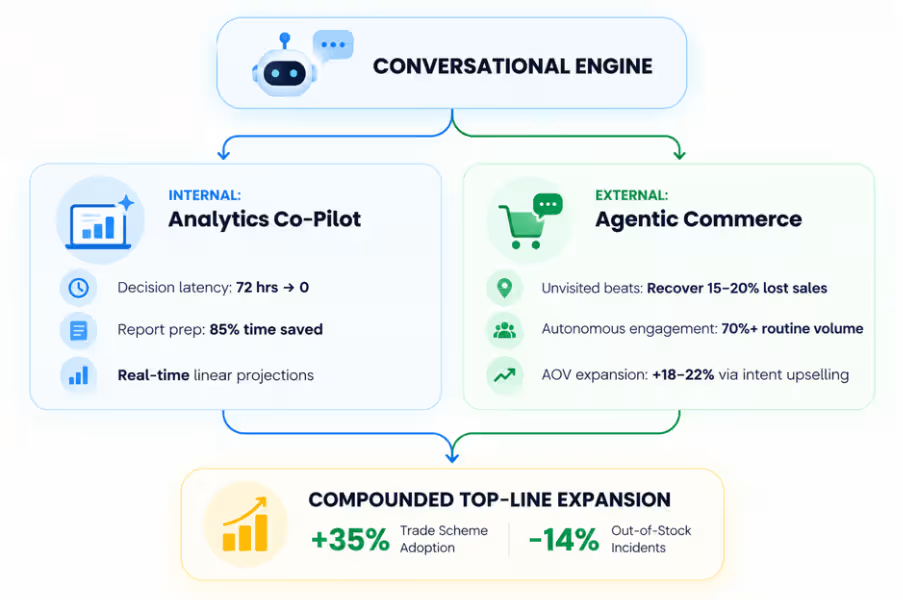
Growth in retail is a function of two variables: the speed of commercial decisions and the frequency and value of outlet orders.
When conversational analytics and agentic AI are deployed across the retail value chain, top-line growth concentrates across five measurable operational vectors:
1. Eliminating Revenue Leakage on Unvisited Beats (15% to 20% Sales Recovery)
By deploying conversational AI in retail directly through native channels like WhatsApp or voice interfaces, the brand establishes an always-on, 24/7 digital sales desk.
- Up to 72% of routine order placements and SKU inquiries are handled autonomously, freeing on-ground teams to focus on relationship-building and new outlet acquisition.
- Outlets that normally sit dormant between scheduled beat cycles can spontaneously restock when inventory dips, capturing 15% to 20% in recovered order volume that would otherwise be lost to supply gaps.
2. Expanding Basket Size & Average Order Value (+18% to 22% AOV)
Human field reps under tight beat schedules often resort to "order taking"- simply jotting down whatever the store owner mentions off the top of their head. They lack the cognitive bandwidth or real-time data to calculate personalized upselling opportunities on the fly.
An agentic conversational layer bridges this gap by cross-referencing live warehouse inventory, local seasonal demand, and the specific store’s purchasing patterns in milliseconds:
- Instead of passive catalog browsing, the AI prompts dynamic, contextual cross-sells: "You sold out of 500ml variants twice last week. Do you want to add 2 cases of the 1L family pack at the promotional rate?"
- This hyper-personalized recommendation engine consistently delivers an 18% to 22% increase in Average Order Value (AOV) across retail touchpoints.
3. Maximizing Trade Promotion ROI (+30% to 35% Scheme Uptake)
Consumer goods brands commit anywhere from 10% to 20% of their gross revenue to trade schemes, retailer margins, and volume discounts. Yet, up to 40% of retail store owners remain completely unaware of the schemes they qualify for due to communication bottlenecks between corporate marketing and the field.
Conversational interfaces turn passive PDF circulars into proactive, in-the-moment incentives:
- When a retailer initiates a routine restock via chat, the AI dynamically calculates the next discount threshold: "Add just 3 more units to qualify for the 6% tier rebate."
- By surfacing margin opportunities at the exact moment of order commitment, brands experience up to a 35% improvement in scheme participation, directly incentivizing higher order volumes without diluting margins.
4. Compressing Decision Latency from Days to Seconds (85% Reporting Overhead Eliminated)
Growth stalls when leadership is blind to field realities. Traditional BI dashboards and fragmented ERP reporting mean regional directors often evaluate month-to-date (MTD) performance days after trends develop.
Integrating conversational analytics transforms how leaders operate:
- Managers bypass data teams and pivot tables entirely by querying sales metrics via voice or text: "Show MTD primary sales vs. targets for West Zone beverages."
- The conversational engine instantly calculates KPIs, detects performance anomalies, plots linear trajectory forecasts, and formats the findings into boardroom-ready presentations.
- This eliminates over 85% of manual reporting overhead, enabling leadership to redirect commercial resources within hours instead of waiting for end-of-month post-mortems.
5. Slashing Out-of-Stock (OOS) Incidents (12% to 15% Reduction)
The ultimate hurdle to retail growth is shelf availability. When high-velocity SKUs run out, consumers switch brands immediately. Traditional reordering cycles follow rigid, weekly schedules that fail to keep pace with demand spikes.
With agentic conversational workflows:
- Retailers trigger reorders spontaneously the moment stock dips below safety thresholds, without waiting for the next physical salesperson visit.
- Predictive reorder prompts alert store owners ahead of high-demand weekends or local festivals.
- This continuous, low-friction ordering cadence drives a 12% to 15% reduction in retail stockouts, preserving shelf share and maximizing throughput.
The Cost of Silence is lost market share
Do you also believe the future of retail Belongs to the fastest conversationalists? Conversational AI has evolved into the central nervous system of modern commerce.
By unifying conversational analytics for zero-latency insights with agentic AI for autonomous field execution, CGOs can finally close the gap between boardroom strategy and supply chain reality. The brands that will dominate the next decade of retail won't necessarily have vastly different products- they will simply have better, faster conversations with their data, their retailers, and their market.



%20(1).avif)