RTM Strategy for Emerging Markets: India, Africa & SEA
Discover how C-suite leaders are leveraging agentic AI, predictive analytics, and intelligent supply chains to build resilient Route-to-Market (RTM) strategies across India, Africa, and Southeast Asia.

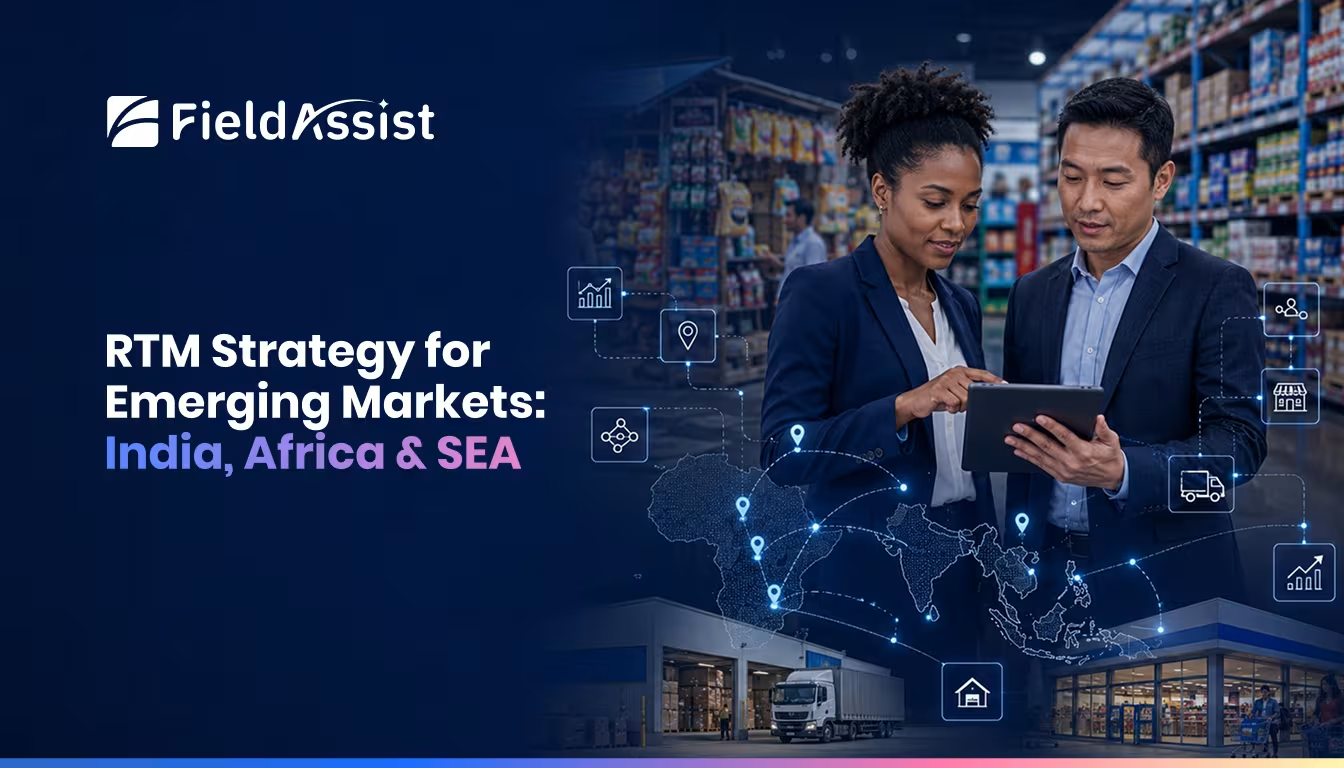
By 2026, emerging markets are projected to account for nearly two-thirds of global growth, expanding at almost three times the rate of advanced economies. Yet, for global enterprises attempting to capture this massive consumption pool, a stark reality remains: winning in New York or London does not grant you the right to win in Mumbai, Nairobi, or Jakarta.
The traditional Route-to-Market (RTM) playbook—relying on monolithic master distributors, linear supply chains, and manual field force execution—is collapsing under the weight of market fragmentation. In India, Africa, and Southeast Asia (SEA), consumption happens predominantly through millions of unorganized, independent mom-and-pop stores (Traditional Trade). Attempting to service this fragmented web using legacy distribution networks results in prohibitive cost-to-serve metrics, blind spots in retail execution, and massive inventory distortion.
To capture the emerging market dividend, Chief Commercial Officers (CCOs) and Supply Chain leaders must fundamentally re-architect their RTM strategies. The future of distribution is no longer about moving boxes; it is about leveraging agentic AI, predictive distribution, and intelligent supply chains to turn chaotic, fragmented networks into transparent, highly responsive ecosystems.
The 2026 Emerging Market Paradigm: India, Africa, and SEA
While India, Africa, and SEA share the common trait of highly fragmented retail environments, the underlying dynamics governing their RTM strategies are distinct. C-suite leaders must tailor their AI-driven RTM approaches to the structural realities of each region.
India: Digital Public Infrastructure and Hyper-Local Scale
India is transitioning from a high-growth emerging market to an integrated economic powerhouse, sustained by rapid domestic consumption and unparalleled digital integration. The expansion of Digital Public Infrastructure (DPI)—such as the Unified Payments Interface (UPI) and the Open Network for Digital Commerce (ONDC)—has digitized the traditional kirana (neighborhood store) ecosystem.
For enterprise RTM strategy, this means data is no longer scarce. Millions of traditional trade outlets are now generating real-time transactional data. The strategic imperative here is utilizing AI GTM platforms to ingest this massive data lake and optimize hyper-local fulfillment. Brands can no longer treat India as a single market; it is a composite of micro-markets requiring dynamic pricing and localized assortment, driven by machine learning forecasting.
Africa: Corridor Stability and the Mobile-First Leapfrog
The African RTM landscape is defined by vast geographic expanses, infrastructure deficits, and an incredibly dense informal retail sector (over 80% of total retail). However, Africa is leapfrogging legacy retail evolution through mobile-first financial revolutions and B2B e-commerce platforms. Furthermore, the implementation of the African Continental Free Trade Area (AfCFTA) is fostering new supply chain corridors, turning nations like Kenya and Egypt into strategic regional gateways.
The challenge in Africa is visibility. C-suite leaders must deploy predictive analytics software capable of operating on sparse or unstructured data. By integrating satellite imagery, mobile money velocity, and telecom data, AI models can map unorganized trade networks and predict demand spikes in rural and peri-urban centers. This allows brands to bypass unreliable middle-tier wholesalers and directly incentivize the most profitable micro-distributors.
Southeast Asia: Archipelago Logistics and Social Commerce Integration
SEA presents a unique logistical puzzle: high mobile and social media penetration layered over complex, fragmented geographies (like Indonesia’s 17,000 islands). The RTM landscape here is rapidly blurring the lines between social commerce, quick commerce (q-commerce), and traditional retail (warungs in Indonesia, sari-saris in the Philippines).
In SEA, RTM strategy must be omnichannel by default. Consumers may discover a product via TikTok, purchase it through an integrated social app, and expect fulfillment from their local warung acting as a micro-fulfillment center. Managing this complexity requires autonomous distribution ecosystems where AI models seamlessly route inventory across fragmented channels, ensuring optimal stock levels at the very edge of the network.
The Rise of the AI-Driven RTM Architecture
The defining shift in 2026 is the transition from a reactive distribution network to an AI-driven predictive ecosystem. Historically, manufacturers pushed inventory to distributors based on historical sales data, creating a bullwhip effect of overstocking and out-of-stocks at the retail level.
Today, the adoption of agentic AI—where artificial intelligence systems autonomously execute routine supply chain and marketing decisions—is enabling a "pull-based" RTM model. AI agents can continuously monitor macro-economic indicators, localized weather patterns, social media sentiment, and AI-enabled raw material market intelligence to predict demand at the individual store level.
Instead of a sales rep visiting a store on a static two-week routing schedule, machine learning models analyze store-level depletion rates to dictate exactly which stores need a visit today, which products they are likely to buy, and what promotional discount will maximize the basket size. This transforms the sales force from order-takers into strategic business consultants.
Three Strategic Pillars for Modern RTM Execution
To build a resilient and profitable RTM engine across emerging markets, leadership must align their operations around three technological pillars.
Pillar 1: AI-Vetted Partner Selection and Granular Incentivization
A global enterprise is only as strong as its local distributor. In fragmented markets, relying on a single national distributor is a critical risk vector. The modern strategy involves a mosaic of regional distributors, specialized last-mile logistics partners, and digital B2B marketplaces.
Predictive analytics software is now utilized to evaluate distributor health before signing contracts, analyzing their capital liquidity, fleet efficiency, and retail coverage overlaps. Once onboarded, AI models manage automated growth campaigns and dynamic trade promotions. Instead of offering a flat 5% margin to all partners, AI algorithms calculate the exact incentive required for a specific distributor in rural Ghana or Tier-3 India to push a new SKU, optimizing the enterprise's trade spend ROI.
Pillar 2: Harmonizing Traditional and Modern Trade via AI GTM Platforms
Emerging markets are characterized by channel conflict. As modern trade (supermarkets) and e-commerce grow, they inevitably clash with the dominant traditional trade sector. A siloed RTM approach leads to price cannibalization and alienated distributor partners.
Enterprise AI GTM platforms provide a unified, single source of truth. By tracking inventory and pricing across all channels simultaneously, these platforms alert commercial leaders to unauthorized cross-border trading, wholesale dumping, or price-floor violations. This harmonization ensures that the launch of a direct-to-consumer (D2C) channel complements, rather than destroys, the traditional distributor network.
Pillar 3: Deploying Autonomous, Intelligent Supply Chains
Moving goods from a central warehouse in Mombasa to a rural kiosk in the Rift Valley involves immense friction. Intelligent supply chains remove this friction by digitizing the entire flow of goods. Route optimization algorithms adjust delivery schedules in real-time based on traffic congestion or infrastructure bottlenecks.
Furthermore, generative AI and agentic workflows are automating inventory replenishment. When a localized spike in demand is detected—perhaps driven by a viral social media trend in a specific Vietnamese province—the AI agent autonomously reallocates inventory from slower-moving depots, drafts the internal transfer orders, and alerts the local 3PL partner, requiring zero human intervention.
Regional RTM Dynamics: A Comparative Analysis
To contextualize these strategies, the following matrix outlines the operational realities across the three critical growth regions.
The C-Suite Action Plan: Building a Decision-Centric RTM Model
Transitioning from a legacy distribution model to an AI-driven, predictive RTM ecosystem is a multi-year transformation. For Chief Commercial Officers, Chief Supply Chain Officers, and Chief Data Officers, the roadmap must be structured, deliberate, and tightly aligned with overarching corporate strategy.
Phase 1: Audit the Data Fabric
You cannot apply machine learning to data you do not possess. The first step is to establish a robust data fabric that connects internal ERP data with external distributor management systems (DMS) and retail execution platforms. Leadership must mandate data transparency as a core requirement for all distributor contracts. If a partner refuses to share secondary sales data, they are not a viable long-term partner for an AI-driven enterprise.
Phase 2: Deploy Predictive Analytics Software for Micro-Segmentation
Move away from macro-demographic assumptions. Implement predictive analytics tools to segment your retail universe down to the individual store level. Understand that a kiosk situated near a university in Nairobi requires a fundamentally different delivery cadence, SKU assortment, and credit term than a kiosk situated near an industrial zone just five miles away. Pilot these algorithms in controlled micro-markets before scaling nationally.
Phase 3: Transition to a Composable RTM Organization
As AI automates the execution layer—route planning, inventory reordering, promotional payout calculations—the organizational structure must flatten. C-suite leaders must transition to composable, AI-dependent organizational designs. The sales force of the future in emerging markets will shrink in headcount but multiply in analytical capability. Reps will transition into relationship managers who leverage tablet-based AI recommendations to consult retailers on space optimization and capital efficiency.
Conclusion: RTM as a Bet-the-Business Capability
In 2026, emerging markets are unforgiving to inefficiency. The margin for error has vanished, replaced by aggressive local competitors, volatile macroeconomic shifts, and a consumer base that expects modern availability from traditional retail outlets.
Route-to-Market is no longer a tactical supply chain function; it is a bet-the-business capability. By embracing agentic AI, intelligent supply chains, and predictive distribution, global brands can decode the complexity of India, Africa, and Southeast Asia. The organizations that succeed will be those that transition from merely participating in these markets to actively owning the decision-centric, AI-powered ecosystems that command them.




.avif)
.avif)