A Guide to Retail Marketing in India: Strategies, Execution & AI-Driven Best Practices
Explore retail marketing strategies for India, from outlet segmentation and field execution to AI-powered image recognition, retail audits, and Perfect Store compliance.

Walk into any Indian market, a Chandni Chowk lane, a Koramangala high street, a small-town bazaar, and you're watching retail marketing play out in real time: pricing, shelf placement, promotions, and the constant negotiation for a shopper's attention. For CPG and FMCG brands, India is one of the most rewarding and most unforgiving retail markets in the world. Rewarding, because the sheer scale of outlets offers headroom few other markets can match. Unforgiving, because that scale is spread across millions of small-format stores where execution, not strategy alone, decides who wins the shelf.
This guide breaks down what retail marketing means in the Indian context, why it's structurally hard to execute here, and the strategies, from outlet segmentation to AI-driven image recognition in retail, that brands are using to close the gap between what's planned in a boardroom and what actually happens at the shelf. That gap is what we at FieldAssist call the last-mile execution problem, and it's where most retail marketing budgets quietly leak value.
What Is Retail Marketing and Why Does It Matter in India?
Retail marketing is the set of activities a brand undertakes to influence purchase decisions at or near the point of sale, pricing, merchandising, in-store promotions, assortment planning, and the overall shopping experience. Unlike brand marketing, which builds awareness over months, retail marketing is judged in seconds: whether a product is visible, priced correctly, and in stock the moment a shopper reaches for it.
Why Retail Marketing Is Important for Indian Businesses?
India's retail sector is on track to exceed US$2,361 billion by 2030, up from roughly US$1,094 billion in 2025. For CPG brands, that growth is spread across general trade, modern trade, and quick commerce at once, which means retail marketing decisions play out across formats a brand doesn't fully control. Get it right, and a brand earns repeat purchase and shelf loyalty. Get it wrong, and a competitor fills that gap within a day.
The 4 Ps of Retail Marketing
Product, Price, Place, and Promotion still anchor retail marketing strategy, but each carries field-level complexity in India:
● Product: Assortment has to flex by region and outlet type, what sells in a metro hypermarket rarely mirrors what moves in a Tier-3 kirana store.
● Price: Thin trade margins mean even small MRP or scheme inconsistencies across outlets can trigger channel conflict.
● Place: Distribution has to reach millions of fragmented outlets, largely through multi-tier distributor networks.
● Promotion: In-store visibility, planogram compliance, and scheme execution matter more than mass advertising once a shopper is at the shelf.
Why Retail Marketing Is Challenging in India?
India's retail landscape remains overwhelmingly unorganised. Roughly 13 million kirana and neighbourhood stores account for the majority of retail trade, contributing close to 11% of GDP and 8% of the workforce. That fragmentation means a national strategy has to be executed store-by-store, by field teams covering outlets that vary in language, buying behaviour, and shelf space within the same district. Layer on Tier-2/3 expansion, seasonal demand swings, and a general trade network that still runs on manual, relationship-driven ordering, and it's clear why plans that look clean on a slide deck break down at the last mile, the final few metres between strategy and the actual shelf.
Retail Marketing Strategies That Drive Growth in India
The brands winning share in India today aren't necessarily spending more, they're executing with more precision. Here's what that looks like in practice.
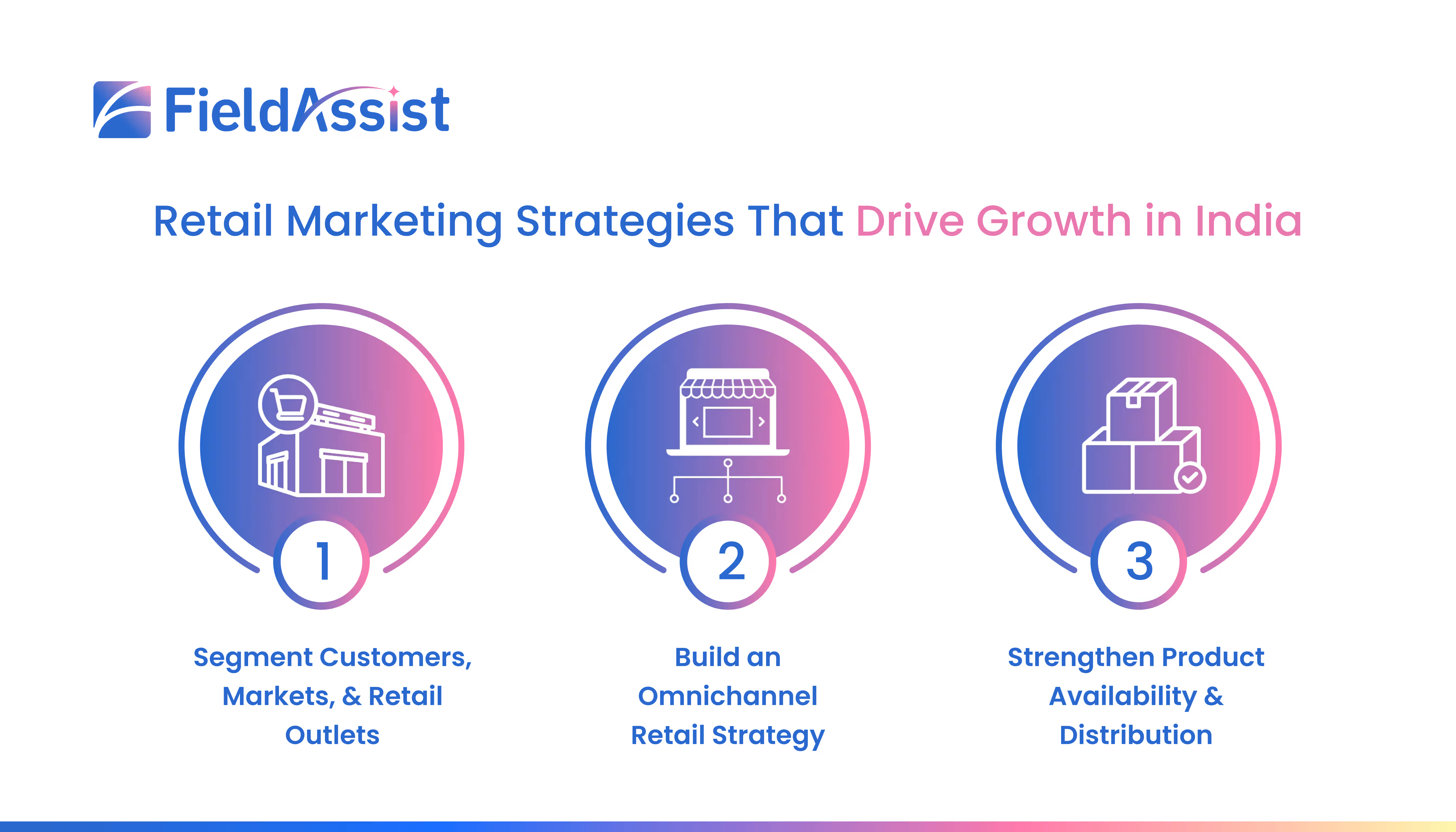
1. Segment Customers, Markets, and Retail Outlets
Not every outlet deserves the same assortment, scheme, or visit frequency. Segmenting outlets by size, footfall, category performance, and consumer profile lets brands prioritise field effort where it actually moves sales, rather than spreading resources evenly across a market that isn't uniform to begin with.
2. Build an Omnichannel Retail Strategy
With quick commerce, modern trade, and general trade now competing for the same shopper, brands need consistent pricing, availability, and promotional messaging across every channel. An omnichannel strategy isn't optional anymore, it's the baseline expectation of a shopper who might discover a product online and buy it from the corner store an hour later.
3. Strengthen Product Availability and Distribution
Availability is still the single biggest lever in Indian retail marketing, a great campaign is wasted if the product isn't on the shelf. This is where Sales Force Automation and Distributor Management System (DMS) technology earns its place: connecting field sales activity with real-time distributor stock and inventory visibility so brands can see, and fix, availability gaps before they become lost sales. Field sales automation of this kind turns order booking and secondary sales data into a live signal instead of a once-a-week estimate.
From Retail Marketing Strategy to Store-Level Execution
Strategy sets direction; execution decides outcomes. This is the layer where most Indian retail marketing plans actually succeed or fail.
- Improving Field Sales Execution
Field sales automation is what turns a retail marketing plan into daily, trackable action. FieldAssist's SFA offering gives field teams structured outlet data, AI-driven beat planning, order booking, and offline functionality for low-connectivity markets, while route optimisation on the platform ensures reps spend more time selling and less time travelling between outlets. For a sales force covering thousands of scattered stores, this level of field sales automation is what makes consistent execution possible at scale.
- Creating a Consistent Perfect Store
A 'Perfect Store' is one where availability, visibility, pricing, and promotions are all executed to standard, every single time a rep visits. FieldAssist's Perfect Store capability gives field teams a clear, outlet-level checklist and gives brand and sales leadership a real-time view of how consistently that standard is actually being met across the network, not just in a handful of flagship outlets.
- Turning Store Gaps Into Corrective Actions
Spotting a gap, an empty shelf, a missing display, a broken scheme, only matters if it triggers a fix. Modern retail audit software closes that loop by flagging store-level issues the moment they're logged and routing them into corrective workflows, rather than letting them sit in a report nobody reads until the next review cycle. Used well, retail audit software turns store audits from a compliance exercise into an early-warning system for lost sales.
How AI Image Recognition Is Transforming Retail Execution?
Manual store audits are slow and expensive to scale across millions of outlets. AI is closing that gap fast, and it's rapidly becoming table stakes for serious retail execution.
What Is Image Recognition in Retail?
Image recognition in retail refers to AI models trained to analyse shelf photographs and automatically identify products, brands, pack sizes, and shelf position. Instead of a field rep manually noting what's on a shelf, image recognition in retail converts a single photo into structured, measurable data in seconds, the foundation that most modern Image Recognition technology used in FMCG execution is built on. Where earlier Image Recognition technology needed heavy manual training per SKU, current models adapt far faster to India's constantly shifting product assortments.
- Computer Vision for Retail Shelf Monitoring
Computer vision for retail takes image recognition further, using pattern detection to assess shelf conditions at scale, stock-outs, facing counts, and shelf share, across thousands of outlets simultaneously. Applied to shelf monitoring, computer vision for retail gives brands a near real-time view of on-shelf availability that would otherwise need an army of auditors. Globally, out-of-stocks alone cost CPG companies an estimated 7.4% of sales and roughly US$82 billion in a single year, underscoring why automated shelf monitoring is now a priority.
- Improving Planogram Compliance With Image Recognition
Planogram compliance, whether products are placed exactly as merchandising guidelines specify, is notoriously hard to enforce manually across a large outlet base. Image recognition automates this check, comparing a live shelf photo against the approved planogram and instantly flagging deviations. For brands running national planogram compliance programmes, this shifts the process from a periodic spot-check to continuous, outlet-level monitoring.
- Monitoring Promotional Compliance With AI
Promotional compliance is where a lot of trade spend quietly disappears, a scheme that's paid for but never actually executed at the outlet. AI-powered image recognition verifies whether promotional displays, danglers, and off-shelf placements are live exactly as agreed, giving brands evidence-backed promotional compliance data instead of relying on a distributor's word or a rep's self-reported visit.
- FA IRIS: Turning Shelf Images Into Retail Intelligence
This is the layer FieldAssist built FA IRIS to solve. By combining Image Recognition technology with field workflows already in use for SFA and Perfect Store execution, FA IRIS turns a shelf photo captured on a rep's phone into structured retail intelligence, availability, planogram compliance, and promotional compliance, feeding directly back into a single retail execution platform rather than sitting in a separate reporting tool.
Choosing the Right Retail Execution Technology for Your Business
Not every CPG or FMCG brand needs the same stack, but most face the same underlying question: does the technology actually close the last-mile execution gap, or does it just report on it after the fact?
What to Look For in a Retail Execution Platform?
A genuine retail execution platform should unify field sales automation, distributor visibility, and store-level monitoring in one system, not require reps and managers to toggle between disconnected apps. Look for offline functionality for low-connectivity markets, AI-driven beat planning, and native image recognition in retail, rather than bolt-on modules stitched together after the fact.
Store Execution Software vs. Point Solutions: What FieldAssist Delivers
Many brands still run separate tools for order booking, route planning, and store audits, effectively rebuilding the same outlet data three times over. FieldAssist consolidates this into store execution software that spans SFA, DMS, Perfect Store, and AI image recognition, so retail audit software output and field sales data live in one system and reconcile automatically instead of requiring manual cross-checking.
Where FieldAssist Stands Against Platforms Like Trax Retail
Global computer vision-first platforms such as Trax Retail have done important work popularising image recognition for shelf monitoring internationally. FieldAssist's differentiation for Indian and emerging-market CPG brands is depth of field coverage: rather than treating computer vision as a standalone layer, FieldAssist embeds Image Recognition technology inside the same retail execution platform that already runs field sales automation, distributor management, and route optimisation across general trade, modern trade, and Tier-2/3 markets. The practical question when evaluating Trax Retail alongside India-focused options is whether a platform was built for millions of unorganised outlets, or adapted to them afterward.
Measuring Retail Marketing Success: KPIs & Best Practices
Retail marketing in India is only as good as the metrics used to prove it's working. The KPIs that matter most at store level:
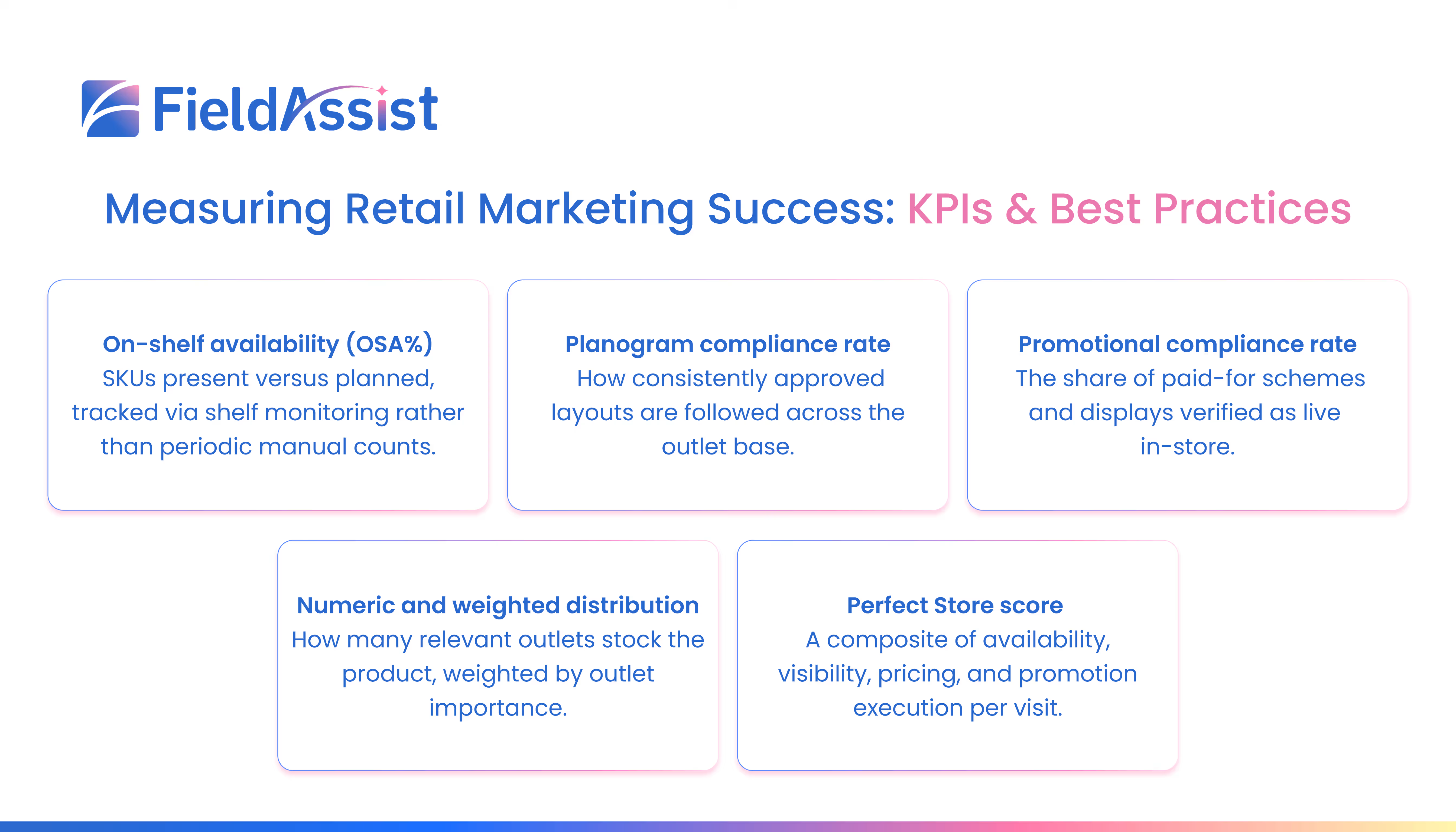
● On-shelf availability (OSA%)- SKUs present versus planned, tracked via shelf monitoring rather than periodic manual counts.
● Planogram compliance rate- how consistently approved layouts are followed across the outlet base.
● Promotional compliance rate- the share of paid-for schemes and displays verified as live in-store.
● Numeric and weighted distribution- how many relevant outlets stock the product, weighted by outlet importance.
● Perfect Store score- a composite of availability, visibility, pricing, and promotion execution per visit.
These aren't vanity metrics. Globally, unresolved out-of-stocks and overstocks, inventory distortion, cost retail an estimated US$1.7 trillion annually, with empty shelves alone accounting for roughly US$691 billion of that figure. Enterprise AI investment is accelerating in response, Gartner projects worldwide AI spending will reach roughly US$2.52 trillion in 2026, much of it aimed at closing execution gaps like these
Best practice: review these KPIs weekly at the outlet-cluster level, not just monthly at the national level, problems compound fast in a market moving this quickly.
Conclusion
Retail marketing in India isn't won on strategy decks, it's won at the shelf, outlet by outlet, visit by visit. The brands pulling ahead are the ones treating field sales automation, store execution software, and AI image recognition not as separate initiatives but as one connected system for closing the last-mile execution gap. Whether it's planogram compliance, promotional compliance, or basic on-shelf availability, the common thread is visibility: you can't fix what you can't see, and in a market as fragmented as India's, seeing every shelf, every day, is no longer optional. That's the problem FieldAssist was built to solve.



.avif)

.avif)