Deploying Decision Agents: What Retail Leaders Need to Know for 2027
Discover how AI decision agents and agentic workflows are reshaping consumer goods Route-to-Market strategies. Learn how FieldAssist builds a "thinking ecosystem" to power smart growth.

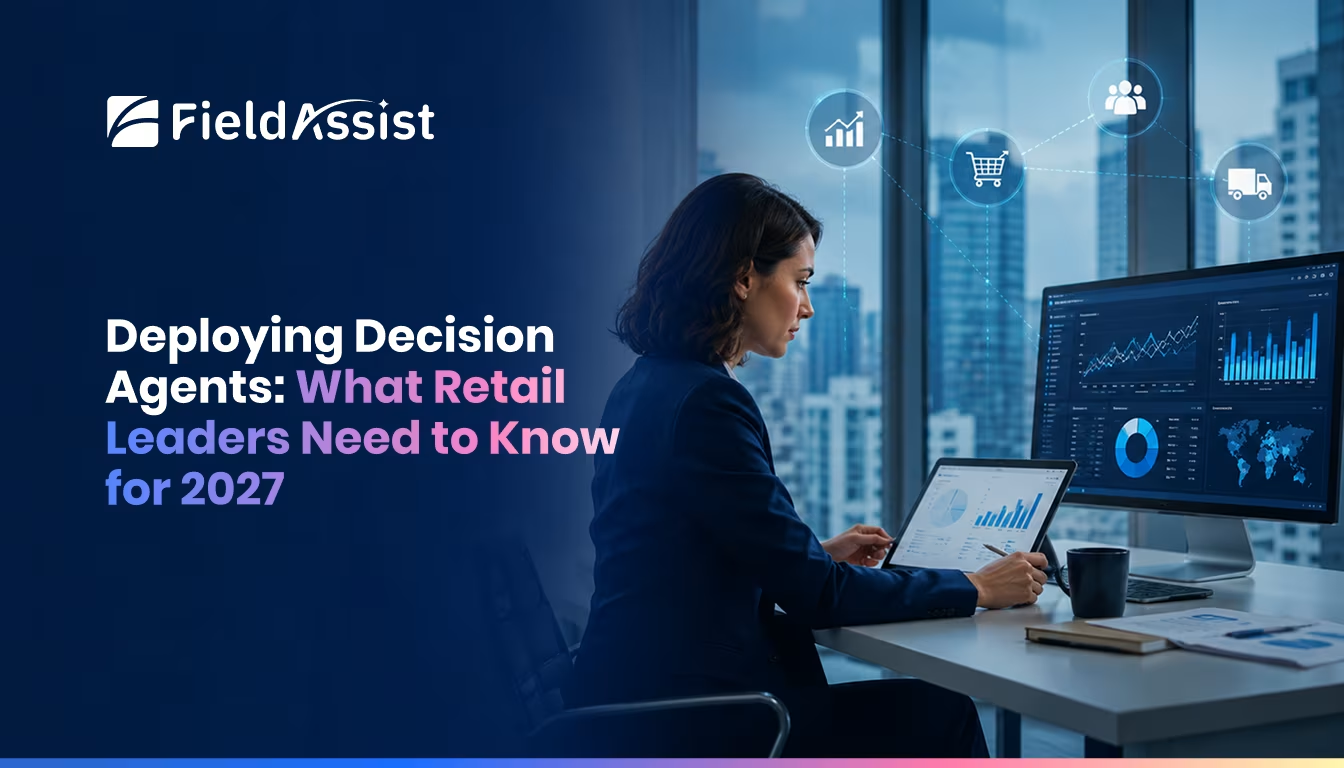
Are your retail execution strategies adapting to real-time market shifts, or merely reporting on them after the fact? What if your Route-to-Market (RTM) ecosystem didn’t just collect supply chain and sales data, but actively made autonomous decisions to secure shelf dominance? And as consumer goods complexity accelerates toward 2027, are your field representatives still burdened by administrative guesswork, or are they empowered by an ecosystem that thinks alongside them?
For the past decade, consumer goods and retail leaders have invested heavily in analytics to understand what happened yesterday, and predictive AI to forecast what might happen tomorrow. Yet, despite these investments, the "last mile" of decision-making has remained stubbornly manual. Executives, sales managers, and field reps are drowning in dashboards, forced to constantly bridge the gap between AI-generated insights and real-world execution.
As we look toward 2027, the competitive frontier is shifting radically. The mandate is no longer about generating more insights; it is about automating the execution of those insights. Welcome to the era of Agentic AI and Decision Agents—the foundation of a new, intelligent operating model for the consumer goods sector.
This transformation will separate the market leaders from the laggards. Here is what retail and CPG leaders need to know to prepare their organizations for the deployment of decision agents.
The Paradigm Shift: From Passive Analytics to Agentic Execution
To understand the magnitude of this shift, C-suite leaders must recognize the evolutionary trajectory of enterprise intelligence. Traditional AI stops at the recommendation layer. It can tell a sales manager that a specific SKU is at high risk of a stockout, but a human must still log into an ERP, adjust the allocation, notify the distributor, and route the field rep to the store.
Agentic AI fundamentally changes this dynamic. Decision agents are autonomous or semi-autonomous software entities designed to perceive their environment, make decisions based on complex parameters, and execute actions to achieve a specific business goal. They do not just recommend; they do.
By 2027, Gartner and other leading analysts project that agentic workflows will intermediate a massive percentage of B2B transactions and retail operations. For CPG brands dealing with fragmented supply bases, volatile consumer demand, and intense margin pressures, deploying decision agents is the only viable mechanism to absorb operational complexity at scale.
The Anatomy of a "Thinking Ecosystem"
Moving from isolated AI tools to a unified network of decision agents requires building what we at FieldAssist define as a "thinking ecosystem." This is an interconnected intelligence layer where data, contextual awareness, and execution logic operate in continuous harmony.
A robust thinking ecosystem in the CPG sector relies on three distinct types of agentic functions operating simultaneously:
- Sensor Agents (The Eyes and Ears): These agents continuously monitor the retail environment. They ingest point-of-sale (POS) data, track competitor pricing, analyze weather patterns affecting foot traffic, and monitor supply chain logistics in real-time.
- Thinker Agents (The Cognitive Engine): When a Sensor Agent detects an anomaly—such as a sudden spike in demand for a specific beverage SKU in a specific micro-market—the Thinker Agent kicks in. It calculates warehouse inventory, assesses margin impacts, evaluates the cost of dynamic routing, and formulates the most profitable response.
- Doer Agents (The Execution Arm): Once the optimal path is calculated, the Doer Agent executes the workflow. It autonomously rebalances inventory, updates the daily route for the local field rep, and pushes a targeted promotion to the retailer's app—all without requiring manual intervention from a human manager.
When these agents are vertically integrated into your Route-to-Market strategy, the ecosystem ceases to be a static software stack. It becomes a living, breathing extension of your workforce.
High-Impact Use Cases for Consumer Goods in 2027
Where should C-suite leaders direct their initial investments in agentic AI? The most immediate ROI is found where operational friction meets high transaction volume.
1. Autonomous Inventory Rebalancing & Shelf Optimization
Out-of-stocks are the silent killers of CPG profitability. Decision agents can proactively predict stock depletion based on hyper-local velocity trends. Rather than waiting for a field rep to visit the store and place a replenishment order, the agent autonomously triggers a micro-fulfillment request, ensuring the product's journey to the shelf is never interrupted.
2. Dynamic Route-to-Market Orchestration
Currently, field sales routes are largely static or modified manually based on gut feeling. Agentic AI transforms this by dynamically adjusting the daily routes of field personnel based on real-time priorities. If a high-value retail partner experiences a sudden drop in visual merchandising compliance, the decision agent autonomously reroutes the nearest available representative, pushing the specific action items directly to their mobile device.
3. Hyper-Localized Assortment and Trade Promotion
Trade spend is traditionally one of the largest and least efficient line items on a CPG P&L. Decision agents can autonomously test, monitor, and adjust trade promotions at the store level. If a promotion isn't yielding the required lift, the agent can pause the spend or reallocate it to a neighboring territory where elasticity models predict a higher return.
4. Easing the Burden on the Frontline
Perhaps the most critical outcome of deploying decision agents is the impact on human capital. The individuals moving your brand's sales forward—the field reps, area managers, and distributors—are currently bogged down by administrative tasks. A thinking ecosystem absorbs this daily friction. By handling the rote logic of order taking and inventory tracking, agents free up human workers to focus on what humans do best: building relationships, negotiating complex deals, and driving strategic brand advocacy.
The FieldAssist Advantage: Pioneering the Agentic RTM
To capitalize on this 2027 mandate, consumer goods businesses need more than disjointed AI point solutions; they need an AI-Native foundation designed specifically for the nuances of retail execution.
This is the core philosophy behind FieldAssist. As an AI-Native SaaS company, FieldAssist exists to help consumer goods businesses stay flawlessly in sync with their market. We provide a vertically integrated Route-to-Market (RTM) platform that gives brands end-to-end control over their product’s entire journey—from the warehouse dock to the consumer's hands.
We do not just provide data; we build the thinking ecosystem. Our platform powers smart, growth-led agentic decisions that natively integrate into your daily operations. By automating the complex, multi-variable decisions that currently paralyze sales operations, FieldAssist systematically eases the daily burden on the individuals moving the brand's sales forward. We ensure that your human talent is amplified by autonomous agents, creating a formidable competitive moat.
A CPG Blueprint for Agentic Readiness
Transitioning to an agentic operating model is a strategic transformation, not merely an IT upgrade. C-suite executives should adopt the following framework to ensure readiness by 2027:
- Establish a Unified Data Ontology: Decision agents are only as effective as the data they consume. If your trade spend data is siloed from your supply chain data, the agents cannot execute cross-functional workflows. Invest immediately in unifying your RTM data architecture.
- Define Autonomy Tiers: You do not have to hand over the keys to the kingdom on day one. Implement "Human-in-the-Loop" (HITL) workflows first. Allow the agent to draft the order or design the route, but require human approval. As confidence in the system grows, gradually increase the agent's autonomy.
- Implement Real-Time Governance: Code your business rules, compliance requirements, and margin floors directly into the agent's logic. This ensures that autonomous execution always aligns with corporate strategy and risk appetite.
- Realign KPIs for an Augmented Workforce: When decision agents handle operational execution, you can no longer measure field teams solely on the number of stores visited or orders logged. Shift your KPIs to measure relationship quality, strategic shelf dominance, and consultative selling success.
Conclusion
The deployment of decision agents in 2027 will mark the end of the "dashboard era" in retail and consumer goods. Brands that continue to rely on human teams to manually connect the dots between predictive insights and field execution will find themselves outpaced by faster, smarter, and infinitely more scalable competitors.
The future of Route-to-Market belongs to those who build a thinking ecosystem. By embracing agentic AI, retail leaders can establish end-to-end control over their product's journey to the shelf, ease the operational burden on their workforce, and unlock unprecedented avenues for smart, sustainable growth. The technology to power this transformation is here. The only question is: are you ready to deploy it?
Ready to transform your Route-to-Market strategy with FieldAssist? Explore the FieldAssist AI-Native RTM Platform and discover how we are powering the future of agentic decisions for global consumer goods brands.



.avif)