Trade Promotion Management Explained: Best Software, Strategies, and ROI Optimization Guide
Discover how FMCG leaders use trade promotion management software for advanced trade optimization and seamless trade scheme management to maximize distribution ROI.

.avif)
Trade schemes and promotion management are no longer just a cost of doing business; they are the engine of your market dominance, yet they remain the most critically mismanaged line item on the executive P&L.
For most FMCG organizations, channel incentives consume up to a staggering 25% of gross revenue. Despite this massive capital outlay, companies continue to bleed profit margins due to fragmented scheme execution, manual calculation errors, and crippling deduction leakage across complex regional distribution tiers.
The Trade Promotion Management (TPM) software is the definitive solution designed to systematically reclaim your promotional ROI. Powered by "Intelligent Scheme" architecture, the platform transcends basic tracking by deploying dynamic, rule-based automation and real-time order evaluation. The system evaluates hierarchy and basket constraints instantly, matching precise payout slabs, utilizing step, continuous, or prorata logic, while enforcing absolute financial discipline by auto-deactivating schemes the exact moment budget thresholds are hit.
This intelligent, automated governance changes the execution game entirely. FMCG leaders leveraging these capabilities routinely eliminate deduction leakage by up to 20%, accelerate distributor claim settlement times by over 30%, and drive a 10-15% lift in true incremental sales volume. Thus, transforming regional trade capital from a financial blind spot into a highly calibrated revenue driver.
What is trade promotion management?
Trade Promotion Management (TPM) is the strategic process of configuring and managing dynamic trade promotions, schemes, discounts, and complex incentive structures across both primary and secondary sales channels. For FMCG executives, it is far more than an administrative tracking function; it is the rigorous financial governance of trade investments specifically designed to drive bulk purchase behavior and drastically improve sales push through structured incentive programs.
At an enterprise level, a modern TPM framework standardizes the entire scheme creation and execution process company-wide. It allows brands to deploy targeted promotional applicability across specific geographic hierarchies, distributor channels, and specialized outlet segmentations. Crucially, it actively controls budget utilization and prevents costly over-execution, transforming fragmented channel spending into a strictly controlled, rule-based revenue engine.
The Reality of Trade Promotion Management in Multi-Tiered Distribution
In highly fragmented regional markets, the reality of FMCG distribution is that high-level promotional strategies often disintegrate before they ever reach the retail shelf. Multi-tiered networks, spanning from corporate warehouses down to regional stockists and hyper-local retail outlets, create massive operational blind spots.
Without a centralized Trade Promotion Management (TPM) platform, brands suffer from severe margin leakage and deploy misaligned incentives that fail to secure genuine market traction.
To combat this geographic and operational chaos, an advanced TPM framework introduces rigorous, system-driven governance across every single tier of the distribution supply chain:
- Precision Hierarchical Targeting: Instead of spraying capital across blanket national campaigns, revenue leaders can restrict scheme applicability to highly specific geographic hierarchies, executing promotions exclusively within designated zones, regions, and individual states.
- Unified Channel Synchronization: The platform seamlessly bridges the critical gap between sell-in and sell-through by managing distinct primary and secondary scheme types. Crucially, it allows primary corporate schemes to be flagged as "extendable," pushing those exact incentives down into secondary distributor orders to guarantee aligned market execution.
- Granular Constraint Fencing: To drastically minimize promotional waste, active campaigns are strictly fenced using advanced distributor and outlet constraints. This ensures high-value incentives are triggered only for designated sales channels, specific retailer segments, focused outlets, or locations explicitly identified via custom tags.
- Intelligent Basket Execution: Attempting to scale promotions through direct, one-off SKU mapping is a common execution pitfall. A robust TPM architecture mandates structured group promotions using a "Scheme Basket," allowing brands to dynamically group inventory by product division, category, or specific attribute to drive strategic bulk-purchase behavior across diverse regional markets.
Why is Trade Scheme Management critical for FMCG distribution?
Trade Scheme Management is the foundational mechanism that prevents FMCG brands from hemorrhaging promotional capital across fragmented supply chains. It is absolutely critical because it transitions organizations from chaotic, ad-hoc discounting to structured, controlled, and intelligent execution.
For executives focused on maximizing market penetration without sacrificing operating margins, an intelligent scheme management delivers essential business value across several fronts:
- Driving Strategic Volume: Instead of relying on basic SKU-level discounting, intelligent scheme management uses defined Scheme Baskets to enable flexible product-grouping logic, actively driving deliberate bulk-purchase behavior across targeted categories and product divisions.
- Automated Execution Control: It ensures that promotional payouts are only authorized when strict mandatory conditions, minimum order quantities, and specific secondary qualifiers are definitively met during real-time order evaluation.
- Eradicating Budget Over-Execution: By systematically configuring budgets based on financial amounts, standard units, or quantities, the platform automatically deactivates active schemes when budgets are exhausted, eliminating the risk of over-execution.
- Amplifying Sales Push: It guarantees highly scalable discounting and a dramatically improved sales push by structuring dynamic incentive programs seamlessly across both primary and secondary sales networks.
What are the common challenges in trade promotion management?
For FMCG leaders, the greatest challenges in Trade Promotion Management (TPM) stem from a lack of systematic governance, which quickly turns well-intentioned channel incentives into significant sources of profit erosion. When trade promotions are executed without strict, automated controls, companies face several critical business risks:
- Unintended Margin Leakage: A primary challenge is the unintended application of promotional schemes, often caused by missing mandatory qualification flags or overlapping schemes applied to the same product basket. This allows distributors to double-dip or claim unearned payouts, directly cannibalizing corporate profit margins.
- Runaway Budget Exhaustion: Without automated financial guardrails, businesses frequently suffer from budget exhaustion due to a lack of real-time monitoring. This leads to costly over-execution, where successful campaigns drain trade capital far beyond acceptable financial thresholds.
- Geographic and Channel Misallocation: Misaligned execution is a massive hurdle in multi-tiered distribution. Errors such as wrong hierarchy tagging ensure that high-value incentives are deployed to the wrong geographic zones or unintended distributor segments, resulting in severe promotional waste.
- Fragmented SKU-Level Execution: Attempting to drive volume through direct SKU mapping rather than intelligent product grouping (like category or attribute baskets) is a common pitfall that prevents businesses from effectively driving strategic bulk purchase behavior. This incorrect entity selection restricts scalable discounting and limits the overall sales push.
Why do CPG and FMCG companies use TPM Software?
CPG and FMCG companies use Trade Promotion Management (TPM) software to transform complex, fragmented channel incentives into a highly controlled, standardized, and profitable revenue engine.
By moving away from manual tracking, TPM software enables highly flexible trade promotions, drives strategic bulk purchase behaviors, and ensures strictly rule-based scheme execution across all distribution tiers. Ultimately, it empowers organizations to aggressively improve their sales push through structured incentive programs while simultaneously controlling budget utilization to prevent costly over-execution.
How can automated Trade Scheme Management prevent distributor claim disputes?
For FMCG leaders, distributor claim disputes are more than just an administrative headache - they are a primary source of deduction leakage and fractured channel relationships. These disputes historically arise from manual spreadsheet calculations, ambiguous qualification rules, and delayed post-campaign reconciliations.
Automated Trade Scheme Management completely neutralizes these issues by replacing human calculation with rigid, system-driven financial governance. Here is how it permanently resolves claim disputes:
- Real-Time Order Evaluation: Instead of calculating payouts weeks after a campaign ends, the system dynamically evaluates active orders at the exact moment of creation. It instantly checks hierarchy applicability, validates basket product matches, and aggregates minimum quantities to determine an immediate outcome.
- Flawless Mathematical Precision: Automation removes the subjective interpretation of payout tiers. By deploying specialized calculation types—such as Step, Continuous, and Prorata logic—the software computes the exact incentive down to the single unit or percentage point.
- Unyielding Qualification Logic: Distributors can no longer debate whether they "almost" hit a target. The system strictly enforces mandatory product flags and secondary qualifiers; if the exact basket configuration and minimum constraints are not perfectly satisfied, the payout is systematically denied.
- Transparent "Claimable" Audit Trails: Schemes can be explicitly configured as "claimable," creating a verified, tamper-proof digital ledger. Because the incentive is pre-validated by the system during the initial order, the distributor simply claims the exact, pre-approved amount from the company without friction.
By automating these mechanics, FMCG brands transform a traditionally adversarial, error-prone claims process into a seamless financial settlement. This completely eliminates deduction leakage, protects corporate operating margins, and builds immense trust across multi-tiered regional distribution networks.
What are the must-have features in modern Trade Promotion Management Software?
To genuinely protect profit margins and optimize trade investments across complex regional markets, FMCG leaders must look beyond basic campaign trackers. A modern Trade Promotion Management (TPM) platform must operate as a strict financial governance system. Here are the three non-negotiable features every enterprise-grade solution must possess:
1. Automated Budget Guardrails and Auto-Deactivation
This allows administrators to configure precise payout budgets based on financial amounts, specific product quantities, or standard units, and will automatically deactivate the scheme the exact moment that the defined budget is crossed.
Why it is a Must-Have: It completely removes the human element from financial compliance.
Business Pain Point Addressed: This directly solves the massive vulnerability of "budget exhaustion without monitoring". By acting as a rigid financial safeguard, it prevents the costly over-execution of campaigns where high-performing regional distributors drain corporate operating margins.
2. Precision Hierarchy and Granular Outlet Targeting
The TPM software must support highly targeted scheme execution by evaluating strict geographic hierarchies (zones, regions, states) and advanced distributor or outlet constraints (channels, segmentations, custom tags).
Why it is a Must-Have: It guarantees that promotional capital is deployed accurately and strategically, isolating the exact markets or specific focused retail outlets that require sales acceleration.
Business Pain Point Addressed: This addresses the common pitfall of "wrong hierarchy tagging" and the subsequent regional misallocation of trade capital. It prevents revenue leakage from blanket discounting, ensuring that incentives do not overlap or misfire across multi-tiered distribution channels.
3. Intelligent Scheme Baskets for Group-Level Promotions
The TPM platform mandates that promotions be defined for a distinct group of products—using product divisions, categories, or specific attributes—that are bound together within a structured "Scheme Basket".
Why it is a Must-Have: It forces scalable, business-aligned product grouping logic rather than relying on inefficient, direct SKU-level mapping.
Business Pain Point Addressed: It specifically resolves the persistent issue of "incorrect entity selection (Category vs SKU mismatch)" which often cripples execution. By shifting from basic SKU limits to basket-based logic, it actively drives strategic bulk-purchase behavior and significantly improves the overall FMCG sales push.
FieldAssist - Best Trade Promotion Management Software
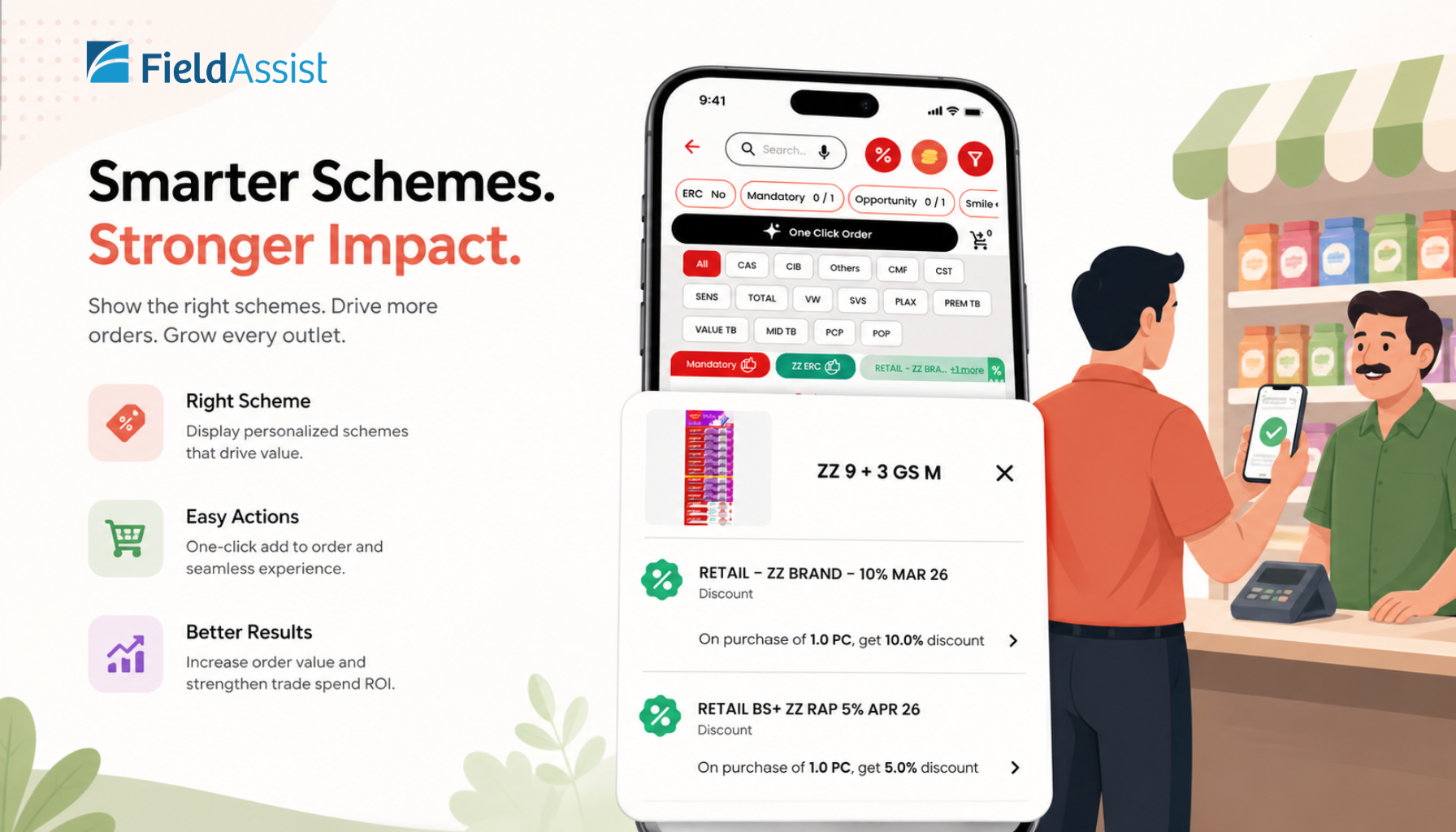
When evaluating the market for enterprise-grade solutions, FieldAssist stands out as the premier Trade Promotion Management (TPM) software because it fundamentally shifts the focus from administrative tracking to aggressive revenue generation. The FA TPM acts as a financial safeguard and a volume accelerator, specifically engineered to dominate multi-tiered regional distribution networks.
By deploying FieldAssist’s "Intelligent Scheme" architecture, FMCG leaders gain an immediate, quantifiable advantage in business growth and market push:
- Aggressive Bulk Selling: Rather than relying on weak, single-SKU discounts, FieldAssist uses "Scheme Baskets" that require minimum order quantities for grouped product divisions or categories. This forces distributors to buy in bulk to qualify for the incentive, drastically increasing average order values and driving strategic inventory movement.
- Scalable Market Push: FieldAssist's "Continuous" payout calculation models fuel limitless sales momentum. For example, a continuous per-unit incentive structure scales exponentially with performance—motivating a distributor to push past a 50-unit order (yielding a 100 payout) all the way to a 200-unit order (yielding a 1,000 payout). This mathematical scalability ensures distributors are constantly pushing for maximum volume rather than settling for baseline targets.
- Zero-Leakage Margin Protection: By automatically validating mandatory basket conditions and checking real-time slab matching during order creation, the platform mathematically eliminates the deduction leakage and calculation errors that traditionally eat up 10-20% of FMCG trade budgets.
Why FieldAssist TPM Software is the Right Choice for FMCG Leaders?
If you are planning to compare varied trade promotion management and optimization software with FieldAssist TPM for business enhancement purposes, here’s your quick guide to making the right choice:
FAQ:
Q1. What is trade promotion management (TPM)?
Trade promotion management (TPM) is the strategic business process for configuring, executing, and managing dynamic trade promotions, discounts, and complex incentive structures across primary and secondary sales channels. For FMCG enterprises, a robust TPM system transitions fragmented discounting into a controlled, rule-based execution model that ensures accurate payout calculations, actively controls budget utilization, and drastically improves overall sales push through structured incentive programs.
Q2. How does a "Scheme Basket" improve promotional ROI?
A Scheme Basket fundamentally improves ROI by allowing FMCG brands to define promotions on a specific group of products, such as product divisions, primary categories, or specialized attributes, rather than relying on isolated SKU-level limits. This flexible grouping logic strategically drives critical bulk-purchase behavior and ensures incentives are paid out only when strict minimum-quantity thresholds and mandatory product conditions are fully satisfied during order evaluation.
Q3. Can modern TPM software synchronize primary and secondary sales channels?
Yes, an advanced TPM architecture seamlessly manages both primary schemes (applicable only to primary corporate orders) and secondary schemes (applicable to downstream orders). Crucially, it features an "extendable" capability, allowing primary incentives to be pushed directly down to secondary stockist orders, ensuring perfectly unified promotional execution from the corporate warehouse to the final retail outlet.
Q4. What is the difference between Trade Promotion Management and Trade Optimization?
While the terms are often used interchangeably, Trade Promotion Management (TPM) traditionally focuses on the operational execution and strict financial governance of campaigns. This includes standardizing the scheme creation process, executing complex payout calculations, and actively controlling budget utilization to prevent over-execution.
Trade Promotion Optimization (TPO), on the other hand, is the advanced strategic layer that actively refines these campaigns to maximize your return on investment. A modern, optimization-driven platform bridges this gap by not only tracking your trade spend but also dynamically evaluating real-time order data against complex slab matching and secondary qualifiers. This intelligent optimization ensures you are actively driving strategic bulk behaviors and paying only for true incremental volume, rather than subsidizing baseline sales.





.avif)
.avif)