What is a Channel Loyalty Program? Strategy, Software & Platform Guide
Discover what a channel loyalty program is and how to build the right strategy to maximize B2B retail partner ROI. Master channel loyalty management using intelligent software solutions today.

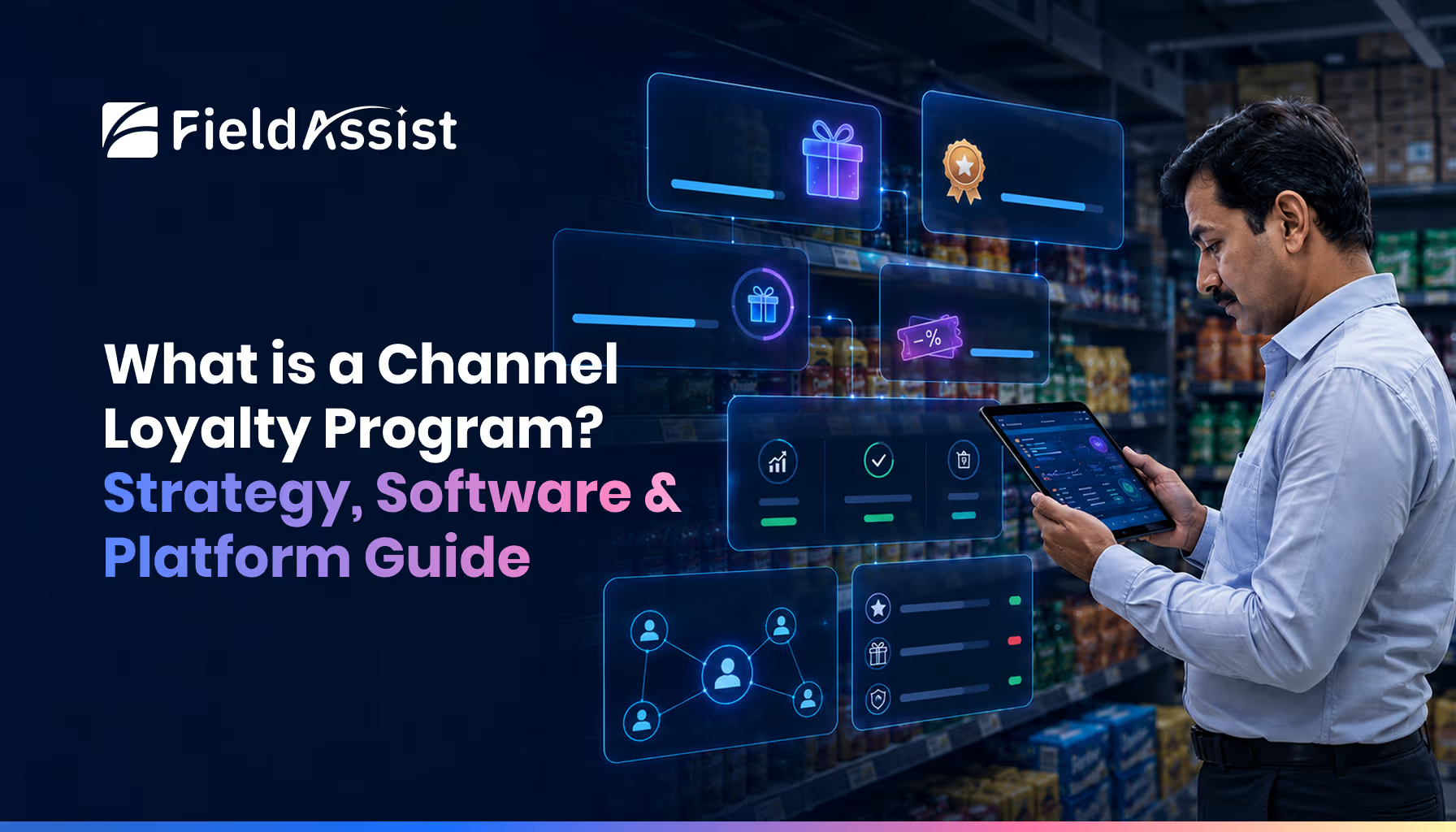
Why do some brands effortlessly command the best shelf space, while others are constantly fighting just to stay in stock?
It usually boils down to one thing: how they manage their channel partners. Let’s be honest, for a lot of businesses, "channel loyalty" still means handing out festive gifts, running messy spreadsheet-based discount schemes, and crossing their fingers. It's often viewed as a leaky bucket; a necessary cost of doing business rather than a real strategy.
But the landscape has shifted. When you align your distribution networks with a structured incentive plan, the numbers speak for themselves. Data shows that building genuine, transparent trust with retailers and distributors can boost repeat purchase rates by up to 30%. A well-executed program doesn’t just eat into your margins; it actively drives secondary sales and secures your market share against competitors.
So, here is the real question: How do you actually scale that kind of relationship? How do you move away from manual guesswork and build an automated ecosystem where your partners are genuinely motivated to push your products first?
That’s exactly what we’re going to unpack. In this guide, we’ll cut through the jargon to explain what a modern channel loyalty program actually looks like. We’ll explore the underlying strategy, how the right software platform makes it all a reality, and exactly how you can build an infrastructure that delivers maximum, measurable ROI.
What is a Channel Loyalty Program?
A channel loyalty program is a strategic B2B incentive framework designed to motivate and reward third-party channel partners—such as distributors, wholesalers, and retailers—for prioritizing a brand's products, sharing market data, and achieving specific revenue targets.
But let’s look under the hood. What does that actually look like in practice, and why should a CEO or CRO care?
What a Well-Designed Channel Loyalty Program Actually Does? A well-architected loyalty program moves your brand away from random, uncoordinated discounts. Instead, it creates a structured ecosystem of incentives. It actively influences partner behavior by rewarding them not just for buying in bulk, but for highly profitable actions—like stocking newly launched SKUs, maintaining brand visibility in their stores, or sharing crucial secondary sales data.
Why It’s Critical for Your Business? In fiercely competitive industries like FMCG and CPG, product differentiation alone won't always win the day. Your biggest competitive advantage is the mindshare of your distribution network. If a retailer or distributor inherently prefers working with you because they see a clear, ongoing financial benefit, they will actively push your product over a rival’s at the point of purchase.
The Core Business Problems It Solves? Most enterprise brands suffer from a "leaky bucket" in their trade promotions. You throw money at the market in the form of generic discounts, but have zero visibility into whether that spend actually drove secondary sales or just padded a wholesaler's margins. A modern channel loyalty program solves this by tying every single incentive dollar directly to measurable ROI and verified sales data. It eliminates guesswork and ends budget leakage.
The Longevity It Ensures? At the executive level, the goal isn't just a spike in this quarter's sales; it’s predictable revenue. A strong loyalty program creates sticky, long-term relationships. When a retailer feels they are building equity and growing their own business alongside yours, they stop jumping ship the second a competitor offers a temporary price drop. This secures your shelf space and protects your market share for years to come.
B2B Partner Loyalty vs. B2C Customer Loyalty
It is a massive mistake to treat your distribution partners like retail consumers. They are business owners, and their motivations are fundamentally different. Here is why your strategy has to shift:
The Business Case: Why Strategic Channel Loyalty Management Matters
If you're familiar with the FMCG industry, you already know that managing a supply chain and distribution network is one of the most capital-intensive parts of your business. Yet, historically, the way brands incentivize these networks has been painfully unscientific.
When you treat channel loyalty simply as an administrative task or an annual gifting exercise, it becomes a black hole for trade spend. Strategic channel loyalty management changes the equation. It transforms trade promotions from an unpredictable cost center into a measurable, performance-based revenue engine. Let’s break down exactly how this impacts the business.
1. Shifting from Transactional to Strategic Partnerships
Why does this shift matter? Because purely transactional relationships have zero switching costs.
If your relationship with a distributor or retailer is based entirely on who offers the deepest invoice discount this week, you are trapped in a race to the bottom. The moment a competitor offers a slightly better margin, that partner will swap your SKUs for theirs. That is the reality of commoditized channel management.
Shifting to a strategic partnership means integrating your brand into your partner’s actual growth plan. Instead of just negotiating on price, you are utilizing a loyalty program to offer tiered financial benefits, performance rebates, and business-building rewards that compound over time.
2. Impact on B2B Revenue, Retention, and Market Share
At the executive level, the success of a channel loyalty program isn't measured in "engagement" or "smiles." It is measured in hard financial outcomes. When you manage your partners strategically, the impact hits three primary areas of your balance sheet:
- Protecting and Expanding Market Share (Share-of-Wallet): Distributors carry multiple brands, often competing ones. A strategic program incentivizes them to consolidate their buying power with you. By tying rewards to secondary sales velocity rather than just primary stock-in, you typically see a direct lift in your Share-of-Wallet (SOW). They push your product off the shelf faster because the backend incentives make your brand their most profitable option.
- Improving Trade Spend Efficiency (ROI): Unstructured trade promotions are notorious for budget leakage—often up to 15-20% of the spend cannot be tied to actual sales lift. A structured channel loyalty program moves you to a pay-for-performance model. You only issue the reward when the verified sale or target is achieved. This dramatically improves your Trade Promotion Optimization (TPO) metrics, ensuring every dollar spent actively drove revenue.
- Reducing Partner Churn (Net Retention Rate): Acquiring a new, high-performing distributor or retail chain is incredibly expensive and time-consuming. Just like SaaS companies track Net Revenue Retention (NRR), FMCG and manufacturing leaders must track channel retention. By offering long-term incentive structures, you stabilize your distribution network. Reducing partner churn by even a few percentage points saves massive amounts of capital in partner onboarding, training, and lost territory sales.
From a purely strategic standpoint, this creates high switching costs. When a distributor is close to hitting a high-tier volume bonus or a lucrative quarterly rebate through your program, abandoning your brand for a competitor’s short-term discount actually costs them money. You are no longer just a vendor; you are a reliable pillar of their own P&L.
Channel Loyalty Program vs. Channel Loyalty Platform: What’s the Difference?
To put it simply: The loyalty program is your business strategy. The loyalty platform is the technology (intelligent software) that executes it.
You can design the most brilliant loyalty program in the world, but if you rely on spreadsheets and WhatsApp groups to manage it, it will collapse under its own weight. Conversely, you can buy the most expensive software platform on the market, but if your underlying incentive strategy is flawed, you are just automating a bad process.
To drive maximum ROI, you need both working in perfect alignment. Here is the exact breakdown of how they differ and rely on one another:
Expert insights: If the program is the blueprint, the platform is the engine. A channel loyalty platform is dedicated software (such as FieldAssist's FlickPoints) that operationalizes your strategy at scale.
When you have 5,000 retailers and 200 distributors, you cannot track secondary sales, calculate tiered margins, and distribute rewards manually. A platform digitizes the entire experience. It gives your partners a mobile app or portal where they can see their real-time progress toward their next bonus, scan QR codes on products, and claim rewards instantly.
More importantly for the C-suite, the platform integrates directly with your existing Tech Stack (such as your ERP or Distribution Management System). It provides your leadership team with a real-time dashboard showing exactly which partners are performing, where your budget is being spent, and your actual ROI for every campaign.
How to Build Your Channel Loyalty Strategy for Maximum ROI?
One of the biggest mistakes brands make is looking at a competitor’s loyalty program and simply copying it. But your supply chain, your profit margins, and your specific market challenges are entirely unique to your business.
Building a strategy for maximum ROI means working backward from your P&L. You have to design a framework where every reward issued is mathematically tied to a net-positive business outcome. Here is the step-by-step executive blueprint for getting it right.
Step 1: Define Clear Ecosystem Objectives
You can’t measure ROI if you don’t know what you are actually trying to achieve. "Selling more product" is too vague. You need to identify the specific friction points in your distribution network.
Before you launch anything, sit down with your sales and finance heads and ask: What specific partner behaviors do we need to change this quarter?
- Data Visibility: Are you blind to what happens after your product leaves the distributor? Your objective might be to incentivize retailers to scan QR codes so you can finally capture real-time secondary sales data.
- Product Mix: Are your partners only buying your low-margin legacy products? Your objective could be tying their quarterly bonuses to the uptake of your newly launched, high-margin SKUs.
- Market Penetration: Are you losing shelf space in a specific region? The goal might be to heavily incentivize the onboarding of new retail outlets in that exact territory.
When your objectives are razor-sharp, you can design a program that surgically targets those exact goals without wasting trade spend.
Step 2: Segment Your Partners Strategically
The golden rule of channel management is the Pareto Principle: roughly 80% of your revenue comes from 20% of your partners. If you treat every distributor and shopkeeper the same, you are over-rewarding underperformers and under-rewarding your VIPs.
You need to segment your network based on their actual value and potential.
- By Role: Distributors operate on entirely different unit economics than rural shopkeepers. Their incentives must be structured differently.
- By Volume and Velocity: Group your partners into tiers (e.g., Platinum, Gold, Silver). Your top-tier distributors and retailers should get white-glove treatment—like exclusive rebates, priority stock allocation during shortages, and direct lines to your leadership team.
- By Potential: A mid-sized retailer in a rapidly growing urban market might be more valuable to your future strategy than a stagnant, large retailer in a saturated market. Build pathways for these high-potential partners to easily climb your tiers.
Step 3: Design Meaningful Incentives (That Don't Erode Margins)
If your only incentive is a flat invoice discount, you are just training your partners to wait for the next sale. Furthermore, flat discounts immediately erode your gross margins.
You need to design a reward structure that builds equity and locks the partner into your ecosystem. Move beyond basic cash hand-outs and consider high-value, business-building incentives:
- Tiered Volume Rebates: Instead of upfront discounts, offer backend rebates that are only paid out after the partner hits a specific quarterly target. This protects your cash flow and keeps them pushing your product until the very last day of the quarter.
- Business Growth Tools: Offer rewards that actually help them run their business better. This could be extended credit terms, co-funded localized marketing, or exclusive access to data dashboards that show them how they are performing against local competitors.
- Frictionless Liquidity: When you do offer points or cash equivalents, make them instantly redeemable. If a retailer earns a reward for hitting a target, allowing them to instantly convert that into a credit note for their next order creates a seamless, self-fueling purchase loop.
Step 4: Streamline with Software
Let’s be realistic: managing a multi-tiered, data-driven loyalty program across thousands of distributors and rural shopkeepers is mathematically impossible if your team is relying on manual invoice verification, WhatsApp groups, or legacy ERP bolt-ons to manage rewards. And nothing destroys partner trust faster than a delayed quarterly rebate.
To make your strategy work, you must delegate the heavy lifting to a dedicated channel loyalty platform. Blending your business rules with the right software unlocks massive operational advantages:
- Drastically Reducing TAT (Turnaround Time): Software automates the entire scheme reconciliation process. When a retailer hits a target or scans a product, the platform instantly verifies the data and issues the reward. Reducing TAT from weeks to seconds builds immense trust and keeps partners engaged in a continuous buying loop.
- Eradicating Budget Leakage & Fraud: Spreadsheets are easily manipulated. A specialized platform ensures that every single reward is tied to a verified, timestamped transaction, protecting your trade spend from manual errors and fraudulent claims.
- Freeing Up Your Sales Force: Your on-ground sales teams should be selling, negotiating shelf space, and building relationships—not acting as administrative assistants chasing down pending loyalty payouts. Software removes the admin burden from your team entirely.
By digitizing the entire ecosystem, you give your partners a seamless, transparent experience, while giving your leadership team real-time visibility into exactly how your trade spend is performing.
Why FieldAssist FlickPoints is the Ultimate Channel Loyalty Platform?
You can spend months designing the perfect loyalty strategy in the boardroom, but if the on-ground execution involves manual data entry, delayed payouts, and fragmented spreadsheets, you will only frustrate your channel partners and bleed trade spend.
This is exactly where FieldAssist FlickPoints steps in to address the most critical business pain points in channel management.
FlickPoints is built specifically for the realities of the FMCG and CPG supply chain. It isn't just a generic rewards catalog; it is an intelligent, integrated loyalty ecosystem that connects directly with your existing Sales Force Automation (SFA) and Distribution Management System (DMS).
It eliminates the guesswork for your retailers, automates the admin work for your sales reps, and gives the C-suite a unified, real-time dashboard of exactly how every incentive dollar is driving growth.
Here is exactly how FlickPoints translates platform features into measurable business outcomes:
The Bottom Line for B2B Leaders
In a market where shelf space is war, your distribution network is your greatest asset. Moving from a manual, reactive discount scheme to an automated, proactive loyalty platform is no longer just an operational upgrade—it is a strategic necessity to protect your market share.
With FieldAssist FlickPoints, you aren't just giving away points; you are building a predictable, scalable revenue engine.




.avif)
.avif)