How AI Improves Scheme Compliance Tracking in FMCG
Improve scheme compliance tracking in FMCG with AI-powered automation, real-time validation, and smarter trade spend governance using FieldAssist.

.avif)
Introduction
Every FMCG brand has felt it, the sinking realization that a trade scheme didn't deliver what was planned. The display was never executed. Secondary sales numbers don't match the payout. And the sales rep filed a compliant beat report anyway.
This isn't a people problem. It's a systems problem.
Across CPG and FMCG organizations, incentive scheme compliance sits in a dangerous middle zone: too complex to track manually, too fragmented to automate well. The result is margin leakage, strained retailer relationships, and schemes that never achieve their intended market impact.
AI scheme compliance software is changing that equation, embedding intelligence into field execution workflows, validating compliance in real time, and giving sales managers the visibility they need to hold teams accountable.
What is Scheme Compliance Tracking in Sales? Understanding the Basics
So, what is scheme compliance tracking in sales? It is the process of verifying that trade promotion schemes, volume incentives, display programs, secondary sales targets, retailer discount schemes, are executed exactly as designed, and that payouts are processed only when compliance conditions are genuinely met.
In practice, this means answering three questions at scale: Did the retailer actually execute the scheme? Did the sales rep accurately report field activity? Are payout calculations based on verified field data or on what was entered into a system?
For organizations still running scheme compliance tracking through spreadsheets and manual beat reports, the honest answer is: we don't really know. Incentive scheme compliance, when unverified, operates on trust, and that trust is routinely eroded by system gaps.
The High Cost of Poor Scheme Enforcement
Margin Leakage and Inaccurate Payouts
The financial exposure is significant. According to McKinsey, CPG companies worldwide invest approximately 20% of their revenue annually in trade promotions, and a staggering 59% of those promotions globally lose money, with the US figure reaching 72%.
When scheme compliance is tracked manually, schemes are paid out on what was reported, not what was executed. Distributors claim secondary sales that never happened. Display compliance is logged on a rep's word. Over a quarter, these gaps compound into serious margin leakage. AI-powered incentive compliance closes this gap by tying payout triggers to verified data, not self-reported inputs.
Friction and Erosion of Trust with Retail Partners
Poor incentive scheme compliance also erodes trust with retail partners. As per a survey of 75+ finance and compliance experts across FMCG and consumer markets found that 79% of respondents reported no reduction in sales and distribution fraud despite multiple regulatory changes, identifying sales and distribution as the second-highest fraud-prone area after procurement.
Disputes over scheme settlements are a consistent source of friction in traditional trade, and they undermine a brand's ability to run high-impact programs in future cycles.
Enter AI: How Modern Technology Reimagined Trade Compliance

Traditional approaches to scheme compliance tracking were largely backward-looking, with exceptions flagged after the damage was done. Modern AI shifts this to real-time enforcement.
Today's AI sales compliance software ingests data from field visits, DMS records, and shelf image capture, cross-referencing all of it against scheme conditions in near real time. Anomalies are flagged before payout. Sales reps are nudged toward compliance during the visit itself.
Gartner predicts that by 2028, at least 15% of day-to-day work decisions in enterprise sales organizations will be made autonomously through agentic AI, up from zero in 2024. Scheme compliance tracking, rule-based, data-intensive, and high-stakes, is one of the most direct beneficiaries of this shift.
Key Ways AI Elevates Scheme Compliance Tracking in FMCG
- Automated, Fraud-Proof Payout Calculations
The best AI-powered incentive compliance systems don't just detect fraud after the fact; they structurally prevent it. FieldAssist's TPM platform automates payout calculations using system-driven models integrated directly into the order evaluation flow. Scheme credits are computed at the moment of order creation, eliminating manual intervention, deduction leakage, and distributor disputes. Budget governance controls automatically deactivate schemes when caps are exhausted, ensuring disciplined spend and margin protection.
- Zero-Delay Scheme Execution with Intelligent Basket Validation
Effective scheme compliance isn't about reviewing execution after the fact; it's about getting it right at the point of order. FieldAssist's Dynamic Promotion Engine validates basket conditions instantly, applying eligibility rules and benefit logic in real time during ordering. Sales reps and distributors operate within a structured, rule-enforced workflow, with scheme conditions checked automatically across quantity, amount, and SKU groupings. This eliminates post-order adjustments and ensures consistent execution across geographically dispersed field teams.
- Precision Targeting for Higher Scheme ROI
Blanket promotions waste trade spend. FieldAssist's TPM platform enables hierarchical scheme targeting, from zone and region down to individual distributor or outlet level, with filters for channel, segmentation, focused outlets, and tags. This ensures schemes reach only the intended audience, improving ROI and enabling strategic alignment with high-value outlets and distribution partners.
- Smarter Trade Spend Governance
AI-powered incentive compliance extends beyond execution to financial control. FieldAssist's built-in budget governance tracks scheme spending in real time, enforcing caps based on predefined financial amounts, product quantities, or standard units. Mandatory condition flags prevent unintended scheme application, while automatic deactivation on budget exhaustion eliminates the risk of costly over-execution.
- Predictive Insights for Future Scheme Design
FieldAssist's AI capabilities, available through the FAi Suite and Analytics Studio, go beyond current-quarter execution. By analyzing historical performance data correlated with actual sell-through, these tools surface insights that help revenue teams identify structural execution gaps, reallocate trade spend toward high-performing geographies and product groups, and improve scheme ROI over successive periods.
The FieldAssist Advantage: Unifying SFA, DMS, and AI Intelligence
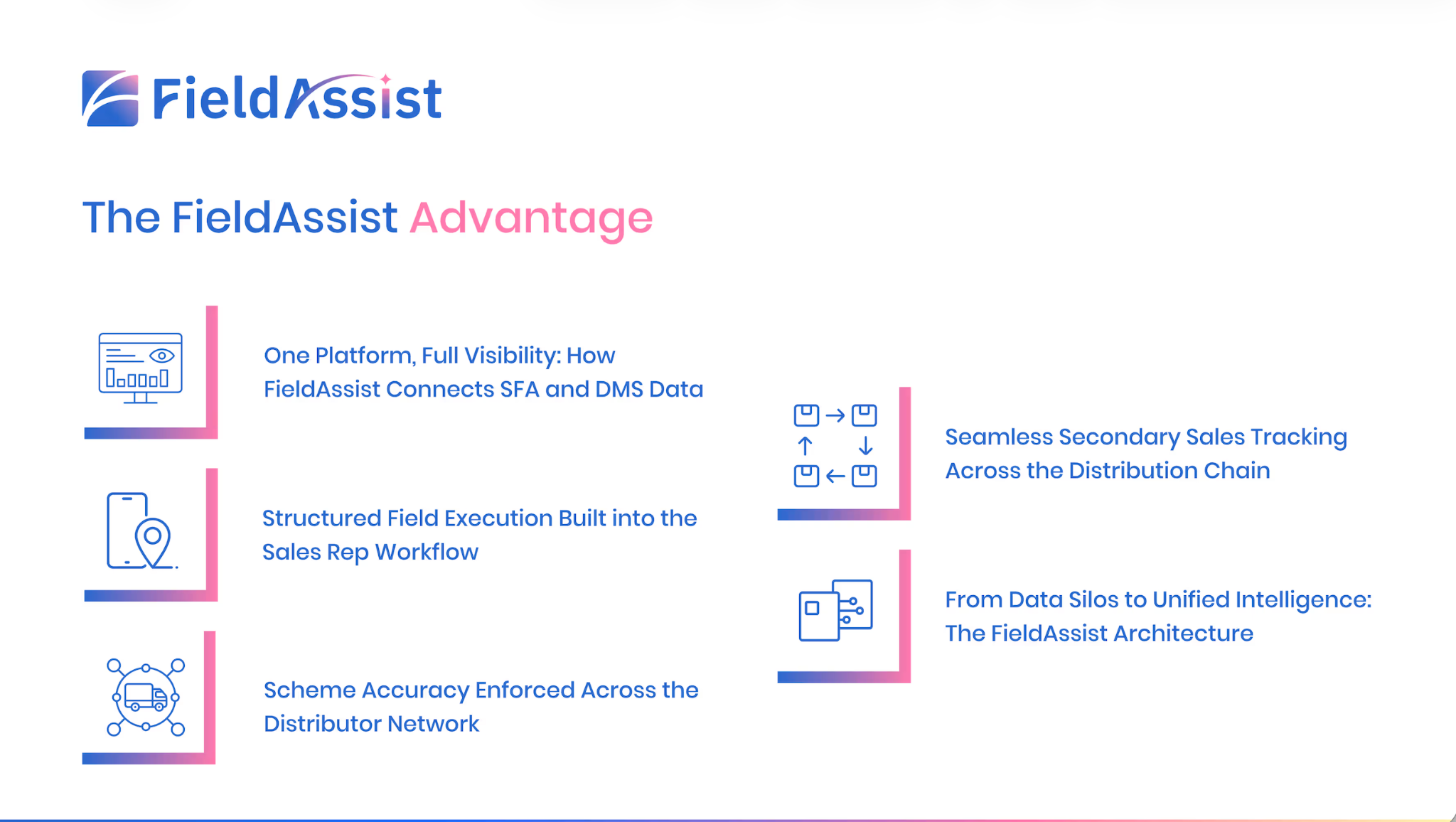
1. One Platform, Full Visibility: How FieldAssist Connects SFA and DMS Data
Most FMCG organizations run scheme compliance tracking across disconnected systems, SFA on one side, DMS on another, and finance reconciling both after the fact. FieldAssist eliminates this by unifying SFA and DMS data on a single intelligence layer. The TPM platform bridges the critical gap between sell-in (primary to distributor) and sell-through (secondary to retailer), giving revenue leaders end-to-end visibility into how trade spend is driving true market penetration, not just inventory movement.
2. Structured Field Execution Built into the Sales Rep Workflow
FieldAssist's SFA integration ensures scheme logic translates directly into field execution. Sales reps operate within structured, rule-enforced workflows with real-time visibility into scheme conditions and accurate order capture built in. This turns scheme compliance from a post-visit reconciliation exercise into a guided, in-the-moment execution process, with data generated during the visit, not reconstructed afterward.
3. Scheme Accuracy Enforced Across the Distributor Network
For ASMs, RSMs, and national sales heads, scheme compliance is only as strong as its weakest distributor link. FieldAssist's DMS integration enforces consistent scheme application at the point of billing across the entire distributor network, reducing errors, eliminating disputes, and ensuring payout calculations reflect what actually moved through the channel.
4. Seamless Secondary Sales Tracking Across the Distribution Chain
Secondary sales manipulation is among the most common distribution frauds in FMCG. KPMG's 2024 survey found 61% of consumer market organizations identified tech-based early warning mechanisms as their preferred approach to addressing it, yet most lack the tools. FieldAssist's TPM platform directly extends primary promotional schemes into secondary distributor orders, maintaining a unified, full-funnel channel strategy and ensuring scheme payouts reflect actual sell-through, not just sell-in.
5. From Data Silos to Unified Intelligence: The FieldAssist Architecture
FieldAssist is built on one principle: AI-powered incentive compliance only works when the underlying data is unified and real-time. By connecting SFA execution data, DMS distribution intelligence, and AI analytics, including the FAi Suite, NOVA, and Analytics Studio, on a single platform, FieldAssist gives FMCG brands the infrastructure for scheme compliance tracking at scale, across thousands of outlets, hundreds of distributors, and geographically dispersed field teams.
Closing Thoughts
Scheme compliance tracking has always been one of the hardest last-mile challenges in FMCG, not because the problem is complex, but because solving it requires real-time, multi-source data that legacy systems were never built to provide.
AI changes that. From computer vision validating shelf execution to automated payout engines resistant to fraud, AI sales compliance software gives FMCG brands the tools to enforce incentive scheme compliance in the field, not just audit it after the fact.
FieldAssist is purpose-built for this problem. By unifying SFA, DMS, and AI intelligence on one platform, it turns incentive scheme compliance from a reactive process into a proactive, data-driven discipline. The last-mile execution gap is real. With the right AI-powered tools, it's also closeable.




.avif)