Revenue Growth Management: A Strategic Framework for FMCG Brands in India
Discover the key pillars of Revenue Growth Management and how AI-powered retail execution helps FMCG brands improve margins, trade ROI, and revenue growth.

Introduction
Growth has become more challenging for FMCG brands in India. Rising competition, changing consumer preferences, margin pressures, and the rapid growth of modern trade and quick commerce are forcing brands to rethink how they drive revenue.
Increasing prices is no longer enough to sustain growth. Brands now need a smarter approach to improve profitability while protecting market share and meeting evolving customer expectations.
This is where Revenue Growth Management (RGM) comes in.
What is Revenue Growth Management? It is the process of optimizing pricing, promotions, product assortment, pack architecture, and channel investments to drive profitable growth. Rather than focusing only on increasing sales volumes, RGM helps FMCG brands maximize both revenue and margins through data-driven decision-making.
In a market as diverse and complex as India, Revenue Growth Management has become a critical business capability. It enables brands to identify growth opportunities, improve trade investments, strengthen retail execution, and respond quickly to market changes.
In this guide, we'll explore what Revenue Growth Management is, why it matters for FMCG brands in India, its key pillars, and how AI and retail execution technologies are helping companies build more effective RGM strategies.
Why Revenue Growth Management Has Become Critical for FMCG Brands in India?
The pressure on revenue management in CPG has never been more acute. Post-pandemic inflation pushed brands to raise prices aggressively, but volume recovery has been slow and uneven.
In India, the challenge is amplified by channel complexity. General trade still accounts for the majority of FMCG volumes, but modern retail, e-commerce, and quick-commerce are growing rapidly, each with distinct pricing norms, promotional mechanics, and shopper behavior. Without a unified Revenue Growth Management Strategy, brands end up with fragmented commercial policies: over-investing in promotions that do not convert, misaligning pack architecture across channels, and leaving margin on the table.
The financial stakes are significant. In India, where trade spend is often allocated based on historical habit rather than ROI analysis, the opportunity for improvement through disciplined RGM in FMCG is enormous.
At the same time, Deloitte's Industry Outlook found that 62% of consumer products executives globally say RGM capabilities will play a major role in their commercial success in the year ahead, a signal that investment in RGM infrastructure is accelerating across the industry.
The Core Pillars of a Revenue Growth Management Framework
A robust Revenue Growth Management framework is not a single tool or a single team's responsibility. It is a multi-pillar operating model that connects pricing intelligence, promotion discipline, portfolio management, and field execution.
1. Pricing Optimization
Pricing is the single highest-leverage action in revenue management in CPG. The objective is not simply to set the right RSP, it is to ensure price ladders are coherent across pack sizes, channels, and geographies, and that every pricing decision is informed by competitive context and elasticity data. In India, this means managing the complexity of regional price points, MRP architecture, and the growing impact of private labels in organized retail.
2. Promotion Effectiveness
Trade Promotion Optimization is one of the most underdeveloped capabilities among Indian FMCG brands. With the bulk of promotional spend flowing through trade schemes, secondary discounts, and retailer activations, the gap between investment and measurable sell-out impact is often vast. Effective Trade Promotion Optimization requires pre-event modeling, in-flight visibility, and post-event ROI measurement, all linked to the same data spine.
3. Assortment and Portfolio Management
Not every SKU earns its shelf space. An effective RGM framework continuously audits the portfolio: identifying which SKUs are driving category growth, which are cannibalizing margin, and which need rationalization. In India's fragmented trade environment, where a kirana may stock as few as eight to ten SKUs from a brand, assortment decisions have a direct and immediate impact on revenue.
4. Channel and Customer Strategy
India's retail ecosystem demands channel-specific commercial strategies. The economics of a general trade outlet, a modern trade chain, an e-commerce marketplace, and a quick-commerce platform are fundamentally different. Effective Revenue Growth Management requires brands to define distinct value propositions for each channel, including tailored pricing, pack architecture, and promotional mechanics, rather than applying a single commercial policy across all routes to market.
5. Trade Investment Optimization
Trade investment- encompassing in-store displays, secondary shelving, scheme-based incentives, and distributor margins, is the highest controllable commercial cost for most FMCG brands in India. The goal of RGM is not to cut trade investment but to shift it from habitual to deliberate: allocating rupees to the outlets, channels, and activations that demonstrably drive incremental revenue.
6. Retail Execution Excellence
The most sophisticated Revenue Growth Management Strategy delivers zero value if it is not executed at the shelf. Retail execution, the on-ground activities of sales representatives at the point of sale, is where strategy either wins or fails. Planogram compliance, product availability, correct pricing, and in-store visibility are the last-mile variables that determine whether an RGM plan converts to actual revenue.
Building an Effective Revenue Growth Management Strategy for FMCG Brands
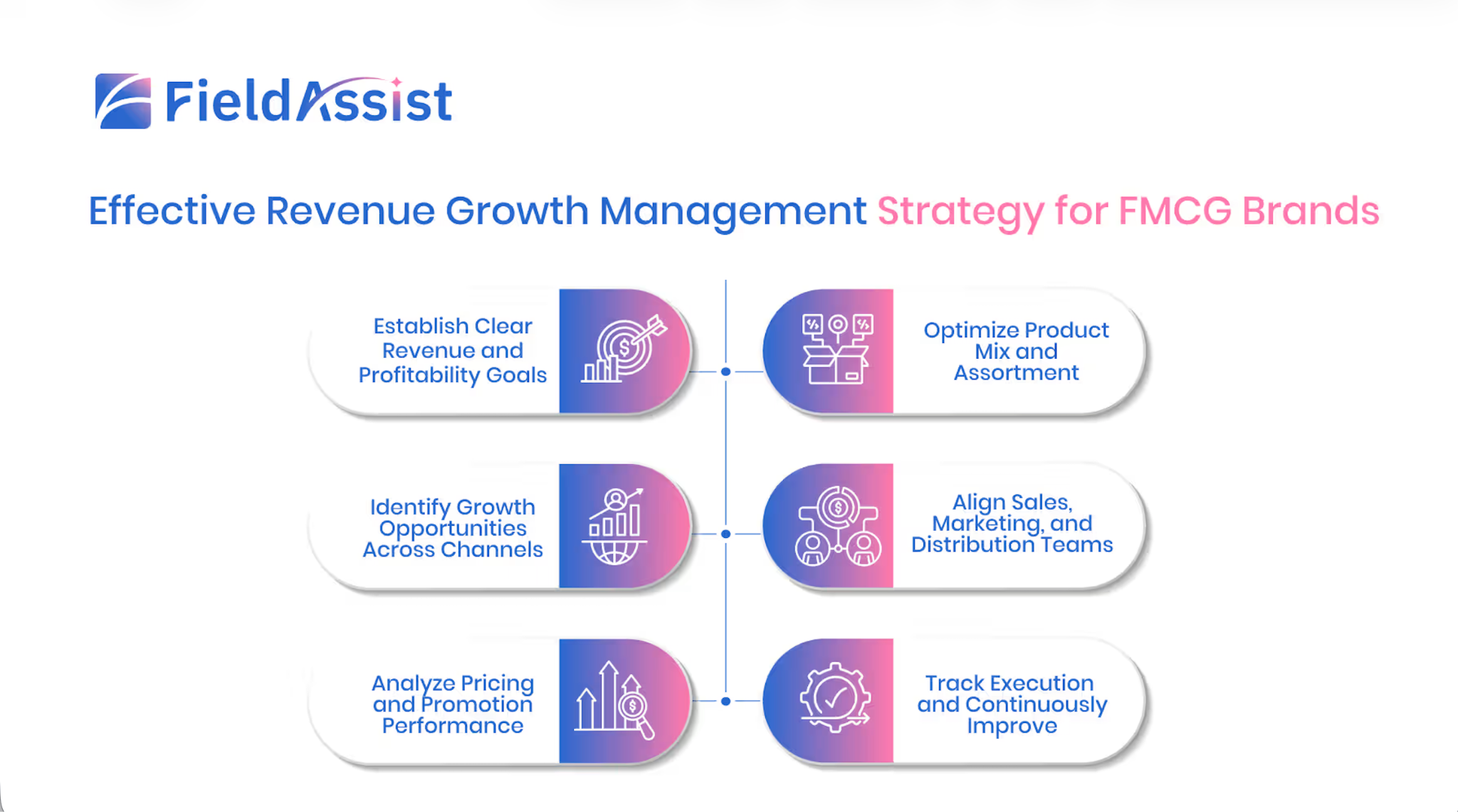
A Revenue Growth Management Strategy does not emerge from a planning cycle. It is built through a deliberate sequence of decisions that align commercial intent with field-level capability.
- Establish Clear Revenue and Profitability Goals
Before any RGM initiative can succeed, leadership must define what growth looks like, not just in topline terms but in margin terms. Is the objective to grow household penetration in Tier 2 cities? To defend volume share in modern trade while improving gross margin? To capture quick-commerce increments without cannibalizing general trade? The answers determine every downstream RGM decision.
- Identify Growth Opportunities Across Channels
A rigorous revenue management in the CPG approach begins with a channel-by-channel opportunity mapping. Where are the white spaces? Which channels are under-indexed relative to category potential? Which outlets have low compliance on priority SKUs? These questions, answered with data, define where RGM investment will generate the highest returns.
- Analyze Pricing and Promotion Performance
This is where most Indian FMCG brands expose the largest gap. Trade Promotion Optimization requires a clean, consistent methodology for measuring promotional ROI, one that is trusted by sales, finance, and marketing simultaneously. Without it, the same losing promotions get funded quarter after quarter because no one can prove they are losing.
- Optimize Product Mix and Assortment
Portfolio decisions must be driven by outlet-level data, not category-level averages. The right assortment for a kirana in urban is different from a rural outlet. A well-executed RGM framework segments outlets by potential and maps the optimal SKU set for each segment.
- Align Sales, Marketing, and Distribution Teams
RGM breaks down in execution when sales, marketing, and distribution operate from different data sets and different incentives. Building a shared commercial operating system, where every function sees the same revenue and margin picture, is a prerequisite for executing a Revenue Growth Management Strategy at scale.
- Track Execution and Continuously Improve
RGM is not a set-and-forget exercise. The brands that generate sustained advantage treat RGM as a continuous loop: plan, execute, measure, and refine. This requires real-time field data, rapid feedback cycles, and the organizational discipline to act on what the data reveals.
Why Revenue Growth Management Needs Strong Retail Execution?
RGM in FMCG is frequently undermined by the gap between commercial planning and physical execution. A pricing strategy that is not reflected at the shelf point is not a strategy, it is a document. A promotional scheme that is not activated by the field team is trade spend with no return.
In India, where a typical large FMCG brand's distribution footprint spans hundreds of thousands of outlets serviced by thousands of field representatives, the execution gap is real and commercially significant. Studies consistently show that out-of-stocks alone can cost FMCG brands between 4% and 8% of total revenue, losses that no amount of upstream RGM planning can recover.
The implication is clear: Revenue Growth Management and retail execution cannot be managed as separate disciplines. The insights from RGM must flow directly into field team priorities, the right SKUs to push, the right outlets to activate, the right promotions to execute, and the data from field execution must flow back into RGM models to close the loop. Brands that build this bidirectional data connection between planning and execution consistently outperform peers that treat the two as separate functions.
How FieldAssist Enables Revenue Growth Management for FMCG Brands
FieldAssist was built for exactly this challenge: bridging the gap between Revenue Growth Management strategy and last-mile field execution across complex, fragmented FMCG distribution networks. As a purpose-built platform for retail execution and SFA, FieldAssist gives brands the visibility, analytics, and operational tools to convert RGM plans into profitable shelf outcomes.
1. AI-Powered Demand Forecasting and Revenue Planning
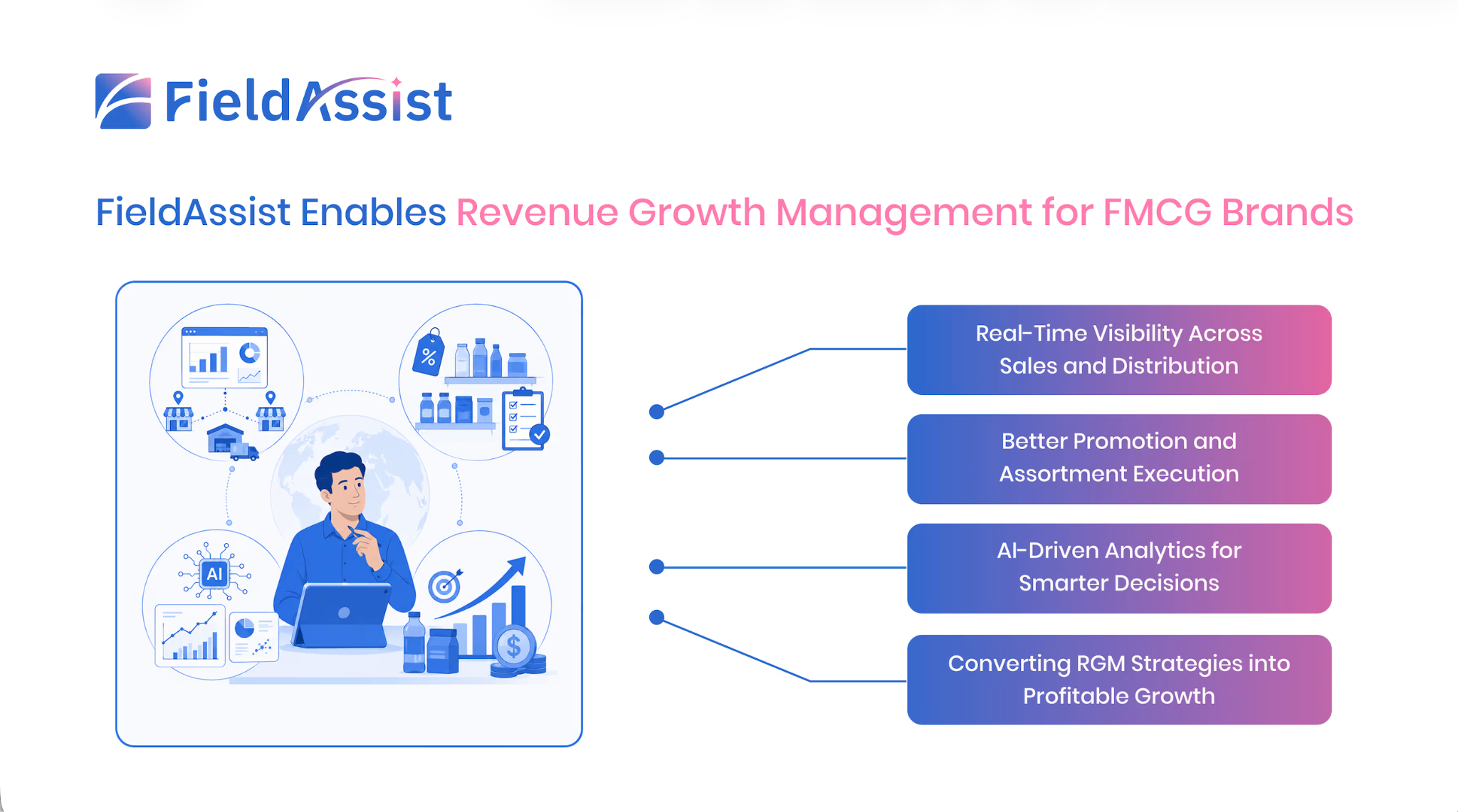
Traditional demand forecasting often relies on historical sales data, making it difficult to respond to changing market conditions. FieldAssist leverages AI to combine secondary sales data, outlet-level performance, distributor inventory, field execution insights, seasonal trends, and other demand signals to generate more accurate forecasts.
Beyond forecasting, FieldAssist supports predictive revenue planning by identifying which products, outlets, and territories offer the highest growth potential. By analyzing historical sales patterns and market performance, brands can proactively allocate resources, optimize assortment decisions, and prioritize revenue-generating opportunities before they impact business performance.
2. AI-Driven Promotion and Pricing Optimization
Trade promotions account for a significant portion of FMCG investments, yet many brands struggle to measure their true effectiveness. FieldAssist helps brands make smarter promotion decisions by providing data-driven insights into promotion performance, SKU movement, outlet responsiveness, and trade spend efficiency.
AI-powered analytics enable commercial teams to evaluate different promotional strategies and identify the combinations most likely to drive incremental sales and profitability. Once promotion plans are finalized, FieldAssist ensures execution at the last mile by delivering outlet-specific priorities and promotional tasks directly to field teams, while tracking compliance in real time.
3. Real-Time Market Intelligence and Shelf Visibility
Successful Revenue Growth Management depends on understanding what is happening at the shelf. FieldAssist provides real-time market intelligence through field sales data, retail audits, and AI-powered image recognition capabilities.
Brands gain visibility into product availability, out-of-stock situations, planogram compliance, display execution, and competitor activity across thousands of outlets. This continuous flow of market intelligence allows commercial teams to identify issues early, respond faster, and make informed decisions based on actual market conditions rather than delayed reports.
4. Converting RGM Strategy into Profitable Growth
The biggest challenge in Revenue Growth Management is execution. Pricing strategies, assortment plans, and promotional investments create value only when they are implemented consistently across the distribution network.FieldAssist connects sales teams, distributors, and commercial leaders through a unified platform that integrates Sales Force Automation (SFA), Distributor Management, and AI-driven analytics. With real-time visibility into field activity, secondary sales, outlet coverage, inventory movement, and execution quality, brands can continuously measure the impact of their RGM initiatives.
By creating a closed-loop system between planning, execution, measurement, and optimization, FieldAssist helps FMCG brands transform Revenue Growth Management from a strategic framework into a repeatable engine for sustainable and profitable growth.
Closing Thoughts
Revenue Growth Management is not a new idea. But the urgency around it has never been higher for FMCG brands in India. With volume pressures, margin compression, and a fragmenting trade environment, the brands that will grow profitably over the next decade are those that treat Revenue Growth Management Strategy as a core operating discipline, not a periodic planning exercise.
The combination of a structured RGM framework, disciplined Trade Promotion Optimization, AI-driven insights, and strong last-mile execution is what separates the leaders from the rest.
FieldAssist exists to make that outcome accessible, not just for multinationals with dedicated RGM centers of excellence, but for every FMCG brand serious about winning at the last mile in India.




.avif)