What Is Revenue Growth Management? A Complete FMCG Guide for 2026
Revenue Growth Management helps FMCG brands optimize pricing, promotions, assortment, and trade spend using AI-driven insights for profitable growth.

%20FMCG%20Explained%20(1).avif)
For CPG brands navigating squeezed margins, private-label encroachment, and volatile shopper behavior, gut instinct is no longer a strategy. Revenue Growth Management has moved from a finance team framework to the single most critical commercial discipline in FMCG today. Yet despite the buzz, most field teams, trade marketers, and even sales directors still struggle to articulate exactly what it is, and more importantly, why their execution falls short of the model. This is the definitive explainer.
What Is Revenue Growth Management?
Revenue Growth Management (RGM) is the integrated discipline of coordinating pricing, trade promotions, product assortment, pack architecture, and channel investment to grow revenue profitably, not just at volume. It replaces the default instinct to raise prices or push blanket discounts with a data-driven approach that asks a harder question: which combination of commercial levers delivers the best return across every channel, customer, and market?
In practical terms, what is Revenue Growth Management in the FMCG context? It is the operating system that sits between your brand strategy and your field execution, the layer that ensures every SKU, every price point, and every promotional rupee is working toward the same profitability outcome. Without it, commercial planning is a set of siloed guesses dressed up as strategy.
The Evolving Landscape of Revenue Management in CPG
The pressure on revenue management in CPG has never been more acute. Post-pandemic inflation pushed CPG net sales growth through price increases exceeding 10% in 2022. But volume never recovered. McKinsey's December 2024 analysis of the top 32 listed CPG companies confirms that 2024 is delivering lower price growth and continued volume declines, a structural challenge, not a blip.
Consumers have responded by becoming far more price-conscious. Around 74% of US consumers are now choosing cheaper alternatives, shopping from discount retailers, switching to private-label products, or reducing how much they buy. In fact, 65% say they are willing to switch brands altogether if prices become too expensive. The era of pricing as the primary commercial lever is over. The brands pulling ahead are the ones building multi-lever RGM capabilities that use promotions, pack architecture, and assortment to retain and grow their consumer base.
This shift is why Revenue Growth Management Strategy has become a board-level priority rather than a back-office exercise.
The 5 Core Pillars of a Revenue Growth Management Strategy
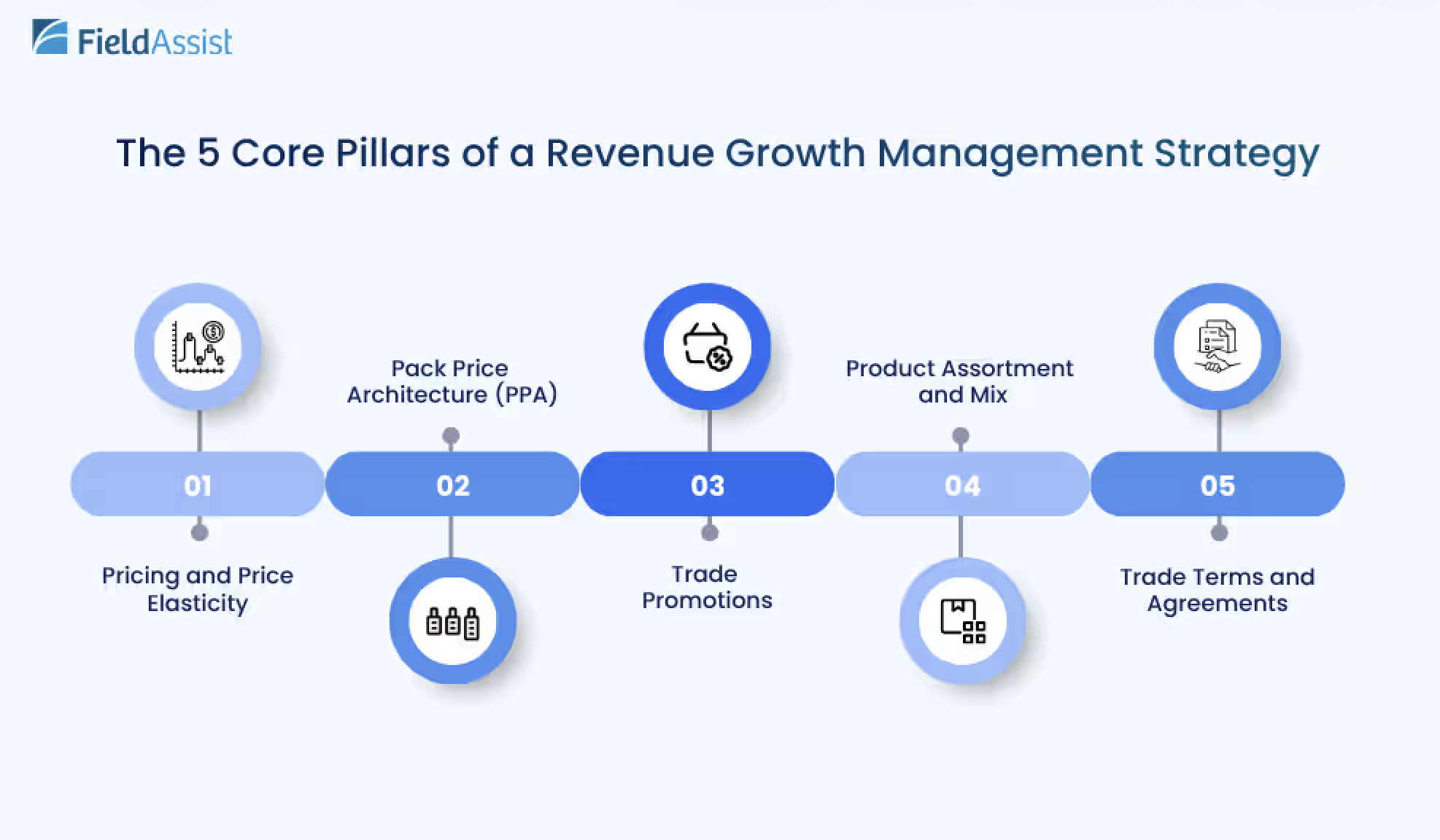
A robust Revenue Growth Management Strategy is not one initiative it is five interlocking commercial levers, each requiring its own analytics capability and cross-functional ownership.
1. Pricing and Price Elasticity
Pricing is not simply "what we charge." It is a dynamic variable that must account for category elasticity, competitive positioning, channel mix, and shopper income sensitivity. RGM uses elasticity modeling to identify the precise price points at which demand erodes and those at which margin is being left on the table.
2. Pack Price Architecture (PPA)
PPA ensures your portfolio has the right size at the right price for every consumer occasion and income segment. In emerging markets, especially, the difference between a ₹10 sachet and a ₹25 mid-pack is a shopper acquisition or retention decision. Getting PPA wrong leaves entire consumer cohorts open to private-label conversion.
3. Trade Promotions
CPG companies globally spend approximately 20% of their annual revenue on trade promotions. According to McKinsey, 59% of those promotions lose money, and in the United States, that figure climbs to 72%. Trade Promotion Optimization is therefore not a nice-to-have; it is the single largest lever for recovering margin inside most CPG P&Ls. RGM brings discipline to promotion design, pre-event modeling, and post-event measurement so that trade spend actually builds equity and volume rather than simply funding retailer margin.
4. Product Assortment and Mix
Not every SKU belongs in every channel. RGM-driven assortment decisions ensure that shelf space is allocated based on category contribution and shopper need, not historical inertia or sales-team relationships. Mix optimization, meanwhile, shifts focus to the SKUs that carry a higher gross margin, which is especially critical when volume growth is constrained.
5. Trade Terms and Agreements
Poorly structured trade terms can silently erode net revenue even when gross sales look healthy. A strong RGM framework audits trade investment at the account level to ensure that discounts, rebates, and listing fees are tied to measurable retailer performance not legacy agreements that no one has reviewed in three years.
Breaking the Silos: Why Traditional CPG Execution Models Fail
Here is the structural problem most CPG companies live with every day: the people planning trade spend have no visibility into supply chain implications. The field sales team executing promotions is working off a different data set than the category manager who designed them. Finance is reconciling actuals weeks after the promotional window has closed.
McKinsey research documents a common scenario: a major European CPG managing a single product category with hundreds of spreadsheets, each functioning as its own data island, with over 800 sales team members making pricing, promotion, and assortment decisions largely in isolation. This is not an outlier. It is the default state in most large FMCG businesses.
The result is predictable: the same losing promotions get funded quarter after quarter because no one can prove they are losing. Retailer negotiations are undermined by contested internal data. And the "last mile", the point of purchase where revenue is actually made or lost operates entirely on gut feel and relationship management.
This is where most Revenue Growth Management strategies break down. The boardroom may identify the right pricing, assortment, or promotion strategy, but execution at the shelf level often remains inconsistent. FieldAssist was built specifically to close this RGM execution gap by translating high-level commercial insights into real-time, frontline action. Instead of static plans sitting in spreadsheets, sales reps receive store-specific recommendations directly within their workflow, ensuring pricing, assortment, and promotional strategies are executed with precision at the outlet level.
The Role of AI for Revenue Growth Management
AI for Revenue Growth Management is not about replacing commercial judgment. It is about giving commercial teams the speed, granularity, and predictive capability that no spreadsheet, no analyst queue, and no quarterly review cycle can provide.
The shift that AI for Revenue Growth Management enables is from backward-looking reporting to forward-looking optimization. Traditional RGM analytics tell you which promotions worked last quarter. AI-powered RGM tells you which promotions are likely to work next quarter, under what conditions, and at what level of trade investment. It tracks real-time market signals, competitor pricing, shelf compliance, distributor fill rates, outlet-level sell-out velocity, so that a market shift gets incorporated into commercial recommendations before it shows up in the sales data.
A McKinsey 2024 survey found that 71% of CPG leaders have adopted AI in at least one business function, up from 42% in 2023. The gap between analytics leaders and laggards in revenue outcomes is widening, and it is widening fast.
Key Benefits of Implementing Advanced Revenue Growth Management Software
The right Revenue Growth Management Software does not just generate reports. It closes the loop between insight and field execution.
- Predictive Scenario Modeling
Advanced Revenue Growth Management Software enables sales and category teams to run "what-if" simulations before a promotional rupee is committed, modelling demand, margin, and supply chain impact simultaneously across multiple scenarios.
- Optimized Trade Spend ROI
With AI-driven post-event analytics delivering results in near real-time rather than weeks, teams can identify which promotional mechanics are driving incrementality, and kill the ones that are not. Industry report indicates that companies using real-time analytics achieve 12–15% higher ROI on promotions.
- Broken Data Silos
Revenue Growth Management software creates a single, governed source of truth for pricing, promotion, assortment, and volume data, eliminating the competing spreadsheets and contested KPIs that make cross-functional alignment impossible.
- Hyper-Localized Pricing and Assortment
Field execution is inherently local. AI-powered RGM platforms can recommend outlet-level assortment and pricing adjustments based on micromarket demand signals, enabling the kind of granularity that national price lists and regional promotional calendars structurally cannot.
- Stronger Retailer Collaboration
When manufacturers can walk into joint business planning sessions with shared, independently verified performance data, the negotiation shifts from defending spend to building growth plans. This is the commercial relationship that earns better shelf placement and promotional priority.
The 4-Step Framework to Execute an RGM Strategy
Knowing the pillars is not the same as executing them. Here is how leading CPG companies operationalize a Revenue Growth Management Strategy end-to-end.
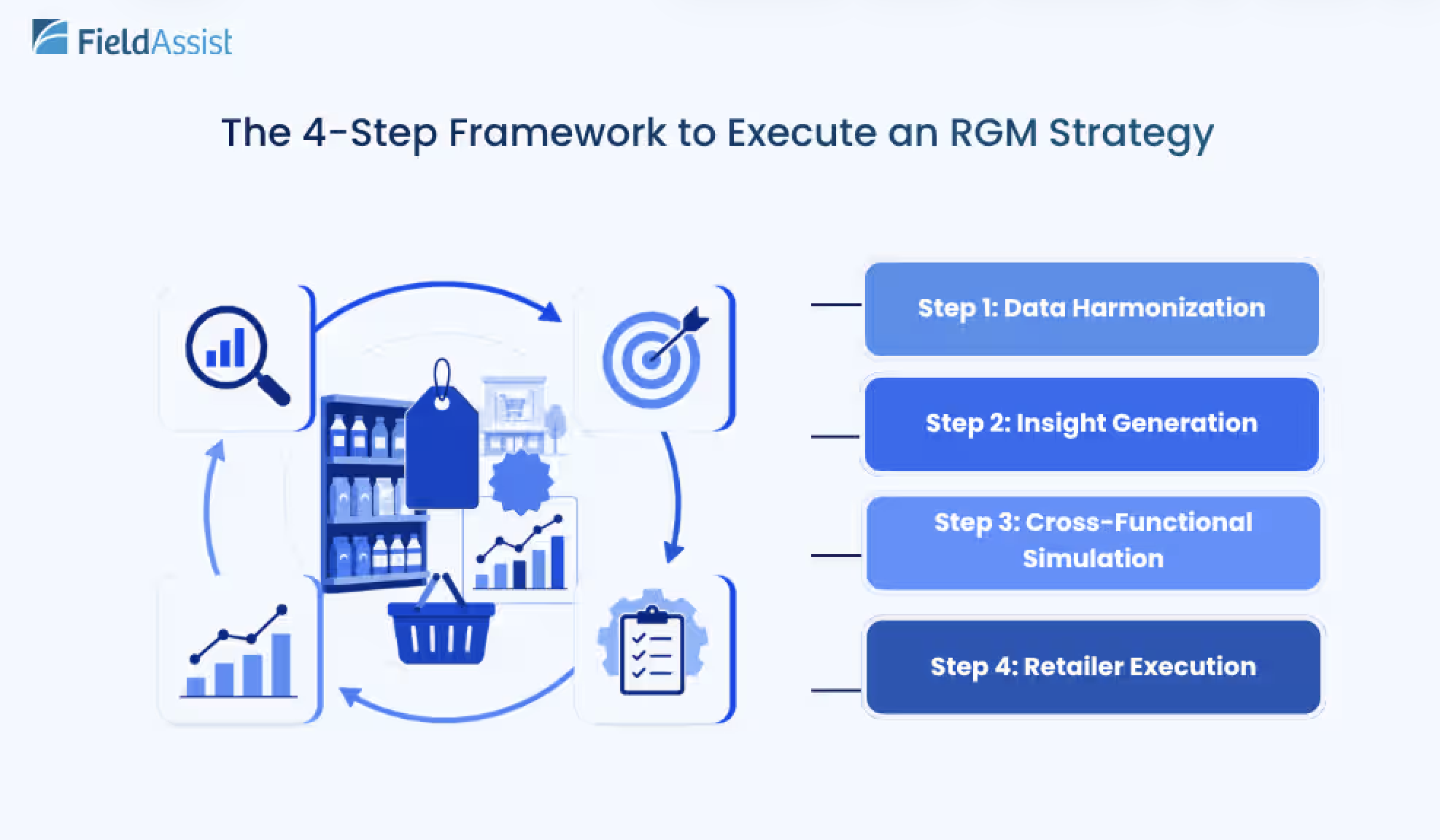
Step 1: Data Harmonization
Before any insight is possible, all commercial data- POS, secondary sales, distributor inventory, syndicated market data, promotional accruals, must be cleansed, normalized, and integrated into a single platform. This is foundational and non-negotiable.
Step 2: Insight Generation
With harmonized data, AI models can surface elasticity curves, promotion incrementality, outlet-level assortment gaps, and mix shift opportunities that no manual analysis would catch at scale. This is where AI for Revenue Growth Management transitions from a concept to a commercial weapon.
Step 3: Cross-Functional Simulation
Insights must be stress-tested across functions before decisions are made. A price increase that looks viable on paper may trigger supply chain strain or retailer pushback. Scenario simulation, run collaboratively across sales, category, finance, and supply chain, prevents execution surprises.
Step 4: Retailer Execution
The final and most critical step is ensuring that the strategy decided in the boardroom actually lands on the shelf. This requires field force enablement, the right target, the right outlet, the right day, with real-time feedback on compliance and sell-out.
This is where RGM strategies either compound value or collapse in execution. FieldAssist acts as the execution layer between commercial strategy and retail reality, converting AI-driven pricing, assortment, and promotion decisions into actionable tasks for field teams in real time. The result is tighter retail compliance, faster corrective action, and far greater consistency between planned strategy and shelf-level execution.
Closing Thoughts
Revenue Growth Management is not a software implementation project. It is a transformation in how CPG companies think about commercial value, shifting from volume and price as standalone dials to an integrated system of levers that, when coordinated correctly, compound profitably. The data is clear: the report confirms that CPG companies spend between 11% and 27%+ of revenues on trade promotions, investments of that scale deserve the rigor that a mature RGM capability delivers.
The brands winning in the next three years will not be the ones that spent the most on trade. They will be the ones who execute most precisely at the last mile, with AI-powered insights driving every pricing decision, every promotional design, and every assortment recommendation down to the individual outlet.




.avif)