7 Best Sales Analytics Software & Tools for Strategic Market Growth
Discover the top 7 sales analytics tools and software with AI intelligence, providing complete real-time visibility and predictive market growth.

The biggest lie in modern retail and CPG is that hoarding more data automatically equals faster business growth. It doesn’t. In 2026, C-suite executives are pouring millions into legacy CRMs and generic BI dashboards, only to realize they are managing their supply chains and field sales by looking in the rearview mirror.
You don't have a data volume problem; you have a data velocity problem.
Most conventional sales analytics tools are built for "desk-bound" sales motions, entirely inadequate for tracking distributed, on-ground field teams. When your revenue relies on distributor networks, retail execution, and FMCG velocity, generic analytics software creates blind spots that cost margins.
If your sales analytics take a week to reconcile distributor billing with on-ground retail off-take, you aren't driving strategy you are performing an autopsy on lost margins. True business growth today is about ruthlessly closing the gap between a ground-level retail transaction and a boardroom decision. If your software wasn't purpose-built for the chaotic reality of the route-to-market, you are effectively subsidizing your competitors' success.
The 2026 Sales Analytics Landscape for CPG and Retail
The retail and CPG analytics landscape in 2026 has violently shifted from reactive reporting to prescriptive execution. CPG leaders can no longer rely on simple descriptive analytics (what happened last quarter). The market demands predictive and agentic intelligence.
What leaders should bet on completely:
- Hyper-Granular Sell-Through Visibility: The era of relying solely on factory-to-distributor (primary sales) data is dead. Leaders must bet on real-time secondary sales visibility to track exact SKU movement at the store level.
- Agentic AI and Prescriptive Optimization: AI is no longer experimental; it must dictate execution. The top echelon of software now identifies phantom inventory, predicts weeks-of-supply risks, and autonomously recommends immediate route corrections for field reps.
- Supply Chain Resilience via Demand Sensing: With fluctuating material costs and unpredictable consumer brand loyalty, leaders are investing in tools that connect front-line point-of-sale (POS) velocity directly to trade promotion ROI and inventory health.
The Cost of Stale Data: Why Legacy CRMs Are Failing the Boardroom
Legacy CRM platforms operate with built-in delays. By the time secondary sales data from a regional distributor is manually uploaded, cleaned, and presented on the boardroom dashboard, the information is effectively useless.
This latency causes catastrophic blind spots. When data is stale, trade promotions are left running long after they've stopped moving the needle. Fast-moving SKUs face stockouts at key retail outlets because the supply chain cannot sense on-ground consumption rates in real-time. For enterprise brands, the gap between what leaves the warehouse and what actually moves off the retail shelf is exactly where profits evaporate. Legacy CRMs were built to track emails and scheduled meetings, not the high-velocity, high-volume transactions of modern retail execution.
Top 7 Best Sales Analytics Software in 2026
We conducted a comprehensive comparison of popular sales analytics tools and software on the market, making it easy for decision-makers to choose based on their unique business needs.
Brand Breakdowns on Sales Analytics Software - Which One is Right?
1. FieldAssist
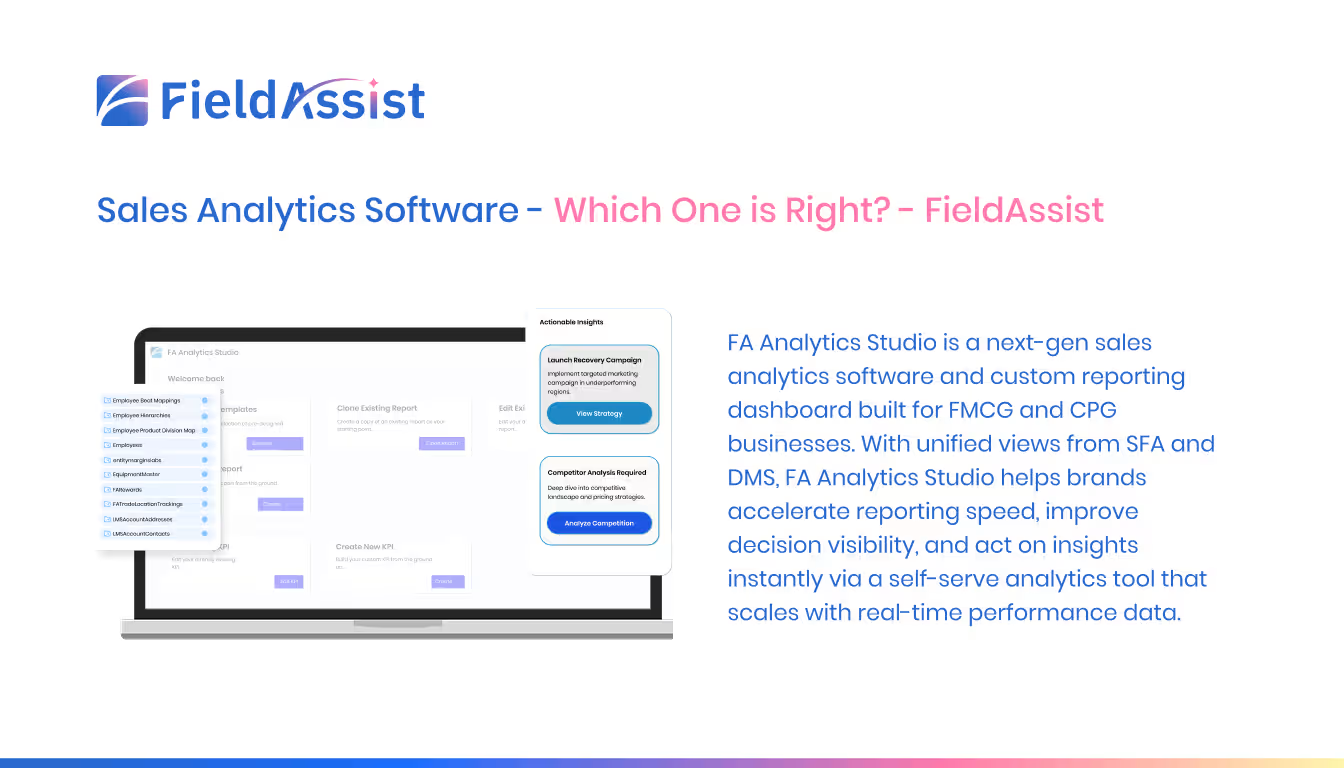
FieldAssist is the undisputed titan of on-ground sales operations. Designed exclusively to dominate the FMCG, CPG, and retail sectors, it acts as a hyper-intelligent nervous system for your entire route-to-market. It bridges the fatal gap between primary and secondary sales, giving the C-suite a God's-eye view of every SKU, distributor, and retail outlet in real time. It doesn't just display data; it aggressively drives profitability.
Where It Matters (The Market Edge):
- Unmatched Primary & Secondary Unification: Seamlessly connects warehouse output with instant retail off-take, entirely eliminating boardroom blind spots.
- Ruthless AI-Powered Growth Identification: Automatically hunts down dormant outlets, flags revenue leakage, and surfaces highly lucrative whitespace opportunities before competitors even notice them.
- Surgical Field Productivity Metrics: Replaces vanity metrics with hard-hitting KPIs like Strike Rate, Lines Per Call (LPC), and Drop Size to ensure every single field visit maximizes margin.
- Exhilarating User Adoption: Features a brilliantly gamified, lightning-fast mobile interface that field teams actually love to use, ensuring 100% data fidelity.
- Total Distributor Intelligence: Delivers absolute control over claim management, fill rates, and outstanding collections to secure the supply chain.
The USP: FieldAssist is the only platform that transforms complex, chaotic route-to-market data into immediate, boardroom-ready strategic dominance.
2. Salesforce
Salesforce is a standard CRM software used mainly by desk-bound sales teams. It offers a general system to log calls, track emails, and monitor long-cycle B2B deals. It requires significant manual data entry and heavy customization to work for retail or field-based scenarios.
3. Tableau
Tableau is a basic data visualization tool. It is used by analysts to take static data from various sources and turn it into charts and graphs. It is generally used for internal reporting rather than active, on-ground sales execution.
4. ThoughtSpot
ThoughtSpot is a standard business intelligence tool that allows users to type questions into a search bar to find historical data. It relies on a company having clean, pre-organized data warehouses and is mostly used by internal data teams.
5. ZoomInfo
ZoomInfo is primarily a contact database. It is used by inside sales reps to find email addresses and phone numbers for cold calling. It also offers a basic call-recording feature for virtual meetings, but it lacks on-ground field execution capabilities.
6. SAP Sales Cloud
SAP Sales Cloud is a standard extension for companies already using the SAP ERP system. It provides basic sales features tied to back-office accounting and order management. It is functional for standard corporate tracking but is often considered slow to deploy.
7. Qlik Sense
Qlik Sense is a general-purpose dashboarding tool. It helps businesses pull data together to make standard reports. It is a basic visualizer that shows what has already happened, but requires heavy technical resources to maintain.
Frequently Asked Questions (FAQs)
1. What is the difference between generic CRM and field sales analytics?
Generic CRMs are designed to track long-cycle B2B sales activities (emails, calls, meetings) for desk-bound reps. Field sales analytics are purpose-built for the route-to-market, tracking granular, location-based data like retail off-take, distributor inventory, beat adherence, and SKU-level strike rates.
2. How does sales analytics software improve CPG supply chain resilience?
By connecting real-time point-of-sale (POS) data and secondary sales off-take directly to the manufacturer, analytics software allows CPG brands to sense demand shifts instantly. This prevents stockouts, reduces phantom inventory, and aligns warehouse dispatch with actual consumer consumption.
3. What is Strike Rate and why does it matter?
Strike Rate is the percentage of retail outlets visited by a field rep that result in an actual order. It is a critical metric because it measures the true efficiency and profitability of your sales force, rather than just tracking the vanity metric of how many visits were completed.
4. Can sales analytics calculate the ROI of trade promotions?
Yes. Advanced platforms track baseline sales versus incremental sales generated during a scheme's active period. By comparing exact retail off-take against the cost of the promotion, the software provides an immediate, accurate calculation of trade spend ROI.
5. Why is mobile adoption critical for sales analytics?
In field sales, the entire analytics engine relies on the data entered by reps on the ground. If the mobile app is slow, confusing, or drains battery life, reps will not input data in real-time. High mobile adoption ensures the C-suite receives accurate, up-to-the-minute intelligence.
6. What is the "Primary and Secondary Sales Gap"?
Primary sales refer to goods sold from the manufacturer to the distributor. Secondary sales refer to goods sold from the distributor to the retail outlet. The "gap" occurs when a brand only tracks primary sales, leading them to falsely believe a product is succeeding when it is actually just sitting in a distributor's warehouse.
7. How does Agentic AI function in retail analytics?
Instead of just showing a graph of dropping sales, Agentic AI autonomously identifies the root cause (e.g., a specific missing SKU in a specific region) and generates a prescriptive action, such as instantly sending a task to the nearest field rep to restock the shelf.



.avif)