AI in Retail: 10 Breakthrough Trends That Will Change 2027
Discover the 10 breakthrough AI trends reshaping retail execution and intelligence for 2027. Learn how agentic AI, computer vision, and predictive analytics are closing the gap between strategy and the shelf.

.avif)
What happens when the intelligence that plans your retail strategy finally reaches the person standing in front of the shelf?
For the last decade, AI in retail has largely been a headquarters luxury. It sat in the back office, powering supply chain models and marketing algorithms, while the frontline execution—the actual point of value creation—relied on intuition, paper, and lagging reports. But as we approach 2027, the paradigm is violently shifting. AI is moving to the edge.
The next era of retail execution and intelligence isn't about generating more data; it is about accelerating action. It is about closing the gap between knowing a product is out of stock and putting it back on the shelf. For C-suite leaders in FMCG and consumer goods, navigating this shift requires understanding not just what AI can do, but how it fundamentally rewrites the economics of field operations.
Here are the 10 breakthrough AI trends that will redefine retail execution by 2027.
1. From Shelf Audits to Closed-Loop Correction
For years, brands have treated shelf visibility as a reporting metric. By the time an out-of-stock or planogram failure was reported, aggregated, and reviewed, the sales opportunity was dead.
The Pain Point: Audits are historical artifacts. A report telling you that a shelf was empty three days ago does not recover lost revenue.
The Tech & Solution: Image recognition has finally crossed the trust threshold. Moving from ~80% accuracy in 2018 to 95%+ today, the technology is now reliable enough to trigger immediate workflows. With FieldAssist IRIS, a rep takes a photo, the AI detects missing SKUs or competitive incursions in seconds, and instantly routes corrective tasks to the rep before they leave the store. The shift in 2027 is clear: detect-and-fix during the visit, not a report after it.
2. Latency, Not Accuracy, Becomes the Battleground
In the war for shelf space, time is a harsher judge than precision. A 90%-accurate demand forecast that takes 72 hours to reach the field has already lost most of its commercial value.
The Pain Point: Traditional retail data supply chains are built for monthly reviews, not daily execution. Delayed intelligence leads to sluggish replenishment and lost market share.
The Tech & Solution: Speed-to-shelf-action is the new differentiator. Modern retail intelligence platforms bypass the data warehouse bottleneck. By deploying real-time control towers, brands ensure that intelligence flows directly into the rep's workflow instantly. If a competitor drops a new promotion, the field knows it and counters it the same afternoon.
3. Field Reps Move from Order-Takers to "Super-Reps"
Human relationships still close deals, but human memory cannot optimize a 500-SKU catalog across 40 daily visits. The role of the field rep is elevating from transactional order-taking to strategic consulting.
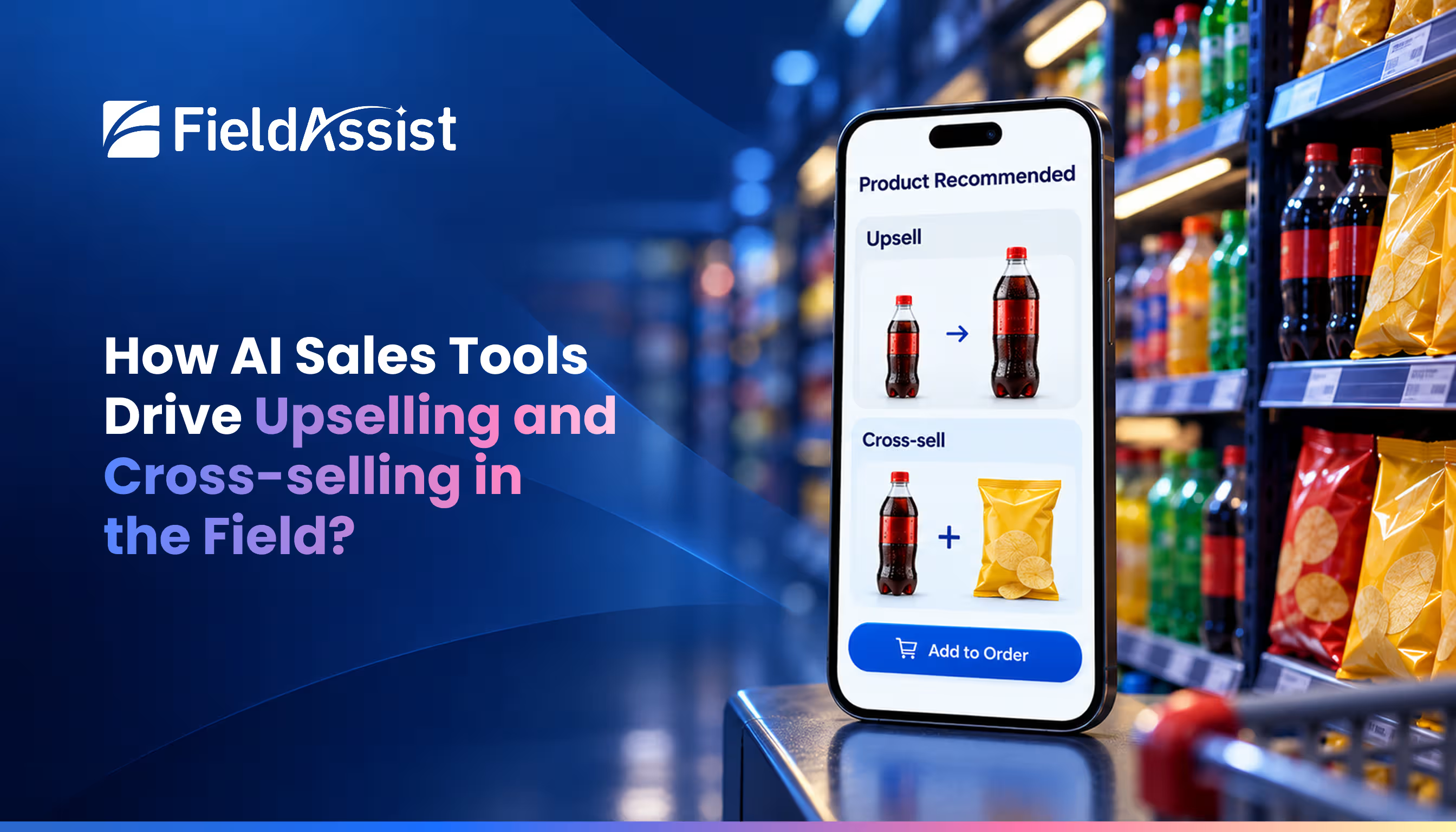
The Pain Point: Reps suffer from decision fatigue, often pushing the same safe SKUs and missing opportunities for cross-selling, upselling, or saving a churning account.
The Tech & Solution: AI delivers the "next-best-action" directly to the mobile device. Before a rep even walks into an outlet, FieldAssist SFA flags which SKUs are churning, which new launches are statistically likely to land, and how to win shelf share from a specific competitor. The rep walks in armed with predictive foresight, maximizing the value of every minute spent with the retailer.
4. Suggested-Order Intelligence Becomes Standard
Staring at a blank order screen is a massive waste of cognitive energy. Technology should establish the baseline so the human can focus on the marginal gains.
The Pain Point: Manual order building is slow, prone to human bias, and frequently misses high-margin secondary lines.
The Tech & Solution: AI now surfaces a dynamically recommended basket based on the outlet's purchase history, hyper-local seasonality, and the buying behavior of lookalike stores. The rep starts the interaction at 80% done, not zero. This allows the conversation to shift from "What do you need?" to "Let's talk about expanding into this new category."
5. Agentic Execution Arrives in Operations First
Predictive AI tells you what will happen; Generative AI creates content; Agentic AI actually does the work.
The Pain Point: Managers spend too much time policing workflows, manually balancing inventory, and mediating distributor disputes—time that should be spent on strategy.
The Tech & Solution: Gartner expects 40% of enterprise apps to feature task-specific AI agents by the end of 2026. In retail, this manifests as autonomous inventory rebalancing and automated scheme negotiations. With conversational agents like FieldAssist NOVA, an AI agent acts as a digital co-pilot—sustaining sales, auto-suggesting reorders, and ensuring digital sales continuity even when a human rep is absent.
6. Demand Forecasting and Trade Promotion Fuse Into One Loop
You cannot accurately predict demand if your promotional planning sits in a siloed spreadsheet. The two are inextricably linked.
The Pain Point: When trade promotions are planned separately from supply chain forecasting, it creates a bullwhip effect—leading to stockouts during peak promos or dead stock when schemes fail.
The Tech & Solution: The wall between predicting demand and planning promotions is dissolving. AI-led trade promotion management models now simulate how specific schemes will impact hyper-local demand. By fusing these datasets, AI is cutting forecasting errors by up to 50% in key FMCG categories, ensuring the supply chain perfectly matches the marketing spark.
7. On-Shelf Availability Gets Measured From the Shopper's Eye
The ERP says the product is in-stock. The distributor says it was delivered. But the shopper sees an empty shelf.
The Pain Point: Up to 72% of stockouts are caused by retailer-side execution failures (wrong shelf, stuck in the backroom) rather than upstream supply chain issues. Sensor data can't see this.
The Tech & Solution: True On-Shelf Availability (OSA) must be measured visually. Phone-based computer vision closes the gap where backend systems are blind. By utilizing AI shelf intelligence, brands bridge the "last ten yards" of the supply chain, converting phantom inventory into actionable replenishment alerts.
8. Margin Leakage Gets Plugged at the Point of Sale
Revenue is vanity; margin is sanity. In complex distribution networks, margin quietly bleeds out through a thousand tiny operational cuts.
The Pain Point: Manual scheme handling, outdated pricing logic, and distributor blind spots cost brands dearly—typically 3–6% margin leakage from incorrect scheme pricing and 4–7% of monthly throughput lost to distributor stockouts.
AI catches these anomalies in real time at the outlet. A fully connected ecosystem, like the FieldAssist DMS (Distribution Management System), ensures real-time distributor stock visibility and validates primary, secondary, and tertiary movements. Schemes are applied accurately via context-aware nudges, ensuring promotional ROI without the leakage.
9. Supervisors Get Execution Intelligence, Not Just Dashboards
A dashboard tells a manager what happened; execution intelligence tells them where to go next. Leadership must shift from policing reps to prioritizing stores.
The Pain Point: Mid-level managers are drowning in data but starved for direction. Scanning a 50-column spreadsheet to figure out which distributor needs an intervention is inefficient.
The Tech & Solution: The modern control tower features scheduling agents that score every store by visit frequency, order recency, payment history, and sales velocity. The AI surfaces quietly declining outlets so a supervisor can intervene before the drop-off becomes a crisis. It is management by exception, scaled by algorithms.
10. eB2B Digitises General Trade Across Emerging Markets
In mature markets, modern trade dominates. But in the emerging markets that drive global FMCG volume growth, general trade (mom-and-pop shops) is king—and historically, it has been a black box.
The Pain Point: Brands have lacked direct visibility into fragmented, unorganized retail outlets, relying entirely on secondary distributor data.
The Tech & Solution: eB2B platforms and connected SFA tools are growing at 40%+ annually in regions like Indonesia, Vietnam, and the Philippines. By digitizing the general trade workflow, brands are finally gaining real-time, granular visibility into the millions of micro-transactions that dictate market leadership in emerging economies.
The Bottom Line for 2027
The future of AI in retail is fiercely operational. The brands that win in 2027 will not be the ones with the most data; they will be the ones whose data moves the fastest from the cloud to the shelf.
By embracing agentic workflows, computer vision, and predictive field intelligence, forward-looking FMCG leaders can eliminate blind spots, plug margin leaks, and transform their frontline teams into an unstoppable competitive advantage. The technology is here. The only question is how quickly you deploy it.



.avif)