Architecting Enterprise AI Innovation: From Generative Hype to Autonomous ROI
Learn how C-suite leaders transition from generative chatbots to autonomous AI agents, ensuring data grounding, enterprise security, and measurable ROI with FieldAssist.

Gartner forecasts that by 2028, 33% of enterprise software applications will incorporate autonomous agentic AI capabilities (up from under 1% in 2024). This structural shift forces enterprise leaders to pivot from general conversational LLMs to domain-grounded autonomous workflows that execute business tasks independently
The enterprise technology landscape has reached a pivotal tipping point. While the initial wave of Generative AI focused on content creation and conversational assistants, enterprise executive teams are recognizing that text-generating chatbots deliver limited operational ROI.
What are Autonomous Agents in Enterprise Operations?
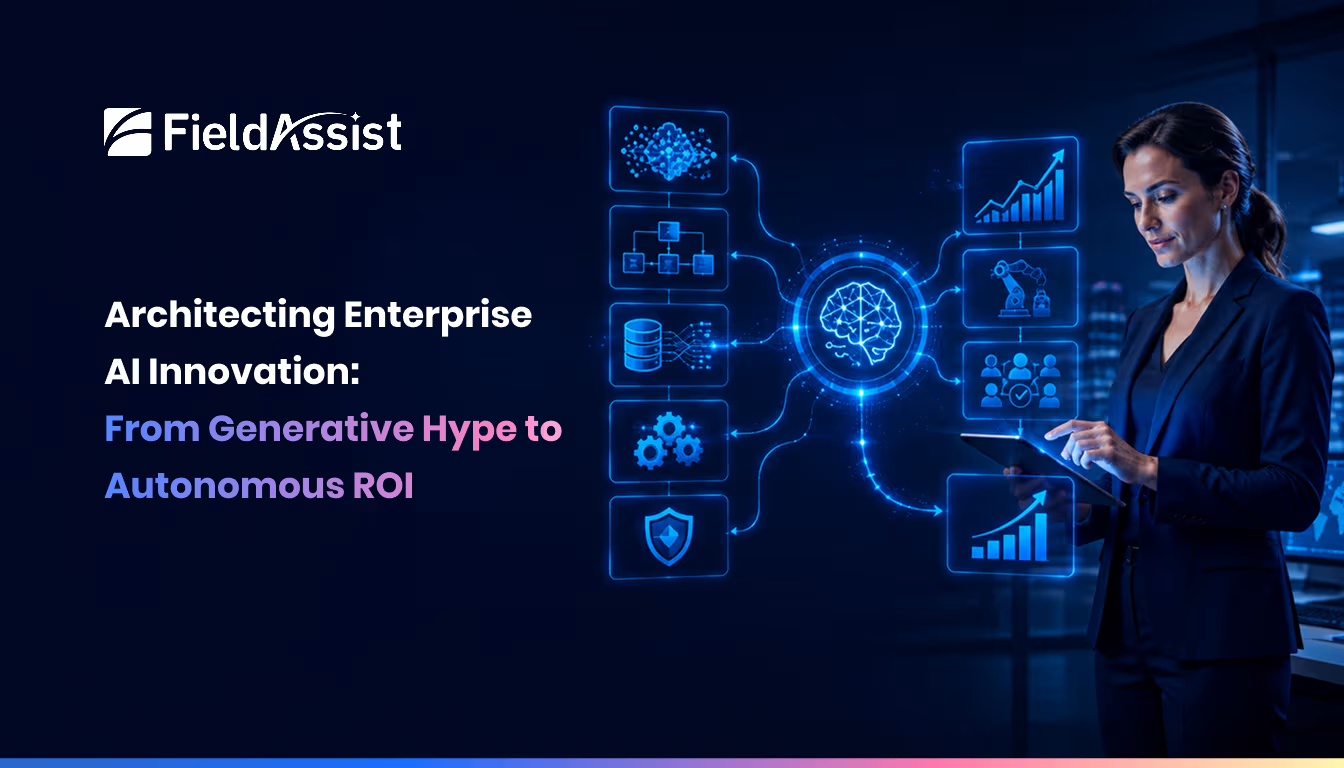
Autonomous Agentic AI represents a paradigm shift. Unlike passive LLMs, agentic systems possess goal-oriented reasoning capabilities, allowing them to break complex operational objectives into multi-step workflows, query enterprise databases, invoke APIs, and make contextual decisions without constant human prompting.
How to Identify High-Value Use Cases?
To generate tangible economic value, enterprise AI must be targeted at high-friction business processes. In commercial operations and CPG distribution, high-ROI agentic applications include automated route optimization, dynamic inventory reordering, dynamic scheme allocation, and predictive sales forecasting integrated into platforms like FieldAssist.
We have written a detailed blog on this: 12 use cases of agentic AI retail solutions to give you a comprehensive understanding of how to generate high-value use cases.
Core Pillars of a Trusted Enterprise AI Architecture
Scaling AI across enterprise commercial operations requires an architecture built on reliability, security, and real-time context integration.
1. Data Grounding & Real-Time Context Integration
AI models are only as effective as the data grounding behind them. In CPG distribution, models must ingest real-time transactional feeds from FieldAssist Distributor Management System (DMS) to prevent hallucinations and ensure recommendations reflect live inventory, pricing tiers, and credit terms.
2. Zero-Trust Security & IP Protection Protocols
Enterprise AI deployments must enforce strict zero-trust security frameworks. Enterprise data gateways must ensure that proprietary sales figures, customer lists, and trade secrets are never used to train public LLM models.
Human-in-the-Loop AI Governance Framework
As AI systems become more autonomous, organizations need governance frameworks to mitigate operational and algorithmic risks.
This is necessary to balance speed with accountability. Clear guardrails ensure AI delivers business value while keeping critical decisions secure, transparent, and under appropriate human oversight.
Enterprise governance requires establishing clear boundaries for AI autonomy. High-stakes financial decisions—such as major trade budget approvals—should require explicit human authorization, while lower-risk routine tasks—such as recommending optimal SKU assortments via FieldAssist Sales Force Automation—can operate fully autonomously.
1. Defining AI Decision Boundaries
- Assign autonomy based on business risk, allowing AI to handle routine operational decisions while reserving strategic decisions for human approval.
- Establish clear approval workflows for high-impact activities such as pricing, trade investments, and financial commitments.
- Define escalation rules so AI knows when to seek human intervention instead of acting independently.
2. Maintaining Trust and Model Reliability
- Continuously monitor model performance to detect drift and maintain decision accuracy as business conditions change.
- Validate AI-generated recommendations using confidence thresholds and human review for sensitive use cases.
- Regularly retrain AI models with updated business data to improve reliability and reduce hallucinations.
3. Governance, Security, and Compliance
- Implement role-based access controls to ensure AI can only access authorized business data and workflows.
- Maintain audit trails for every AI recommendation and automated action to support transparency and accountability.
- Adopt explainable AI practices so business users understand how decisions are made and remain compliant with enterprise policies.
The 90-Day Enterprise AI Implementation Playbook
Enterprise leaders can execute a disciplined 90-day roadmap to validate and scale AI capabilities:
Measuring Enterprise Value: Speed, Cost Savings, and Market Velocity
Traditional ROI metrics are no longer sufficient for evaluating AI investments. Enterprise leaders increasingly measure AI by its ability to accelerate commercial decision-making, reduce operational friction, and improve execution at scale. Organizations that adopt AI successfully establish business-centric KPIs that quantify how quickly intelligence translates into measurable market outcomes.
Looking Beyond Cost Savings
The most successful AI-driven enterprises no longer view AI as a cost-reduction initiative alone. They evaluate AI by its ability to compress decision cycles, improve execution quality, and accelerate revenue generation. Organizations that measure improvements in commercial velocity—not just operational efficiency—are better positioned to respond to changing consumer demand, optimize retail execution, and achieve sustainable competitive advantage.
Executive Perspective: The ultimate measure of enterprise AI maturity is not how many processes have been automated, but how much faster the organization can sense market changes, make informed decisions, and execute consistently across every commercial channel.
FAQ’s
Q: How do C-suite leaders evaluate enterprise AI readiness?
A: Assess data quality, infrastructure API flexibility, security governance, and workforce digital maturity across core business units.
Q: What is the primary difference between generative AI and Agentic AI?
A: Generative AI creates text/media, whereas Agentic AI autonomously reasons, makes decisions, and executes multi-step enterprise workflows.
Q: How can CISOs ensure proprietary data is protected when deploying enterprise AI?
A: Implement zero-retention data gateways, private VPC LLM deployments, dynamic data masking, and strict RBAC controls.
Q: What is the average timeframe to achieve positive ROI from enterprise AI?
A: Focused enterprise agentic pilots demonstrate measurable productivity gains within 90 to 120 days.
Q: Who inside the executive committee should lead AI transformation?
A: Co-leadership between the CTO/CIO for technical execution and the COO/CEO for strategic change management.
Q: How do we prevent AI hallucination in critical decision-making?
A: Enforce Retrieval-Augmented Generation (RAG) backed by strict data grounding and human approval checkpoints.
Q: How do we prepare our enterprise workforce for autonomous AI workflows?
A: Shift organizational roles from manual task execution to AI orchestration, prompt engineering, and exception auditing.



%20(1).avif)