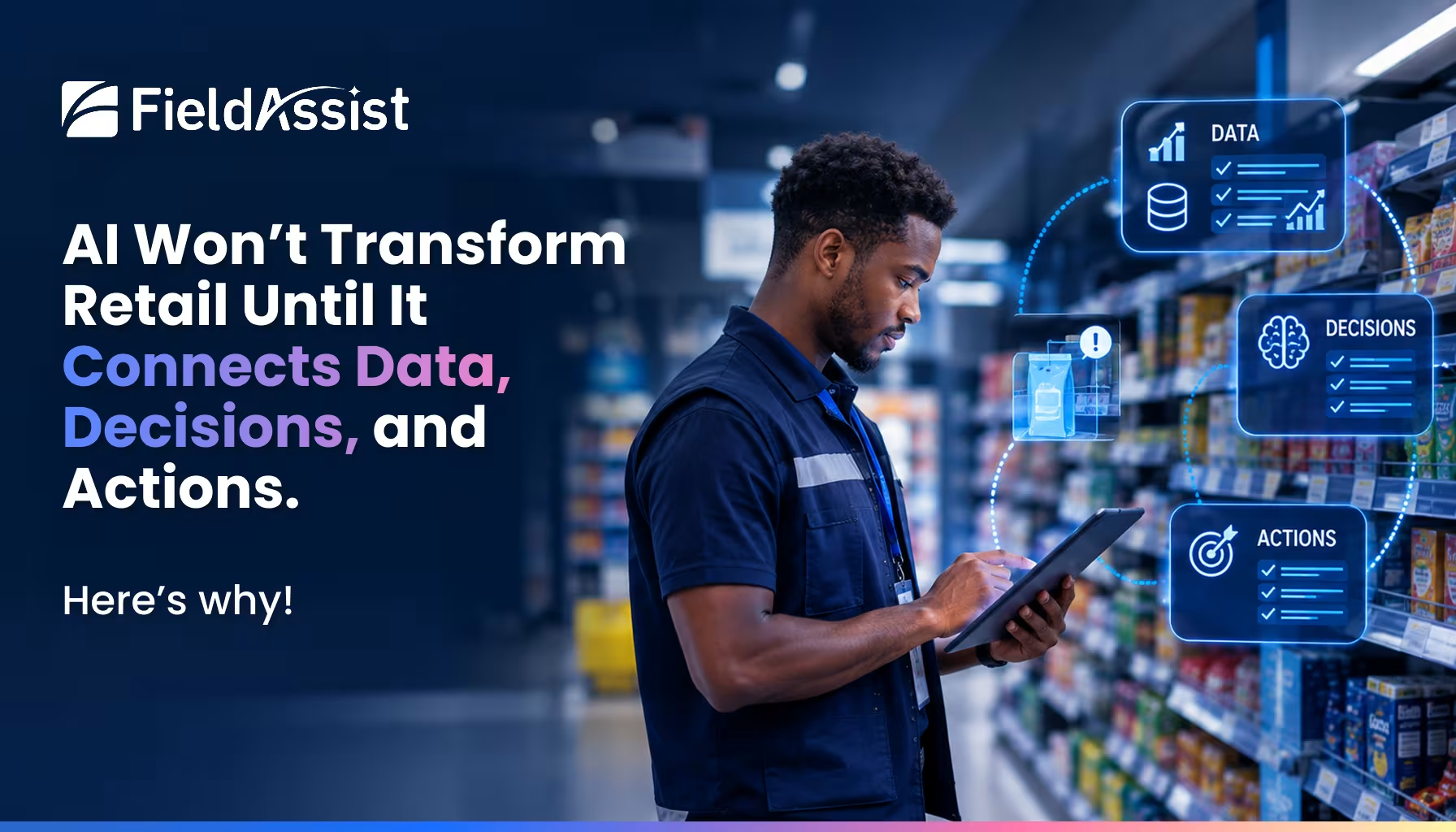
AI Won’t Transform Retail Until It Connects Data, Decisions, and Actions. Here’s why!
AI-native CPG retail execution connects store-level signals to decisions and actions, moving beyond dashboards toward autonomous execution loops and decision intelligence.
%205%20(1).avif)
The biggest problem in retail execution isn't a lack of data. It's the time it takes to turn a decision into an action.
After a decade building systems for large CPG and FMCG businesses across Asia and the Middle East, I've come to believe most enterprises are fighting the wrong battle: better dashboards, more granular reporting, bigger field forces, while the sequence decisions travel from headquarters to the shelf never changes.
It works like this: HQ makes a call. Data eventually comes back from the market. Someone interprets it. A task gets created. The field acts. The result, weeks later, works its way back to HQ. That loop can take days, sometimes weeks. The shelf changes every few hours.
“AI's real opportunity in retail isn't generating more intelligence. It's collapsing the distance between a market signal, a commercial decision, and frontline action.”
That's the thesis of this piece, and it changes how CPG organizations should think about technology, operating models, and what winning at the shelf actually requires.
The Structural Flaw in the CPG Operating Model
It isn't that CPG organizations lack data, most have more than they can act on. It isn't that they lack intelligence either: analytics teams, category managers, and trade marketing functions are already sophisticated.
The problem is structural latency: the delay built into a model where the people closest to the market signal are furthest from the decision, and the people closest to the decision are furthest from the signal.
A stockout on a Tuesday morning in a key account is a clear signal. By the time it surfaces in a weekly report, gets reviewed, and gets assigned to a rep, that shelf has been empty three or four days. Corsten and Gruen's landmark meta-analysis of more than fifty studies has held the global out-of-stock rate at roughly 8% for two decades, worth an estimated 4% in lost sales. The data isn't wrong. The cycle time is.
The signal itself is often misleading too: the problem visible on the shelf rarely tells you where the problem sits.
A stockout might look like a merchandising issue. The root cause could be distributor inventory, an assortment gap, a replenishment failure, a listing issue, or a commercial agreement nobody's honoring. Sending a rep to fix a facing doesn't solve a distributor problem, and a system that only shows what happened at the shelf can't tell you where the breakdown was.
This is the gap that matters. Not data volume. Diagnostic precision, at speed.
Why Agentic AI Changes the Operating Model
Traditional enterprise software was built to assist human decision-making: surface information so a person can interpret it, decide, and trigger the next step. That made sense when data was scarce and analysis was slow. It doesn't anymore.
Agentic systems work differently. Instead of waiting for someone to interpret a signal, they interpret it, identify the likely cause, determine the right action, and coordinate it across systems and people, continuously, at the market's own pace.
The difference isn't efficiency. It's a different operating model. Instead of a linear sequence of signal, report, review, decision, task, and action, you get a loop:
- A signal is detected at the shelf.
- The system diagnoses likely root causes across the supply chain.
- It determines the right action and the right person or system to execute it.
- Action is taken. Results are verified.
- The system learns and calibrates the next decision accordingly.
Signal to Diagnosis to Decision to Action to Verification to Learning, running continuously and on its own, is what separates a next-generation operating model from a sophisticated dashboard.
None of this requires removing people from every decision. It requires knowing which decisions can run on their own: diagnosis and task generation earn autonomy fast, large commercial commitments and real financial exposure still need a human gate, and probably always will. That distinction, more than any model's raw capability, determines whether an agentic system earns enough trust to run in production.
The field rep is no longer someone who receives a checklist and records compliance. They're the human node in an intelligent execution loop now: guided to the highest-impact outlets, equipped with real-time context, connected to a system that coordinates the upstream response the moment a problem surfaces.
Three Shifts Defining the AI-Native CPG Enterprise
Based on what I've seen building and deploying these systems, the shift to AI-native retail execution comes down to three changes in how commercial organizations operate.
From Dashboards to Decision Intelligence
For the last decade, enterprise software has mostly told commercial teams what happened: better visualization, faster reporting, more granular drill-downs. All useful. All retrospective.
The next generation needs to answer different questions: what matters right now, why it's happening, what we should do next, and who should do it.
That's the shift from reporting to decision intelligence. Most commercial teams aren't short on information, they're short on the ability to convert it into prioritized action fast enough. A field manager overseeing forty outlets can't manually work out which three deserve attention this morning. A decision intelligence system can.
When we built the diagnostic layer in our own platform, the most valuable capability wasn't seeing voids. It was telling a ranging-gap void apart from a distributor-inventory void apart from a planogram-mismatch void, each needing a different response from a different person. Getting that diagnosis right, automatically and at scale, is where the real commercial value sits.
From Store Compliance to Store Intelligence
The traditional model treats store visits as a compliance exercise: did the rep run the checklist? That framing undervalues what's actually happening on every visit.
Every shelf visit throws off a rich stream of commercial signals: availability by SKU, assortment gaps, pricing deviations, competitor activity, promotional compliance, shelf capacity, display adherence. In most organizations those signals get captured in a form, reviewed, and filed away. The intelligence in them never gets systematically extracted.
The opportunity is to turn every outlet visit into continuous commercial intelligence. Shelf-level computer vision can capture what a field rep sees in seconds, not as a compliance photo, but as structured data feeding category planning, distributor performance management, trade marketing ROI, and competitive positioning.
Over time, that builds something genuinely useful: a continuously updated, store-level picture of commercial reality that no amount of retrospective reporting can match. The store stops being the place where strategy goes to be executed or ignored. It becomes the most current source of commercial intelligence the business has.
From Workflows to Autonomous Execution Loops
The most common use of AI in enterprise software is workflow automation: take a manual step, make it faster, cut human effort. Useful, but not the interesting part.
What changes when AI becomes a genuine participant in the operating model is the nature of coordination itself. A workflow tool routes a task from one person to another. An autonomous execution loop routes the right action to the right system or person, verifies the outcome, and adapts the next action based on what it learns.
In practice, a single shelf signal can trigger a replenishment order to the distributor, create a prioritized task for the field rep's next visit, update the commercial team's view of promotional compliance, and flag a pattern to category planning, all without a human manually deciding what each signal means and who should act on it.
Bain's own analysis of more than 200 Perfect Store engagements since 2010 puts disciplined, systematic in-store execution at a 3 to 10% sales improvement. The limit was never ambition, it was the coordination cost of executing well at scale across thousands of outlets and hundreds of field teams. Autonomous execution loops cut that cost directly.
What This Looks Like in Practice
I'm not describing a theoretical architecture. These principles run in the systems we've built at FieldAssist, deployed across more than 700 CPG and FMCG businesses in over 30 markets, from Southeast Asia to the Middle East to Africa.
A few observations from that experience worth sharing.
The biggest barrier to agentic AI adoption in CPG isn't technology, it's data trust. Before an autonomous system can make good decisions, the underlying data (outlet master, distributor inventory, product hierarchy, field visit records) has to be reliable and consistent. NVIDIA's 2026 State of AI in Retail and CPG survey backs this up: data quality, not model capability, is the most-cited scaling barrier. Organizations that invest in data quality see AI deliver value faster. Those that haven't find it just amplifies the problems already there.
Second: the most impactful AI applications aren't the most technically complex ones. Automatic root-cause diagnosis for shelf voids, working out whether a stockout is a field issue, a distributor issue, or a commercial issue, sounds straightforward. But routing that diagnosis automatically, in real time, to the right person has more impact than any number of sophisticated analytics features that still need a human to interpret and act.
Third: the organizations getting the most from AI-native execution systems are the ones rethinking field roles, not just field tools. Giving a field rep an AI-powered app doesn't change much if their manager still measures them on the number of calls made. The operating model has to move with the technology, not behind it.
What the Next-Generation CPG Organization Looks Like
I'll end with a prediction, not a conclusion. I think it's more useful.
The next generation of retail execution platforms won't be systems that tell sales teams what happened yesterday. They'll be systems that continuously work out what needs to happen next, at the outlet, territory, and enterprise level, and orchestrate the people and systems required to make it happen. The commercial leaders who build toward that model now will hold a structural advantage that compounds over time.
The CPG organizations leading the next decade won't be the ones with the largest field forces or the most sophisticated analytics. They'll be the ones that solve the latency problem: the ones that get the cycle time between a market signal, a commercial decision, and frontline action down from days to minutes.
The competitive advantage won't come from having more data. It will come from having a shorter distance between a signal and a decision.
That's the operating model we're building toward. Not a smarter dashboard. A faster, more intelligent loop.
Nikhil Aggarwal
Nikhil Aggarwal is Chief Product Officer and Co-Founder at FieldAssist, where he leads the AI-native product vision behind route-to-market execution for CPG and FMCG enterprises worldwide, and has spent over a decade shaping how consumer brands sell, distribute, and execute at the shelf.
Maninder Singh
Maninder Singh is Senior Vice President and Chief Growth Officer at Happiest Minds Technologies, where he drives growth and strategic business initiatives across the organization. With a strong focus on building customer-centric solutions and creating new growth opportunities, Maninder works closely with businesses to leverage technology and innovation to drive meaningful business outcomes.




.avif)