How AI is Transforming CPG Growth: Explained with 12 Use Cases.
Is your brand ready for AI in CPG? We have identified 12 high-impact artificial intelligence use cases to drive growth in the consumer goods industry.

The tangible benefits of AI in CPG center entirely around capital efficiency and revenue velocity. Traditional brands operate reactively: manufacturing products, pushing them to distributors, and waiting weeks for syndicated data to tell them if a launch succeeded.
By embedding AI in CPG, organizations transition to proactive models. Machine learning algorithms analyze disparate datasets, point-of-sale terminal data, macroeconomic indicators, and competitor pricing matrices—to prescribe exact actions. The primary benefits include defending profit margins against inflation, radically reducing working capital trapped in obsolete inventory, and maximizing the ROI of every dollar spent on trade promotions.
1. Eradicating Supply Chain Inefficiencies and Waste
Traditional forecasting relies on historical data, which fails completely during market shifts. Artificial intelligence models ingest real-time signals to align production with actual market reality.
- Reduces forecasting errors: Machine learning cuts demand forecasting errors by up to 50%.
- Frees up working capital: Prevents cash from being trapped in overproduced, slow-moving inventory.
- Slashes material waste: Algorithmic formulation optimization can reduce physical ingredient waste by 20-40%.
2. Maximizing Trade Promotion ROI
Trade spend is typically the second-largest P&L line item, yet much of it generates zero incremental volume. AI in CPG transforms trade spend from a sunk cost into a precision growth lever.
- Identifies wasted spend: Analyzes historical promos to pinpoint campaigns that merely subsidized existing behavior.
- Optimizes discount depth: Simulates thousands of pricing scenarios to find the exact discount that maximizes margin.
- Real-time adaptation: Allows brands to adjust promotions mid-cycle based on competitor actions.
3. Accelerating Product Innovation Cycles
Waiting 18 months to launch a new product means missing the trend entirely. AI CPG use cases in R&D compress the innovation timeline drastically.
- Digital twin formulation: Simulates millions of ingredient combinations without touching a physical lab.
- Cuts time-to-market: Reduces product development cycles from 12-18 months down to 3-4 months.
- Increases launch success: Validates consumer fit via sentiment analysis before physical prototypes are built.
4. Achieving Hyper-Personalization at Scale
Consumers demand relevance, but manual segmentation is too broad. Artificial intelligence enables 1:1 personalization for millions of consumers simultaneously.
- Boosts Customer Lifetime Value: Recommendation engines increase DTC basket sizes and repeat purchase rates.
- Drives marketing ROI: Predictive targeting increases marketing returns by up to 30%.
- Automates campaign iteration: Generative AI creates dynamic ad variations tailored to micro-segments instantly.
5. Enforcing Retail Execution and Shelf Dominance
A great product fails if it isn't merchandised correctly at the point of sale. AI CPG strategies turn field reps into data-driven auditors.
- Instant compliance audits: Computer vision verifies planogram accuracy in seconds.
- Protects share of shelf (SOS): Alerts reps to competitor adjacencies and out-of-stocks instantly.
- Increases sales velocity: Ensures the right localized assortment is placed on the right shelf, driving a 2-3% sales uplift.
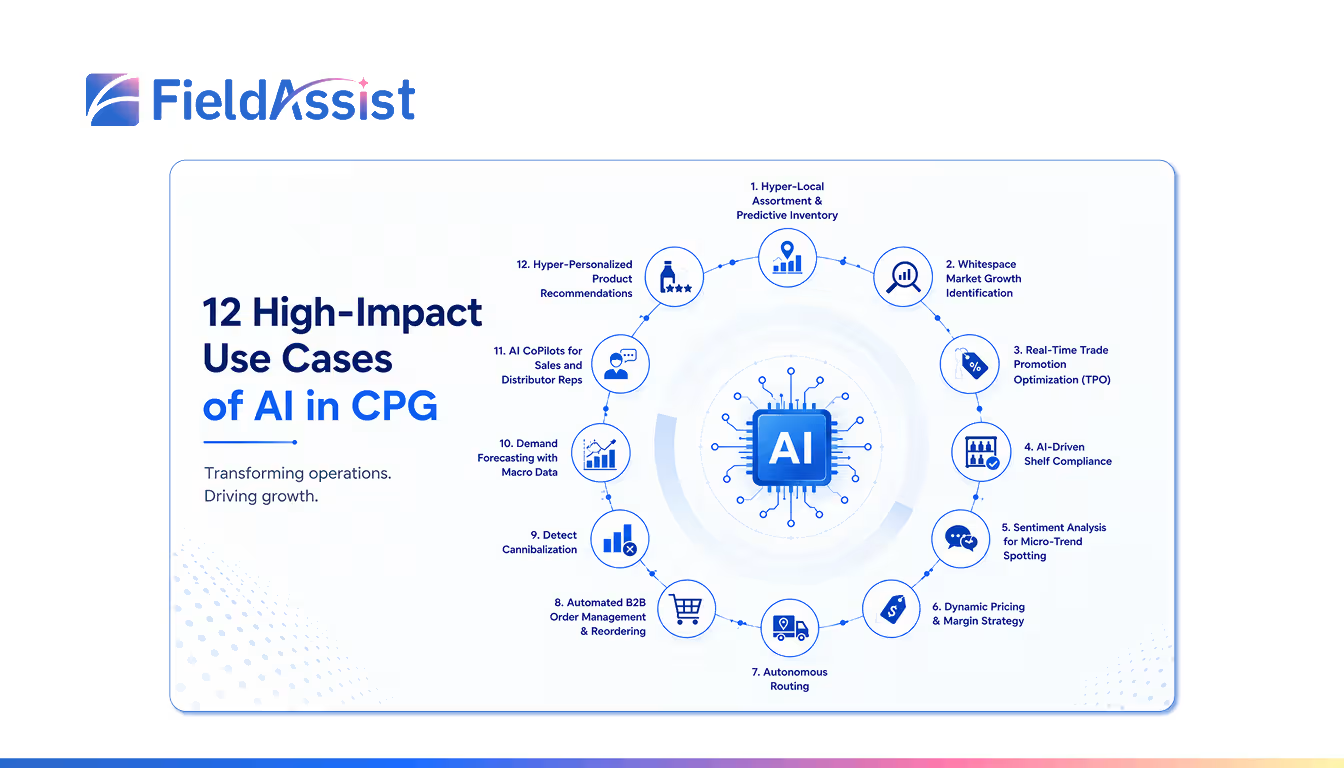
12 High-Impact Use Cases of AI in CPG
To transform operations, CGOs must move beyond theoretical artificial intelligence and implement these 13 technical AI CPG use cases.
1. Hyper-Local Assortment & Predictive Inventory
Mass-market distribution is highly inefficient. By leveraging machine learning models, CPGs can predict localized demand down to the individual zip code. This ensures that capital isn't wasted shipping products to stores where they won't sell, dramatically reducing out-of-stocks (OOS) while minimizing holding costs for slow-moving SKUs. The outcome is a hyper-localized shelf that maximizes revenue per square foot.
Where it matters the most:
- Urban vs. suburban demographic purchasing divides.
- Seasonal inventory shifts (e.g., weather-dependent beverage sales).
- High-turnover grocery environments prone to out-of-stocks.
2. Whitespace Market Growth Identification
Stop guessing where to launch next. Advanced clustering algorithms analyze geographical, demographic, and competitor saturation data to identify untapped whitespace markets. This allows brands to execute precise SKU strategies by micro-markets, deploying capital only where the predictive probability of category capture is highest, resulting in immediate market share acquisition.
Where it matters the most:
- Geographic expansion of niche or premium product lines.
- Identifying underserved retail deserts for core SKUs.
- Directing field sales teams to high-potential independent grocers.
3. Real-Time Trade Promotion Optimization (TPO)
Trade spend optimization requires moving past static historical baselines. Prescriptive artificial intelligence models continuously simulate thousands of promotional scenarios to dynamically adjust trade spend, optimize discount depth, and maximize Net Revenue Retention (NRR). This guarantees that every promotional dollar drives incremental growth rather than just cannibalizing future baseline sales.
Where it matters the most:
- Highly commoditized categories driven by price sensitivity.
- Key holiday or seasonal promotional periods.
- Defending market share against aggressive competitor markdowns.
4. AI-Driven Shelf Compliance
Manual retail audits are slow, subjective, and inaccurate. Utilizing edge-computing and computer vision, field reps can snap a photo of a shelf and instantly receive data on planogram compliance, share of shelf, and competitor adjacency. This AI CPG strategy ensures merchandising agreements are strictly enforced and protects top-line revenue at the point of decision.
Where it matters the most:
- Securing premium eye-level shelf placements.
- Auditing end-cap display execution across massive retail networks.
- Validating promotional signage and pricing tags.
5. Sentiment Analysis for Micro-Trend Spotting
Waiting for syndicated data reports means you are already late to the trend. With competitor’s shelf intelligence models and demand data, one can spot micro-trends and consumer need-states early, creating a first-mover advantage that captures highly engaged consumers before your competitors react.
Where it matters the most:
- Flavor and ingredient innovation (e.g., the rise of adaptogens).
- Packaging sustainability demands and eco-conscious trends.
- Identifying viral TikTok or social media usage behaviors.
6. Dynamic Pricing & Margin Strategy
Inflationary pressures require highly agile pricing. Reinforcement learning algorithms continuously ingest data on price elasticity, competitor markdowns, and raw material costs to prescribe dynamic pricing adjustments. This allows CPGs to ruthlessly protect margins and optimize yield across different retail channels without triggering severe volume degradation.
Where it matters the most:
- Navigating rapid raw material inflation.
- E-commerce and Direct-to-Consumer (DTC) pricing adjustments.
- Managing price thresholds for price-sensitive legacy SKUs.
7. Autonomous Routing
For brands utilizing direct-store-delivery (DSD), logistics bleed profitability. Spatial AI in consumer goods and autonomous routing algorithms dynamically calculate the most efficient delivery paths in real-time, factoring in traffic patterns, vehicle load weights, delivery windows, and high-priority accounts. The outcome is a massive reduction in fuel costs and fleet wear-and-tear while improving on-time delivery rates.
Where it matters the most:
- Perishable goods requiring strict cold-chain compliance.
- Dense urban delivery environments with high traffic variance.
- Managing volatile daily volume fluctuations.
8. Automated B2B Order Management & Reordering
Friction in B2B distribution kills velocity. By integrating eb2b retailer app, CPGs can automate the order management process. When a retailer run low on core SKUs, eb2b enable retailers to digitally place order instantly and ensure faster replenishment fulfillment , ensuring total supply continuity and removing the manual administrative burden from sales reps.
Where it matters the most:
- Managing long-tail networks.
- Preventing stockouts of hero/flagship products.
- Streamlining restocking, reordering, invoicing and reconciliation processes.
9. Detect Cannibalization
Launching a new flavor that simply steals sales from your legacy product is a failure of innovation. By bringing end-to-end retail intelligence, one can analyze complex cross-elasticity matrices to forecast the true incremental value of a new product. This allows CGOs to identify and prevent cannibalization before the SKU hits the manufacturing line, ensuring overall category growth.
Where it matters the most:
- Brand line extensions (e.g., a new flavor of an existing chip).
- Introducing value-tier vs. premium-tier product variations.
- Optimizing shelf space where one in, means one out.
10. Demand Forecasting with Macro Data
Traditional time-series forecasting breaks down during volatile market conditions. Next-gen demand sensing feeds external AI datasets—ranging from hyperlocal weather patterns and inflation indices to geopolitical events—into neural networks. This creates a hyper-accurate, adaptive demand forecast that aligns production strictly with market reality, mitigating the bullwhip effect.
Where it matters the most:
- Categories highly sensitive to weather (e.g., ice cream, sunscreen).
- Managing complex global supply chains with long lead times.
- Navigating periods of high economic uncertainty and inflation.
11. AI CoPilots for Sales and Distributor Reps
Field sales teams are often overwhelmed with data they cannot quickly process during a 10-minute buyer meeting. AI CoPilots act as digital assistants, synthesizing complex data to instantly generate tailored sell-in stories, handle real-time buyer objections, and recommend the optimal order mix. This turns average reps into data-driven consultants, driving higher close rates.
Where it matters the most:
- Pitching new SKU innovations to skeptical retail buyers.
- Cross-selling and up-selling during routine distributor check-ins.
- Onboarding and training new field sales personnel rapidly.
12. Hyper-Personalized Product Recommendations
As CPGs build out DTC channels, owning first-party data is critical. Collaborative filtering algorithms power hyper-personalized product recommendations on owned digital properties, mirroring the sophisticated cross-selling techniques of tech giants. This highly targeted approach maximizes basket size, increases conversion rates, and drives higher Customer Lifetime Value (CLTV).
Where it matters the most:
- Subscription-based replenishment models (e.g., razor blades, pet food).
- Cross-category digital bundling strategies.
- Email marketing and lifecycle retention campaigns.
Frequently Asked Questions (FAQ)
1. What are the top use cases for AI in the CPG industry?
The top use cases for AI in the CPG industry center on predictive revenue growth and supply chain efficiency. Key applications include hyper-local assortment planning, real-time Trade Promotion Optimization (TPO), AI-driven shelf compliance using computer vision, and dynamic pricing models powered by reinforcement learning.
2. How are CPG brands using generative AI?
CPG brands are using generative AI primarily to scale hyper-personalized marketing content and empower field sales teams. For example, brands deploy generative AI CoPilots to instantly synthesize complex supply and pricing data into tailored sell-in pitches for distributor reps, accelerating B2B sales cycles.
3. What kinds of data do CPG companies need to run AI effectively?
To run AI effectively, CPG companies need a unified data lake that combines internal and external datasets. This includes historical sales data, ERP inventory levels, and CRM records, layered with macro-economic data like hyperlocal weather patterns, inflation indices, competitor pricing, and social sentiment graphs.
4. Can AI help manage CPG inventory more efficiently?
Yes, AI drastically improves CPG inventory management by shifting from historical baselines to predictive demand sensing. Machine learning algorithms forecast demand at the zip-code level, which prevents costly out-of-stocks while minimizing the working capital trapped in slow-moving or obsolete SKUs.
5. What is the best way for CPG companies to get started with AI?
The best way for CPG companies to get started with AI is to avoid massive, multi-year IT overhauls and instead pilot a single, high-ROI use case—such as optimizing trade spend or automating shelf compliance. Concurrently, leadership must prioritize breaking down internal data silos to ensure the AI models have clean, structured data to ingest.
6. How does AI support retailer engagement in CPG?
AI supports retailer engagement in CPG by powering 1:1 personalization at scale. Recommendation engines curate digital product bundles for Direct-to-Retailer (DTR) shoppers, predictive analytics identify and prevent churn, and ensure maximum output.



%20(1).avif)