Why Vertical AI for Consumer Goods Is Winning Over Horizontal AI?
Vertical AI for consumer goods helps FMCG brands improve retail execution, demand forecasting, and field sales performance with industry-specific intelligence.

The CPG boardroom is no longer debating whether to adopt AI. The debate has shifted to a sharper question: which kind of AI is actually worth deploying at scale? For brands navigating trade margins, distributor sprawl, and shelf-level execution gaps, that distinction could define the next decade of competitive advantage.
This is especially critical in B2B Route-to-Market (RTM) ecosystems, where execution depends on complex distributor networks, fragmented retail environments, and field teams operating across thousands of outlets daily. Horizontal AI may generate insights, but it often lacks the contextual understanding required to improve secondary sales visibility, outlet prioritization, scheme compliance, or field productivity at scale. Vertical AI, on the other hand, is designed around these realities, making it significantly more effective for B2B RTM execution in consumer goods.
What is Vertical AI? Why does it matter in CPG?
Vertical AI is purpose-built for a specific industry, domain, or workflow, as opposed to Horizontal AI, which is trained on broad, generic datasets to handle a wide range of tasks. Where Horizontal AI answers "what," Vertical AI answers "what next, in this context, for this industry."
For consumer goods specifically, Vertical AI is trained on CPG-native data structures, outlet hierarchies, beat plans, distributor layers, secondary sales patterns, planogram compliance, and field force behavior. It doesn't need to be taught what an RSP is, what a beat deviation means, or why a stockout at a high-frequency outlet costs more than one at a low-traffic store. That context is built in.
The core distinction:
- Horizontal AI is a Horizontalist hired for any job
- Vertical AI for consumer goods is a seasoned CPG professional — trained, contextualized, and ready to execute
This is why enterprises evaluating AI for FMCG companies are increasingly asking not just "does this AI work?" but "does this AI understand our industry?"
The AI Adoption Surge in the Consumer Goods Industry
AI is rapidly becoming a core growth driver for FMCG companies. From demand forecasting and retail execution to pricing and field sales productivity, brands are using AI to improve speed, visibility, and decision-making across the value chain.
But as adoption increases, many companies are discovering that horizontal AI tools struggle with the operational complexity of consumer goods. FMCG businesses need AI systems built for distributor networks, outlet-level execution, and field sales realities, not just broad automation.
Why FMCG Companies Are Under Pressure to Adopt AI Faster?
The pressure is structural, not cyclical. Consumer goods companies are contending with shrinking margins, proliferating SKUs, volatile demand signals, and a field force that needs to execute flawlessly across thousands of outlets every day.
According to industry analysis, CPG and retail companies that lead in digital and AI already generate three times greater total shareholder returns compared to sector peers. Meanwhile, a 2024 McKinsey survey found that 71% of CPG leaders had adopted AI in at least one business function, up from 42% the prior year. AI in the consumer goods industry has moved from pilot labs to P&L-linked mandates. The question is whether the AI being deployed is actually fit for purpose.
The Problem: Not All AI Is Built for Consumer Goods
Horizontal-purpose AI tools were never designed for FMCG complexity. They don't understand beat plans, outlet hierarchies, secondary placement compliance, or distributor-led market structures. Deploying them in CPG environments produces surface-level automation at best and expensive failures at worst.
This is precisely why the Horizontal AI vs Vertical AI debate has become so consequential for consumer goods companies today.
Horizontal AI vs Vertical AI- What's the Real Difference?
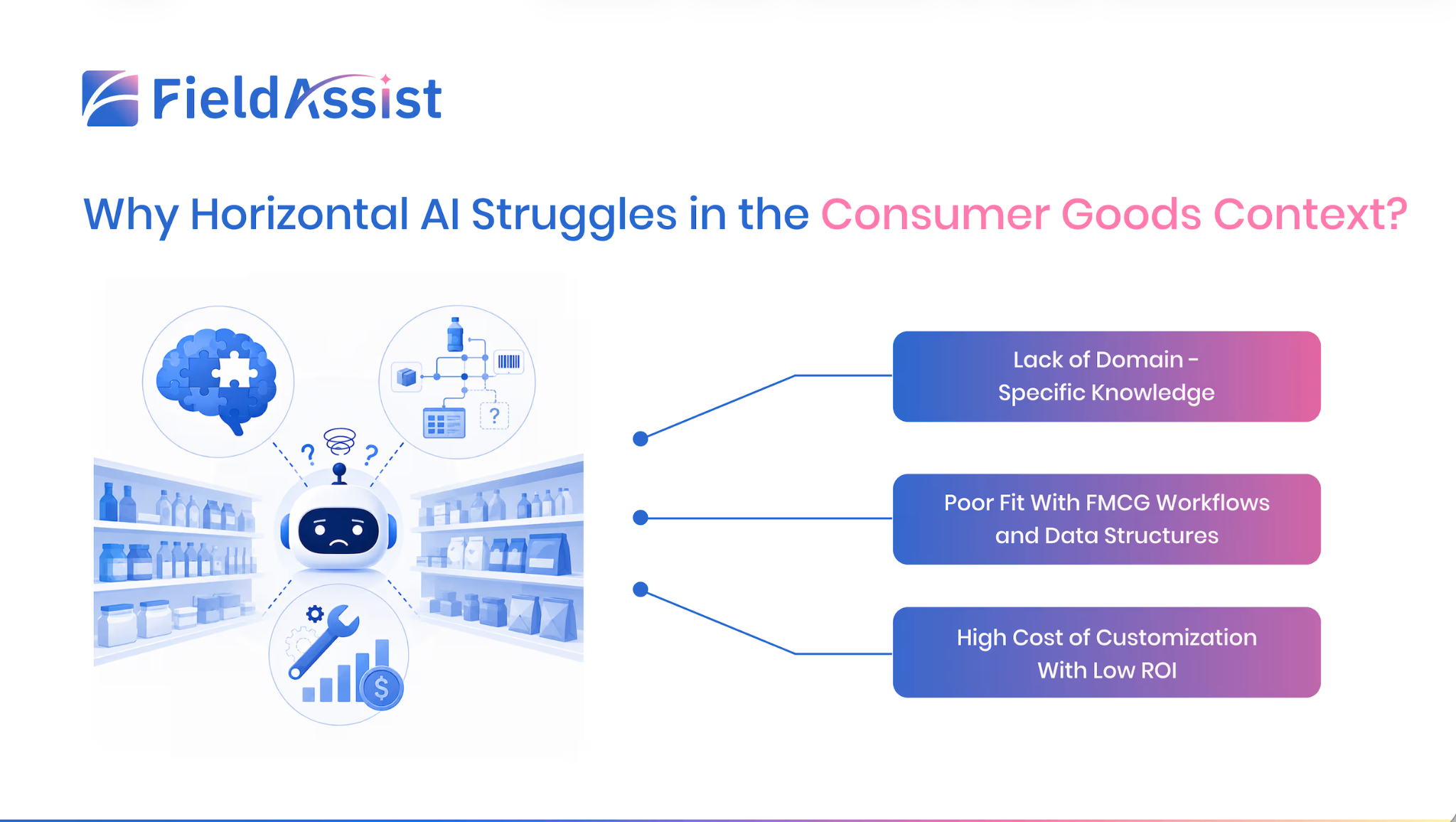
Why Horizontal AI Struggles in the Consumer Goods Context?
1. Lack of Domain-Specific Knowledge
Horizontal AI models are impressively broad, and that breadth is precisely their limitation in CPG. They do not understand that an outlet in a semi-urban market behaves differently from a modern trade account, or why a certain SKU underperforms in a specific channel during a promotional window. They have no baseline grasp of the FMCG execution variables that seasoned sales managers carry in their heads.
The result: recommendations that are technically coherent but operationally irrelevant. AI for FMCG companies must go deeper than pattern recognition on generic business data.
2. Poor Fit With FMCG Workflows and Data Structures
FMCG operations generate a specific class of data, beat-level visit logs, secondary sales figures, outlet compliance scores, distributor inventory aging, and planogram adherence rates. Horizontal AI platforms are not architected to ingest and reason over these data types without significant re-engineering. Every custom connector and workaround adds cost and introduces fragility.
Enterprise AI for FMCG cannot be bolted onto a horizontal platform. It needs to be embedded in the workflow from day one.
3. High Cost of Customization With Low ROI
A Gartner survey of over 300 CIOs found that more than 90% said managing AI costs limits their ability to extract value, with potential cost estimation errors ranging from 500% to 1,000% when GenAI scaling is poorly understood (Gartner, October 2024). For CPG companies trying to retrofit Horizontal AI into field-force and retail execution contexts, this is not a theoretical risk; it is a lived experience.
What Vertical AI for Consumer Goods Actually Looks Like?
Vertical AI is not simply a generic AI model applied to FMCG data. It is purpose-built for the realities of consumer goods operations, designed around how sales teams, distributors, merchandisers, and retail networks actually function. Instead of offering broad automation, vertical AI delivers context-aware intelligence that improves execution, forecasting, and decision-making across the entire FMCG value chain.
- Built-In Understanding of Retail and CPG Workflows
Vertical AI for consumer goods arrives pre-contextualized. It understands the taxonomy of a CPG operation, territories, routes, outlet types, compliance KPIs, and distributor layers. It speaks the language of a Regional Sales Manager, not just a data scientist, surfacing insights that map directly to decisions field teams make daily: which outlets to prioritize, which SKUs to push, where execution gaps are costing revenue.
- From Shelf Intelligence to Demand Forecasting
The scope of purpose-built AI in consumer goods spans the full commercial chain. At the shelf, computer vision can audit planogram compliance at scale, flagging gaps and share-of-shelf deviations in real time. At the demand planning layer, vertical AI models trained on FMCG-specific signals, weather, seasonality, and outlet-level sell-out trends dramatically outperform generic forecasting tools.
Industry report indicates that AI-driven demand forecasting can reduce forecasting error by up to 65% in consumer goods operations, with direct downstream impact on inventory, waste, and service levels.




.avif)