What ROI Looks Like When FMCG Brands in Southeast Asia Unify SFA, DMS, and Route Planning
Boost sales productivity, reduce stockouts, and improve trade promotion ROI by unifying SFA, DMS, and route planning on a single platform for FMCG brands in Southeast Asia.

.avif)
There's a quiet revenue drain happening inside most FMCG sales organizations today, and it doesn't show up cleanly on any single P&L line. It lives in the gap between a field rep's morning beat plan, a distributor's inventory ledger, and a route that was designed three-quarters ago.
When your sales force automation, distributor management system for FMCG, and route planning tools operate as three separate islands of data, the cost isn't just operational friction. It's measurable, compounding margin erosion.
This blog cuts through the noise to answer a specific commercial question: what does the financial return actually look like when FMCG teams bring SFA, DMS, and route intelligence onto a single data layer? The answer isn't theoretical; it shows up in strike rates, inventory turns, promo conversion, and cost-to-serve ratios. Let's map it precisely.
The Financial Cost of Disconnected Route-to-Market (RTM) Systems
Before quantifying the gains, we need to be honest about the baseline cost of fragmentation. Most FMCG sales leaders accept disconnected systems as an operational reality. They shouldn't. The losses are structural.
1. Soaring Cost-to-Serve
When field data, distributor inventory, and route planning operate in silos, every outlet visit becomes more expensive. Reps follow inefficient beats, stock visibility remains limited, and reorders rely on guesswork instead of demand signals. The result is a higher cost-to-serve that erodes margins across thousands of outlets, particularly for CPG brands operating in fragmented, high-density traditional trade markets.
2. Lost Revenue from Out-of-Stocks (OOS)
Out-of-stocks are one of the biggest revenue leaks in FMCG distribution. Industry studies consistently show average OOS rates of 5–10% for mainstream FMCG products, with the figure spiking sharply during promotional periods. Without real-time secondary sales visibility, stockouts go unnoticed for longer, leaving shelves empty and consumers switching to competing brands before corrective action can be taken.
Research shows that retail inventory distortions, overstocks, and out-of-stocks combined, represent a $1.9 trillion problem globally, with FMCG categories bearing a disproportionate share of that burden.
3. Inefficient Trade Spend
Trade promotion is one of the largest cost lines in FMCG, typically 15–20% of gross revenue for CPG companies. Yet McKinsey research has found that 59% of trade promotions globally fail to generate a positive return, with the figure reaching 72% in mature markets. The core reason: disconnected systems mean promotion planning happens in one silo, field execution in another, and outcome measurement barely happens at all. Without a unified data layer connecting SFA execution data with DMS claims reconciliation and real-time shelf visibility, trade spend optimization is essentially guesswork.
4. High Inventory Carrying Costs
Disconnected systems create a fundamental demand-signal lag. The distributor doesn't know what the retailer is selling. The brand doesn't know what the distributor is holding. The result is a classic bullwhip effect: overstock at the distributor level, stockout at the retail level, and inflated carrying costs eating into distributor margins and straining your RTM relationships. This is especially critical in markets where FMCG distribution management software SEA has historically been manual, spreadsheet-driven, or reliant on periodic physical audits with no real-time visibility.
The Unified Triad: How SFA, DMS, and Route Planning Converge on One Data Layer
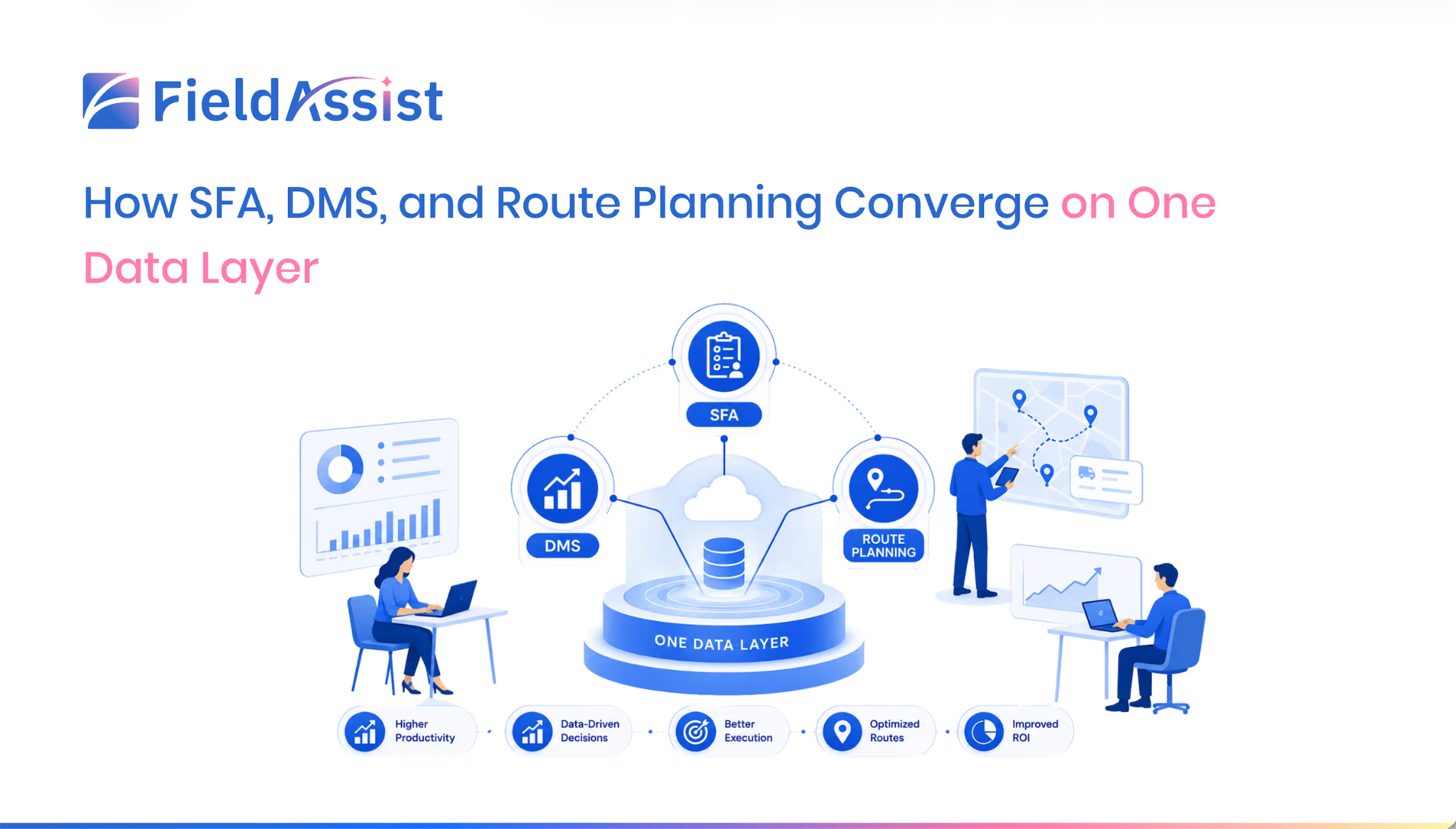
The phrase "integrated platform" gets thrown around carelessly in enterprise software. What matters for FMCG commercial leaders is a specific kind of integration: transactional and behavioral data from all three execution layers flowing into a single, real-time intelligence system.
Here's what that actually means in practice:
Sales Force Automation captures outlet-level execution data, visits made, orders placed, stock observed, schemes communicated, and compliance recorded. In isolation, it tells you what the rep did. It cannot tell you whether the right rep visited the right outlet on the right day, or whether the stock was available to fulfill the order.
A distributor management system for FMCG captures secondary sales data, inventory positions, scheme claims, and payment cycles at the distributor tier. In isolation, it tells you what moved through the distributor. It cannot tell you whether the field team is converting that stock into retail orders, or where the gaps in outlet coverage lie.
Route Planning and Optimisation is only as effective as the data behind it. Without real-time outlet insights from SFA and inventory visibility from DMS, route plans are based on outdated information.
When these systems operate on a unified platform, route decisions are driven by outlet demand and stock availability. Replenishment happens proactively, promotions are validated automatically, and field execution becomes more efficient. This creates the operational foundation for a successful route-to-market strategy in competitive FMCG markets.
Decoding the ROI: The Tangible Financial Impact of a Unified Platform
1. Exponential Sales Productivity Gains
Unified systems reduce non-selling time by helping reps focus on the right outlets. AI-driven beat plans and stock-aware routing eliminate unproductive visits, while data-driven order recommendations increase lines per call without additional effort. McKinsey research has documented that companies using AI-driven sales tools see lead and appointment conversion improve by nearly 50%, with meaningful reductions in administrative overhead.
2. Eliminating Last-Mile Leaked Revenue
The last mile is where execution gaps hurt the most. Without unified inventory and field visibility, reps often discover stockouts only after reaching an outlet. A unified platform connects distributor inventory with field operations, enabling proactive replenishment, preventing stockouts, and recovering revenue that would otherwise be lost.
3. Slashing Field Waste with Commercial Prioritization
Not all outlets contribute equally to revenue. A unified platform combines sales and field execution data to prioritize high-potential outlets, helping reps focus on visits with the highest conversion opportunity while reducing wasted calls and travel time.
Brands on FieldAssist's unified platform have achieved 30% faster market penetration through AI-powered beat planning that eliminates low-yield visits.
4. Promo ROI Maximization and Flawless Shelf Execution
Given that CPG companies allocate 15–20% of revenue to trade spend, even a modest improvement in promo ROI moves the needle significantly. A unified platform improves trade promotion ROI by linking planning, execution, and claims management. Brands gain outlet-level visibility, reps can address compliance gaps in real time, and claims reconciliation becomes automated.
FieldAssist's IRIS (Image Recognition) module and Perfect Store framework bring AI-verified shelf execution data into the loop, delivering a 40% improvement in shelf performance with smart promotions. This is promo spend that works, not spend that is written off after the quarter closes.
The FieldAssist Difference: Driving Agentic AI
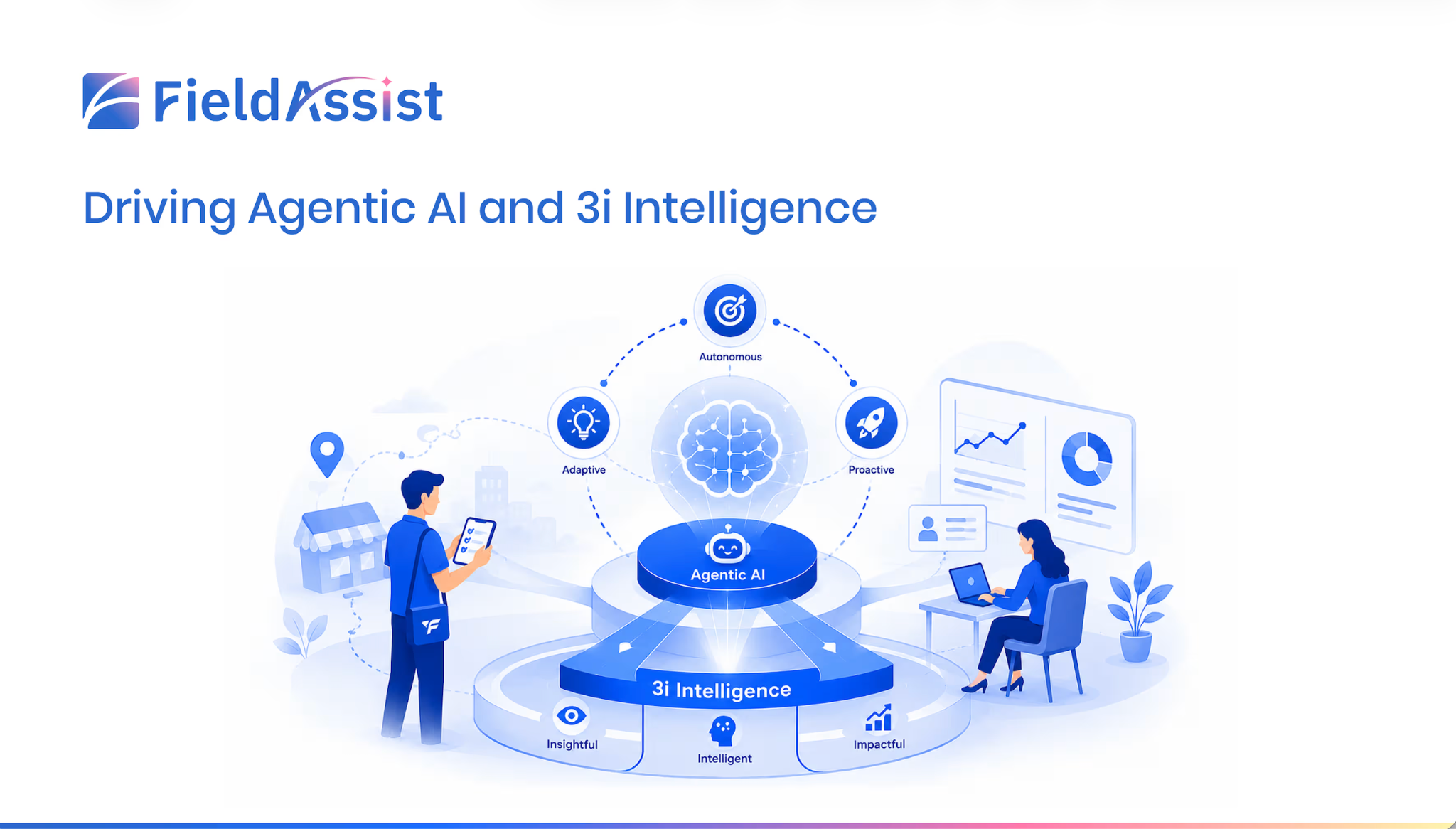
FieldAssist is trusted by hundreds of enterprises, including Unilever, Coca-Cola, Mars, and Nivea, not because of feature lists, but because of a fundamental design philosophy: close the last-mile execution gap by making every layer of the RTM visible, intelligent, and connected.
The platform is built on the 3i Intelligence framework: Information, Insight, and Impact, which ensures that data from the field doesn't just get collected; it gets transformed into decisions and execution.
What separates FieldAssist's FMCG distribution management software SEA capability is its native understanding of the region's market complexity: fragmented traditional trade, multi-tier distribution, route density challenges, and the need for localized execution strategies within a unified platform architecture.
FieldAssist has a dedicated Southeast Asia presence, supporting brands in Indonesia and across the region with a platform built for the specific realities of high-density, low-margin, high-volume FMCG markets.
Closing Thoughts: Stop Paying for Silos, Start Investing in Unification
Every disconnected system you maintain is a tax on your commercial performance. It's a tax paid in wasted field hours, unresolved OOS situations, unrecovered trade spend, and distributor relationships that operate on paper trails instead of real-time data.
For FMCG brands competing in price-sensitive, execution-intensive markets, that tax compounds. It shows up in declining strike rates, inflated cost-to-serve, and a route-to-market strategy for CPG brands that looks robust on paper but leaks value at every mile of execution.
The ROI of unifying SFA, DMS, and Route Planning is not aspirational. It's documented: 21% more productive calls, 13–25% improvement in outlet coverage, 40% better shelf performance, 90% execution accuracy. These are FieldAssist customer outcomes, not projections.



%20(1).avif)