Modern Trade Promotions vs General Trade Schemes: Key Differences FMCG Leaders Must Know
Explore the differences between modern trade and general trade promotions in FMCG, and how automation drives better visibility, compliance, and ROI.

For most FMCG brands, trade promotion spend is the second largest line item on the P&L, right after the cost of goods sold. According to the Promotion Optimization Institute (POI), CPG companies allocate between 11% and 27%+ of their revenues on trade promotions. Yet despite this massive outlay, the returns are deeply uneven, and nowhere is that more visible than in the gap between how modern trade promotions are designed versus how general trade schemes are actually executed on the ground.
Understanding the structural differences between these two channels is not an academic exercise. It directly shapes how brands design schemes, deploy field teams, settle claims, and, ultimately, how much promotional spend translates into real sell-out growth versus pure leakage.
Decoding the FMCG Retail Landscape: General Trade vs. Modern Trade
The global FMCG retail universe is bifurcated. On one side sits modern trade, organized retail formats like hypermarkets, supermarkets, cash-and-carry chains, and e-commerce platforms. On the other sits general trade, the vast, fragmented universe of independent kiranas, convenience outlets, wholesale distributors, and traditional mom-and-pop stores that continue to dominate volume in high-growth markets across Asia, Africa, Latin America, and the Middle East.
Both channels are critical. But they operate with fundamentally different supply chain structures, buyer behaviors, and execution realities. A promotion strategy designed for a modern trade buyer at a national chain cannot simply be replicated as a general trade scheme handed to a field sales representative managing 200 outlets across a territory.
This is where trade promotion management FMCG teams consistently face execution failure. The mechanics, controls, and measurement tools required for each channel diverge sharply, and brands that fail to account for that divergence are the ones bleeding promotional spend with little to show for it.
Modern Trade Promotions vs General Trade Schemes: The Core Differences
The table below breaks down the key structural differences between modern trade promotions and general trade schemes across execution, design, measurement, and risk dimensions.
The most critical takeaway: modern trade promotions operate in a structured, high-visibility environment where compliance can be verified, and claims are invoice-backed. General trade schemes, by contrast, are deployed across thousands of dispersed outlets where execution depends on field rep discipline, distributor honesty, and outlet awareness, none of which are guaranteed without the right systems in place.
The Operational Hurdles in Trade Promotion Management (TPM) for FMCG Brands
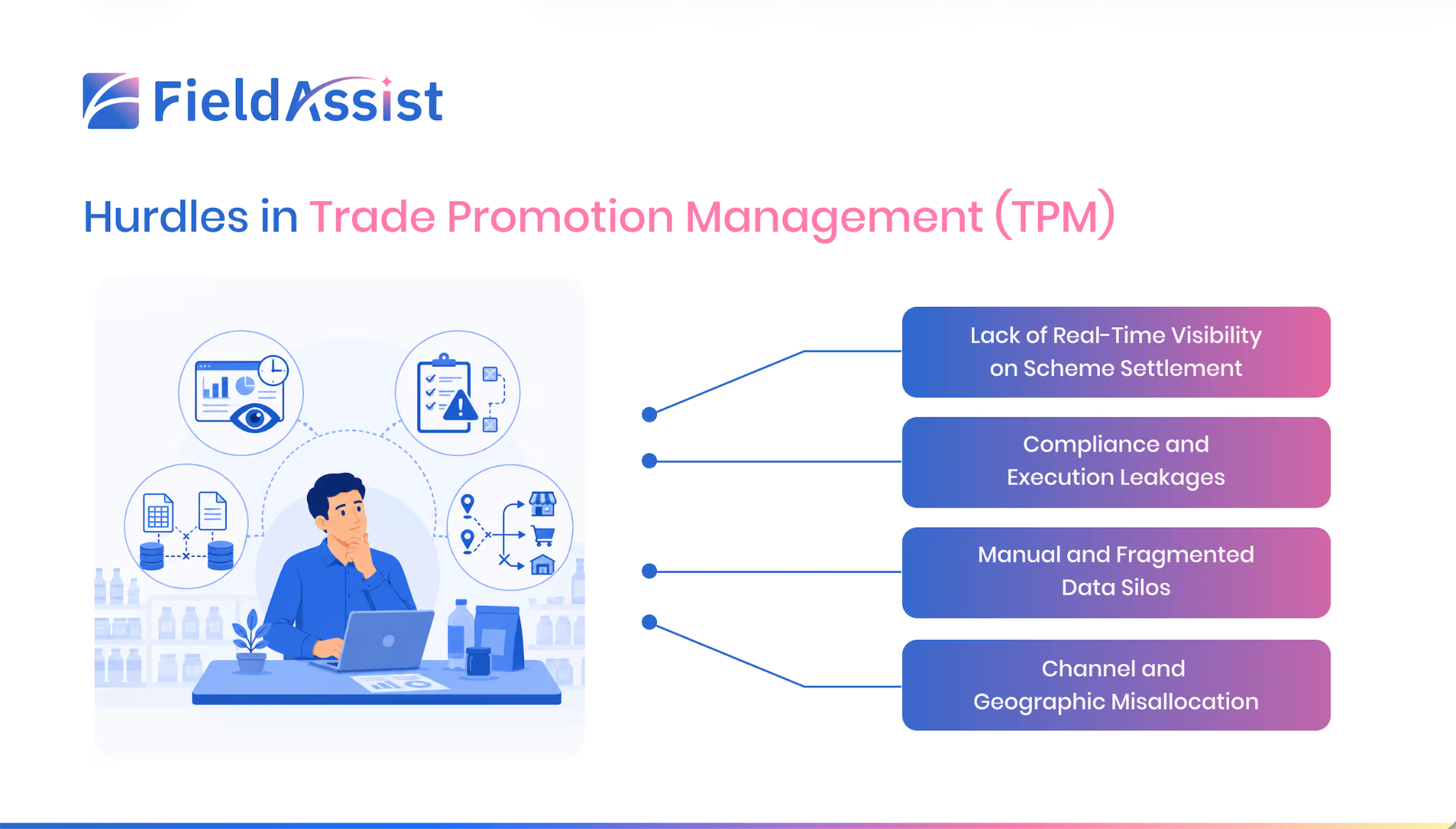
Even the best-designed trade promotion management FMCG strategies run into severe execution friction when the underlying systems are fragmented. Here are the four recurring hurdles brands face across both channels.
1. Lack of Real-Time Visibility on Scheme Settlement
Whether it is a volume-linked rebate for a modern trade chain or a per-case discount running through a general trade distributor, most brands have no real-time view of scheme utilization. Claims arrive weeks after the promotional window closes, reconciliation is manual, and by the time finance flags a discrepancy, the window to course-correct is long gone. As per McKinsey, CPG companies invest approximately 20% of revenue in trade promotions, yet 59% of those promotions lose money globally. Real-time settlement visibility is the foundational fix most brands are still missing.
2. Compliance and Execution Leakages
Scheme compliance gaps are endemic, particularly in general trade. A promotional offer may be communicated correctly at the distributor level but never transmitted accurately to the outlet. Alternatively, field reps may mark scheme delivery as complete without verification. Industry reports have found that 81% of organizations still rely on manual or semi-manual compliance processes, limiting speed and scalability, and 61% of CPG companies report difficulty executing planned promotions consistently.
3. Manual and Fragmented Data Silos
In most FMCG organizations, modern trade promotion data lives in key account management tools or spreadsheets maintained by the category team, while general trade scheme data is scattered across distributor ledgers, DSR reports, and sales dashboards that don't talk to each other. A 2023 report found that 43% of brands still use spreadsheets as their primary tool for trade promotion management and FMCG decisions, a statistic that explains why evaluation happens months after spend has already occurred.
4. Channel and Geographic Misallocation
Without granular data, brands often over-invest in modern trade promotions where competition is visible and under-invest in general trade schemes where volume actually moves. The reverse also happens: brands run aggressive general trade schemes in geographies where distribution is thin, resulting in scheme spend with no incremental offtake. This misallocation is a direct consequence of running trade promotion management FMCG decisions on lagged, aggregate data rather than outlet-level intelligence.
Why Brands Must Automate Trade Promotions in FMCG?
The case to automate trade promotions FMCG-wide is not merely about operational efficiency. It is about financial control. Here is what automation actually delivers:
- Eliminate Claim Leakages and Fraudulent Claims
Manual claim processing in general trade creates significant opportunities for inflated or duplicate claims, whether from distributors gaming volume thresholds or field reps logging fictitious outlet visits. Automated TPM systems enforce rule-based claim validation: a scheme credit only triggers when the system confirms product offtake at the outlet level. This alone can close claim leakage gaps of 10–20% of total scheme spend for brands operating at scale.
- Instant Scheme Visibility
When brands automate trade promotions, FMCG field teams get real-time dashboards showing scheme uptake by territory, outlet, and SKU. Instead of waiting for end-of-month distributor statements, trade managers can see, within hours, whether a scheme is performing below threshold and redirect focus to underperforming geographies before the window closes. Modern trade promotions benefit equally: key account teams gain live visibility into planogram compliance and promotional uplift by store.
- Data-Driven Insights
Industry report says best-in-class CPG promotions deliver five times the return compared to the least efficient ones. The difference is not the budget; it is the measurement. Brands that automate trade promotions FMCG-wide can evaluate scheme ROI at the SKU, outlet, and geography level in near real-time, enabling them to kill underperforming schemes mid-cycle and double down on what is working. A 2023 Boston Consulting Group study found that 30-40% of trade promotions underperform against their stated objectives, a number that shrinks substantially when evaluation is continuous rather than retrospective.
- Eliminate Data Silos
Automation creates a unified data layer across both modern trade promotions and general trade schemes. Finance sees one version of scheme liability. Sales sees one version of outlet-level scheme uptake. The category sees one version of promotional ROI by channel. This single source of truth is what converts trade spend from a P&L cost center into a strategic lever, and it only becomes possible when brands commit to systems that capture execution data at the point of sale, not at month-end reconciliation.
How FieldAssist Simplifies Trade Promotion Management Across Both Channels
FieldAssist is built for the realities of last-mile execution in FMCG, not for the sanitized environment of structured modern retail alone. The platform's trade promotion management capabilities are designed to handle the full complexity of both channels simultaneously.
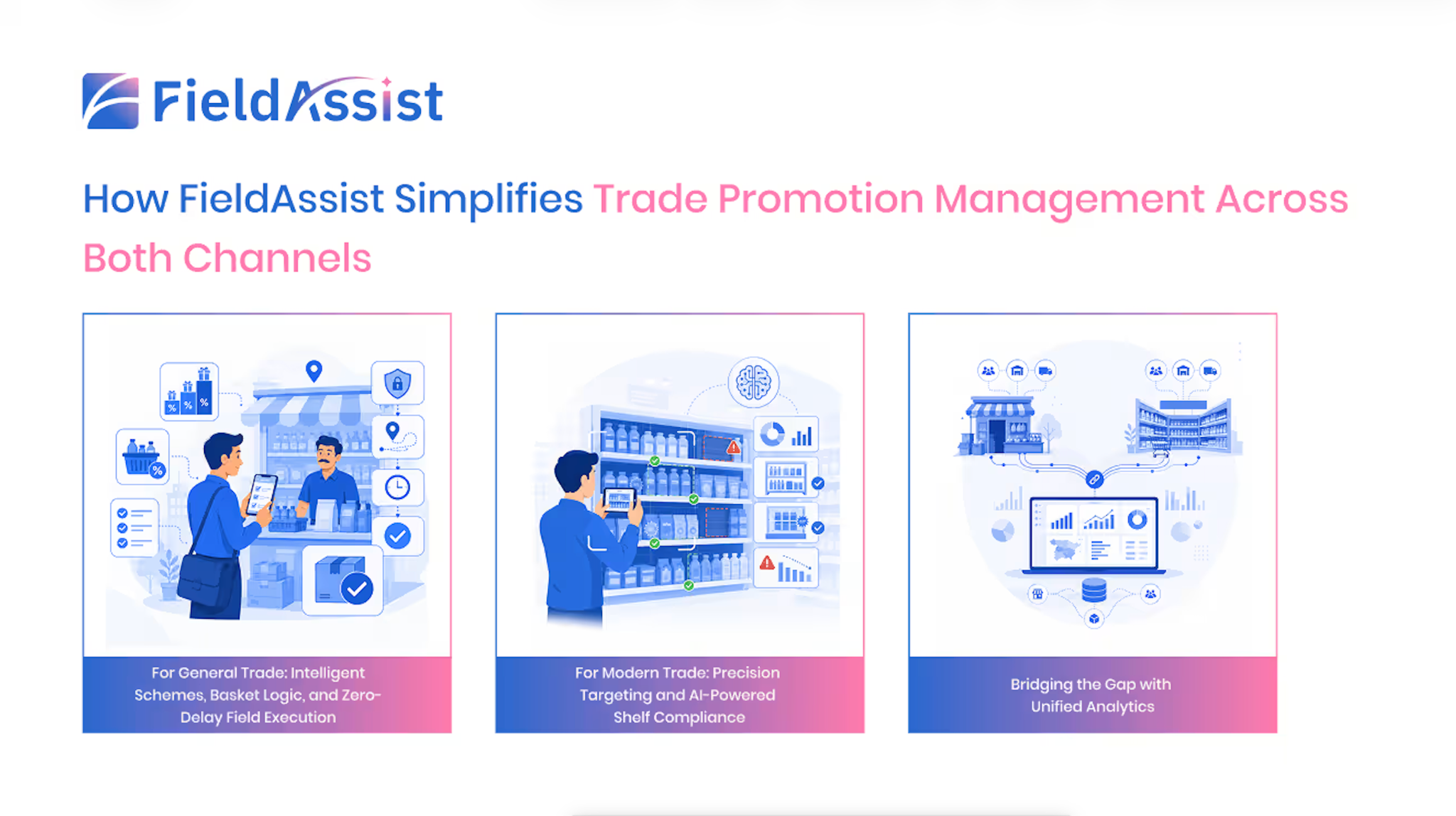
- For General Trade: Intelligent Schemes, Basket Logic, and Zero-Delay Field Execution
FieldAssist enables brands to configure and cascade general trade schemes, from slab-based incentives and value-linked discounts to combo and basket offers, directly to field reps through the mobile SFA app. Scheme eligibility is calculated automatically at the point of order capture: the DSR sees the applicable scheme in real time, without waiting for a paper scheme card or a WhatsApp cascade from the distributor. Every scheme application is logged with outlet ID, GPS coordinates, and timestamp, creating a tamper-proof audit trail that eliminates the single biggest source of general trade leakage.
- For Modern Trade: Precision Targeting and AI-Powered Shelf Compliance
For modern trade promotions, FieldAssist's FAi IRIS image recognition technology transforms shelf compliance verification from a manual audit exercise into an automated, real-time intelligence feed. Field reps capture shelf images using the mobile app; the AI engine analyzes share of shelf, planogram adherence, and promotional display execution, flagging gaps before the promotional window closes. This means modern trade promotion teams no longer have to wait for a retail audit cycle to discover that a key account's promotional display was never set up correctly.
- Bridging the Gap with Unified Analytics
FieldAssist's analytics layer consolidates both modern trade promotions and general trade schemes into a single performance dashboard. Trade spend versus offtake is visible by channel, region, distributor, SKU, and outlet tier. ROI comparisons between channel types can be run within minutes, not weeks. This unified view is what finally enables FMCG commercial teams to make rational budget allocation decisions between modern trade and general trade instead of relying on historical split ratios or sales team lobbying.
Closing Thoughts
The divide between modern trade promotions and general trade schemes is not going away. If anything, it is widening as modern retail consolidates buying power and general trade channels fragment further at the last mile. FMCG brands that treat these as variations of the same problem will continue to bleed trade spend without visibility into where it goes.
The brands that pull ahead are those that recognize the structural differences, build distinct execution playbooks for each channel, and invest in systems that automate trade promotions FMCG-wide, so that every scheme, across every channel, is measurable, controllable, and tied to real offtake rather than paperwork.
That is precisely the last-mile execution gap that FieldAssist is built to close. Get in touch to see how FieldAssist manages modern trade promotions and general trade schemes within a single platform.




.avif)