Intelligent Product Recommendations in FMCG Sales: A Complete Guide for Modern Brands
See how AI-powered product recommendations help FMCG brands increase order value, improve SKU penetration, and make field sales more effective.

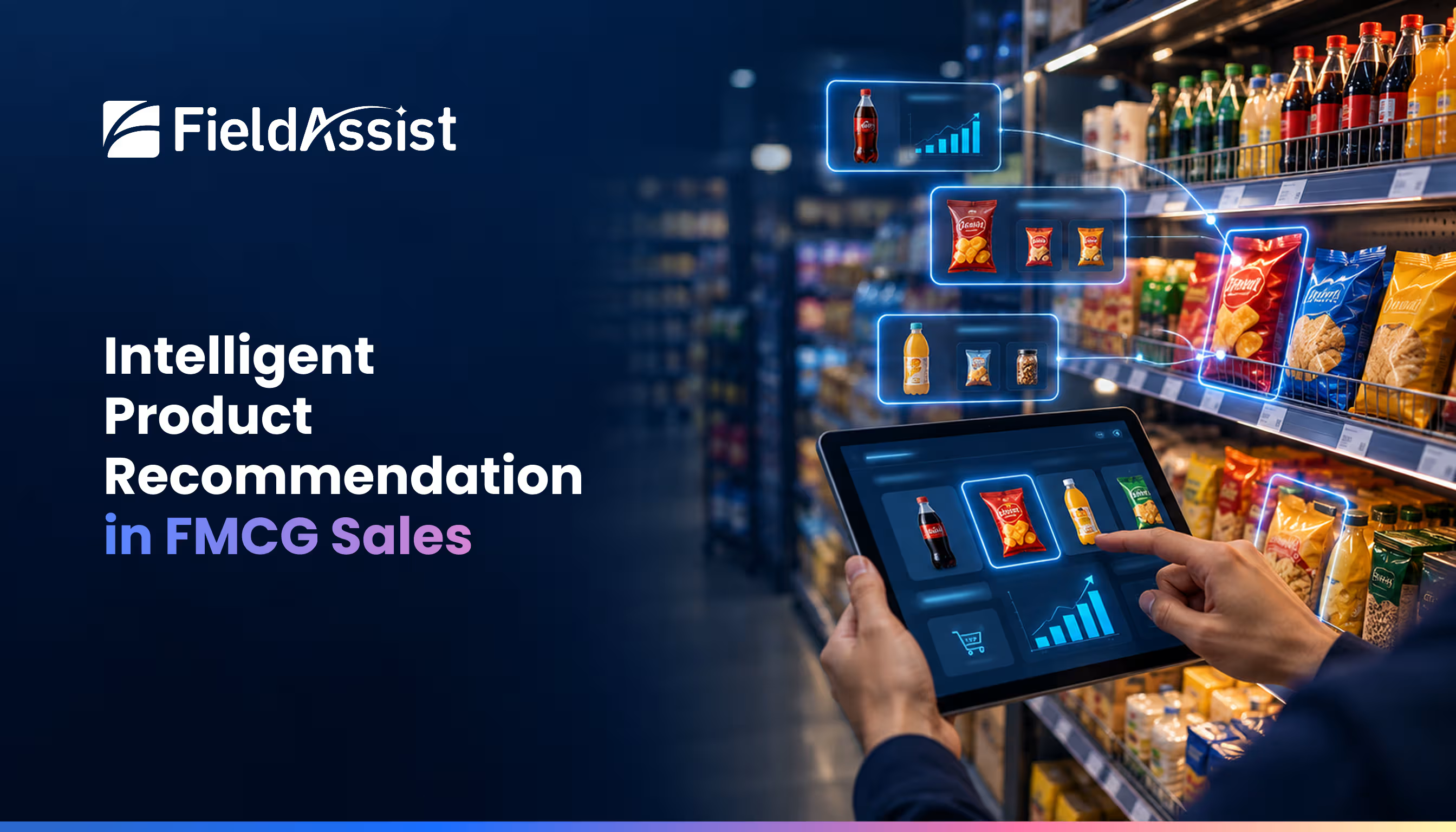
Every field rep knows the feeling: twelve outlets before lunch, a retailer in a hurry, and a catalog of 300 SKUs. Under that pressure, the order defaults to whatever the shopkeeper already buys. This guide explains how intelligent selling closes that gap, and how brands can put it to work on the beat.
The Evolving FMCG Sales Landscape and the Need for Intelligence
FMCG growth is being pulled apart. Bain & Company found that insurgent brands captured nearly 36% of growth in NielsenIQ-tracked FMCG channels in 2025 while holding less than 2% of total market share. Challengers win by getting the right product into the right outlet faster than incumbents can. For established brands, the lesson is uncomfortable: a 200-SKU portfolio only matters if reps actually sell it.
On the ground, though, orders are still written from habit. Reps lean on memory, on what the outlet “usually takes,” and on whatever the distributor pushed this week. New launches stall, mid-tier SKUs get ignored, and the average order stays flat while route costs climb. A well-timed product recommendation removes that guesswork by telling the rep, outlet by outlet, what to pitch next. This is the “last mile” execution gap FieldAssist was built to close.
Complexity compounds the problem. A typical brand now manages multiple channels, hundreds of distributors and thousands of beats, each with its own outlet mix. No sales manager can hand-tune assortments at that scale, which is why recommendation intelligence is moving from a nice-to-have to core sales infrastructure.
What is an AI Product Recommendation Engine for FMCG?
An AI product recommendation engine for FMCG is software that studies outlet-level sales history, category trends and market context, then suggests which SKUs a rep should offer at each outlet while the order is being booked.
Think of it as a retail product recommendation engine built for general trade rather than e-commerce. There is no browsing history or abandoned cart to learn from. The signals are secondary sales, visit history, outlet type, geography and scheme uptake. The output is a ranked list of SKUs and quantities that appears inside the sales app.
That makes it very different from a static must-sell list. A true FMCG product recommendation system is outlet-specific, because a chemist and a corner kirana never get the same list. It is dynamic, because it changes with stock and recent orders. And it lives inside the order flow, so the rep never has to open a separate report.
How AI product recommendations improve FMCG sales?
1. Driving Higher Order Value and Larger Basket Sizes
McKinsey’s research shows that personalization most often drives a 10 to 15 percent revenue lift, with company-specific results ranging from 5 to 25 percent depending on sector and execution. In field sales, that lift shows up as basket depth. The rep who adds a body wash to the shampoo order, or moves a kirana from the 500 ml pack to the 1 L pack, is doing manually what the engine can do at every visit.
Consider the arithmetic, as an illustration rather than a benchmark. If one rep covers 60 outlets a week and the engine adds just one extra line per call, that is 60 additional SKU placements per rep per week, before launches or schemes are counted. Across a 400-rep team, the effect stops being marginal.
Automated SKU suggestions for retail outlets work because they surface the add-on a good rep would have thought of on a good day, across every rep and every beat. FieldAssist deployments of its recommendation module report a 13% growth in outlet ROI.
2. Accelerating New SKU Penetration and White Space Expansion
New launches rarely fail on shelf appeal. They fail in distribution, because reps default to familiar products and the new SKU never gets pitched. A product recommendation engine fixes this by pushing the launch to outlets whose lookalikes already buy it, instead of asking reps to push it everywhere.
The same logic exposes white space: categories and SKUs an outlet should be carrying but isn’t. Paired with FieldAssist’s Micromarket for territory-level opportunity mapping, recommendations point reps to where incremental volume actually sits. FieldAssist reports an 18% increase in SKU availability from this approach.
Consider a beverage brand launching a zero-sugar variant. A blanket push puts the new SKU in front of every outlet, including those where diet variants never sell. Targeted by lookalike behavior, the same launch reaches the outlets most likely to reorder, so early sell-through data is cleaner and distributors are less likely to be left holding slow stock.
3. Reducing Order-Taking Time and Eliminating Field Rep Guesswork
A rep has minutes per outlet. Every minute spent scrolling a 300-line catalog is a minute not spent on the shelf or the relationship. Gartner’s survey found that sales organizations giving sellers AI-enabled next best actions are 2.6x more likely to achieve commercial growth.
Smart Basket software for sales delivers that next best action on the order screen. Automated SKU suggestions for retail visits mean the catalog scroll disappears. The rep opens a pre-built suggested basket, edits it with the retailer and confirms. New hires ramp faster because the system carries the territory knowledge that used to live in a senior rep’s head.
How an AI Product Recommendation Engine for FMCG Works
Under the hood, the engine follows a five-step loop. Each step matters, and a weak link anywhere shows up as bad suggestions in the field.
- Analyzing Historical Sales and Purchase Patterns
The engine starts with one to two years of ordering data from SFA and DMS: what each outlet bought, how often, in what quantities, and under which schemes. Seasonality, returns and gaps between orders all feed the model. Data hygiene decides everything here. Duplicate outlets, inconsistent SKU codes and missing distributor data produce recommendations reps quickly learn to ignore. Brands with thinner history can still launch a product recommendation engine on category-level patterns and sharpen it as data accumulates.
- Outlet Segmentation and Intelligent Clustering
Next, the engine groups outlets that behave alike, using collaborative clustering and dynamic segmentation rather than static tiers like “A, B, C.” If a cluster of similar outlets buys a SKU in depth and one member doesn’t, that is a gap worth flagging. A good retail product recommendation engine also re-clusters as outlets change, so a growing store graduates into a new peer group on its own.
- Generating Personalized SKU Suggestions
With clusters in place, the engine builds an outlet-level assortment. It weighs buying history, geography, margin and brand priorities, then adds complementary SKUs for cross-sell and upsell. Launches and focus brands get prioritized, and every suggestion carries a reason the rep can repeat to the retailer. These automated SKU suggestions for retail outlets turn analysis into a pitch.
- Delivering Real-Time Recommendations During Order Booking
Timing is what separates a useful FMCG product recommendation system from a report nobody opens. Suggestions appear as the rep builds the order, adjust as items are added, and respect stock. A recommendation for a SKU the distributor can’t deliver isn’t help, it’s a broken promise to the retailer. Offline-first design matters too, since reps on rural and semi-urban beats often lose connectivity and suggestions must still load from a locally synced model.
- Continuously Improving Recommendations with AI and Machine Learning
Every accepted, edited or rejected suggestion is feedback. Daily sales, visit history and order patterns refresh the model, so the product recommendation engine improves with use. Over time it learns that a suggestion rejected by thirty outlets in one cluster needs rethinking, and it quietly stops making it.
Implementing Smart Basket Software in Field Operations
Technology rarely fails in the pilot. It fails in the rollout. Smart Basket software for sales only delivers when it is wired into daily workflows and trusted by the people using it.
1. Integrating AI Recommendation Engines with Sales Force Automation (SFA)
The engine must sit inside your sales force automation app, not beside it. It needs live access to the outlet master, SKU master, scheme rules and distributor stock, and it has to write accepted suggestions straight into the order. Start with one region and two or three categories, compare against a control set of beats, then scale. A standalone retail product recommendation engine that reps must open separately will not survive first contact with a busy route. Before go-live, confirm three things: the SKU master is synchronized across SFA and DMS, distributor stock refreshes at least daily, and the app works offline, since many routes have unreliable connectivity.
2. Overcoming Field Rep Resistance and Driving Software Adoption
Reps resist tools that feel like surveillance or noise. Gartner reports that trust in AI tools drops by 60% when sellers doubt data accuracy, so one bad suggestion can undo weeks of onboarding. Four practices help:
- Show the “why” behind each suggestion, such as “similar outlets buy this.”
- Keep the list short, five to seven SKUs, not fifty.
- Let reps reject with a reason, and visibly act on that feedback.
- Link recommendation uptake to incentives, and have managers coach from the data.
Adoption improves when the rep feels the engine works for them, not on them. Smart Basket software for sales should save time before it asks for compliance. Pilot with respected reps first: when a senior rep tells the team the suggestions held up on her own beat, that peer proof does more than any training deck.
3. Measuring ROI and Core Performance Metrics
Judge the rollout on field outcomes, not login counts. Track these against a control group:
- Average order value and lines per call per visit
- SKU penetration and numeric distribution of new launches
- Recommendation acceptance rate, by rep and by cluster
- Order-booking time per outlet
- Strike rate and incremental volume in recommended categories
Three pitfalls are worth avoiding: measuring too early, which mistakes a learning curve for failure; over-recommending, which buries the strongest suggestions under noise; and ignoring distributors, whose stock and service levels decide whether a recommended SKU actually arrives. Acceptance rate is the early-warning metric. If it is low, the problem is usually data quality or relevance, not the rep. Review results at 30, 60 and 90 days, and give the engine at least one full ordering cycle before drawing conclusions, since many outlets reorder only every two to three weeks.
The Future of FMCG Sales with FieldAssist’s Recommendation Engine
FieldAssist’s AI product recommendation engine for FMCG studies past ordering patterns, clusters similar outlets, prepares personalized assortments and delivers suggestions in real time during order booking, with stock checks built in. Brands use it to expand SKU penetration, improve cross-sell and upsell ratios, and give managers visibility into assortment performance.
Moving from Static Order Booking to Agentic AI-Driven Selling
The next shift is from suggesting to acting. Instead of waiting for a rep to open the app, agentic AI can flag the outlets most likely to respond to a launch, trigger a replenishment request when stock runs thin, and prepare the visit plan before the rep leaves the depot. FieldAssist’s NOVA agentic AI for retail takes this direction, with the rep staying firmly in charge of the conversation. Judgment stays with the human; the legwork goes to the system.
Building a Scale-Ready Distribution Ecosystem with FieldAssist
An FMCG product recommendation system performs best when connected to the rest of execution. FieldAssist pairs recommendations with Perfect Store for outlet audits, Micromarket for white space intelligence and ARS for auto-replenishment, so that what gets recommended is also what gets stocked and displayed. The platform already tracks 8.9 million outlets across 32 countries, which gives the models real range across mature and emerging trade. For leadership, the question is no longer whether to bring intelligence into the order flow but how quickly. Brands that connect recommendations, replenishment and market intelligence early will compound their learning, while those that wait will keep rebuilding assortments by hand.
If your reps are still booking orders from habit, the gap is measurable and closable. See FieldAssist’s product recommendation software in action and book a demo.