Which Route-to-Market Model Is Right for Your FMCG Brand?
Learn the differences between FMCG RTM models and choose the right strategy to improve coverage, visibility, and growth.

.avif)
Choosing the wrong route-to-market strategy in FMCG doesn't just cost you margin, it costs you markets. Brand leaders across Asia, Africa, and Latin America are discovering that the gap between a product leaving the factory and landing on a retailer's shelf is where competitive battles are truly won or lost. That gap is the last mile. And the RTM model you choose determines whether you own it or lose it to inefficiency, opacity, and poor field execution.
This blog breaks down the core RTM frameworks, how to select the right model for your brand's stage and ambition, and how to execute whichever model you choose with measurable precision.
What is a Route-to-Market (RTM) Strategy in FMCG?
A route-to-market strategy in FMCG is the structured plan that defines how a brand's products travel from production to the point of purchase, and who controls each leg of that journey. It encompasses channel selection, distributor relationships, sales force deployment, pricing architecture, and retail coverage targets.
RTM is not just logistics. It is a commercial decision that determines your brand's visibility, your cost structure, your speed of response to market shifts, and ultimately, your revenue ceiling. A poorly designed route-to-market strategy in FMCG leaves brands chronically under-distributed, over-reliant on a handful of trade partners, and blind to what's actually happening at the outlet level.
The Three Route-to-Market Models Every FMCG Brand Should Know
When FMCG teams talk about direct vs indirect distribution in FMCG, they are really asking: how much control are we willing to trade for coverage, and at what cost? The answer sits across three broad models.
1. Direct RTM Model
In a direct distribution model, the brand manages the entire path to retail, owning the sales force, vehicles, warehousing, and retail relationships. Presellers or van salesmen visit outlets on a fixed beat, take orders, and execute in-store priorities directly on behalf of the brand.
This model gives brands maximum visibility and control: shelf compliance, pricing adherence, promotional execution, and real-time outlet data are all within reach. It suits brands with premium SKUs, concentrated urban geographies, or outlets that require high-touch engagement, modern trade, pharmacies, or flagship kiranas.
The trade-off is cost. Direct sales infrastructure is capital-intensive and difficult to scale rapidly. For a brand entering a new market or expanding into fragmented rural terrain, a pure direct model may price itself out before it reaches profitability.
2. Indirect RTM Model
When the direct distribution vs distributor model debate tips toward distributors, third-party partners, stockists, super-distributors, and wholesalers sit between the brand and the retailer. The brand sells to a distributor, who in turn sells to retailers.
This model dramatically reduces capital requirements and enables rapid geographic scale. A single super-distributor in a region can cover thousands of outlets that would take the brand months and significant headcount to reach directly. For brands operating in markets where traditional trade dominates, indirect RTM remains the practical default. According to a report, traditional trade held a 69% market share of FMCG distribution in Indonesia as recently as Q3 2023.
The structural weakness of indirect RTM is visibility. When a distributor sells to 800 outlets, the brand sees aggregate offtake, not which outlets are covered, how frequently, at what price, or with what shelf share. This opacity is exactly where the last-mile execution gap widens, and growth potential is squandered.
3. Hybrid RTM Model
The hybrid RTM model in FMCG has become the operating reality for most mature FMCG brands. Rather than a binary choice, brands segment their outlet universe: direct coverage for high-value, high-compliance outlets; distributor-led coverage for long-tail markets; and increasingly, digital or assisted-ordering models for remote or low-frequency retailers.
A hybrid RTM model in FMCG demands sophisticated coordination. Your sales force manages distributor relationships while also executing direct retail activities. DMS platforms track secondary sales. Route planning tools optimize beat productivity. Without unified technology connecting all channels, a hybrid model creates more complexity than it resolves, which is precisely why so many brands that attempt it underperform against their coverage targets.
Direct vs Indirect vs Hybrid RTM: A Side-by-Side Comparison
The table below summarises key trade-offs across the three primary RTM models. Use this as a starting framework for your RTM model selection for FMCG brands; the right answer will depend on your specific market maturity, product portfolio, and coverage ambitions.
How to Select the Right RTM Model for Your FMCG Brand?
RTM model selection for FMCG brands is not a one-time strategic choice; it is an ongoing calibration. Markets evolve, channel power shifts, and a model that served you well at 500 outlets struggles at 50,000. Here are five diagnostic lenses every FMCG leadership team should apply.
- Evaluate Your Market Coverage Goals
Start with the numbers: how many outlets exist in your target geography, what percentage are currently served, and what is your numeric distribution target at 12 and 24 months? If you are starting at 15% numeric distribution in a market of 200,000 outlets, no direct model will scale fast enough. Distributor-led expansion is the only practical engine, but it needs to be monitored through a distribution management system to avoid becoming a black box.
- Assess Channel Complexity
Modern trade, traditional trade, e-commerce, and institutional channels each require distinct execution rhythms, pricing logic, and compliance standards. Brands that operate across multiple channel types without a structured route-to-market strategy in FMCG end up with pricing conflicts, inconsistent shelf standards, and distributor disputes. Map your channel universe before selecting your model, and be honest about which channels need direct brand ownership versus managed distribution.
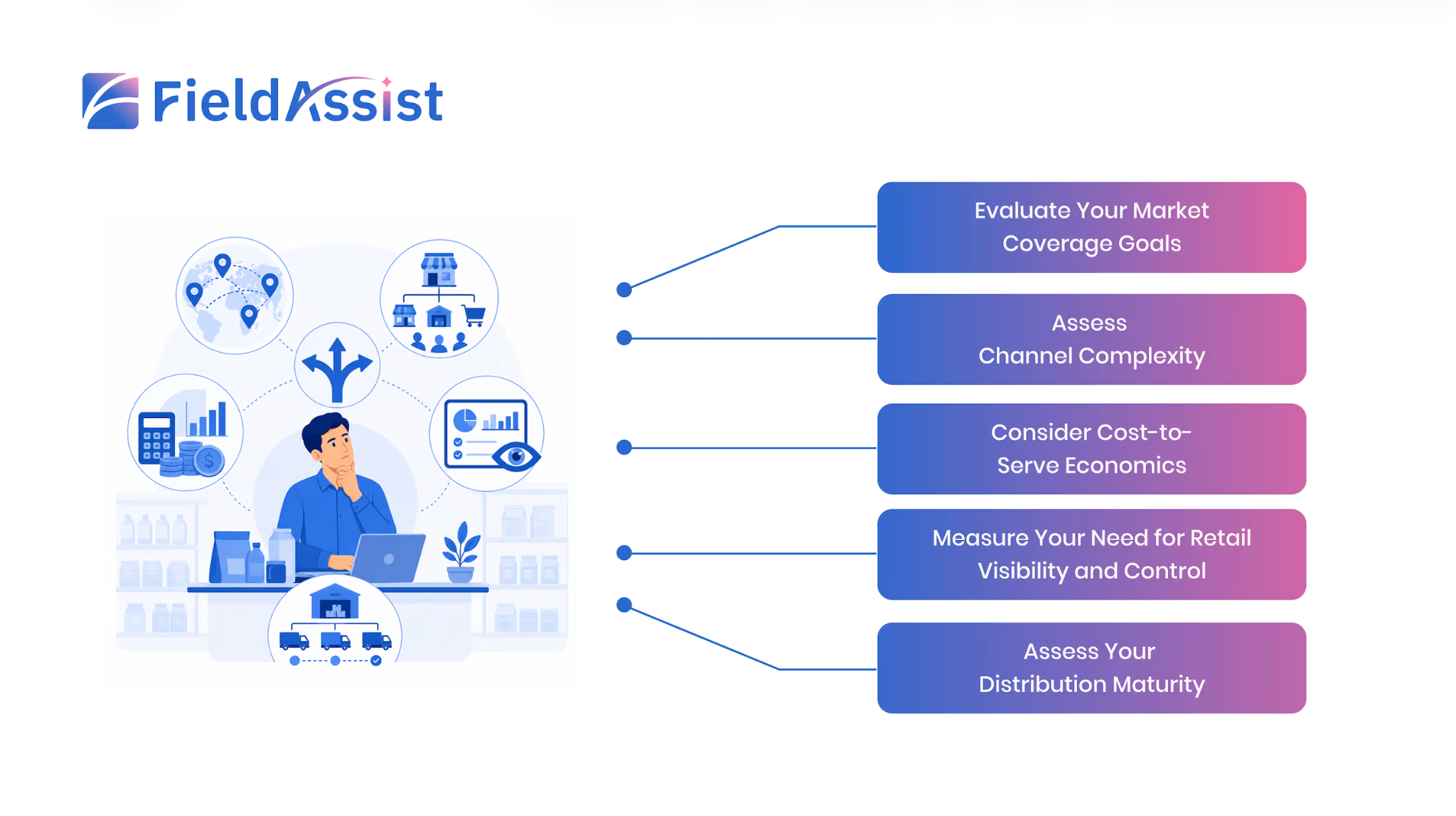
- Consider Cost-to-Serve Economics
The direct distribution vs distributor model debate is ultimately a cost-to-serve conversation. Direct models carry high fixed costs, headcount, vehicles, and route infrastructure that only justify themselves above a certain outlet density and revenue-per-visit threshold. Distributor models shift cost to variable but introduce margin leakage and visibility risk. A rigorous cost-to-serve analysis, built outlet by outlet, is the only honest way to determine where the break-even point lies for your brand.
Industry report highlights that global FMCG average price growth has slowed to 2.6% in 2025, down from 4.1% in 2024, meaning brands can no longer rely on price to offset distribution inefficiency. Volume-led growth through sharper outlet execution is now the imperative.
- Measure Your Need for Retail Visibility and Control
Ask one honest question: Do you know what percentage of your targeted outlets were visited last week, what was sold, and whether your promotional material was placed? If the answer is no, your current model has a last-mile execution gap, regardless of which RTM framework it sits in. Brands with high compliance requirements, price-marked packs, planogram agreements, and cold chain mandates need the real-time visibility that only direct coverage or a tech-enabled hybrid RTM model in FMCG can deliver.
NielsenIQ's 2025 SMB report found that 98% of businesses now acknowledge data's critical role in decision-making. For FMCG brands managing hundreds of SKUs across thousands of outlets, the same logic applies at scale: without outlet-level data, your route-to-market strategy in FMCG is built on assumptions rather than evidence.
- Assess Your Distribution Maturity
Distribution maturity is a function of three things: the quality of your distributor network, the capability of your sales force, and the sophistication of your data infrastructure. Brands early in their distribution journey often lack the processes to run a hybrid RTM model in FMCG effectively. They benefit from starting with a structured indirect model and building toward direct coverage in priority geographies as their systems mature. Brands with established DMS infrastructure and GPS-tracked field forces are typically ready to manage the complexity of a multi-channel model.
How FieldAssist Helps FMCG Brands Execute Any RTM Model Successfully?
FieldAssist is built on a single conviction: the last-mile execution gap is not a people problem, it is a data and systems problem. Whether your brand runs a direct model, operates through a distributor network, or manages a complex hybrid RTM model in FMCG, FieldAssist gives you the infrastructure to execute with precision and measure what matters.
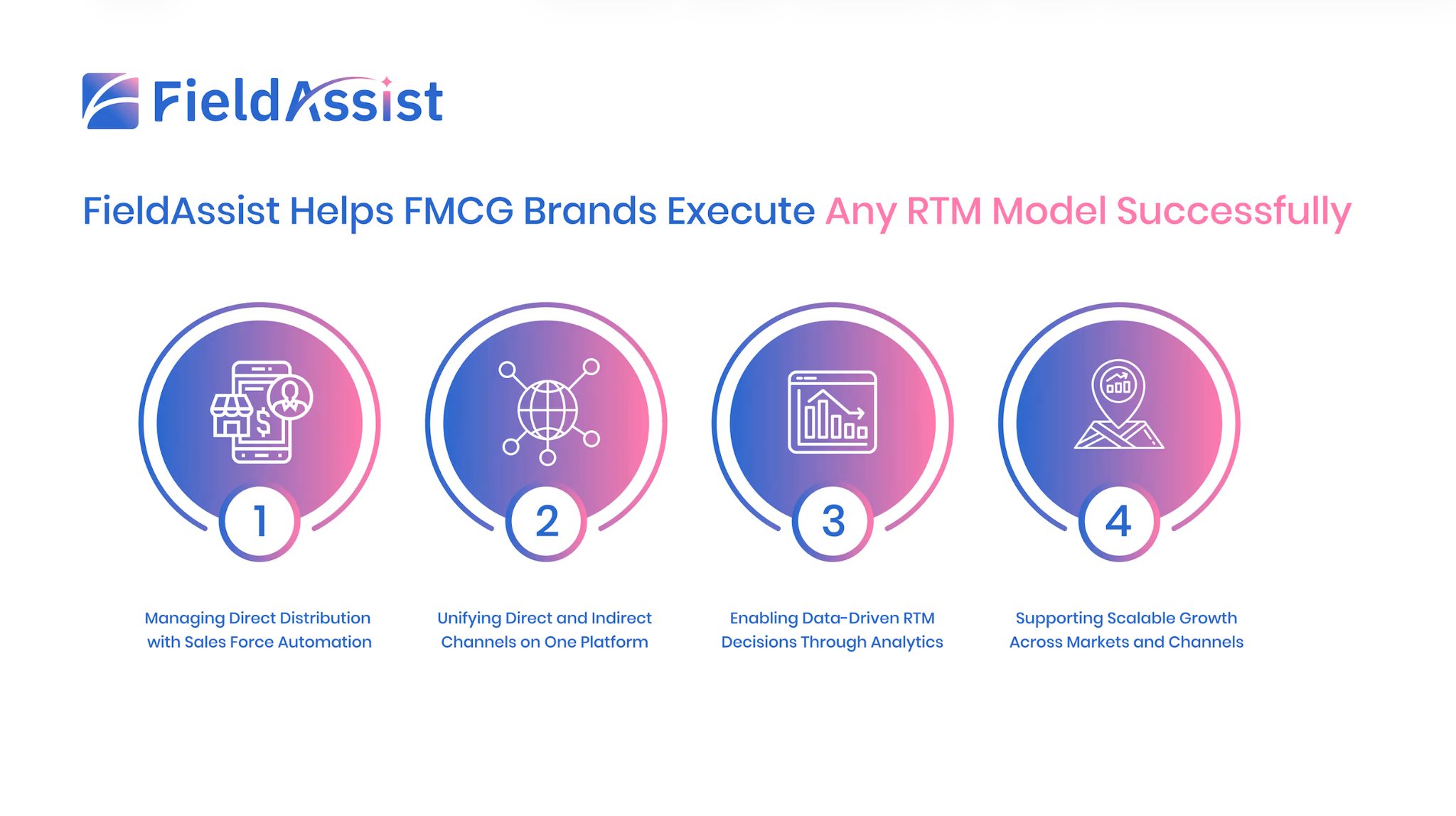
1. Managing Direct Distribution with Sales Force Automation
For brands running direct coverage, FieldAssist's SFA platform brings every field activity under a single, real-time view. Beat plans are pre-loaded and GPS-verified. Order capture happens at the outlet, not from the car park. Geo-stamped visits confirm coverage, and outlet-level data rolls up instantly to management dashboards. Sales managers know exactly where their teams are, which outlets were served, and what was sold, by SKU, by geography, by time of day.
The result: brands shift from managing activity to managing outcomes. Field reps spend time in the right outlets; supervisors spend time coaching rather than chasing reports.
2. Unifying Direct and Indirect Channels on One Platform
The single biggest challenge of a hybrid RTM model in FMCG is channel blind spots. Your direct salesforce operates in one system; your distributors operate in another, or none at all. FieldAssist's integrated DMS bridges this gap. Secondary sales data from distributor operations flows into the same platform as your direct field data, giving you a unified view of offtake, coverage, and inventory across the entire channel stack. No manual reconciliation. No guesswork on distributor sell-through.
3. Enabling Data-Driven RTM Decisions Through Analytics
RTM model selection for FMCG brands should be a data-led process. FieldAssist's IRIS and NOVA intelligence modules surface the outlet-level insights that most brands have never had access to: which outlets are being underserved, where coverage has lapsed, which SKUs are absent from high-potential stores, and where route productivity can be improved. Brands use these insights to redesign beats, reallocate field resources, and make evidence-based decisions about where to invest in direct coverage versus distributor management.
This is the 3i Intelligence framework in practice: the right information, at the right moment, enabling the right field action.
4. Supporting Scalable Growth Across Markets and Channels
As FMCG brands expand into new geographies, moving from metro markets to Tier 3 towns, or from a single country to a multi-market Southeast Asia footprint, RTM complexity compounds. FieldAssist is built to scale with that ambition. The platform supports multilingual field teams, multi-distributor hierarchies, country-specific route planning logic, and market-level performance benchmarking. Brands on FieldAssist do not need to rebuild their execution infrastructure as they grow; they extend it.
Closing Thoughts
There is no universally correct route-to-market strategy in FMCG. Direct coverage maximizes control but demands capital and field infrastructure. Indirect distribution scales faster but trades visibility for reach. A hybrid RTM model in FMCG gives you both, but only if you have the systems to manage the complexity it introduces.
What every model shares is a common requirement: measurability. If you cannot measure outlet coverage, secondary sales, brand execution standards, and distributor performance at a granular level, your RTM strategy is a framework on paper, not an engine for growth.
FieldAssist exists to close that gap. The platform gives FMCG brands the execution infrastructure to make their chosen RTM model work, not just on the strategy slide, but on the last shelf in the last store on the last beat of the week.



.avif)

.avif)