How Automated Incentive Management Software Boosts FMCG Sales Productivity?
Modernize FMCG incentive management with automation, real-time tracking, and faster payouts.

%20(1).avif)
Walk into any RTM review meeting at a CPG company, and you will hear the same complaint: the field is working harder than ever, but secondary sales growth refuses to keep pace. More often than not, the bottleneck is not the sales team's effort. It is the incentive engine sitting behind it. Spreadsheet-based payout calculations, delayed disbursements, and opaque target tracking quietly erode the motivation of TSIs, ASMs, and distributor sales reps across general and modern trade.
This is precisely the last-mile execution gap that FieldAssist Sales Incentive Management Software was built to close. In this guide, we break down how a modern incentive management software, when designed for the realities of FMCG field execution, becomes a direct lever for sales productivity.
Understand What Incentive Management Software Is
Incentive management software is a purpose-built system that automates the calculation, tracking, approval, and disbursement of incentives, commissions, and scheme payouts for field sales teams. Instead of finance and sales ops teams reconciling beat-wise achievement data in Excel every month, a sales incentive platform pulls live data from order booking, distributor management systems, and route plans to compute payouts automatically against pre-configured schemes.
Gartner's Market Guide for Sales Performance Management defines this category cleanly: SPM solutions automate incentive compensation processing while giving sales and finance leaders sharper performance insights (Gartner).
For FMCG brands specifically, this isn't a generic HR tool repurposed for sales. A sales incentive management platform built for CPG needs to handle multi-tier schemes, beat-level and SKU-level targets, retailer-facing schemes, and distributor payout reconciliation, all in one workflow.
The Hidden Productivity Killers in Traditional FMCG Incentive Methods
Many FMCG sales incentive programs still depend on traditional processes that can limit efficiency and frontline engagement. Here are four areas where improvement can make a significant difference:
1. Lack of Real-Time Visibility
In a traditional setup, field sales reps and distributors operate in a data black box. They find out whether they hit their targets or earned their bonuses weeks after a sales cycle ends.
Without real-time dashboards to track their progress, reps can't prioritize effectively. They don't know if they are just one case of inventory away from hitting a major bonus tier, leading to missed opportunities. Instead of being proactively motivated by a ticking visual goal, they work blindly, which naturally dampens daily urgency and hustle.
2. Rigid KPIs Over Action-Based Metrics
Legacy frameworks focus almost entirely on lagging endpoints like "total volume sold." This completely ignores the daily inputs that drive long-term sales health, such as improving shelf visibility or expanding store placements. It incentivizes short-term inventory dumping ("channel stuffing") rather than building sustainable retail habits.
3. Payout Disputes & Admin Burden
When data is trapped in manual spreadsheets, math errors and system mismatches are common. Sales reps and managers spend valuable time validating receipts and coordinating with finance to resolve incentive discrepancies. Every hour spent on administrative damage control is an hour stolen from active selling.
4. Attrition Due to Payment Delays
In traditional models, the lag between closing a sale and receiving a payout can span 30 to 90 days. For frontline workers relying on variable pay, these delays breed financial strain and distrust. Morale plummets, directly fueling high attrition that forces expensive recruitment and resets territory progress.
How to Choose the Best Sales Incentive Software for FMCG Brands?
Not every sales incentive platform on the market is built for the complexity of FMCG field operations. Here is what actually matters when evaluating the best sales incentive software for your organization, and why generic software for FMCG sales teams rarely fits without deep customization.
- Evaluate Scalability for Large Field Teams
FMCG operations are massive, often spanning thousands of on-ground reps, multiple distribution tiers, and layered regional hierarchies. The software you choose must be capable of processing immense volumes of real-time data simultaneously. During peak periods, like month-end closings or festive scheme cycles, the system cannot lag or crash. It needs a robust data architecture that scales seamlessly to ensure payouts are calculated accurately and on time, no matter how large your field footprint grows.
- Check FMCG-Specific Incentive Capabilities
Generic sales software is usually built for B2B or SaaS structures, where a rep closes a few high-value deals a month. FMCG is entirely different; it requires tracking daily "beats" (assigned store routes), specific SKU combinations, category-focused goals, and complex retailer-distributor margins. The right platform must natively understand these FMCG nuances. It should allow you to launch targeted product schemes or distributor payout structures right out of the box, without needing to hire developers to force-fit generic logic.
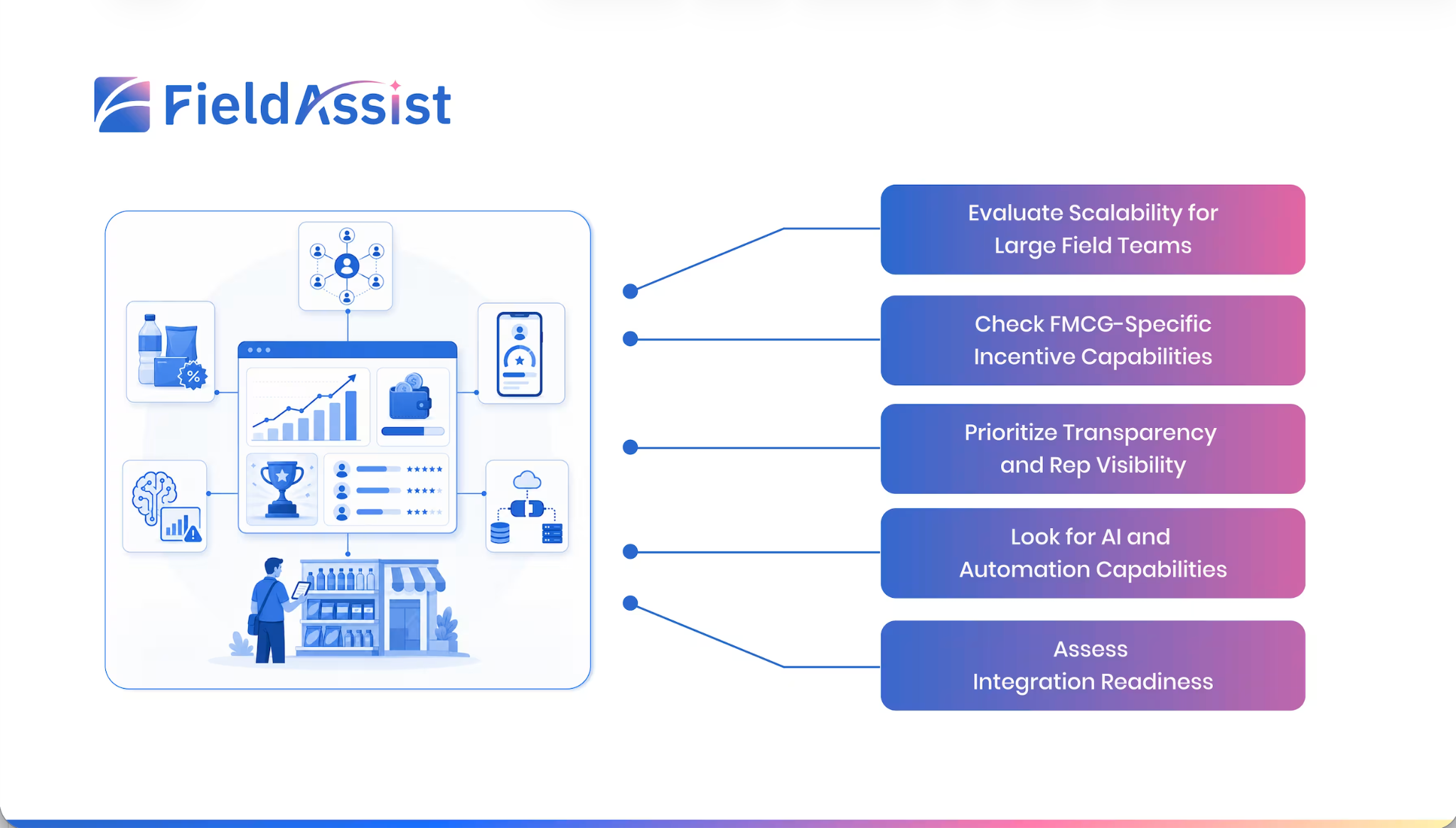
- Prioritize Transparency and Rep Visibility
If a field rep doesn't understand how their bonus is calculated, the incentive loses its power to motivate. The best software includes a mobile-friendly, self-serve interface that gives reps absolute clarity over their daily progress. They should be able to see exactly what they have achieved, what they stand to earn, and precisely what they need to do next to hit the next payout tier. This real-time transparency removes guesswork and stops reps from wasting time asking managers to explain their numbers.
- Look for AI and Automation Capabilities
Modern platforms do much more than basic math; they act as a strategic layer for your sales operations. By leveraging conversational AI, the software can automatically flag unusual claim patterns or anomalies before they turn into costly errors or fraud. Advanced platforms also offer predictive scoring, analyzing historical data to tell you whether a newly planned incentive scheme will actually drive sales or underperform. This shifts your team from reactive calculation to proactive strategy.
- Assess Integration Readiness
Incentive data cannot live in a vacuum. To be effective, A sales incentive management platform must seamlessly plug into the software your company already uses, your Sales Force Automation tool, DMS, and Enterprise Resource Planning (ERP) backend. A highly integratable system ensures that order bookings, shipment data, and inventory levels automatically feed right into the incentive calculations. This creates a single source of truth and prevents your finance and sales ops teams from manually moving data between fragmented systems.
How FieldAssist Sales Incentive Management Software Drives FMCG Sales Performance?
FieldAssist's Sales Incentive Management Software is built specifically around the realities of FMCG field execution that we have walked through above, not adapted from generic sales commission tools.
1. Automate Complex Incentive Calculations Without Spreadsheets
FieldAssist's incentive management software eliminates the need for manual, spreadsheet-based calculations that strain sales operations and teams. It automatically computes multi-tiered and multi-scheme payouts directly from live order and beat data, ensuring highly accurate, hassle-free processing every single month.
2. Give Sales Reps Real-Time Visibility Into Targets and Earnings
By integrating target progress and earning tracking directly into the daily FieldAssist app, reps can see their financial rewards instantly as they book orders. This immediate visibility motivates field teams by clearly linking daily actions to their final payouts.
3. Accelerate Payout Processing and Reduce Disputes
The system utilizes configurable, rule-based approval workflows that significantly speed up payout timelines. Furthermore, it creates a fully auditable data trail, allowing teams to quickly resolve commission disputes through concrete evidence rather than endless, back-and-forth email chains.
4. Use AI-Powered Insights to Improve Incentive Effectiveness
Leveraging the "3i Intelligence Framework" (Insights, Intelligence, and Intervention), the software uses AI to identify underperforming incentive schemes and flag claim anomalies. It then recommends data-backed adjustments to help companies design more effective, high-performing sales strategies.
5. Seamlessly Integrate Incentives With Field Execution
Incentives move beyond being just an isolated finance function. Because data lives inside the unified platform managing route planning, DMS, and Perfect Store execution, the incentive structure seamlessly acts as a direct, day-to-day extension of overall field operations management.
Why FMCG Companies Are Moving Toward AI-Powered Incentive Management?
AI adoption inside core revenue functions is no longer experimental. McKinsey's research found that 88 percent of organizations now report regular AI use in at least one business function, up from 78 percent the previous year, with sales among the functions seeing the clearest revenue gains.
That gain is measurable at the sales function level too. According to McKinsey's analysis of generative AI's economic potential, sales productivity could increase by roughly 3 to 5 percent of current global sales expenditure when AI is embedded into core sales workflows, a category that includes incentive design and execution.
The compensation strategy itself is also under more scrutiny than ever. Gartner's sales compensation benchmarking research allows sales leaders to benchmark their plans against 145 cross-industry B2B sales organizations globally, underlining how data-led, continuously optimized incentive design has become standard practice rather than a nice-to-have.
For FMCG brands managing thousands of field reps and distributors across fragmented general and modern trade geographies, AI-powered incentive management is what turns a static, once-a-year scheme design exercise into a continuously optimized productivity lever.
Closing Thoughts
The math is simple: a motivated, transparently rewarded field force sells more, stays longer, and executes schemes more faithfully at the shelf. Manual incentive processes were never built to handle the scale and complexity of modern FMCG distribution.
An automated Sales Incentive Management Software platform closes that last-mile execution gap by giving reps real-time visibility, finance teams clean audit trails, and sales leaders AI-powered insight into what is actually driving performance.
If your incentive management software is still living in spreadsheets, it is costing you more in lost productivity than the platform itself would ever cost to implement.




.avif)