FMCG Pricing Strategy: How Data-Driven Brands Conquer the Shelf
Build a smarter FMCG pricing strategy with real-time retail pricing analytics, competitor tracking, and flawless field execution to improve margins and shelf performance.

For CPG brands, the shelf is a battlefield. Every facing, every price tag, every trade scheme is a tactical decision with direct revenue consequences. Yet, in boardrooms across emerging and developed markets alike, the most sophisticated FMCG pricing strategy often breaks down at the very last mile, the retail outlet, the kirana store, the distributor's loading dock.
The numbers are unambiguous about the stakes. As per Bain & Company's Consumer Products Report, 75% of global FMCG value growth in 2023 was driven by price increases, not volume gains, and in the US and Europe, that figure reached 95%. With consumer wallets stretched thin and private label products gaining ground, the era of "price your way to growth" is drawing to a close. What separates the winners now is execution intelligence: the ability to craft a precision retail pricing strategy and enforce it, store by store, SKU by SKU, in real time.
This is the definitive guide to building that capability.
The Core Elements of a Winning Pricing Strategy in FMCG
A robust pricing strategy in FMCG is never a single lever. It is an interlocking system of cost structures, channel realities, promotional mechanics, and consumer psychology, all of which must work in concert at the shelf.
1. Cost-Based vs. Value-Based Pricing Structures
Most legacy CPG brands default to cost-plus pricing: calculate input costs, add a target margin, and push the number down the channel. This approach is financially legible but strategically blind. It ignores the consumer's willingness to pay, the competitive price corridor, and the brand equity premium you've spent years building.
Value-based pricing, anchoring price to the perceived benefit of the product in the consumer's life, consistently delivers stronger margin outcomes. A biscuit brand in a mid-tier urban market isn't competing on biscuit cost; it's competing on the occasion, the snacking ritual, the pack size that fits a ₹10 impulse budget. The strongest FMCG brand strategy practitioners understand this distinction and price accordingly across their portfolio tiers.
2. Regional and Channel-Specific Pricing Variances
A single national price list is a fiction. The economic reality of a Tier-1 metro general trade outlet, a modern trade hypermarket, an e-commerce listing, and a rural kirana are entirely different. Freight costs, retailer margin expectations, local competitive pressure, and consumer income profiles all vary. Brands that apply one MRP across all these contexts are either leaving margin on the table in affluent markets or pricing themselves out of volume in price-sensitive geographies.
Effective FMCG pricing strategy mandates a deliberate, channel-wise, and region-wise price architecture, and the operational infrastructure to enforce it.
3. The Role of Trade Promotions and Schemes
Trade promotions: retailer discounts, distributor schemes, consumer offers, account for a substantial portion of CPG revenue spend globally. The challenge isn't running schemes; it's ensuring they reach their intended beneficiary and deliver the expected ROI. Poorly designed schemes leak margin at every node of the distribution chain. Properly structured ones drive volume, build retailer loyalty, and protect shelf space.
A winning retail pricing strategy treats trade promotion not as a reactive cost but as a proactive investment, governed by data, with clear claim-and-redemption trails that prevent revenue leakage.
4. Elasticity and Consumer Psychology at the Point of Sale (POS)
Price elasticity is not uniform. A 5% price increase on a staple commodity can destroy volume; the same increase on a branded health supplement may go unnoticed. Similarly, ₹99 outperforms ₹100 in consumer psychology terms far beyond what the ₹1 difference suggests. "Price pack architecture", designing the right product format at the right price point, is one of the highest-ROI levers available to an FMCG brand strategy team.
Understanding these psychological thresholds, then building them into your pricing engine, is
what separates brands that protect volume during inflationary cycles from those that bleed it.
The Costly Pitfalls of "Blind" Retail Pricing Execution
Even the most carefully engineered pricing strategy in FMCG will underperform if your field execution is opaque. Here is where the "last mile gap" creates real, measurable revenue destruction.
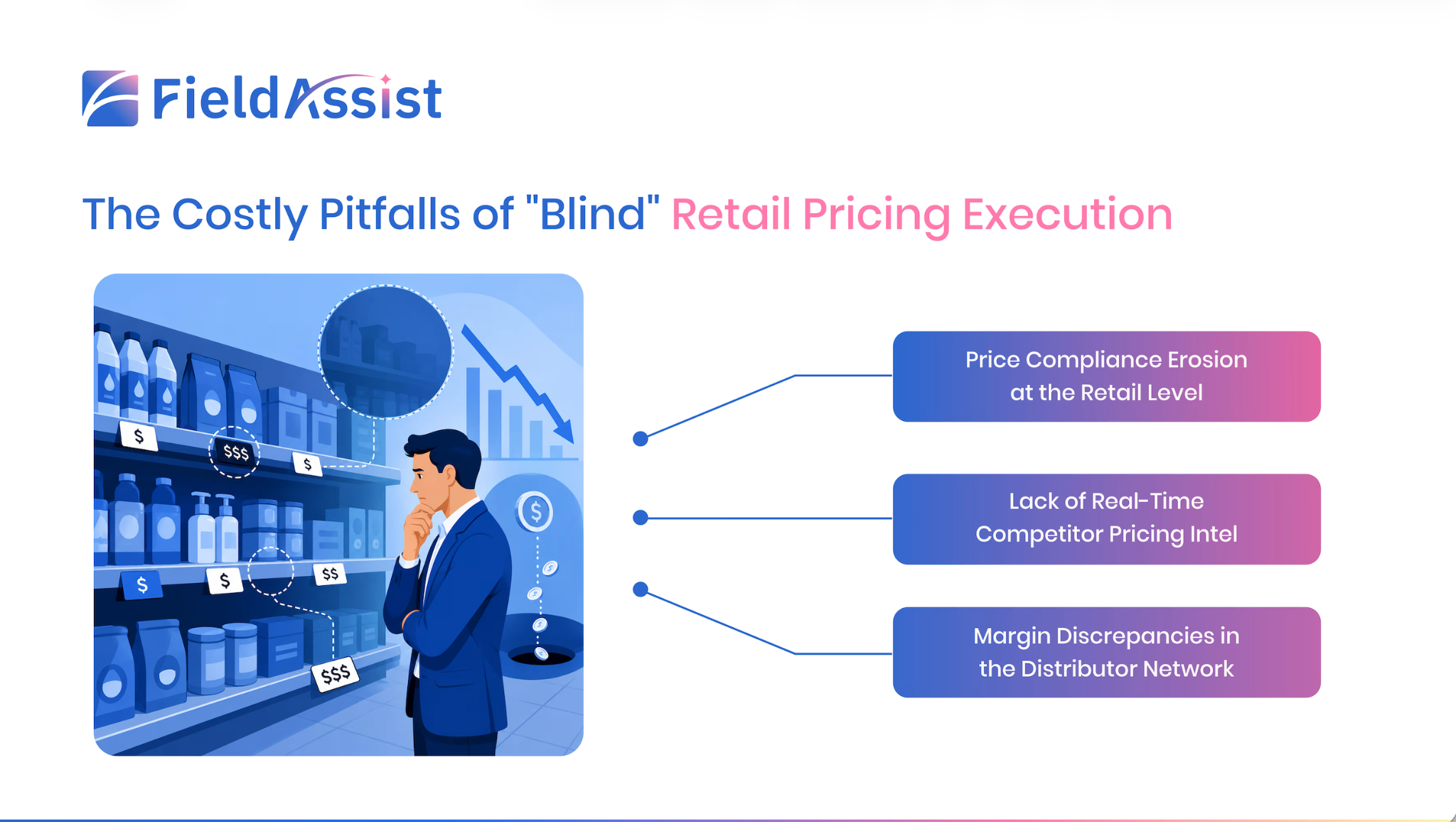
- Price Compliance Erosion at the Retail Level
Your pricing circular says ₹45 MRP. Your sales rep visits 80 outlets a month and manually records whatever the retailer shows. What you don't see: the 23% of outlets where the retailer is quietly charging ₹ 48, pocketing the difference; the modern trade chain that has quietly dropped your facing to push a higher-margin private label at a competing price point; or the rural sub-stockist who has bumped prices by ₹2 to cover undisclosed logistics costs.
Price compliance erosion is silent and systemic. Without a structured Retail Pricing Analytics Tool, it is entirely invisible to the brand team until it shows up as an unexplained volume dip in the monthly review.
- Lack of Real-Time Competitor Pricing Intel
In FMCG, competitive pricing moves are not strategic announcements; they are ground-level guerrilla actions. A competing brand reduces its 500g pack by ₹5 in North Karnataka. Your field team notices it three weeks later. By then, the retailer has reoriented their recommendation to the consumer, and you've lost a month of share.
According to a survey, companies that resist easing up on pricing management, even as inflation recedes, and stay analytically close to competitive moves consistently outperform peers on margin retention. The insight is simple: you cannot respond to a competitive price move you don't know about. Real-time competitive intelligence, captured by your field force and surfaced through a Retail Pricing Analytics Tool, is now a baseline operational requirement.
- Margin Discrepancies in the Distributor Network
The distributor layer is where retail pricing strategy intentions often go to die. Secondary margins, additional discounts promised verbally by field reps, scheme misinterpretation, and claim inflation can collectively erode 2-4% of net realization without appearing on any single dashboard. Distributor Management Systems that aren't synchronized with SFA and pricing policies create structural blind spots that compound over time.
The brands that address this aren't doing so with audits alone; they're building data pipelines that make discrepancies visible before they become disputes.
What Makes an FMCG Pricing Strategy Work?
Deploying a Flawless Retail Pricing Strategy with FieldAssist
FieldAssist is built for exactly this problem: bridging the gap between the pricing strategy designed in the brand team's conference room and what actually happens at the shelf. Here is how each layer of the platform contributes to flawless retail pricing strategy execution.
1. FieldAssist SFA: Automated Ground-Level Pricing & Competitor Intel
The FieldAssist Sales Force Automation platform turns every field rep's beat visit into a structured data collection event. Reps capture outlet-level selling prices, competitor pricing, scheme visibility, and planogram compliance, not on paper forms that get transcribed a week later, but via a structured mobile workflow that uploads in real time.
This means brand managers have a live, outlet-level pricing map updated daily. Price compliance exceptions are flagged automatically. A competitive price cut in a specific geography surfaces within 24 hours, not three weeks. This ground-level intelligence layer is the foundation on which any meaningful pricing strategy in FMCG must be built.
2. FieldAssist Analytics: The Executive Command Center
Raw field data is noise without the right analytical framework. FieldAssist Analytics transforms outlet-level pricing signals into actionable business intelligence: regional price-compliance heatmaps, competitor price benchmarking by category and SKU, trade-scheme ROI analysis, and volume-price sensitivity modeling.
This is the Retail Pricing Analytics Tool that closes the loop between strategy and execution. Sales directors can identify underperforming geographies before they become quarterly problems. Category managers can test price-pack architecture hypotheses against real secondary data. And the C-suite gets a pricing command center, not a lagging-indicator report.
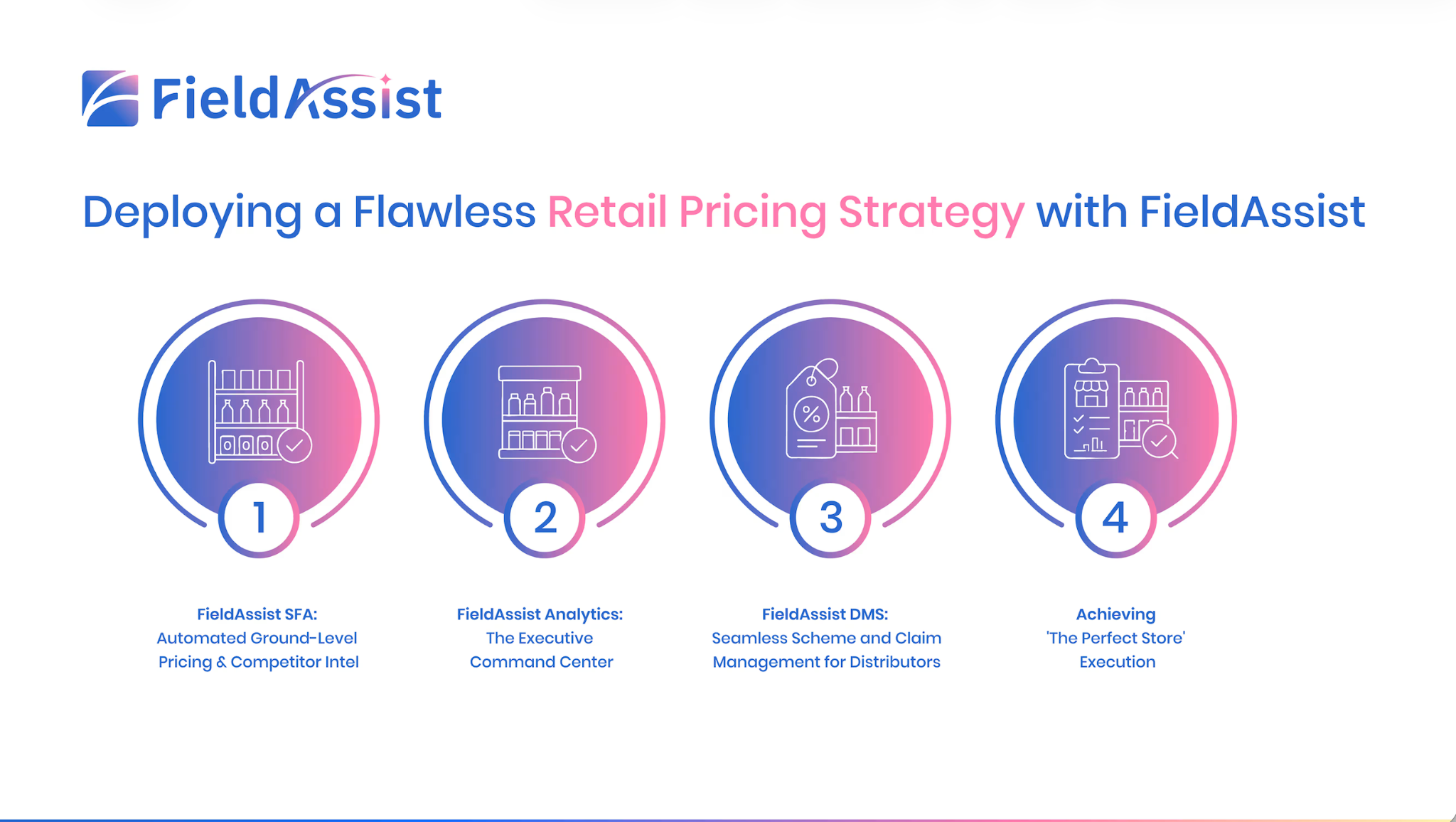
3. FieldAssist DMS: Seamless Scheme and Claim Management for Distributors
The FieldAssist Distributor Management System (DMS) is the operational backbone for trade promotion integrity. Every scheme, whether a volume-linked discount, a display incentive, or a seasonal consumer offer, is configured in the system with clear eligibility criteria, redemption caps, and verification requirements.
Distributors claim against actual secondary sales data, not verbal assurances. Claims are validated automatically against purchase data. This eliminates the dual leakage problem: schemes that don't reach the retailer because the distributor absorbed them, and claims that exceed entitlements because there's no verification trail. The result is an FMCG pricing strategy where every promotional rupee is accounted for, and every scheme drives the intended behavior down the channel.
4. Achieving 'The Perfect Store' Execution
The Perfect Store is the FMCG industry's gold standard: every outlet within your distribution network is stocked with the right SKUs, at the right price, with the right scheme visibility, on every visit. It is the operational expression of your FMCG brand strategy at the shelf.
FieldAssist's integrated SFA + Analytics + DMS platform is engineered to make Perfect Store a measurable, improvable metric, not an aspiration. Outlet scorecards track performance against the Perfect Store template across pricing compliance, availability, visibility, and scheme adherence. Deviations are flagged to the rep, the ASM, and the RSM in real time. Over time, the data identifies the structural barriers specific to geographies, specific outlet formats, and specific SKU categories, where pricing execution consistently falls short, enabling targeted correction rather than blanket directives.
Conclusion: The Future of FMCG Pricing Belongs to the Agile
The structural forces reshaping FMCG pricing are not temporary. Industry reports projects FMCG sales to grow at a 5.3% CAGR through 2025- 2029, but this growth will be increasingly volume-driven rather than price-driven, as consumer price sensitivity structurally constrains the headroom for further increases. In this environment, the brands that win are those that make the right pricing call at the right time in the right channel and execute it without leakage.
A winning FMCG pricing strategy in 2025 and beyond is not just a set of numbers on a pricing circular. It is a live capability: field intelligence feeding analytics, analytics informing decisions, and DMS infrastructure enforcing integrity at the distributor level.
FieldAssist exists to close the last-mile execution gap. If your pricing strategy is losing something between the boardroom and the shelf, it's time to find out exactly where and fix it.




.avif)