FMCG Field Sales Productivity Benchmarks: How Does Your Team Compare?
Are your field teams hitting the mark? Discover the CPG sales productivity benchmarks for strike rates, outlet coverage, and secondary sales to optimize execution.

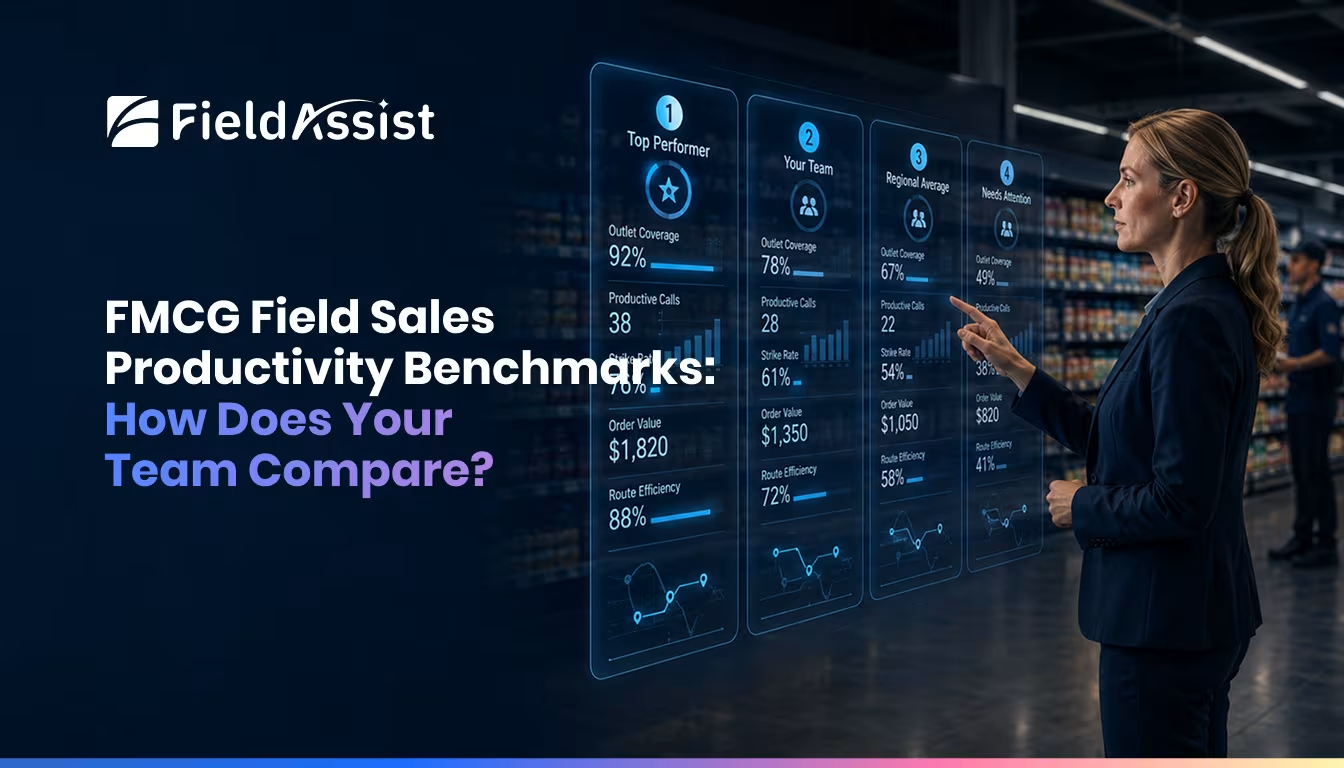
Two FMCG enterprises operate side-by-side. Both fields have exactly 500 sales reps, command a near-identical distribution footprint, and fight for the exact same retail shelf space. Yet one organization scales its active outlet coverage by 15% year-over-year, while the other sees volume stagnate and distributor margins erode.
If headcount, product quality, and trade budgets are equal, where is the growth delta coming from?
The answer lies in the micro-efficiencies of field sales execution. While one team loses thousands of collective hours to inefficient routing, poor order capture mechanics, and low strike rates, the other has turned its field force into a precision engine.
For the C-suite, this reality exposes an uncomfortable truth: headcount is a vanity metric; operational velocity is the growth driver. In an environment where cost-to-serve is rising, and the battle for the perfect store is won at the counter, relying on gut feel or lagging indicators creates dangerous blind spots.
If you aren't auditing the exact time your reps spend in front of retailers, you are likely subsidizing invisible revenue leaks.
Why Productivity Matters More Than Team Size?
For decades, the standard FMCG playbook for capturing market share was simple: expand the territory, hire more reps, and increase the sheer volume of "feet on the street." Today, that brute-force model is financially unsustainable.
Sales leaders are operating against a confluence of margin-crushing headwinds that make field efficiency the single biggest driver of profitability:
- The Rising Cost-to-Serve: Compensation, travel logistics, and tech overhead have sharply inflated the baseline cost of fielding a sales team. Every unproductive store visit or empty route now carries a much heavier financial penalty to the bottom line. We have written a detailed blog on how the cost to serve works in Africa.
- SKU Proliferation: Reps are no longer just order-taking for three flagship products. They are tasked with pitching increasingly complex portfolios including new category expansions and localized variants often within a frantic three-minute window at a crowded counter.
- Territorial Strain: As brands push deeper into tier-3 cities and aggressively expand urban perimeters, reps are tasked with covering larger, more geographically dispersed territories. Without optimization, this spikes "windshield time" (transit) at the direct expense of active selling time.
- Retail Fragmentation: The channel mix has fractured. A single territory now spans traditional mom-and-pop kiranas, localized modern trade, and quick-commerce dark stores. Navigating this requires high agility and multi-format execution rather than a one-size-fits-all route plan.
In this high-friction environment, trying to solve distribution bottlenecks simply by inflating headcount leads to bloated P&Ls and diminishing returns. The mandate from the board is clear: drive higher throughput and deeper penetration with the resources already on the payroll.
The top-performing FMCG brands do not win because they deploy a larger army of reps. They win because every individual rep generates a disproportionately higher yield of commercial value per day.
The 10 Productivity Benchmarks Every FMCG Leader Should Track
Visibility without benchmarking is just noise. To diagnose execution gaps, FMCG leaders must track the specific micro-metrics that drive bottom-line results.
Here are the 10 critical benchmarks that separate average distribution networks from elite, high-velocity field teams.
1. Productive Calls Per Day
A "call" only counts if it results in meaningful engagement or a transaction. Tracking raw visits masks the reality of quick drop-ins that yield zero commercial value.
2. Outlet Coverage %
This measures the percentage of assigned, mapped outlets your reps actually visit within a billing cycle. Leaving coverage to chance means leaving shelf space to competitors.
3. Strike Rate (Conversion)
Calculated as Orders ÷ Total Calls. This is the ultimate measure of pitch effectiveness and assortment relevance. Walking into a store is an expense; securing the order is the ROI.
4. Average Order Value (AOV)
Volume is vanity; value is sanity. AOV measures the actual revenue yield of each successful visit. Flat AOV despite rising strike rates often indicates heavy reliance on low-margin fast movers rather than pushing premium SKUs.
5. SKU Productivity (Lines Per Call)
Tracking the average number of distinct SKUs sold per order reveals the depth of your distribution. High SKU productivity indicates that reps are actively upselling, cross-selling, and executing proper assortment strategies rather than just order-taking for flagship items.
6. New Outlet Acquisition
The rate of new, productive outlets added monthly. This is a critical health metric during aggressive General Trade (GT) expansion, rural market penetration, or launching new sub-categories where historical distribution footprints fall short.
7. Time Spent Selling vs. Travelling
Elite teams treat time as their most constrained asset. A poorly optimized route bleeds selling time into "windshield time."
8. Sales per Rep
The most straightforward metric on the board: total revenue generated divided by headcount. It provides an immediate baseline for calculating the breakeven cost of your field force.
9. Beat Adherence
The ratio of planned route visits versus actually completed visits. Top-performing teams maintain 95%+ beat adherence, ensuring that territory plans designed at the macro level are executed at the micro level.
10. Outlet Growth Contribution
How much of your top-line sales growth is coming from same-store velocity versus net-new outlet expansion? Many FMCG brands underestimate this metric, failing to realize their core outlets are stagnating while overall numbers look artificially healthy due to aggressive territorial expansion.
Build Your FMCG Productivity Index
Evaluating these benchmarks in isolation can create blind spots. The most effective sales leaders aggregate these metrics into a weighted scorecard—a single Productivity Index that provides an objective, at-a-glance health check of field operations.
Here is a recommended weighting model to assess total team performance out of 100 points:
Why Most Teams Miss These Benchmarks
When teams fall into the "average" or "poor" tiers, it is rarely a symptom of lazy reps. It is usually a symptom of systemic operational failures that limit their capacity to sell.
- Poor Beat Planning: Relying on static, legacy routes means reps spend hours navigating traffic or crisscrossing territories inefficiently.
- Low Visibility: Managers are often looking in the rearview mirror. Reviewing end-of-month reports means diagnosing the problem weeks after revenue was lost.
- Manual Reporting: If reps are spending hours manually tallying stock, writing orders, or compiling daily reports, that is time actively stolen from pitching to retailers.
- No Outlet Prioritization: Treating a massive wholesaler and a low-volume corner store with the same visit frequency misallocates valuable field hours.
- Data Silos: When secondary sales data, supply chain inventory, and field execution metrics live in disconnected systems, reps walk into stores blind to out-of-stocks or credit issues.
What Top FMCG Teams Do Differently
Bridging the gap between a 55% and an 80% strike rate requires structural changes to how reps operate. Market leaders equip their teams with intelligence, not just targets.
This is where platforms like FieldAssist naturally enter the conversation, transforming legacy distribution models into agile, data-driven engines. Top teams leverage technology to execute:
- AI-Assisted Beat Planning: Dynamically restructuring routes based on geography, store priority, and historical traffic patterns to minimize transit time.
- Outlet Prioritization: Tiering stores by volume and strategic importance to dictate intelligent visit frequencies.
- Real-Time Performance Monitoring: Giving managers live dashboards to course-correct underperforming territories mid-cycle, not post-mortem.
- Predictive Sales Recommendations: Equipping reps with automated, store-specific pitches (e.g., "This retailer is out of SKU X, and usually buys SKU Y together") to maximize lines per call.
- Automated Reporting: Removing administrative friction so reps focus entirely on retailer engagement.
Self-Assessment Checklist
Are your field operations built for 2026? Use this rapid diagnostic to evaluate your current baseline against the benchmarks above. Give your team one point for every criteria they consistently meet.
- Reps achieve 25+ productive calls per day
- Active outlet coverage exceeds 90%
- Overall strike rate sits above 70%
- Beat adherence consistently hits 95%+
- Managers have real-time, intra-day visibility into field activity
- Active selling time drastically exceeds travel time
Your Productivity Score:
- 5 - 6 (High Performing): Your field force is a precision asset. Focus on predictive AI and micro-segmentation to extract marginal gains.
- 3 - 4 (Needs Improvement): You are leaking revenue through operational friction. Prioritize route optimization and strike-rate enablement.
- 0 - 2 (Significant Gap): High risk of market share erosion. An immediate structural overhaul of your beat planning, field tech, and reporting cadence is required.
Conclusion:
The gap between market leaders and lagging brands isn't defined by the size of the sales team, but by the velocity of their execution. Measuring your team’s productivity against rigid industry benchmarks is the first step toward uncovering hidden revenue leaks across outlet coverage, field execution, and daily sales performance.
Relying on legacy processes means accepting invisible leaks in your distribution engine. Elevating your metrics from average to top-quartile requires moving past static data and equipping your field force with real-time, actionable market intelligence.



%20(1).avif)