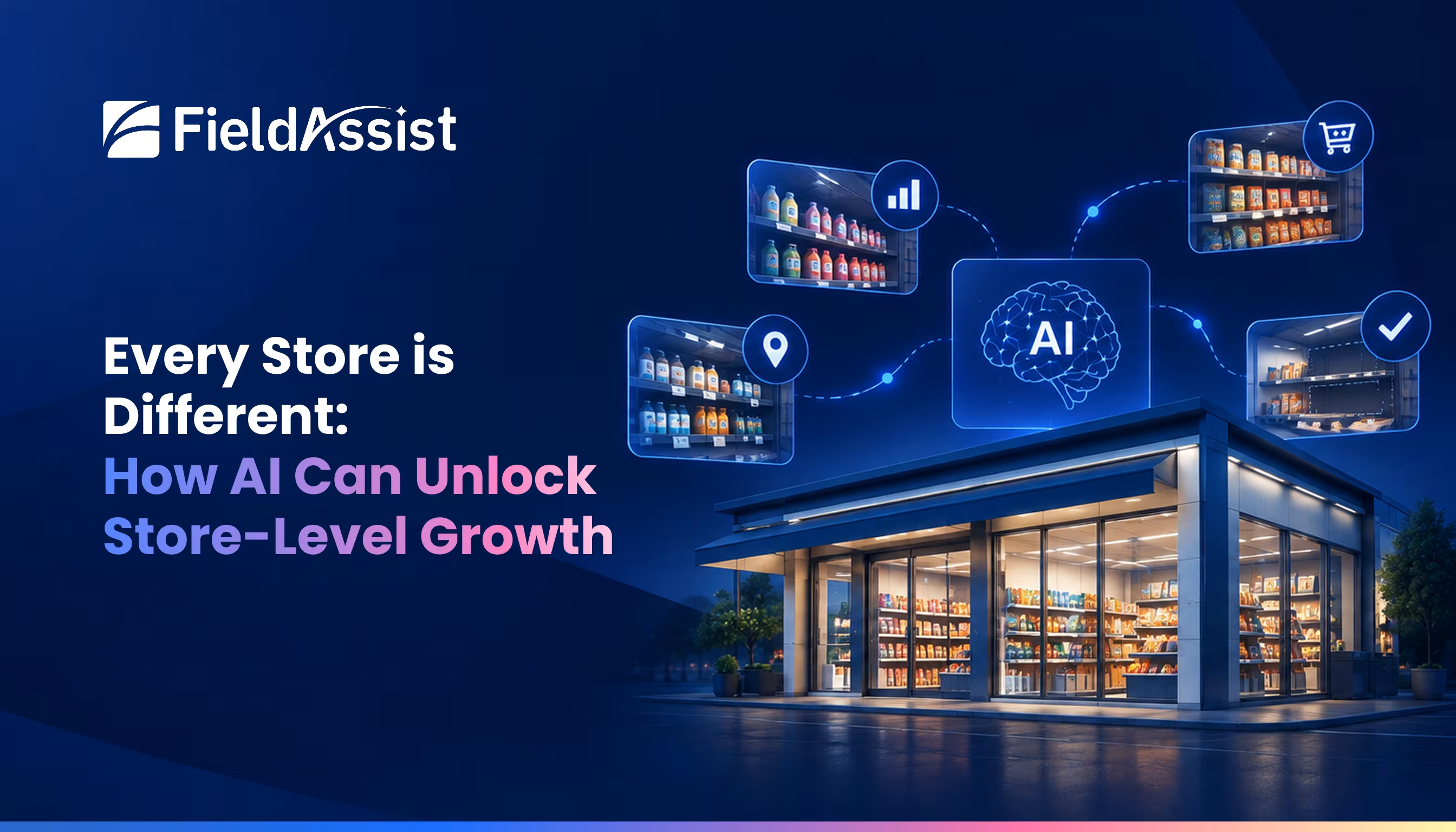
Every Store Is Different: How AI Can Unlock Store-Level Growth
How agentic AI and supply chain intelligence help CPG and FMCG brands turn store-level signals into next-best actions, reduce stock-outs, and unlock growth.
%205%20(1).avif)
Walk into any two stores in the same city, same brand, same planogram, same regional manager, and you're looking at two different businesses. One runs on weekday footfall from a nearby office park. The other peaks on weekends, driven by a school or festival calendar that the HQ has not mapped. One is three days from an out-of-stock on its fastest-moving SKU. The other is sitting on excess inventory of that exact product.
Most retail and CPG operating models were never built to see that difference. Assortment plans, replenishment cycles, and promotional calendars are set at the network or regional level, then pushed down uniformly, on the working assumption that the "average store" is a reasonable proxy for the real one. It isn't. No store is average. Every store is a distinct combination of catchment, footfall, credit cycle, and shelf reality, and the gap between the network plan and that reality gets absorbed, store by store, as lost sales, tied-up working capital, or a rep visit that fixes nothing because it was never told what that specific outlet actually needed.
This is exactly the gap that Groceryshop's Agentic AI and Supply Chain Intelligence theme puts front and center this year, and it's the core belief FieldAssist and Happiest Minds are bringing to the show floor together: the next unlock in retail isn't a more accurate network forecast. Brands have spent a decade making the average more precise, better models, tighter regional cuts, faster refresh cycles, and the average is still just an average. It describes ten thousand stores and predicts none of them. The real opportunity is combining store-level signals and supply-chain context to determine the next best action for that specific store, and acting on it before the moment passes.
The Cost of Managing to the Average
Here's the part that doesn't show up on a regional dashboard: averaging isn't neutral. A forecast that looks accurate in aggregate can be wrong for most of the individual stores that built it, some overstocked, others starved, both losing money in opposite directions at the same time. The math cancels out on a spreadsheet. It does not cancel out on a shelf, where an empty peg is a lost sale regardless of what the regional number says.
That hidden cost has a number attached to it. IHL Group's 2026 Inventory Distortion Study puts the global cost of out-of-stocks and overstocks combined at $1.7 trillion, roughly 6.2% of global retail sales, with out-of-stocks accounting for close to two-thirds of that figure. That isn't demand-planning noise. It's the compounding result of thousands of stores being run against rules written for a store that doesn't exist, quarter after quarter, market after market.
Sharpening the national model doesn't close this gap, because the gap was never a forecasting problem. A brand can improve its demand model every quarter and still lose the same sale in the same outlet, because the model was never built to know that outlet's particular rhythm in the first place. The fix isn't a better average. It's the ability to see, and act on, the store that actually exists.
What “Store-Level Signals” Actually Means?
Every store generates a stream of signals that describe its own reality, and they generally fall into four buckets. Demand signals: sell-out velocity by SKU, basket patterns, and seasonal or event-driven spikes specific to that catchment. Execution signals: on-shelf availability, planogram compliance, pricing accuracy, and how consistently the store is actually being serviced. External signals: local weather, nearby competitor activity, footfall trends, and neighborhood-level buying behavior. And supply chain signals: distributor stock, in-transit inventory, and last-mile delivery timing feeding that specific outlet.
Most organizations already collect a version of each of these. What's usually missing is the ability to connect all four, reason over them together, and act on the result store by store, at the speed the ground demands. A stock-out risk flagged on Monday is only useful if it reaches a decision, and a delivery, before Thursday.
Where Agentic AI Changes the Equation
This is where agentic AI moves the conversation from dashboards to decisions. Traditional analytics tells a regional manager that a store's numbers look off, and leaves the interpretation and the follow-through to a human who is also managing two hundred other stores. Agentic AI can look at that one store's specific combination of demand, execution, external, and supply chain signals, weigh them against real constraints, and recommend, or even initiate, the next best action: a replenishment trigger, a localized promotion, an assortment tweak, or a route change for the field rep covering that outlet.
The distinction matters. A dashboard describes what happened. A rules-based alert flags a threshold being crossed. An agent reasons across signals it wasn't explicitly told to combine and proposes, or takes, an action suited to that store's specific situation, not a generic one.
Sales organizations already operationalizing this pattern are seeing the impact. Gartner reports that sales teams providing AI-enabled next-best-action recommendations are 2.6 times more likely to achieve commercial growth than those that don't. The same shift is underway upstream: Gartner also predicts that by 2030, half of cross-functional supply chain management solutions will use intelligent agents to autonomously execute decisions across the ecosystem.
Store-level growth and supply chain intelligence are converging into the same problem: getting the right decision to the right store, fast enough to matter. Solve that, and “next best action” stops being a sales-enablement buzzword and becomes an operational capability.
Supply Chain Intelligence Is the Other Half of the Story
Store-level context is only half the picture. The other half is whether the supply chain can act on it. A next-best-action recommendation is only as good as the organization's ability to fulfill it: is the stock available, is the distributor route optimized, can the last mile actually deliver in time? A perfectly reasoned recommendation that arrives against an empty warehouse is not a next best action. It's a missed one.
This is why supply chain visibility and store-level intelligence can't be solved in isolation. IBM research finds that organizations investing more deliberately in AI across supply chain operations report revenue growth 61% higher than peers who haven't made the same investment. Agentic AI is the connective layer that lets a store-level signal, a stock-out risk, a demand spike, trigger a supply chain response automatically, instead of waiting for someone to notice it in a report days later.
In practice, that means the same agentic layer that reads a store's shelf and footfall data should also be reading the distributor's stock position and the delivery route serving it. Store-level intelligence without supply chain intelligence produces recommendations nobody can fulfill. Supply chain intelligence without store-level context produces fulfillment nobody specifically needed. The value sits at the intersection of the two.
Turning Store-Level Intelligence Into Store-Level Action
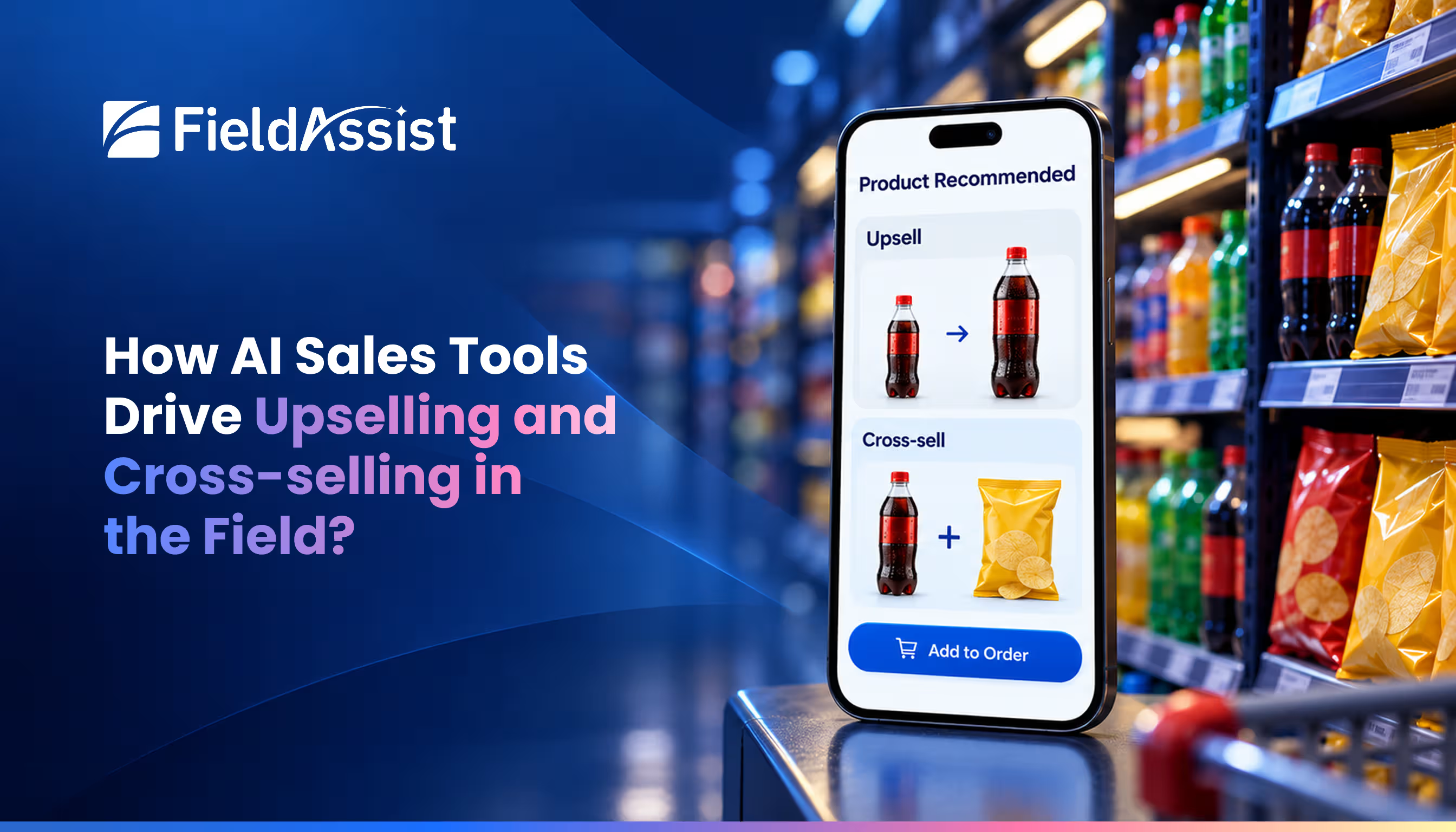
This shift from average-based decisions to store-specific ones is already showing up in the tools brands use every day, and it's worth grounding the idea in what it actually looks like. On the demand side, engines like FieldAssist's Product Recommendations system study a store's own ordering history, category trends, and outlet clustering to recommend the specific SKUs that outlet is statistically likely to need next, in real time during order booking, instead of defaulting to a generic best-seller list. It's the same next-best-action logic Gartner's research points to, applied at the level of a single order for a single outlet.
On the execution side, the same logic applies to what happens on the shelf, not just the order sheet. Store-level tools such as the Perfect Store solution auto-prioritize which outlets a field rep should visit based on sales potential, historical compliance, and visibility gaps, then flag the specific issue at that outlet: a missing must-sell SKU, a planogram deviation, a shelf-share slip, so it can be corrected on that visit instead of surfacing in a report weeks later. Brands using this kind of store-level targeting have reported meaningful gains in outlet ROI, planogram compliance, and SKU availability, precisely because the system is reacting to what one store needs rather than what the network average suggests.
Neither tool treats the network as one store. Both treat every outlet as its own decision, informed by that outlet's own signals, which is the point this whole conversation is really about.
Why Is This Harder and More Valuable in Fragmented Markets
This problem compounds sharply for CPG and FMCG brands operating through general trade, high-density urban markets, and fragmented distribution networks across Asia, Africa, and the Middle East. A brand with a few hundred modern-trade stores can still manage variation manually, with effort. A brand selling through tens of thousands of small-format outlets, serviced by a layered distributor network, cannot.
In these markets, the “average store” barely exists at all. Two outlets on the same street can differ by footfall, credit cycle, shelf space, and even which SKUs the shopkeeper is willing to stock.
This is precisely where store-level, context-aware AI has the most room to close a gap that manual oversight and one-size-fits-all planning were never built to close, and where the combination of agentic AI and supply chain intelligence becomes the only realistic way to operate at scale.
What This Looks Like in Practice?
The shift from average-based planning to store-level intelligence isn't hypothetical. McKinsey has documented a large grocery retailer moving away from one-size-fits-all rules toward decisioning built on store location, time of day, weather, and local shopper segments, enabling offers and operational decisions that flex store by store instead of defaulting to network-wide rules.
The pattern holds across categories: the retailers and brands pulling ahead are the ones whose systems can tell the difference between Store A and Store B and act on it before it becomes a lost sale.
What Leaders Should Ask Before Investing?
For CXOs evaluating where to place their agentic AI and supply chain intelligence bets, a few questions cut through the hype. Does the system reason across store-level and supply chain signals together, or does it treat them as separate reports that a human still has to reconcile? Does it recommend an action specific to that store, or a generalized best practice dressed up as personalization?
And critically, can the recommended action actually be executed on the ground, by the field team or the distributor serving that outlet, without a week of manual follow-up?
Answering those three questions honestly is usually enough to separate a genuinely agentic, store-aware system from a dashboard with a new label.
Why This Matters Right Now
For CPG and FMCG brands managing thousands of outlets across fragmented, high-friction markets, “every store is different” isn't a nuance; it's the entire operating reality. The brands that unlock store-level growth will be the ones whose AI can sense what's happening at each individual store and its surrounding supply chain, and act on it before a human ever has to ask.
That's the conversation FieldAssist and Happiest Minds are bringing to Groceryshop this year: combining retail execution intelligence with supply chain and agentic AI capability, so “the next best action” is a store-specific answer.
If you're rethinking how store-level intelligence and supply chain agility come together for your business, we'd welcome the conversation at the FieldAssist x Happiest Minds booth at Groceryshop.
Chitransh Jain
Chitransh Jain is Chief Revenue Officer at FieldAssist, where he leads customer success and AI-driven RTM strategy for global CPG/FMCG enterprises. With deep expertise spanning autonomous retail execution, agentic AI, and distributor-led growth, Chitransh has spent years partnering with enterprise brands across international markets- walking stores, studying point-of-sale execution firsthand, and turning that ground intelligence into predictive, data-led strategies that move brands beyond reactive distribution.
Maninder Singh
Maninder Singh is Senior Vice President and Chief Growth Officer at Happiest Minds Technologies, where he drives growth and strategic business initiatives across the organization. With a strong focus on building customer-centric solutions and creating new growth opportunities, Maninder works closely with businesses to leverage technology and innovation to drive meaningful business outcomes.




.avif)