eB2B in FMCG: How Retailer Apps Are Transforming Direct Ordering
Discover how eB2B retailer apps are reshaping the FMCG route-to-market. Learn why C-suite leaders are adopting direct ordering for omnichannel growth.

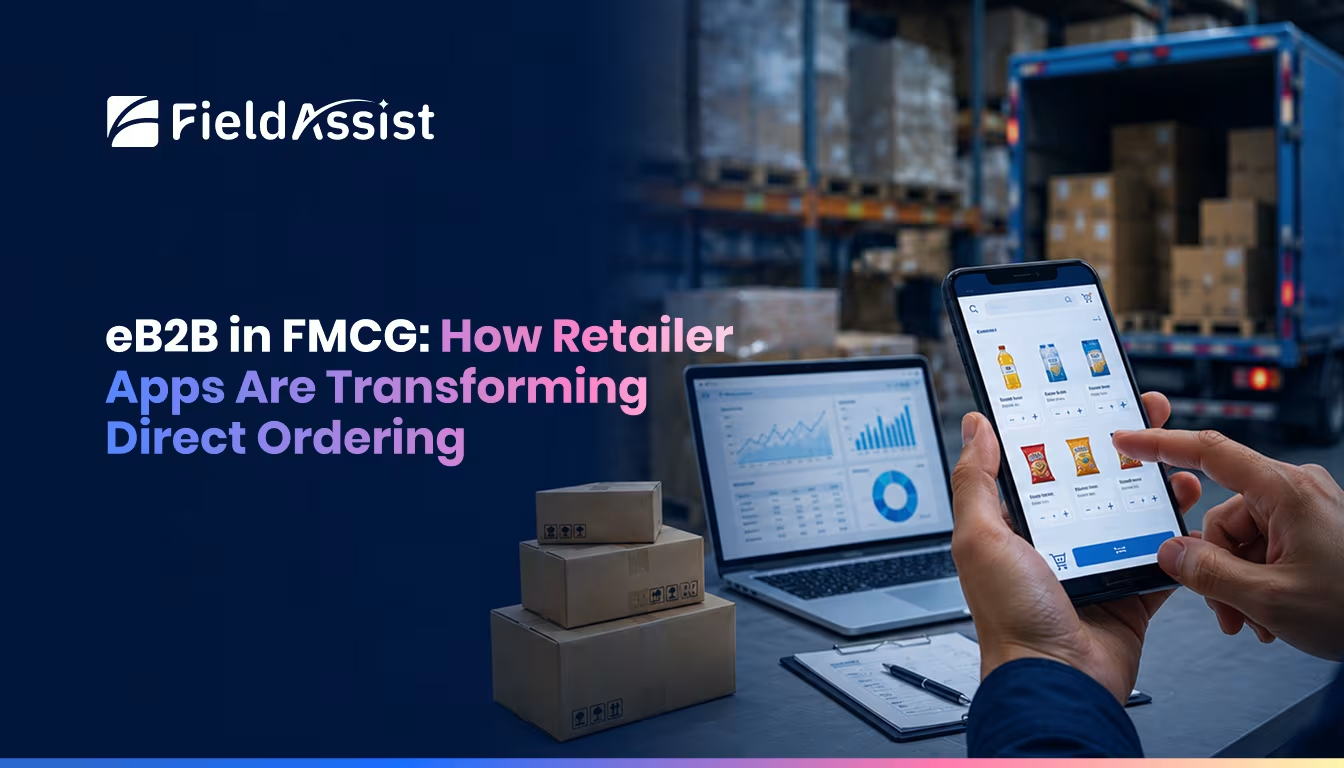
What happens when every retailer, from the largest urban supermarket to the most remote rural mom-and-pop store, becomes just a click away from your brand? Why are leading fast-moving consumer goods (FMCG) enterprises aggressively abandoning purely push-based distribution models in favor of unified, pull-driven eB2B ecosystems? Furthermore, are your highly trained field representatives still functioning as glorified order-takers, or have they been empowered to operate as strategic territory consultants?
These are not merely operational questions; they are boardroom imperatives. In the hyper-competitive FMCG landscape, traditional route-to-market (RTM) strategies have reached a critical inflection point. For decades, the consumer goods sector relied heavily on a linear, fragmented supply chain characterized by manual order collection, asymmetric information, and significant time lags between retailer demand and brand fulfillment. Today, this legacy approach is rapidly giving way to an agile, interconnected reality driven by eB2B in FMCG. At the epicenter of this transformation is the Retailer App—a digital conduit that directly bridges the gap between the brand and the vast, fragmented general trade ecosystem.
The Inflection Point in FMCG Route-to-Market
To understand the strategic necessity of eB2B retailer apps, C-suite executives—CEOs, Chief Operating Officers, and CIOs—must first examine the friction inherent in the traditional FMCG value chain. Historically, brands have struggled with pervasive "last-mile blindness." While modern Enterprise Resource Planning (ERP) and early-generation Sales Force Automation (SFA) systems provided visibility down to the distributor tier, the actual retailer—the true engine of secondary and tertiary sales—remained an opaque node in the network.
Data concerning out-of-stocks, trade scheme adoption, and shifting consumer preferences filtered back to the brand headquarters with a severe time delay, if it arrived at all. This lack of algorithmic retail visibility resulted in higher costs-to-serve, bloated distributor inventories, and missed revenue opportunities when retailers ran dry between scheduled sales representative visits.
The implementation of a robust eB2B retailer app fundamentally alters this dynamic. It shifts the go-to-market strategy from an intermittent, rep-dependent order cycle to an always-on, digital commerce environment. This is not merely about digitizing a manual order form; it is about rewiring the entire commercial relationship. Retailers are no longer passive recipients of periodic sales pitches; they are active, digitally-empowered participants in a brand's connected growth ecosystem.
Strategic Levers: How Retailer Apps Drive Enterprise Value
For FMCG leadership, investing in an eB2B platform is not simply an IT upgrade; it is a direct revenue generation and risk mitigation strategy. Here is how retailer apps are delivering measurable enterprise value:
1. Always-On Commerce and the End of the "Beat Plan" Constraint
In a traditional setup, a retailer's ability to restock is strictly constrained by the physical beat plan of the field sales representative. If a top-selling SKU stocks out a day after the rep's scheduled visit, the retailer either waits a week for the next visit or, more likely, pushes a competitor's substitute to the end consumer.
Retailer apps obliterate this constraint. By providing a 24/7 direct ordering channel, retailers can place orders instantly the moment stock runs low. This zero-missed-opportunity framework ensures continuous product availability, effectively recapturing the "lost sales" that quietly erode top-line growth. It transforms a rigid, periodic supply chain into a dynamic, demand-responsive network.
2. Algorithmic Trade Promotions and Scheme Utilization
FMCG brands spend millions annually on trade promotions, yet visibility into the actual execution and ROI of these schemes at the retail tier is notoriously poor. Often, schemes are communicated via word-of-mouth or physical pamphlets, leading to confusion, low participation, and high claim-settlement disputes.
A modern eB2B platform digitizes this entire workflow. Retailers gain real-time visibility into active promotions, targeted discounts, and slab-based trade offers directly through their app interface. Advanced platforms utilize gamification—such as progress bars and instantaneous reward tracking—to incentivize higher order volumes. When retailers can tangibly see how close they are to a margin-boosting payout, basket sizes increase organically.
3. Democratizing Data for Hyper-Personalization
Data is the currency of modern retail, yet legacy systems hoard this data at the enterprise level. Retailer apps democratize data by turning everyday general trade transactions into predictive insights. Every click, search, and order placed through the app generates behavioral data.
For the C-suite, this translates into actionable intelligence. Brands can track SKU velocity in real-time, identify dormant retailers, and deploy AI-led nudges for reactivation. Instead of a one-size-fits-all approach to general trade, brands can execute hyper-personalized communication strategies. If a particular demographic in a micro-market shows a sudden affinity for a premium product tier, the brand can instantly push a targeted, localized scheme through the app to capitalize on the trend.
4. Supply Chain Resilience and Forecasting Accuracy
One of the most persistent headaches for a Chief Operating Officer is demand volatility. The bullwhip effect—where small fluctuations in retail demand cause massively amplified swings in upstream production and inventory—is a direct symptom of disconnected supply chains.
When retailer apps feed direct, unfiltered demand signals back to the enterprise, demand planners gain an unparalleled advantage. Instead of forecasting based on historical distributor off-take (which is essentially a lagging indicator), production and logistics teams can forecast based on real-time, granular retailer consumption patterns. This predictive capability optimizes factory runs, reduces warehousing costs, and minimizes the risk of obsolete inventory.
5. Enhancing Trust Through Grievance and Returns Management
A significant, yet often overlooked, friction point in brand-retailer relationships is the management of damaged goods and claim settlements. Manual processing leads to back-and-forth delays, administrative bloat, and eroded trust.
By integrating grievance and return management modules directly into the retailer app, brands can drastically reduce claim turnaround times. Retailers can raise issues instantly, upload photographic evidence, and track the status of their return from initiation to resolution. This transparency builds profound, long-term trust—a critical differentiator in markets where retailers heavily influence consumer brand choice.
6. Elevating the Field Force: From Order Takers to Brand Consultants
A common misconception is that eB2B apps are designed to replace the field sales force. In reality, they are designed to elevate it. When routine order collection and scheme communication are automated through the app, the field representative's time is liberated.
Instead of spending 15 minutes at an outlet mechanically logging an order, the rep can use that time to focus on strategic execution: visual merchandising, auditing planogram compliance, pitching new product categories, and building deeper relational capital. This shift not only improves field morale but significantly increases the ROI of your human capital.
The Architecture of a Future-Ready eB2B Ecosystem
A standalone ordering app is merely a tactical tool; a fully integrated eB2B platform is a strategic weapon. The true power of direct ordering is unlocked when it operates as part of a unified technology ecosystem.
When a retailer places an order via the app, that data must flow seamlessly into the Distribution Management System (DMS) to ensure instant inventory validation and faster billing. Simultaneously, this data must be reflected in the SFA system so that sales reps have complete visibility into the retailer's buying patterns before their next physical visit. This interconnectedness ensures visibility from the moment an order is conceived to the moment it is delivered, creating a closed retail-to-distributor loop that eliminates operational leakages.
Spotlight: The FieldAssist Edge in eB2B Transformation
Recognizing the complexities of emerging markets and the diverse technological maturity of the retail base, the FieldAssist Retailer App has been engineered specifically to solve the unique challenges of FMCG distribution.
Trusted by over 700+ CPG brands and actively tracking $0.6 billion in GMV across 0.9 million outlets globally, the FieldAssist platform is designed for rapid adoption and enterprise scale. Key architectural capabilities include:
- Multi-Channel Accessibility: Acknowledging that not every retailer will download a native app, FieldAssist supports Android, Progressive Web Apps (PWA), and WhatsApp-based conversational commerce workflows. This ensures frictionless adoption, even in low-connectivity rural zones.
- Seamless Interoperability: The app integrates flawlessly with the FA suite (DMS, SFA) and external ERP systems. Built-in business rules automatically track pending orders and prevent overbooking using real-time distributor inventory data.
- Intelligence at Scale: Leveraging Agentic AI that reasons and acts, the platform provides automated product recommendations, discovers new SKUs tailored for specific retailers, and identifies churn risks before they materialize.
- Multilingual Interface: By speaking the retailer's language natively, the app drives rapid user onboarding and sustained daily engagement, seamlessly turning a technological tool into an indispensable daily business habit.
Conclusion: The Cost of Inaction in the Digital Era
For the FMCG C-suite, the transition toward eB2B direct ordering is no longer an optional innovation pathway; it is a baseline requirement for survival and market dominance. The future belongs to brands that move faster, think smarter, and execute with absolute clarity.
Brands that cling to exclusively analog distribution models will face structurally higher costs-to-serve, slower response times to market shifts, and a retailer base that increasingly favors the frictionless experience offered by digitized competitors.
Embracing a comprehensive eB2B strategy through solutions like the FieldAssist Retailer App empowers organizations to turn trust into visibility, and relationships into measurable results. By weaving every retail partner into the digital fabric of your business, you unlock the ultimate competitive advantage: an intelligent, self-optimizing, and aggressively scalable route-to-market. The paradigm has shifted—it is time for your distribution strategy to do the same.



.avif)