7 Proven Ways AI is Transforming Retail Revenue Management
Discover how AI is transforming retail revenue management for CPG brands. Explore 7 proven strategies, from predictive ordering to smart route planning.

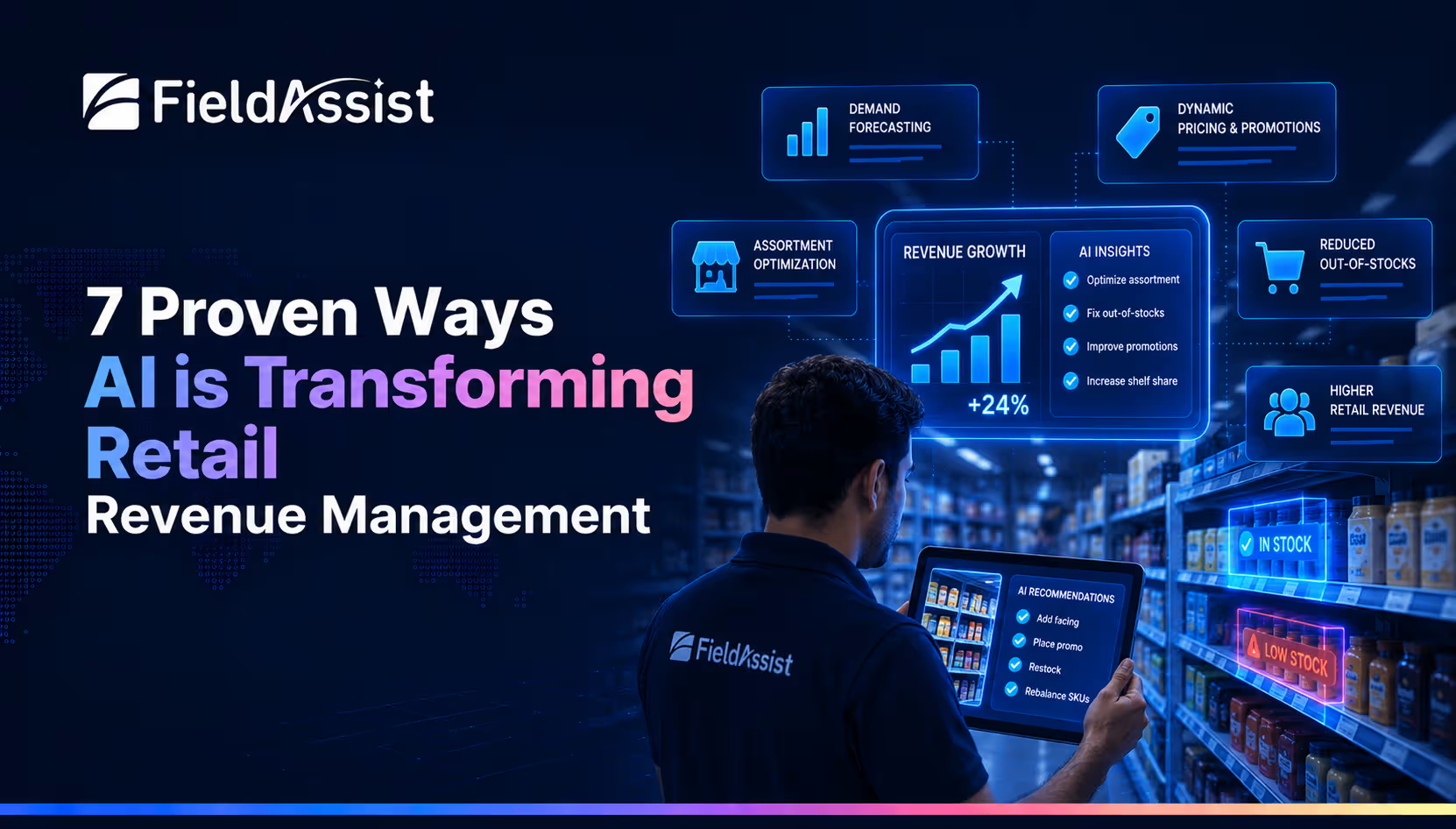
The consumer goods and retail landscape is shifting faster than ever. Margins are under constant pressure from fluctuating supply chain costs, market dynamics are evolving rapidly, and traditional go-to-market strategies are no longer enough to guarantee top-line growth. For decades, retail revenue management has relied heavily on historical data, static spreadsheets, and the intuition of field sales teams. But in today’s hyper-competitive ecosystem, looking in the rearview mirror is a surefire way to lose market share.
Enter Artificial Intelligence. No longer just a futuristic buzzword or a novelty tech experiment, AI has matured into a foundational pillar of modern retail execution. It is fundamentally rewiring how brands forecast, distribute, and sell on the ground. By converting billions of unstructured market signals into precise, autonomous actions, AI empowers sales leaders to plug revenue leaks, optimize operational efficiency, and unlock unprecedented growth.
Here are seven proven ways artificial intelligence is actively revolutionizing retail revenue management and driving profitable growth for forward-thinking brands.
1. Predictive Ordering and Hyper-Personalized Cross-Selling
Historically, field sales representatives relied on standard product catalogs or rudimentary historical averages when taking orders from retailers. This approach often leads to missed opportunities, out-of-stock scenarios for fast-moving items, and stagnant launches for new SKUs.
AI flips this dynamic by turning every sales interaction into a data-driven consultation. Deploying sophisticated AI product recommendation software allows brands to analyze micro-market trends, seasonal fluctuations, and retailer-specific purchasing habits. Instead of guessing what a retailer might need, AI acts as a smart co-pilot, surfacing the "Next Best Action" and recommending the exact product mix and quantities required to maximize basket size. This targeted cross-selling not only boosts average order value but ensures that the right products are always available to the end consumer.
2. Intelligent Route and Beat Optimization
A field sales team’s most valuable asset is time. Unfortunately, a significant portion of that time is often wasted navigating inefficient routes, visiting low-yield outlets, or dealing with unexpected cancellations. Traditional, static beat planning simply cannot account for the dynamic realities of the street.
By utilizing AI-powered route planning, sales operations can dynamically optimize daily beats based on real-world variables like traffic patterns, outlet density, historical buying times, and current inventory levels. AI evaluates these complex parameters to guide representatives to the highest-value opportunities first. This ensures that field teams spend less time behind the wheel and more time closing deals, dramatically improving the revenue-per-rep metric and reducing overall operational travel costs.
3. Perfecting the Shelf with Image Recognition
In retail, the battle is won or lost at the shelf. However, manual visual merchandising audits are notoriously slow, prone to human error, and easily manipulated. If a brand cannot accurately measure its share of shelf, planogram compliance, or out-of-stock rates in real time, it is undoubtedly bleeding revenue.
Implementing retail image recognition software transforms a simple smartphone camera into an advanced analytics engine. When a representative snaps a photo of a store shelf, AI instantly processes the image to identify SKUs, track competitor positioning, verify promotional compliance, and flag missing inventory. This immediate feedback loop allows reps to take corrective action on the spot—restocking empty slots and reclaiming lost shelf space before the consumer ever notices.
4. Maximizing ROI on Trade Promotions
Trade promotions represent a massive line item in the budget of any Consumer Packaged Goods (CPG) company. Yet, a staggering percentage of these schemes fail to deliver a positive return on investment due to poor execution, delayed claim settlements, and a lack of visibility into actual retail utilization.
AI takes the guesswork out of trade promotion management. By analyzing historical performance data alongside real-time sales velocity, AI can predict which promotional structures will perform best in specific micro-markets. Furthermore, it automates the complex reconciliation of distributor claims, preventing revenue leakage and ensuring that trade spend is directly driving secondary sales rather than padding wholesale margins.
5. Proactive Inventory and Distributor Management
One of the greatest challenges in retail revenue management is bridging the gap between primary sales (brand to distributor) and secondary sales (distributor to retailer). When these two flows are misaligned, the result is either capital tied up in excess distributor inventory or severe stockouts at the retail level.
AI effectively synchronizes this ecosystem. By integrating advanced machine learning algorithms within a unified sales and distribution management system, brands can precisely forecast inventory needs at the individual distributor level. AI-led auto-replenishment ensures that distributors carry optimal stock levels based on real-time secondary sales velocity, creating a leaner, more agile, and highly profitable supply chain.
6. Uncovering Whitespace and Accelerating Market Penetration
Growth eventually stalls if a brand only sells to its existing network. However, blind expansion is expensive and risky. Identifying exactly where to open new territories or which unserved retail outlets offer the highest probability of success is a complex geographical puzzle.
AI-driven location intelligence solves this by mapping out high-potential "whitespace" opportunities. By analyzing demographic data, competitor presence, and the brand's own ideal retail profile, AI pinpoints specific neighborhoods and storefronts where demand is already building. This allows revenue leaders to deploy their field forces with sniper-like precision, accelerating market penetration while maintaining high capital efficiency.
7. Enabling 24/7 Always-On Retailer Engagement
The traditional retail distribution model relies entirely on the physical presence of a sales representative. If a rep misses a scheduled visit due to illness, bad weather, or logistical delays, the brand loses that ordering window—and often loses the sale to a competitor whose rep happened to walk in.
Modern retail demands an omnichannel approach. Equipping your network with AI retail merchandising software and leveraging agentic AI for retail ensures that the ordering channel never sleeps. Intelligent B2B apps and conversational AI agents can proactively nudge retailers via text or app notifications when their stock is projected to run low. This continuous, automated engagement captures orders that would otherwise fall through the cracks, securing baseline revenue and freeing up human reps to focus on strategic relationship building.
The Future of Revenue is Autonomous
The era of reactive, intuition-based retail execution is over. The brands dominating today's shelves are those that treat data not just as a reporting tool, but as the active engine of their daily operations. From smart route planning and instant shelf diagnostics to predictive ordering and continuous retailer engagement, artificial intelligence is proving to be the ultimate lever for scalable revenue management.
Transitioning to an AI-native execution architecture doesn't just improve incremental metrics; it creates a proactive, agile sales force capable of outmaneuvering the competition at every single touchpoint.




%20(1).avif)
.avif)