Route Optimization with AI Nudges: What’s the Future?
Route optimization helps field teams plan smarter routes, reduce travel time and costs, improve productivity, and enhance operational efficiency.

Route optimization is the algorithmic and mathematical process of determining the most cost-effective, time-efficient, and operationally viable sequence of stops and travel paths for fleets, commercial field sales teams, and mobile workforces. Unlike basic point-to-point GPS navigation or static route planning, advanced route optimization evaluates multidimensional constraints such as dynamic traffic, customer delivery time windows, vehicle load capacities, technician skill sets, driver rest mandates, and business priorities in real time.
Enterprise organizations implementing artificial intelligence (AI) driven route optimization typically achieve a 15% to 25% reduction in total fleet mileage, 20% to 35% improvement in field productivity, and significant reductions in operating expenditure (OpEx) and carbon emissions.
What is Route Optimization?
In modern supply chain and field & delivery operations management, route optimization refers to the automated, computational calculation of the optimal journey paths and stop sequences across an entire network of mobile resources.
While the concept is intuitively simple getting personnel or vehicles from origin points to multiple destination points efficiently the operational reality is extraordinarily complex. True route optimization does not merely solve for the "shortest distance" (spatial distance); it solves for the lowest total cost and highest operational feasibility within a dynamic real-world environment.
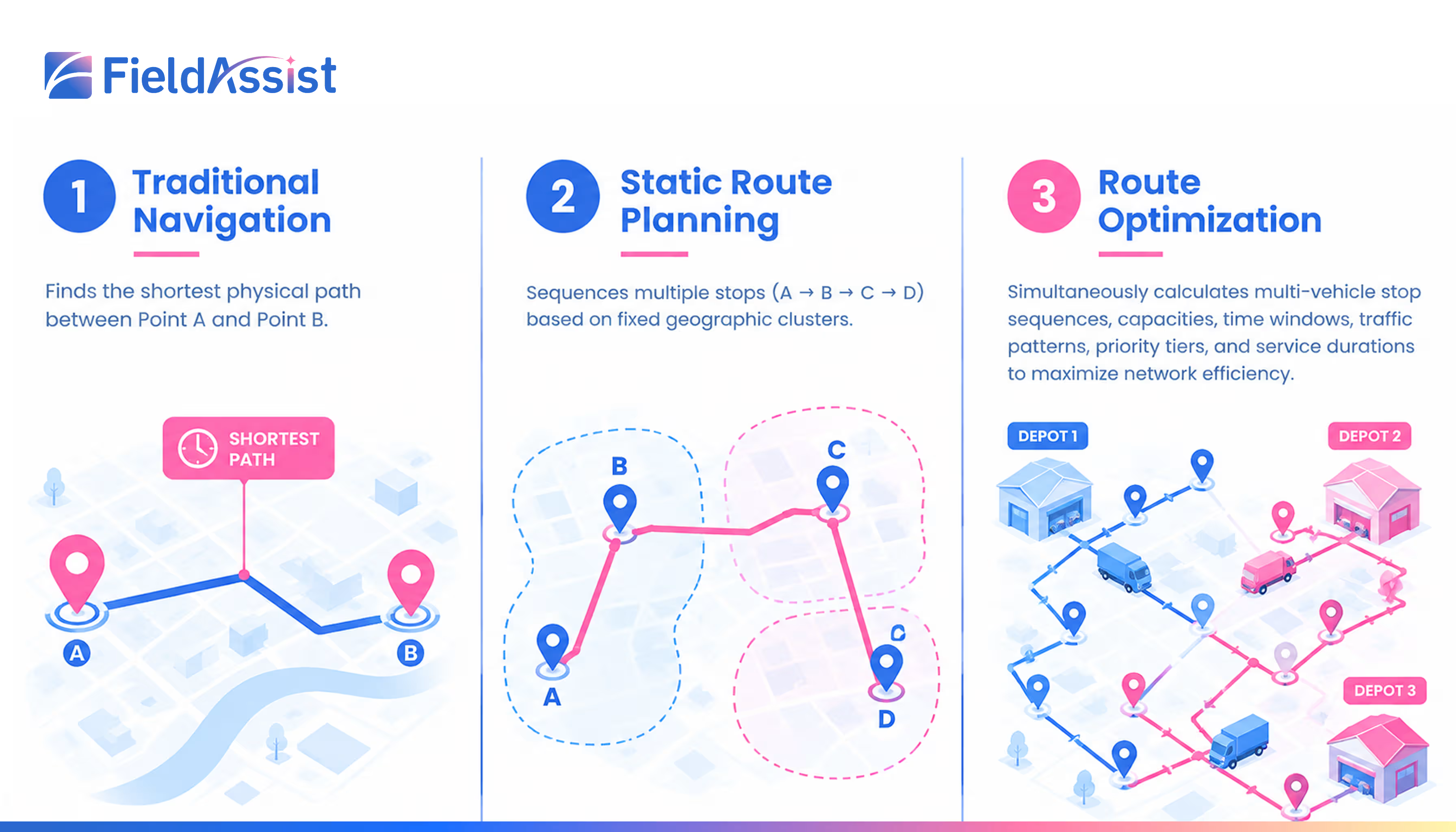
The Shift from Spatial Distance to Operational Cost
Traditional fleet operators often conflate shortest paths with optimal routes. In practical enterprise operations, the physically shortest route is frequently inefficient:
- A route that is two miles shorter may require traversing urban bottlenecks during peak rush hours, consuming twice the fuel and idling time.
- A route designed without factoring in specific delivery or service appointment windows results in costly wait times, missed service-level agreements (SLAs), or redundant return trips.
- A route that ignores vehicle payload capacities or driver shift limitations triggers regulatory non-compliance, driver fatigue, and increased overtime expenses.
Modern route optimization engines reconcile these trade-offs mathematically, treating spatial distance as just one of dozens of competing operational variables.
What’s the difference between Route Optimization vs. Route Planning?
A frequent point of confusion among operational leaders is the distinction between route planning (or route sequencing) and route optimization. While often used interchangeably in casual conversation, they represent fundamentally different levels of operational sophistication.
The Route Planning Baseline
Route planning is primarily a mapping exercise. It typically involves plotting known destination points on a digital map, grouping them into rough regional clusters, and arranging them in a logical manual sequence. Route planning answers the question: "In what basic order should these stops be visited?"
However, route planning operates on static assumptions. It rarely accounts for dynamic multi-variable constraints simultaneously across an entire fleet. When a schedule disruption occurs—such as an urgent client request, traffic congestion, or delayed loading—a static route plan rapidly deteriorates, leaving dispatchers and drivers to make ad-hoc, suboptimal adjustments.
The Route Optimization Paradigm
Route optimization is an algorithmic discipline rooted in operations research, graph theory, and artificial intelligence. It evaluates thousands of possible permutation combinations across an entire fleet simultaneously. It answers the question: "What is the mathematically superior allocation and sequence of all field tasks across all available resources to minimize total system cost while satisfying 100% of operational constraints?"*
How Does Route Optimization Work?
Route optimization works by processing multi-dimensional data including GPS coordinates, live traffic patterns, customer time windows, service durations, and historical account values through advanced mathematical algorithms (heuristics and machine learning). Rather than merely plotting the shortest geometric line between points, the engine simultaneously calculates millions of possible journey combinations across an entire fleet or field team to output the most cost-effective, high-value, and time-efficient sequence of stops in seconds.
Enterprise-grade route optimization engines use sophisticated mathematical models that categorize real-world conditions into hard constraints (non-negotiable requirements) and soft constraints (flexible preferences with penalty scoring).
7 Strategic and Operational Benefits of Route Optimization System
Implementing enterprise-grade route optimization transforms field operations from a cost center into a strategic competitive advantage. Across cross-industry enterprise deployments, seven primary value drivers consistently emerge:
1. Slashing Operational Overhead and Fuel Expenditure
Fuel and vehicle maintenance represent two of the largest line items in fleet operating budgets. By eliminating redundant circuitous travel, backtracking, and congested idling, route optimization directly compresses mileage.
- Direct Mileage Compression: Enterprises routinely see a 15% to 25% reduction in total fleet miles driven.
- Vehicle Asset Longevity: Reduced mileage slows vehicle depreciation, extends tire lifecycles, and lengthens intervals between costly scheduled preventative maintenance cycles.
- Overtime Reduction: Predictable, highly structured routes reduce unexpected driver delays, significantly cutting variable overtime wage expenditures.
2. Maximizing Field Workforce Productivity and Face Time
For commercial field representatives, account executives, and on-site service engineers, driving is non-revenue-generating "windshield time."
- When daily travel time per representative is reduced by 45 to 60 minutes, that capacity is redirected toward productive commercial engagement, technical maintenance, or relationship building.
- Optimized sequencing ensures representatives spend up to 30% more time on-site with accounts, driving revenue expansion and deeper customer loyalty.
3. Increasing Capacity Without Adding Fleet Assets or Headcount
Expanding geographic coverage or servicing higher order volumes historically required purchasing additional vehicles and hiring more drivers. Route optimization decouples volume growth from linear operational cost growth.
- By maximizing vehicle cubing (capacity utilization) and sequencing stops efficiently, fleets frequently absorb a 20% to 35% increase in daily stop volume utilizing their existing fleet and labor baseline.
4. Elevating On-Time Performance and SLA Compliance
In an era of stringent commercial SLAs, late arrivals erode client trust and incur contractual financial penalties.
- By incorporating historical time-of-day traffic matrices and precise service dwell times, optimization engines calculate highly accurate Estimated Times of Arrival (ETAs).
- Enterprises improve on-time arrival rates to 95%+, narrowing customer delivery or service windows from vague 4-hour timeframes to tight, high-confidence 30-minute arrival intervals.
5. Balancing Workload Equity and Mitigating Driver Fatigue
Manual dispatching frequently creates severe workload disparities: one driver completes their shift in 6 hours while another labors through a 10-hour day covering poorly organized territories.
- Optimization algorithms enforce equitable workload distribution across personnel, balancing total travel distance, physical unloading efforts, and task difficulty.
- Balanced workloads directly lower driver fatigue, decrease roadside incident rates, and improve workforce retention in an industry facing chronic driver and technician shortages.
6. Improving Enterprise Agility and Exception Management
Operational disruptions are inevitable: sudden vehicle breakdowns, emergency client orders, cancellations, or severe weather conditions.
- Static routes collapse under disruptions. Modern optimization engines feature dynamic re-optimization capabilities that recalculate optimal routes for the remainder of the day in real time.
- If a vehicle breaks down, the engine can instantly reassign its remaining pending stops across adjacent active fleet units without violating customer delivery windows.
7. Delivering Measurable Environmental Sustainability (ESG)
Enterprise sustainability mandates are no longer optional. Supply chain decarbonization is a primary board-level priority.
- Every gallon of diesel saved eliminates approximately 22.4 pounds (10.2 kg) of $CO_2$ emissions.
- For a mid-sized fleet of 100 vehicles driving 25,000 miles annually per vehicle, a 20% mileage reduction eliminates over 250 metric tons of carbon emissions each year, providing auditable data for corporate ESG disclosures.
Where is Route Optimization Used? (Real-World Use Cases)
Route optimization is useful for any organization that has people or vehicles moving across multiple locations every day. It is widely used to deliver strategic value across any enterprise function that manages mobile personnel, distributed customer touchpoints, or physical asset movements. Some popular use cases include:
1. Commercial Field Sales and Territory Account Management
In large commercial distribution organizations, sales representatives manage territories containing hundreds of commercial accounts, distributor points, and partner locations.
- The Challenge: Representatives often plan their daily visits based on habit or geographic comfort rather than account value, resulting in neglected high-potential accounts, erratic visit frequencies, and excessive windshield time.
- The Optimized Solution: The optimization engine dynamically creates disciplined visit schedules based on account prioritization tiers (e.g., Tier 1 accounts visited weekly, Tier 3 monthly), geographic clustering, and optimal traffic flows. Representatives achieve complete territory coverage with maximum commercial contact hours.
2. Multi-Stop Commercial Distribution and Wholesale Logistics
Wholesale distributors operating private fleets face tight operating margins and complex physical delivery constraints.
- The Challenge: Vehicles must deliver mixed-pallet loads to dozens of customer facilities daily, navigating commercial delivery docks, varying receiving hours, and localized truck access regulations.
- The Optimized Solution: The engine reconciles vehicle cubic volume, weight distribution limits, customer receiving dock hours, and offloading equipment requirements, producing fully sequence-optimized load and dispatch sheets.
3. Field Technical Services and Equipment Maintenance
Enterprises providing on-site equipment maintenance, telecommunications infrastructure servicing, or commercial utilities maintenance manage complex human capital constraints.
- The Challenge: Work orders require specific technician certifications, parts inventories, and unpredictable on-site repair durations.
- The Optimized Solution: The optimization engine pairs skill-based matching algorithms with dynamic geographic routing. If a critical service ticket is logged, the system identifies the closest qualified technician who has the necessary replacement parts in their vehicle inventory and can arrive within the contractual SLA window.
4. Urban Delivery and Courier Transportation Networks
High-density urban logistics require navigating severe congestion, parking scarcity, and compressed delivery timeframes.
- The Challenge: Massive stop counts per vehicle (80–150 stops/day) in dense metropolitan environments where a single street closure can derail an entire afternoon schedule.
- The Optimized Solution: The engine utilizes micro-zone clustering, predictive parking delay modeling, and real-time turn-by-turn dispatch updates to maintain flow and schedule integrity throughout high-density runs.
What Features Should You Look for in Route Optimization Software?
When evaluating commercial route optimization software, enterprise procurement and technology leaders should assess platforms across six architectural and functional pillars:
1. High-Performance Algorithmic Solving Speed
Enterprise operations cannot wait hours for nightly batch routing jobs to finish. The platform should feature a modern, multi-threaded optimization solver capable of processing thousands of stops across hundreds of vehicles in seconds. Rapid solving speed is also essential for real-time what-if scenario planning during intraday dispatching.
2. Real-Time Dynamic Rerouting and Dispatch Automation
Static, pre-dispatch planning is insufficient for modern agile operations. The platform must offer continuous dynamic rerouting capabilities:
- Automated re-optimization when road delays or appointment cancellations occur.
- Real-time dispatching of ad-hoc or on-demand orders into active, in-progress routes without disrupting existing commitments.
- Automated exception alerts for dispatchers when a vehicle diverges from its designated path or falls behind projected arrival windows.
3. Enterprise Ecosystem Connectivity (API & Integration Architecture)
Route optimization software must not exist as an isolated silo. It must seamlessly integrate with core enterprise platforms via robust REST APIs and pre-built enterprise connectors:
- Enterprise Resource Planning (ERP): Ingests orders, inventory manifests, and billing data.
- Customer Relationship Management (CRM) & Sales Force Automation (SFA): Synchronizes account hierarchies, commercial priorities, and representative visit logs.
- Distribution Management Systems (DMS) & Warehouse Management Systems (WMS): Aligns route schedules with dock loading times and warehouse staging sequences.
- Telematics & GPS Hardware: Ingests live vehicle telemetry, engine diagnostics, and driver behavior data.
4. Native Field Mobile Experience
The best optimization engine is ineffective if field personnel refuse to use it. The mobile field application must provide:
- Clean, distraction-free turn-by-turn navigation integrated with commercial map layers.
- Clear, ordered daily manifests with all customer contact details, access notes, and special instructions.
- Digital Proof-of-Service / Proof-of-Delivery (PoD) capture, including electronic signatures, photos, and time-stamped geo-coordinates.
- Full offline capability ensuring representatives can view routes and log task completions in areas with zero cellular connectivity.
5. High-Precision Geocoding and Address Cleansing
Address data in enterprise systems is notoriously messy, containing typos, colloquial building names, and missing postal codes. The platform must include an automated address normalization and geocoding engine that validates, parses, and converts ambiguous text into precise rooftop coordinates before optimization begins.
6. What-If Scenario Simulation and Business Intelligence (BI)
Strategic planning requires evaluating structural changes before committing capital. The software should allow operations leaders to run hypothetical simulations:
- *"What is the cost and fleet impact if we expand our delivery service guarantee from 48 hours to 24 hours?"*
- *"How many vehicles could we decommission if we shift from fixed regional territories to dynamic cross-boundary pooling?"*
- Comprehensive analytics dashboards tracking Planned vs. Actual performance, cost per stop, route adherence, and carbon footprint trends.
Route Planning Maturity Matrix: Assessing Your Enterprise Readiness
To determine where your organization stands and identify the path forward, evaluate your operational capabilities against this four-stage maturity model:
Why Choose FieldAssist? (Best Intelligent Route Optimization Software with AI Nudges)
For enterprise organizations seeking to modernize their commercial operations, territory coverage, and distribution networks, FieldAssist provides an advanced, AI-powered route optimization and field intelligence engine.
Purpose-built to manage high-frequency field sales, complex distribution ecosystems, and mobile workforce networks, FieldAssist transforms complex commercial rules into mathematically optimal, easy-to-execute field plans.
Core Strategic Advantages of FieldAssist:
- Intelligent Territory and Visit Optimization: Rather than generating generic geometric routes, FieldAssist blends geographic efficiency with commercial value. The engine prioritizes high-impact accounts, ensuring field personnel invest their time where revenue opportunity is greatest while minimizing travel transit overhead.
- Dynamic Workload Balancing: The platform eliminates uneven territory burdens by algorithmically distributing visits based on account density, service times, and travel friction, driving up rep productivity and field morale.
- Seamless Field Automation Integration: FieldAssist's optimization engine functions in complete harmony with broader Sales Force Automation (SFA) and Distribution Management System (DMS) workflows. Field representatives access optimized routes, account histories, digital order placement, and execution checklists within a single unified mobile interface.
- Actionable Planned vs. Actual Analytics: Enterprise leaders gain crystal-clear visibility into route adherence, time-on-site metrics, travel deviations, and productivity gains through executive dashboards designed for rapid operational decision-making.
Frequently Asked Questions (FAQ)
1. What is the primary difference between GPS navigation and route optimization?
GPS navigation calculates the shortest or fastest path between a single origin and a single destination (Point A to Point B) for an individual driver. Route optimization evaluates a complex network of multiple vehicles and hundreds of destination stops simultaneously, determining the most cost-effective assignment and sequence of all stops across the entire fleet while honoring time windows, vehicle capacities, driver schedules, and business priorities.
2. What data inputs are required for route optimization software to function?
At a minimum, route optimization software requires:
- Customer destination addresses (which the software cleanses and geocodes).
- Order or task requirements (delivery volumes, item weights, service descriptions).
- Availability constraints (customer delivery or visit time windows).
- Fleet resource specifications (number of available vehicles, cargo capacities, starting and ending depot locations).
- Personnel schedules (shift hours, required rest breaks, technical skill sets).
3. How quickly do enterprises achieve Return on Investment (ROI) after implementation?
Most enterprise fleets and field organizations achieve full ROI within 3 to 6 months of deployment. Because route optimization directly attacks variable operating expenses—reducing fuel consumption by 15% to 25%, curbing driver overtime, and increasing daily stop completion rates by 20% to 35% without additional asset acquisition—the financial payback begins in the first billing cycle.
4. Can route optimization software adapt to real-time disruptions during the day?
Yes. Advanced route optimization platforms feature dynamic rerouting capabilities. When real-time exceptions occur—such as extreme traffic delays, emergency client orders, appointment cancellations, or vehicle mechanical failures—the system recalculates optimal sequences for the remainder of the working day, reallocating stops across active vehicles to protect customer delivery commitments.
5. How does route optimization support enterprise ESG and sustainability initiatives?
Transportation is one of the largest global sources of greenhouse gas emissions. By cutting total fleet mileage by up to 25% and reducing engine idling in traffic congestion, route optimization directly eliminates carbon emissions ($CO_2$). The software provides auditable, data-backed reports detailing fuel saved and emissions avoided for corporate ESG sustainability disclosures.
6. Does route optimization work in areas with poor or intermittent internet connectivity?
Modern enterprise field applications are architected with "offline-first" capabilities. The mobile application downloads the optimized daily schedule, map caches, and customer details locally to the device during initial morning synchronization. Field personnel can execute their entire day navigating stops, capturing digital signatures, and recording task completions offline. Data automatically synchronizes with the central server once connectivity is restored.



.avif)