What Is Market Intelligence? Definition, Types, Benefits & Strategies
Understand market intelligence and how it helps businesses track competitors, customers, and market trends. Discover proven strategies and tools for smarter decisions

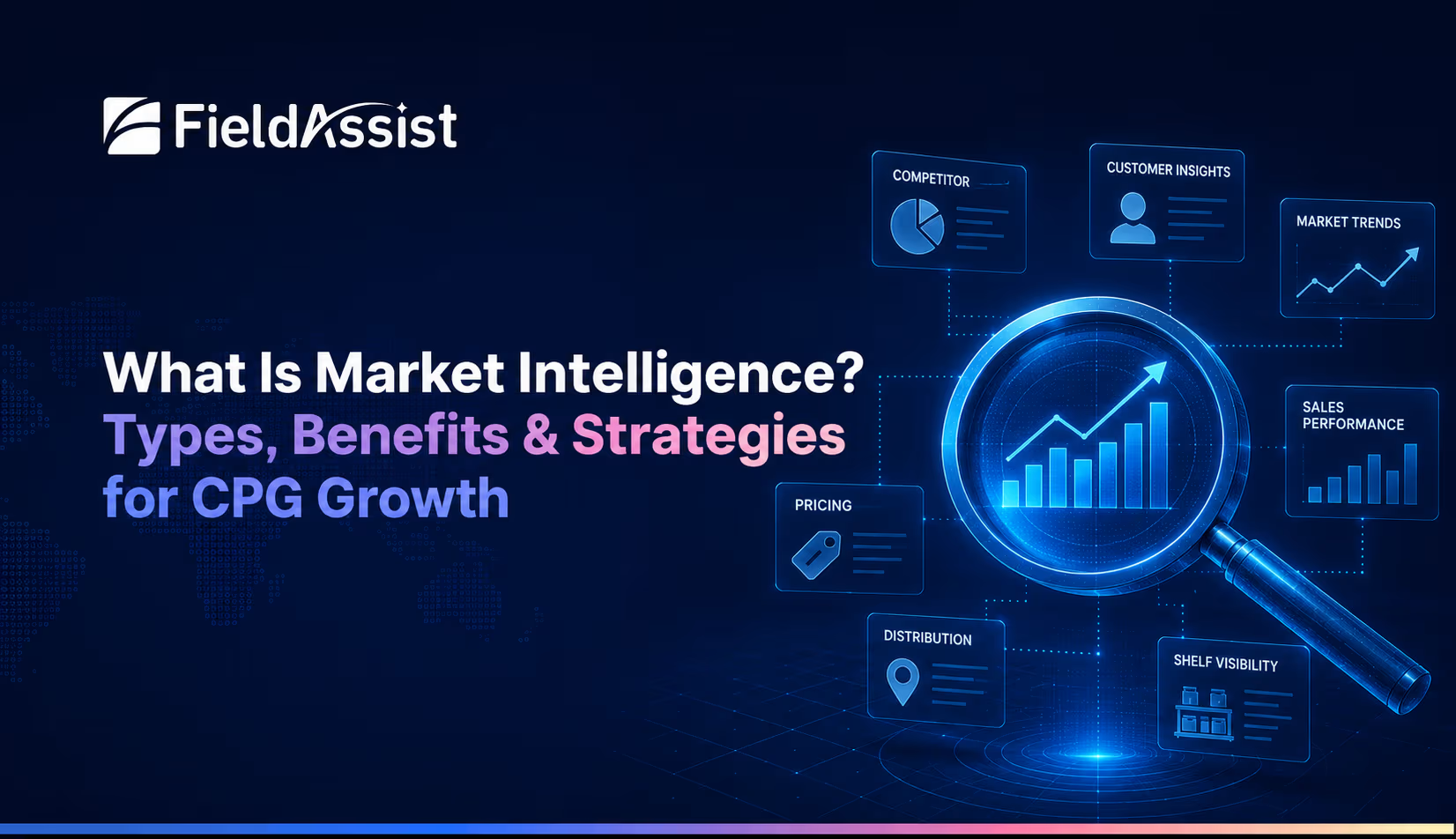
CPG and FMCG brands invest heavily in new products, new markets, and promotional schemes. However, some of that investment goes to waste when decisions are based on guesswork, outdated distributor reports, or old market surveys.
Market intelligence solves this problem by collecting and analyzing information from different sources, such as customer buying behaviour, competitor activities, pricing changes, retail performance, and market trends. It turns scattered data into useful insights that businesses can act on.
In this guide, we'll explain what market intelligence is, the different types of market intelligence, the benefits it offers, and how consumer goods companies can build an effective market intelligence strategy that works in real-world market conditions.
What Is Market Intelligence?
Market intelligence is the ongoing process of collecting, analysing, and applying information about a company's market, its customers, competitors, distribution channels, and broader industry trends, to guide business decisions. It differs from a one-off market research study in one important way: market intelligence is continuous. It's a living feed of insight, not a report that gets filed away after a launch.
For CPG and FMCG brands specifically, market intelligence pulls together data that often lives in disconnected systems: sales force automation (SFA) logs, retail execution audits, distributor sell-out numbers, and outlet-level pricing checks. Done well, it gives brand and sales leaders a single, current picture of what's actually happening on the ground, not what a dashboard assumed happened three weeks ago.
How Does Market Intelligence Work?
Market intelligence works in a loop, not a straight line. It starts with defining what a business needs to know, a new market entry, a competitor's pricing move, a stockout pattern in a specific territory, and then pulls relevant data from internal and external sources: field sales apps, retail audits, syndicated market data, distributor systems, and public industry reports.
That raw data is then cleaned, structured, and analysed to surface patterns: where distribution is thin, which SKUs are losing shelf share, which regions are outperforming forecast. The final and most overlooked step is distribution, getting the insight to the person who can act on it, whether that's a sales rep adjusting a beat plan or a category manager renegotiating shelf space. Without that last step, even the sharpest market intelligence never leaves the dashboard.
Various Types of Market Intelligence
Market intelligence isn't a single stream of data, it's a set of distinct disciplines, each answering a different business question.
1. Competitor Intelligence
Tracks what rival brands are doing on pricing, promotions, new launches, and shelf presence, so a business can react to a competitive move within days rather than discovering it a quarter late in a sales review.
2. Customer Intelligence
Builds a picture of who's buying, what they prefer, and why they switch, combining outlet-level sell-out data with direct feedback to spot shifting preferences before they show up as a revenue decline.
3. Product Intelligence
Looks at how a product actually performs after launch: which variants move, which sit on shelf, and which packaging or pricing changes affect sell-through, closing the loop between R&D decisions and real market response.
4. Market Trend Intelligence
Watches category-level shifts, changing consumer habits, emerging formats, macro pressures like inflation, so brands can plan portfolio and pricing decisions ahead of the trend rather than reacting to it after competitors have already moved.
5. Sales Intelligence
Feeds field and channel data, call compliance, order patterns, outlet coverage gaps, directly into how sales teams prioritise their day, making market intelligence in sales a working tool for territory planning rather than a retrospective report.
6. Channel & Distribution Intelligence
Tracks how effectively product is moving from depot to shelf across every channel, general trade, modern trade, e-commerce, flagging distribution gaps and stockouts before they turn into lost sales at the point of purchase.
Common Challenges in Market Intelligence
For most CPG organisations, the obstacle isn't a shortage of data, it's what happens to that data after it's collected.
- Data Silos and Fragmented Information
Sales data sits in the SFA platform, distributor data sits in Excel, and retail audit data sits with a third-party agency. Nobody has the full picture, and market intelligence built on fragments is only ever half-right.
- Poor Data Quality
The cost of this is not abstract: poor data quality costs organisations an average of $12.9 million a year, according to Gartner's research on data quality.
For a field-driven business, that shows up as duplicate outlet records, inconsistent SKU codes, and beat plans built on outdated distributor lists.
- Delayed Insights
A stockout report that arrives two weeks after the shelf went empty is not market intelligence, it's a post-mortem. Manual audits and monthly reporting cycles routinely turn actionable signals into historical footnotes.
- Lack of Actionable Recommendations
Dashboards full of charts don't move a business forward on their own. Without a clear recommendation attached, increase call frequency here, adjust pricing there, insight stays interesting instead of becoming useful.
- Difficulty Converting Insights into Execution
Even a sharp piece of market intelligence dies quietly if it can't reach a field rep's app or a distributor's next order cycle. The last-mile execution gap between insight and action is where most market intelligence efforts stall.
Benefits of Market Intelligence
When the challenges above are solved, the benefits of market intelligence show up directly on the P&L, not just in a strategy deck.
1. Faster and More Accurate Decision-Making
This is where market intelligence in sales earns its keep: companies that build strong analytics into their commercial engine see it pay off, with 72% of the fastest-growing B2B companies saying their analytics are effective for sales planning, compared with just 50% of the slowest-growing ones, per McKinsey’s research.
2. Better Understanding of Customer Needs
With 40% of consumers now willing to let AI influence their everyday shopping decisions, according to NielsenIQ, brands that track this shift early can adapt assortment and messaging before competitors catch up.
3. Improved Competitive Advantage
Knowing a competitor's pricing move or promotional push in near-real time, rather than at the next quarterly business review, is what separates brands that lead a category from brands that follow it.
4. Stronger Sales Performance
This is where the benefits of market intelligence are most tangible: reps armed with outlet-level intelligence spend less time guessing and more time selling into gaps that are actually there.
5. Reduced Business Risks
From early warning on demand softening to visibility into supply chain and distributor risk, a functioning market intelligence system gives leadership room to course-correct before a small problem becomes a quarterly miss.
How to Build an Effective Market Intelligence Strategy?
A market intelligence strategy only works if it's built around decisions the business actually needs to make, not around whatever data happens to be easiest to collect.
- Define Clear Business Objectives
Start with the decisions the intelligence needs to support, market entry, pricing, distribution expansion, and work backwards to the data required, rather than collecting everything and hoping it's useful later.
- Identify Relevant Data Sources
Map internal sources (SFA, DMS, CRM) against external ones (syndicated data, industry reports, competitor tracking) so the strategy draws on a complete, not partial, view of the market.
- Establish Data Collection Processes
Standardise how field data is captured,consistent outlet IDs, consistent SKU hierarchies, consistent audit formats, so intelligence gathered in one region can be compared cleanly against another.
- Use AI and Analytics for Deeper Insights
Move beyond static reporting into predictive and prescriptive analytics that flag an emerging stockout pattern or a pricing anomaly before a human analyst would spot it manually.
- Align Intelligence with Sales and Distribution Teams
A market intelligence strategy that lives only in a strategy team's inbox has failed. Insight needs to reach the field sales app and the distributor scorecard, where it can actually change behaviour.
- Measure and Refine Your Strategy Continuously
Track whether the intelligence is actually changing outcomes, fewer stockouts, faster response to competitor moves, and refine the sources and cadence accordingly rather than treating the strategy as fixed.
Market Intelligence Tools Businesses Use Today
The right stack of market intelligence tools depends on what a brand is trying to see, but for CPG and FMCG companies, a few categories consistently do the heavy lifting.
1. Sales Force Automation (SFA) Platforms
Capture field activity, visits, orders, surveys, as it happens, turning the sales force itself into a live sensor network for market intelligence in sales rather than a once-a-month reporting exercise.
2. Retail Execution & Shelf Intelligence Tools
Use image recognition software and outlet audits to verify planogram compliance, shelf share, and stock availability, replacing subjective field reports with measurable, comparable data.
3. Market Mapping and Territory Intelligence Software
Overlay outlet density, competitor presence, and demand potential geographically, helping teams identify white space before drawing up the next expansion plan.
4. Analytics and Business Intelligence Platforms
Turn raw field and sales data into dashboards and trend analysis that leadership can actually read at a glance, connecting day-to-day execution data to quarterly business reviews.
5. AI-Powered Market Intelligence Tools
Apply machine learning to flag anomalies, forecast demand, and recommend next-best actions automatically, the layer that's increasingly separating category leaders from the rest of the field.
How FieldAssist Helps Brands Turn Market Intelligence into Growth?
FieldAssist was built around a simple observation: most CPG brands don't have a data problem, they have a last-mile execution gap. Our AI-driven retail execution and Sales Force Automation platform closes that gap by capturing field, distributor, and retail execution data in one connected system, instead of three disconnected ones.
That means a market intelligence strategy built on FieldAssist isn't theoretical. Sales teams get outlet-level intelligence inside the same app they use to place orders and log visits. Category and trade marketing teams get shelf and distribution visibility without waiting on a third-party audit cycle. And leadership gets a single source of truth that reflects the market as it is today, not as it was reported last month. For a category as fast-moving and execution-heavy as CPG, that's the difference between market intelligence that sits in a deck and market intelligence that shows up in same-store sales.
The Future of Market Intelligence
The next phase of market intelligence is increasingly automated rather than analyst-driven, Gartner predicts that half of all business decisions will be augmented or automated by AI agents
a shift that will push market intelligence tools further from static dashboards and toward systems that recommend, and in some cases trigger, the next action directly.
For CPG and FMCG brands, that means the businesses that win the next decade won't simply be the ones collecting the most data, they'll be the ones that have closed the loop between market intelligence and last-mile execution, so every field visit, every shelf check, and every distributor order sharpens the picture instead of adding to the pile.



%20(1).avif)