What is Decision Intelligence, and How Does It Improve Business ROI?
Turn data into action with Decision Intelligence. Understand how modern enterprises use AI-powered decision-making to improve resource allocation, reduce risk, and drive growth.

.avif)
In today's hyper-competitive FMCG and CPG landscape, the brands that win aren't always the ones with the best products; they're the ones that make the best decisions, faster. Yet most enterprises still operate on a paradox: they have more data than ever before and less clarity on what to do with it. Dashboards multiply. Reports pile up. But the critical question is, what should we do next? often goes unanswered until it's too late.
This is where Decision Intelligence changes the game. More than a buzzword, it's a systematic approach that converts raw data into precise, timely, and high-ROI actions. For CPG and FMCG brands managing complex last-mile distribution networks across India, Southeast Asia, and Africa, Decision Intelligence is fast becoming the backbone of intelligent, scalable growth.
The Problem with Traditional Decision-Making
For decades, business decisions in distribution-intensive industries have been driven by experience, intuition, and periodic reporting cycles. A Regional Sales Manager would review last month's offtake data, run a weekly call with territory sales in charge, and make a gut-feel call on scheme rollouts or route prioritization. In an era of 500 SKUs, thousands of retail outlets, and dynamic shelf conditions, that approach is simply too slow and too imprecise.
The data overload problem is real. Most enterprises today are drowning in signals, ERP outputs, field rep activity logs, retailer order histories, competitor pricing data, but starved of actionable direction. Traditional BI tools surface what happened yesterday; they don't tell you what to do today.
As per Gartner's research, 65% of organizations still use data selectively to justify decisions they've already made, rather than letting data drive decision-making. That backward loop, where data confirms bias rather than challenging it, is costing enterprises growth cycles, working capital efficiency, and market share.
The consequences at the field level are tangible: missed beat plans, scheme non-compliance, outlet churn, and ghost visits that inflate productive call numbers while real numeric distribution quietly erodes. Intelligent decision making isn't a luxury for large enterprises anymore; it's a survival imperative.
What is Decision Intelligence?
Decision Intelligence (DI) is a practical discipline that sits at the intersection of data science, artificial intelligence, machine learning, and human judgment. Unlike conventional analytics, which tells you what happened, Decision Intelligence is designed to tell you what to do and why.
Gartner defines Decision Intelligence as "a practical domain framing a wide range of decision-making techniques, bringing multiple traditional and advanced disciplines together to design, model, align, execute, monitor, and tune decision models and processes." In operational terms, DI transforms the insight-to-action cycle from a manual, periodic exercise into a continuous, automated, and auditable workflow.
For a CPG field force head managing 2,000 TSIs across 300,000 kirana outlets, Decision Intelligence means: knowing which outlet to prioritize today, which SKU is at risk of going out of stock, and which promotion is driving real secondary sales, all before the morning huddle.
Decision Intelligence vs. Business Intelligence: What's the Difference?
The Three Layers of Intelligent Decision Making
Decision Intelligence operates across three progressive layers:
- Descriptive Analytics - What happened? Historical sales data, field activity reports, and POS trends.
- Predictive Analytics - What will happen? Demand forecasting, outlet churn probability, and scheme uptake modeling.
- Prescriptive Analytics - What should we do? Automated beat recommendations, dynamic route optimization, and SKU-level visibility alerts.
Decision Intelligence sits squarely at the prescriptive layer, the layer that actually drives ROI. It doesn't just inform; it acts.
Core Components of a Decision Intelligence Platform
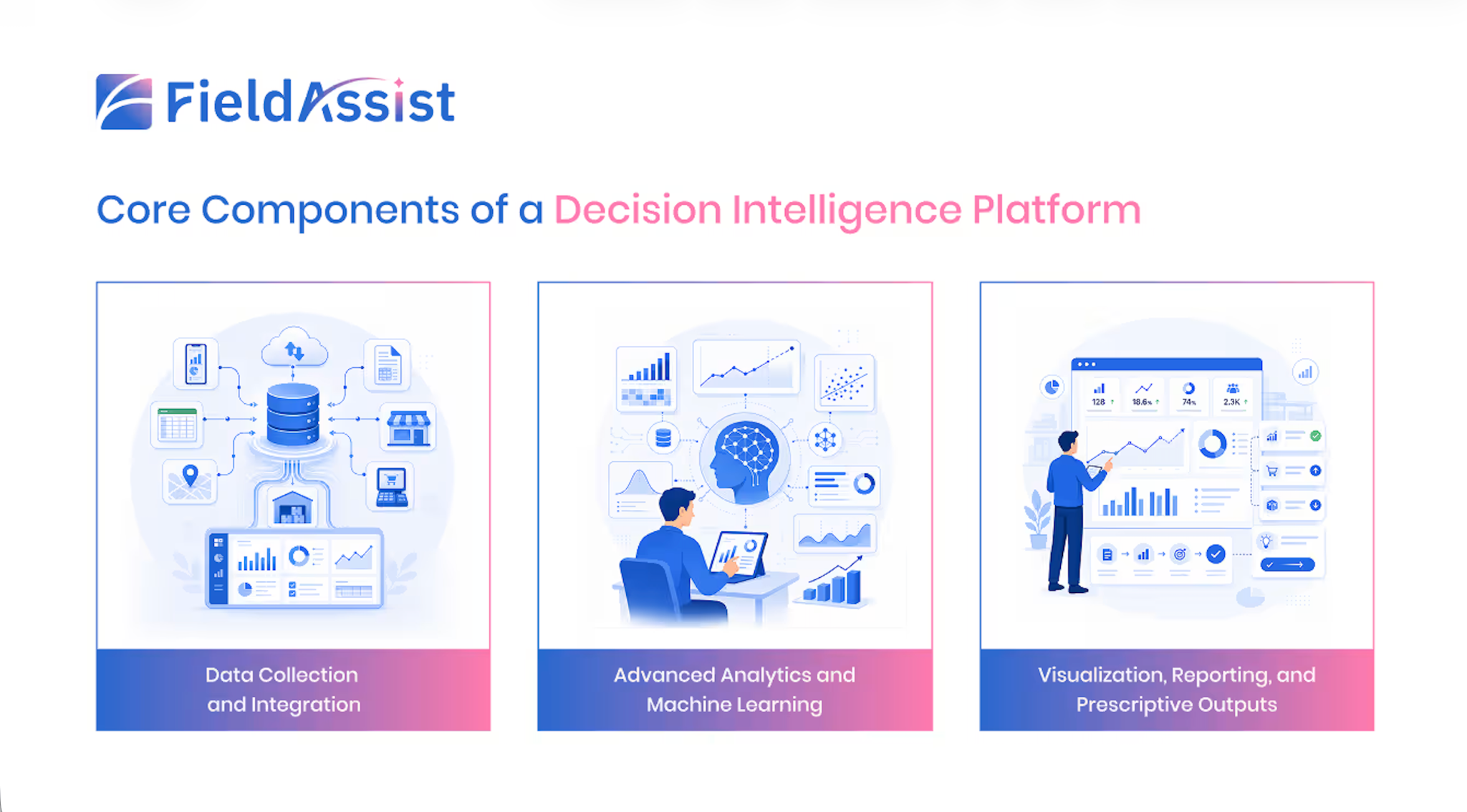
A robust Decision Intelligence platform is not a single tool; it's an integrated architecture that spans data ingestion, advanced modeling, and actionable output delivery.
1. Data Collection and Integration
The foundation of any Decision Intelligence platform is seamless, real-time data collection across all touchpoints, primary and secondary sales, TSI field activity (geo-verified visits, lines per call, productive calls), distributor inventory levels, planogram compliance photos, competitor pricing signals, and consumer offtake data from modern trade. Without this unified data layer, Decision Intelligence models are only as good as the siloed data they consume.
2. Advanced Analytics and Machine Learning
This is where raw data is converted into intelligence. ML models process historical patterns, detect anomalies, and generate forecasts. For FMCG brands, this translates to demand sensing at the outlet level, identifying whitespace for numeric distribution expansion, and scoring outlets by growth potential. The models improve continuously as they ingest more field data, a closed-loop learning mechanism that makes recommendations sharper over time.
3. Visualization, Reporting, and Prescriptive Outputs
Decision Intelligence is only valuable if the right insight reaches the right person at the right time. Best-in-class Decision Intelligence software delivers prescriptive outputs through intuitive dashboards for leadership, real-time alerts for field managers, and in-app nudges for TSIs in the field, not a 50-slide PowerPoint that gets reviewed once a quarter.
How Decision Automation Eliminates Bottlenecks Across Business Functions?
Decision automation, the ability to execute high-frequency, rule-bound decisions without human intervention, is the operational accelerant of Decision Intelligence. Across every function in a CPG enterprise, automation removes the lag between insight and action.
- Marketing and Sales Optimization
Marketing teams can automate scheme targeting, ensuring the right promotion reaches the right retailer segment in the right geography, rather than blanket-rolling a scheme that benefits low-value outlets. Sales teams get automated route recommendations that maximize productive calls per TSI per day. Decision automation removes the cognitive load from the field force so they focus on execution, not navigation.
- Supply Chain and Inventory Management
Supply chains are especially susceptible to decision lag. When distributors hold excess inventory of slow-moving SKUs while high-velocity products go out of stock at the last mile, it's a planning failure, not a supply failure. According to McKinsey, data-driven organizations are 19x more likely to be profitable, a direct function of smarter inventory and supply chain decisions that reduce waste and improve fill rates. Decision automation in supply chains triggers replenishment orders, flags distributor anomalies, and recalibrates demand forecasts in real time.
- Retail Execution and Customer Experience
This is the last-mile execution gap that FieldAssist was built to close. Decision automation at the retail execution layer means shelf visibility issues get flagged before the promotion goes live, planogram deviations are caught by AI-powered image recognition, and outlet visit priorities dynamically adjust based on sales potential, not static beat plans drawn up six months ago.
How Decision Intelligence Software Improves Business ROI?
The ultimate test of any enterprise technology is its impact on financial performance. Decision Intelligence software drives ROI across multiple dimensions, including cost, risk, productivity, and revenue.
1. Faster Decisions, Lower Operational Costs
Every hour of delayed decision-making in a distribution network has a cost: stockouts, missed scheme windows, and under-utilized field force. Decision Intelligence software compresses the insight-to-action cycle from days to minutes. When a TSI's beat plan is dynamically optimized the night before rather than manually reviewed weekly, the cumulative productivity gain across 2,000 reps translates directly to more outlet visits per day and lower cost-per-productive call.
2. Reduced Bias and Risk Exposure
Human decisions are subject to recency bias, regional favoritism, and political prioritization. A senior manager may over-invest in a distributor they trust, regardless of what the data says. Decision Intelligence software introduces objectivity; recommendations are generated from pattern data, not personal relationships. This reduces compliance risk, scheme leakage, and the financial exposure of misallocated trade spends.
3. Resource Allocation That Maximizes Productivity
Intelligent decision making enables CPG brands to reallocate resources, field headcount, trade budgets, and distributor coverage toward the highest-ROI opportunities, rather than maintaining legacy allocations. McKinsey research confirms that data-driven organizations are 23x more likely to acquire customers and 6x more likely to retain them. In FMCG terms, that means better numeric distribution in high-potential markets, improved productive call rates, and sharper scheme ROI.
Choosing the Right Decision Intelligence Platforms for Your Business
With the Decision Intelligence platforms market expanding rapidly, the selection decision itself requires intelligent decision-making. Not every platform is a true decision intelligence platform; many tools offer descriptive analytics dressed up with AI terminology. Here's what to evaluate:
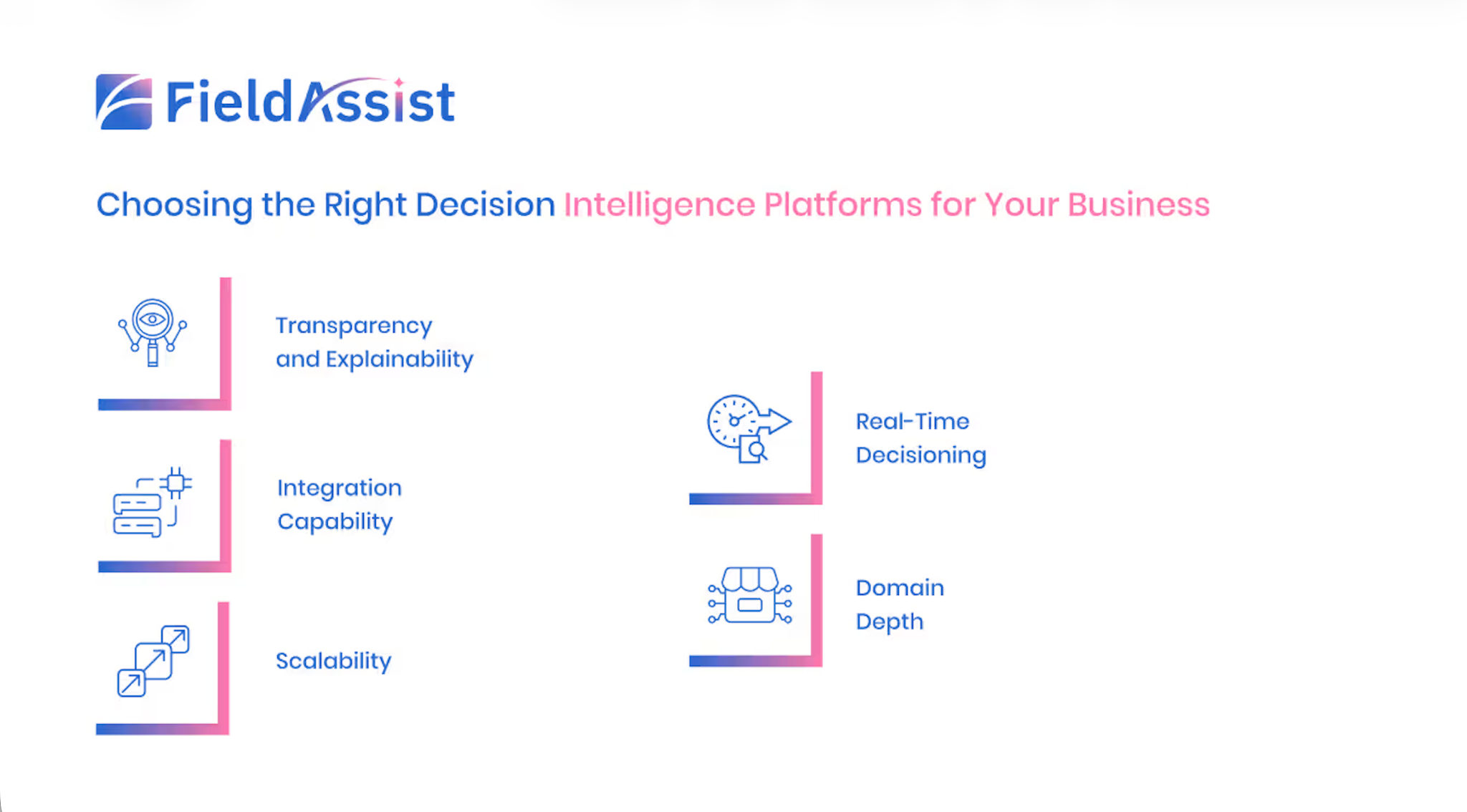
- Transparency and Explainability: Can your field managers and leadership understand why a recommendation was made? Black-box AI is a compliance and adoption risk. Look for platforms that surface the reasoning behind every automated decision.
- Integration Capability: Your Decision Intelligence software must connect to your existing ERP, DMS, and CRM stack without requiring a 12-month integration project. Pre-built connectors and API-first architecture are non-negotiable.
- Scalability: Can the platform handle millions of daily transactions across thousands of TSIs and hundreds of thousands of outlets without degrading decision latency? Test at scale before committing.
- Real-Time Decisioning: Batch-processed insights delivered the next morning have limited value for field execution. Look for platforms that deliver prescriptive outputs in real time, at the point of action.
- Domain Depth: A generic analytics platform is not the same as a Decision Intelligence platform built for FMCG and CPG. Industry-specific models outperform generic ones because they're trained on the right data patterns.
This is exactly where FieldAssist stands apart. Built ground-up for FMCG and CPG brands operating in emerging markets, FieldAssist's AI-powered retail execution platform, anchored in FAi IRIS, the 3i Intelligence framework, and FAi Agentic AI, is purpose-built as a Decision Intelligence platform for the last mile. Rather than surfacing generic BI dashboards, FieldAssist delivers prescriptive recommendations to reps in the field, distribution managers at the hub, and category heads at headquarters, all from a single, integrated platform.
With NOVA, FieldAssist's intelligent decision engine, brands can automate beat planning, detect shelf visibility anomalies via AI image recognition, predict outlet-level demand to within a 5% margin, and allocate field resources dynamically based on revenue potential, not legacy habit. FieldAssist is not just a Decision Intelligence software vendor. It's the execution layer where intelligent decisions get operationalized, every day, at scale.
The Future of Intelligent Decision Making in the Enterprise
The next frontier of Decision Intelligence is agentic AI, where the system doesn't just recommend decisions but executes them autonomously, within defined guardrails. In retail execution, this means AI agents that auto-adjust distributor replenishment based on live POS signals, reallocate field reps' beats mid-week in response to a competitor promotion, or dynamically re-price trade promotions based on offtake velocity.
For CPG brands operating in high-frequency, high-complexity markets like India, Kenya, or Indonesia, the sheer volume of micro-decisions, which outlet to visit, which SKU to push, which scheme to recommend, is beyond human bandwidth. Intelligent decision-making at scale requires machines to handle the volume and humans to handle the judgment calls. That combination, human-machine collaboration, powered by a robust Decision Intelligence platform, will define the next generation of market leaders.
The enterprises that invest in Decision Intelligence infrastructure today are building a compounding advantage: better data begets better models, better models beget better decisions, and better decisions beget better market outcomes. The window to build that lead is open, but it won't stay open.
Closing Thoughts
Decision Intelligence is not the next upgrade to your BI stack. It is a fundamentally different operating discipline, one that closes the gap between data and action, between insight and revenue. For CPG and FMCG brands navigating the complexity of emerging market distribution, it is the difference between reactive firefighting and proactive growth execution.
The question for enterprise leaders is no longer whether to invest in Decision Intelligence; the market data, the ROI benchmarks, and the competitive dynamics have settled that debate. The question is how fast you can embed intelligent decision-making into every layer of your go-to-market engine, from the national strategy desk to the TSI's smartphone on the shop floor.
FieldAssist exists to answer that question. Explore how our AI-powered retail execution platform and Decision Intelligence capabilities can transform your last-mile execution and ROI. Get in touch




.avif)