Trade Promotion Management in the Age of Agentic AI
AI in Trade Promotion Management enables CPG brands to measure promotion ROI, automate decisions, and close last-mile execution gaps.

.avif)
For most CPG and FMCG brands, trade spend is one of the largest investments after the cost of goods sold. Yet, it's often the hardest to measure. Every quarter, brands invest heavily in trade promotions, but many still struggle to answer a basic question: Which promotions actually drove incremental sales, and which simply rewarded sales that would have happened anyway? The gap between a promotion being planned and what actually happens in the market is what we call the last-mile execution gap.
This piece is written for the sales and marketing leaders who are done accepting "that's how trade spend has always worked" as an answer. We'll unpack how Trade Promotion Management actually works end to end, why most Trade Promotion Management Software still leaves brands flying blind, and how AI in Trade Promotion Management is moving from passive dashboards to agentic systems that plan, flag, and course-correct on their own, closing the last-mile execution gap that has quietly eaten CPG margins for a decade.
What Is Trade Promotion Management, and Why Are CPG Leaders Rethinking It?
Trade Promotion Management is the process of planning, funding, executing, and reconciling the discounts, schemes, and merchandising deals that CPG manufacturers offer distributors and retailers to drive off-take. The idea is simple- fund a promotion, watch volume lift, settle the claim. In practice, at the scale most FMCG brands operate, thousands of SKUs, tens of thousands of outlets, dozens of distributors and retail partners, it becomes one of the most operationally complex functions in the business.
And the numbers back up just how badly this complexity is currently being managed. In a landmark analysis of more than $500 billion in annual trade promotion spend, industry report found that 59% of trade promotion events globally failed to even break even, despite CPG manufacturers routinely investing around 20% of their revenue into these programs. It's a systemic failure of visibility, and it's exactly the failure that modern Trade Promotion Management is meant to fix.
How Trade Promotion Management Works?
Strip away the jargon, and Trade Promotion Management runs through a fairly consistent lifecycle, the difference between brands that win at trade and brands that bleed margin lies entirely in how tightly each stage is connected to the next.
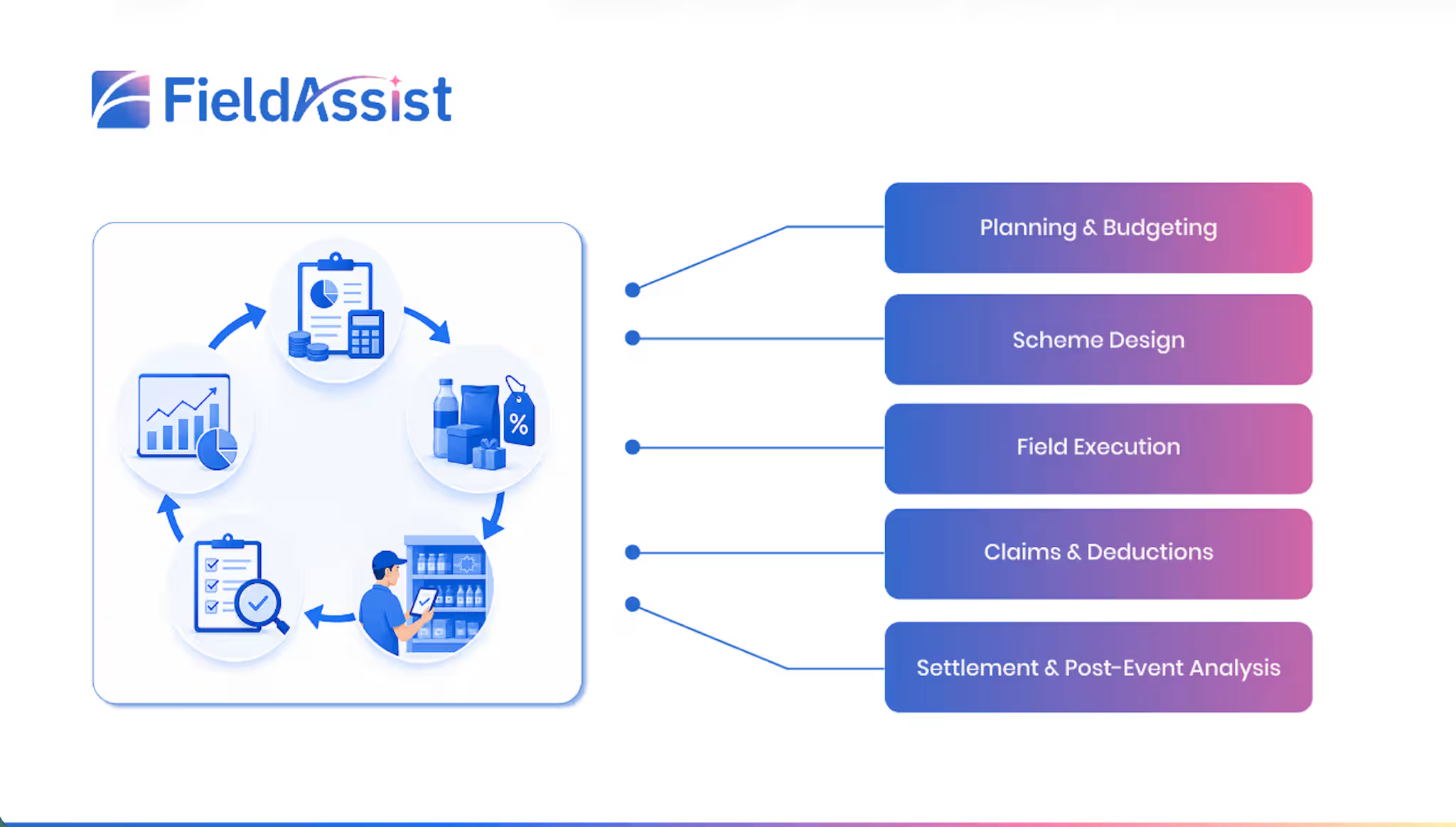
The Five Stages Every Trade Promotion Management Software Should Support:
- Planning & Budgeting- allocating trade funds across brands, regions, and channels based on historical performance and category objectives.
- Scheme Design- structuring the offer: price-offs, bundled packs, slabs, secondary display incentives, or retailer-specific schemes.
- Field Execution- ensuring the scheme is actually live at the shelf, communicated to the sales force, and compliant with retailer agreements.
- Claims & Deductions- capturing retailer/distributor claims, validating them against agreed terms, and catching leakage or duplicate claims.
- Settlement & Post-Event Analysis- closing the loop financially, and, critically, measuring whether the promotion actually drove incremental sales.
Most legacy systems handle two or three of these stages well and leave the rest to spreadsheets and email trails. That's where the last-mile gap opens up: a scheme approved on paper in the head office rarely matches what a distributor's sales rep actually executes on the ground.
Why Legacy Trade Promotion Management Software Is Holding Brands Back?
Most brands didn't choose their trade spend chaos, they inherited it. Trade funds get tracked in one spreadsheet, claims arrive as scanned PDFs from distributors, secondary sales data lives in a separate DMS, and by the time finance reconciles everything, the quarter is already over and the losing schemes have already been re-funded for the next one. Traditional Trade Promotion Management Software was built to digitize this paperwork, not to question it.
- No real-time link between scheme execution at the outlet and fund utilization at HQ
- Claims validated manually, months after the promotion has already ended
- Little to no visibility into incrementality, was this genuinely new demand, or pantry loading and cannibalization?
- Underperforming schemes keep getting re-approved simply because nobody flagged them in time
Trade Promotion Analytics: The Data Layer Every Agentic Decision Runs On
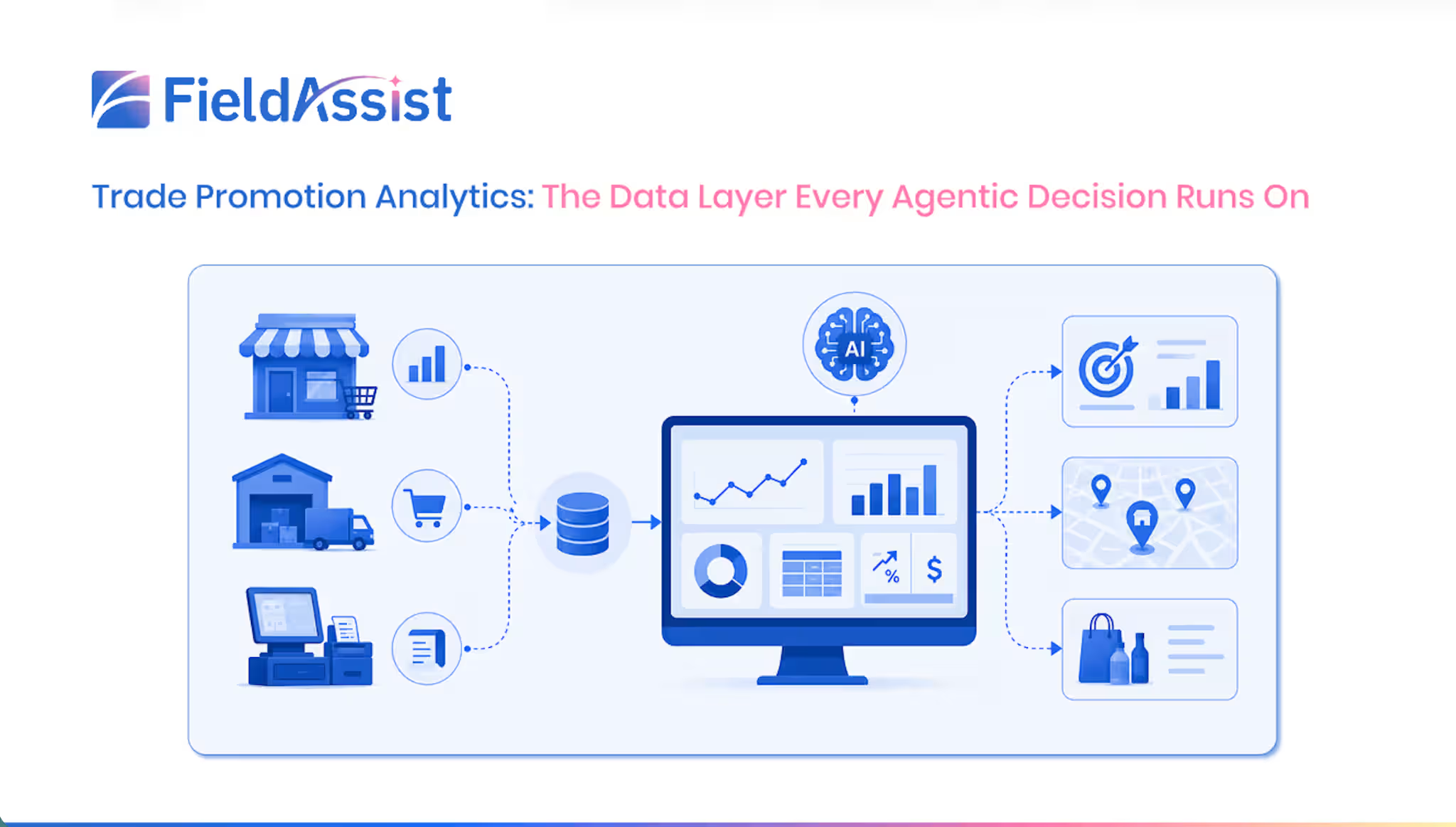
This is where Trade Promotion Analytics enters, and where the conversation shifts from "did we spend the budget" to "did the spend actually work." Trade Promotion Analytics is the practice of measuring baseline sales, incremental lift, cannibalization, and ROI for every scheme, at SKU-and-outlet granularity, so that the next quarter's plan is built on evidence rather than habit.
CPG brands that have made this shift are already seeing it pay off. According to McKinsey's 2024 Global Survey on AI, 71% of CPG leaders had adopted AI in at least one business function, up sharply from 42% just a year earlier, with trade and revenue growth management consistently cited as one of the highest-value functions for applying it.
What Strong Trade Promotion Analytics Looks Like in Practice?
- Real-time ingestion of secondary sales and POS data, not month-end reconciliation
- Predictive ROI simulation before a scheme is even approved
- Outlet- and distributor-level granularity, not just brand or region roll-ups
AI in Trade Promotion Management: From Dashboards to Autonomous Decisions
For years, AI in Trade Promotion Management meant predictive models: forecasting demand, suggesting an optimal discount depth, flagging an outlier claim for someone to review. Useful, but still fundamentally passive, a human still had to notice the dashboard, interpret it, and act. Agentic AI changes that equation. Instead of surfacing an insight and waiting, an agentic system can detect that a scheme is underperforming mid-cycle, simulate two or three corrective actions, and reallocate the remaining trade fund toward the higher-performing option, with a human sales leader approving the exception, not authoring it from scratch.
Agentic AI vs. Traditional AI in Trade Promotion Management
From Trade Promotion Analytics to Autonomous Action
None of this works without the analytics layer underneath it, an agent is only as good as the data it reasons over. The upside is significant: McKinsey estimates generative and agentic AI could add $400 billion to $660 billion in additional operating profit annually across the retail and CPG sector, much of it flowing through exactly this kind of sales, trade, and inventory decisioning.
FieldAssist Trade Promotion Management Software for FMCG
This is precisely the gap FieldAssist was built to close. We don't think of trade promotion as a finance reconciliation problem, we think of it as a last-mile execution problem, because that's where most trade budgets actually leak. FieldAssist's Trade Promotion Management Software connects scheme planning directly to what happens at the shelf: field sales force activity, distributor secondary sales, retailer billing, and claims, all on one platform, instead of stitched together after the fact.
Built for the Last-Mile Realities of Emerging Markets:
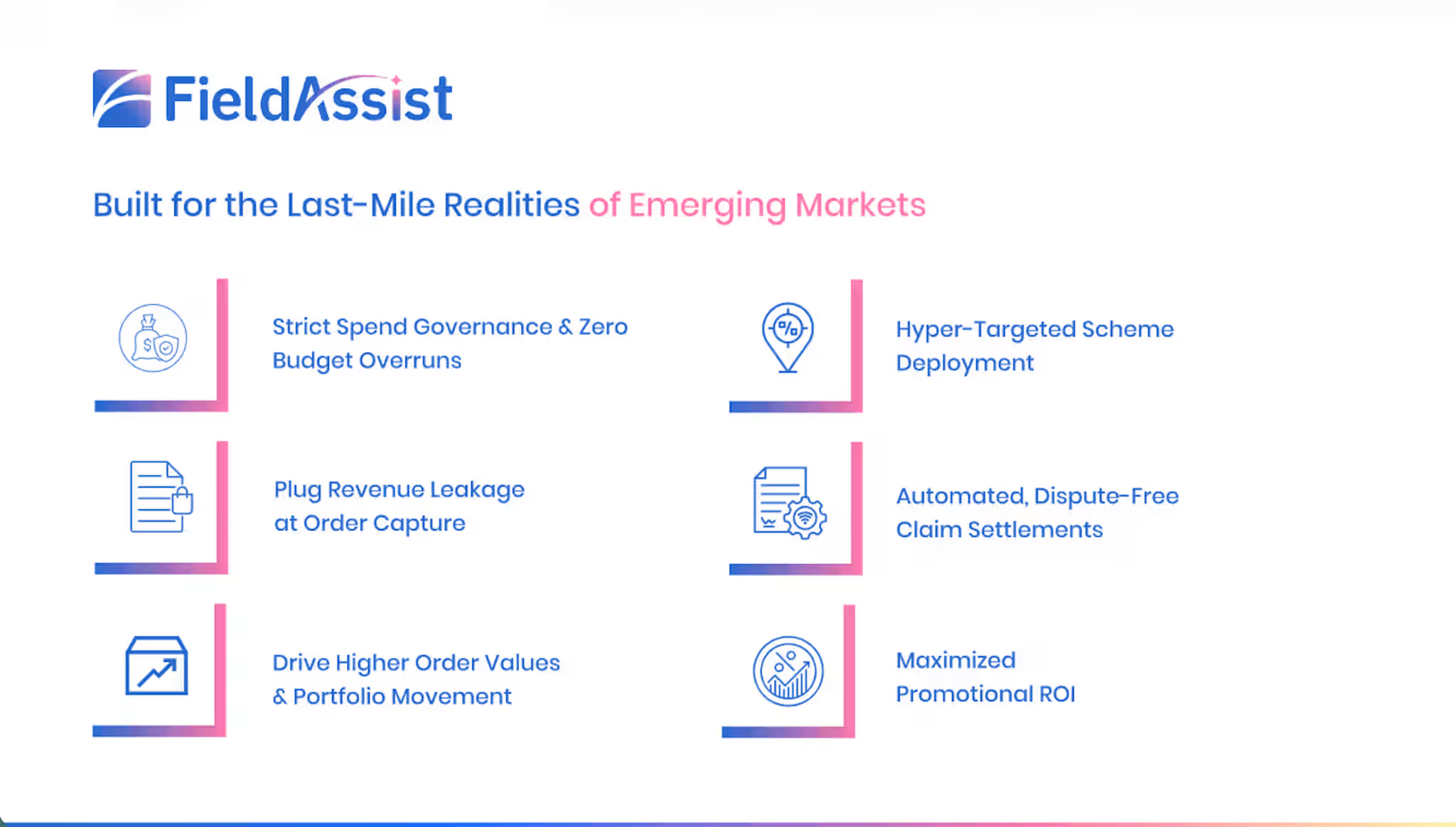
1. Strict Spend Governance & Zero Budget Overruns
Set automated hard caps on trade spend by budget value, order volume, or unit thresholds. The system automatically deactivates promotions the instant limits are hit, protecting margins from over-execution.
2. Plug Revenue Leakage at Order Capture
Validate scheme rules and product eligibility instantly on field reps' mobile apps. This stops unauthorized discounts, manual overrides, and double-dipping before orders hit the system.
3. Drive Higher Order Values & Portfolio Movement
Incentivize distributors to buy across multiple categories using group basket logic. Retailers must purchase long-tail or slow-moving SKUs alongside high-demand products to unlock trade benefits.
4. Hyper-Targeted Scheme Deployment
Scope promotions precisely by region, state, distributor, or specific retail channels (e.g., GT, MT). This ensures trade dollars are directed strictly to priority outlets rather than spent on blanket discounts.
5. Automated, Dispute-Free Claim Settlements
Digitize payout calculations (Step, Continuous, Pro Rata) and match them against actual secondary sales data. This speeds up distributor credit cycles and eliminates post-event trade disputes.
6. Maximized Promotional ROI
Track scheme performance, offtake, and incremental volume live. Revenue Growth Management (RGM) teams gain immediate visibility to double down on high-performing deals and pull back underperforming schemes.
Choosing Trade Promotion Management Software Built for the Agentic Era
If you're evaluating options, the question isn't just "can it manage schemes” anymore- most Trade Promotion Management Software can do that. The real question is whether it's architected to support the agentic layer that's coming next. A few things worth pressure-testing with any vendor:
- Does it natively integrate with your SFA, DMS, and retailer ordering systems, or does it require manual data reconciliation?
- Can it measure incrementality at outlet-and-SKU level, not just aggregate scheme ROI?
- Is claims validation automated against real sell-out data, or dependent on manual review?
- Can it support field-level adoption across hundreds or thousands of distributor sales reps, not just a head-office finance team?
- Is the roadmap built for agentic decisioning, mid-cycle fund reallocation, automated anomaly flagging, or bolted-on AI features?
The Road Ahead: AI in Trade Promotion Management as a Competitive Moat
The brands that win the next decade of trade spend won't be the ones that spend the most, they'll be the ones that can see, in real time, exactly what their spend is producing, and correct course before the budget is gone rather than after. That's the real promise of AI in Trade Promotion Management: not replacing the sales director's judgment, but giving them a system that never stops watching the last mile on their behalf.
If you're rethinking how your trade promotion function should work in an agentic world, explore how FieldAssist's platform brings retail execution, field sales automation, and Trade Promotion Management. Get in touch with us today



%20(1).avif)

.avif)