Building an Effective RTM Strategy Across General Trade and Modern Trade
Build a stronger FMCG distribution strategy with actionable insights on General Trade and Modern Trade execution, demand forecasting, beat planning, and channel growth.

.avif)
India's CPG landscape is unlike any other. A brand that wins a ‘modern’ hypermarket shelf in Gurugram can still lose the battle in Nagpur if its kirana coverage is weak. This duality makes RTM in FMCG India both a strategic priority and an operational puzzle. Brands that master FMCG sales channel optimization across general trade and modern trade are those that protect volume today while building category equity for tomorrow.
Understanding RTM in FMCG India: Why It Matters More Than Ever
Route-to-market (RTM) is the backbone of the FMCG distribution strategy. It defines how a product moves from the factory gate to a consumer’s hands, every distributor, stockist, sales rep beat, and outlet touchpoint in between.
India’s FMCG market stood at USD 289 billion in 2025 and is projected to reach USD 642 billion by 2030, according to report. But size alone tells an incomplete story. The sector recorded a 13.9% value growth in Q2 2025, driven by rural demand, a channel served almost exclusively by general trade, as reported by NielsenIQ’s Q2 2025 Quarterly Snapshot.
Yet at the same time, modern trade recorded a threefold acceleration in growth in Q4 2025 versus the previous quarter, supported by faster pricing execution and stronger operational systems, as per report. Both signals are real. Both channels matter. And that is precisely why RTM in FMCG India can no longer be a single-channel playbook.
General Trade vs Modern Trade in India: Understanding the Channel Dynamics
Before building a balanced FMCG distribution strategy, brand teams must understand what makes each channel structurally different, not just in scale, but in the dynamics that drive execution success.
The general trade and modern trade dynamic in India is not a zero-sum game. General trade dominates volume; modern trade drives premiumization and brand visibility. Both need each other in a high-growth market.
Why FMCG Brands Need a Balanced General Trade and Modern Trade Strategy?
Relying exclusively on one channel creates a highly vulnerable business model. If a brand over-indexes on Modern Trade, it risks severe margin erosion through heavy listing fees, aggressive commercial margins, and expensive trade discounts. Conversely, a brand that focuses solely on General Trade misses out on the urban premiumization trend, high-margin modern shoppers, and rapid cross-selling opportunities.
A comprehensive evaluation of general trade vs modern trade FMCG networks shows that a balanced approach provides a structural cushion against economic volatility. During localized supply chain disruptions, the agility of independent kirana stores keeps product categories moving. Simultaneously, during festive seasons, the promotional scale of organized retail spaces boosts volume velocity.
True FMCG sales channel optimization means ensuring these two formats complement, rather than cannibalize, each other. By balancing your portfolio, you ensure high volume velocity in corporate retail while maintaining deep, resilient market penetration across the millions of traditional stores that form the backbone of the consumer economy.
Unique RTM Challenges When Managing Multiple FMCG Sales Channels
Simultaneously executing strategies across general trade and modern trade environments uncovers distinct structural bottlenecks that can slow down market momentum.
1. Inconsistent Field Execution Across Channels
Field teams face completely different operational realities in each channel. A sales representative in General Trade needs to visit 30-40 stores a day, focusing heavily on order placement, relationship building, and basic visibility. A Modern Trade executive, on the other hand, deals with store managers, stock fill-rates, and complex planogram compliance. Without channel-specific digital workflows, field execution becomes chaotic, leading to missed store visits and lost sales opportunities.
2. Limited Visibility into Outlet-Level Performance
Many consumer goods brands remain completely blind to what happens after inventory leaves the primary distributor. In General Trade, a lack of secondary and tertiary sales data means companies cannot track which SKUs are actually moving off kirana counters. In Modern Trade, stockouts frequently occur on the shelves even when the store’s backroom is full, simply because there is no real-time data flow connecting field merchandisers to the central inventory system.
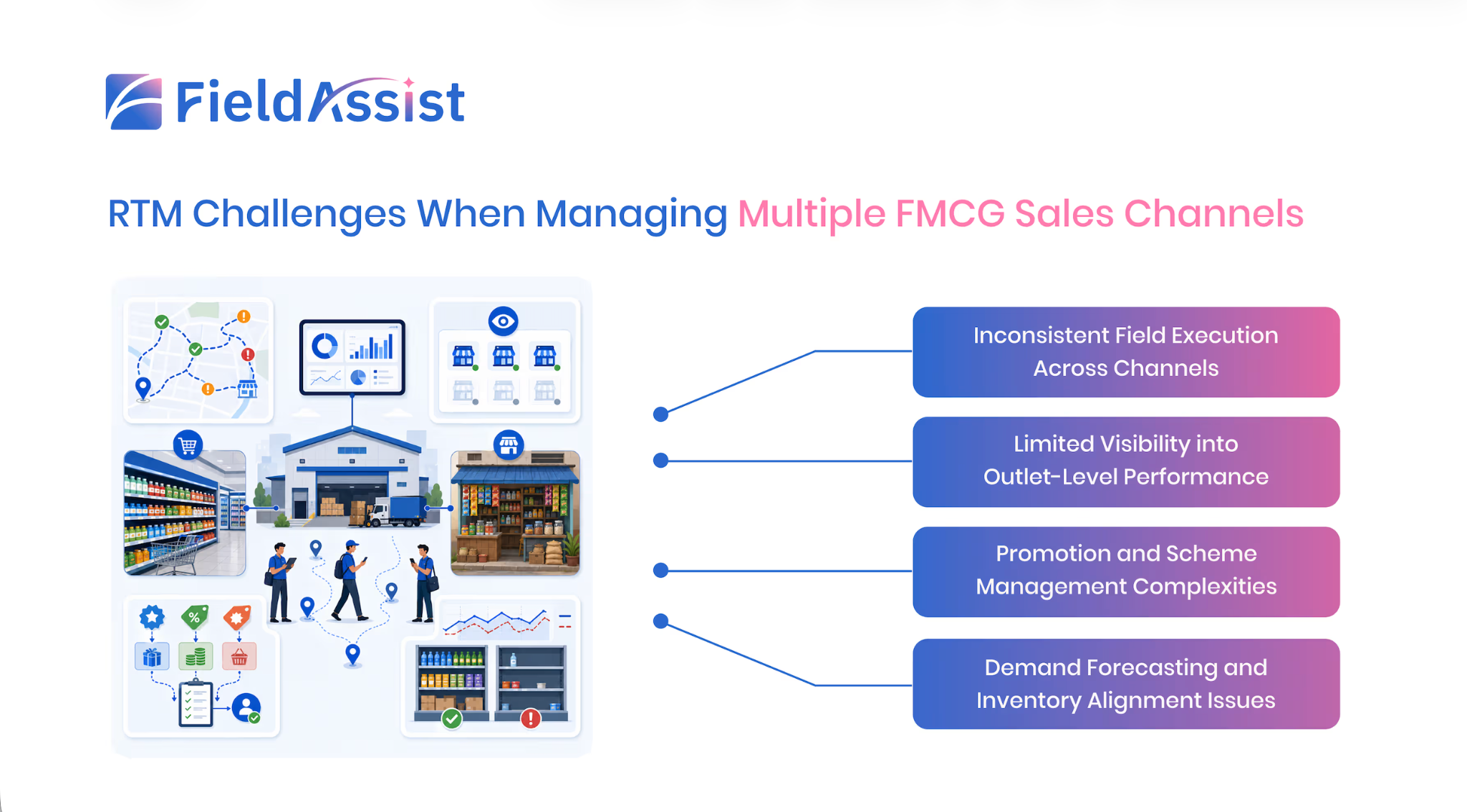
3. Promotion and Scheme Management Complexities
Trade promotions are a significant cost center for FMCG brands. General Trade relies on volume-based discounts, localized dealer schemes, and free goods to incentivize small retailers. Modern Trade demands complex price-offs, bundled consumer promos, and high-visibility endcap displays. Manually managing, validating, and auditing these highly diverse schemes across thousands of outlets results in significant margin leakage and widespread distributor disputes.
4. Demand Forecasting and Inventory Alignment Issues
Misalignments in demand forecasting lead to the twin evils of distribution: stockouts and inventory piles. Data from an IIM Ahmedabad research report on retail distribution channels reveals that modern urban consumer behavior has shifted dramatically toward instant availability and convenience, pushing brands to radically shorten delivery cycles. When data from traditional and modern pipelines remains siloed, manufacturing plants either overproduce slow-moving lines or fail to supply high-demand SKUs, causing empty shelves across both channels.
Effective FMCG Distribution Strategy for Channel Growth
A high-performing FMCG distribution strategy in a multi-channel market must be engineered for execution- not just planned on a slide deck. Here’s how leading CPG brands are doing it.
- Segmenting Outlets Based on Channel Potential
Not every kirana is the same. Brands that segment general trade outlets by potential (volume tier, category affinity, growth trajectory) are able to allocate field resources and product assortment far more efficiently. The same principle applies to modern trade; a D-Mart and a neighborhood convenience chain demand different RTM mechanics. Outlet segmentation is the foundation of any mature RTM in the FMCG India framework.
- Optimizing Coverage and Beat Plans
Beat planning in general trade is frequently the single biggest lever for FMCG sales channel optimization. Overbuilt beats with excessive travel time reduce productive outlet interactions; underbuilt beats mean missed coverage. Dynamic beat planning, informed by actual outlet density, road conditions, and historical productivity data, can improve field rep efficiency significantly while reducing distribution cost per outlet.
- Aligning Trade Promotions with Channel Objectives
General trade and modern trade promotions must serve different purposes within an integrated general trade and modern trade strategy. GT schemes are typically volume-driven, credit-based, or secondary-push oriented. MT promotions are visibility-driven, activation-focused, and tied to planogram compliance. Brands that define channel-specific KPIs for promotions and track them in real time are able to measure ROI rather than just claiming it.
- Using Data for Smarter Distribution Decisions
The single biggest shift in modern FMCG distribution strategy is the move from intuition to intelligence. Outlet-level data on coverage, SOS, secondary sales, and scheme compliance, captured digitally in the field, allows brand and RTM teams to reallocate resources toward high-potential zones, plug distribution gaps before they become competitive vulnerabilities, and build a real-time picture of how general trade and modern trade are each contributing to category targets.
FieldAssist Helping FMCG Brands Achieve RTM Excellence
At FieldAssist, we purposefully design our tech stack to close the execution gap between corporate planning and real-world field realities. We provide an end-to-end cloud platform that transforms raw retail data into actionable, channel-specific field directives.
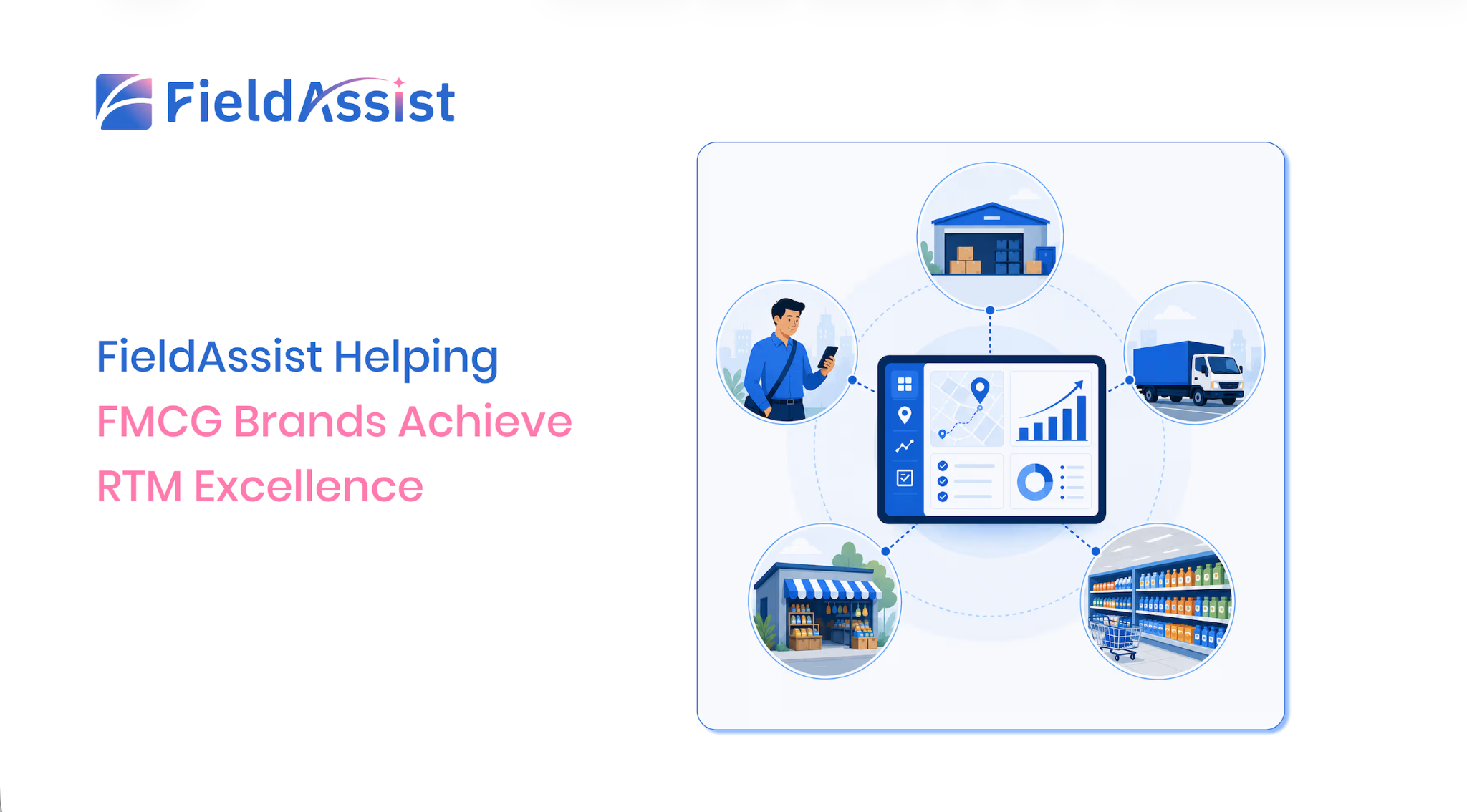
Our specialized Sales Force Automation (SFA) platform gives traditional trade teams predictive, analytical order suggestions, automated beat optimization, and real-time visibility into distributor inventory. This empowers field reps to maximize their daily strike rates across fragmented traditional retail networks.
For modern retail environments, our specialized Modern Trade App and analytics tools give brands granular control over visual merchandising tracking, planogram compliance, stock-out alerts, and complex multi-tier promotional validation.
FAi IRIS, FieldAssist’s AI-powered retail image recognition engine, enables brands to capture shelf visibility data at scale, across both kirana shelves and modern trade gondolas, transforming every store visit into a structured intelligence signal. The 3i Intelligence framework gives RTM leaders a unified view across distribution, execution, and business outcome metrics.
By unifying your entire field organization onto a centralized, automated data engine, FieldAssist eliminates information siloes, automates complex trade schemes, and provides complete clarity on outlet-level performance. We help consumer goods brands transition from reactive logistics to proactive market execution across all target channels.
Closing Thoughts
RTM in FMCG India is not a choice between general trade and modern trade; it’s the discipline of making both channels perform together. Brands that try to win this market by optimizing for only one channel are leaving significant volume, margin, and brand equity on the table.
The execution gap is real. It shows up every day in unvisited outlets, missed scheme compliance, inaccurate forecasts, and field teams operating without visibility. Closing that gap is what separates category leaders from brands that merely participate.
With the right FMCG sales channel optimization infrastructure, the right data, and a field execution engine built for India’s retail complexity, RTM excellence is achievable, not aspirational.
Ready to build your balanced general trade and modern trade strategy? Talk to a FieldAssist RTM expert today.



%20(1).avif)

.avif)