Retail Audit Checklist: 10 Things FMCG Sales Teams Must Check in Every Store
Discover the retail audit checklist covering 10 essential checks FMCG sales teams must perform in every store to improve product availability, shelf visibility, and retail execution.

A sales rep finishes the store visit, marks it as complete on the app, and moves to the next outlet. But at the head office, the dashboard shows the store as compliant, even though no one has verified what actually happened inside the store.
The truth was that the discount price tag was three weeks old, a competitor's cooler was positioned where your display should have been, and two of the top SKUs were out of stock. The last-mile execution gap is the discrepancy between what the report claims and what the shelf displays, and it is where FMCG companies covertly lose revenue on a daily basis.
IHL Group's 2026 study puts the global cost of out-of-stocks and overstocks at $1.7 trillion, or 6.2% of global retail sales. This is where Retail Audits become critical. They help sales teams assess what is happening inside retail outlets, identify execution gaps, verify merchandising standards, and ensure products are positioned to sell.
A structured Retail audit checklist gives field representatives a consistent way to evaluate every store visit. Instead of relying on observations or incomplete reporting, FMCG businesses can capture actionable retail data and make faster decisions about availability, visibility, promotions, and replenishment.
This guide covers the 10 essential checks FMCG sales teams should perform during every store visit, why retail audits matter, and how retail audit software can improve execution across a distributed retail network.
What is Retail Audit?
A retail audit is an evaluation of a retail outlet to assess product availability, assortment, shelf placement, pricing, promotional execution, merchandising, and overall sales performance.
Retail Audits help connect sales plans with actual in-store execution. They reveal whether a product is reaching the shelf, whether promotional activities are implemented correctly, and whether sales teams are addressing the right opportunities during store visits.
A retail audit is not simply a store inspection. It is a way to measure retail execution against defined sales, distribution, and merchandising objectives.
Why Are Retail Audits Important for FMCG Businesses?
Product availability, shelf visibility, pricing, and retailer relationships all have a direct impact on sales in the fast-paced retail environment in which FMCG firms operate. Frequent store audits assist brands in upholding execution standards and spotting issues before they have an impact on sales results.
Improve Product Availability
The most expensive issue in FMCG is empty shelves. Frequent audits identify stock-outs as soon as they occur, allowing a representative to place a replenishment order before a customer visits a rival.
For FMCG brands, this reinfo6tttttttrces the need to regularly check shelf availability rather than relying only on distributor stock or sales reports.
Maintain Consistent Brand Visibility
A product being present in a store does not guarantee that shoppers will notice it. Shelf position, facings, secondary displays, signage, and merchandising all influence product visibility.
Sales teams can verify whether products occupy the designated shelf space, adhere to display requirements, and remain visible among rival products with the help of retail audits.
Identify Retail Execution Gaps
Audit data reveals where plans fall short, such as which distributors supply late, which outlets fail planogram targets, and which representatives ignore categories.
Monitor Competitor Activities
Retail outlets provide direct insight into competitor activity. Sales representatives can observe competitor pricing, promotional schemes, new launches, additional facings, display investments, and assortment changes helping brands adapt their trade strategies based on actual market conditions instead of assumptions.
Improve Sales Performance and Store Productivity
A structured audit makes every store visit more productive. Representatives can identify opportunities to increase assortment, improve availability, place orders, execute promotions, and resolve retailer concerns.
Over time, consistent audits help businesses understand which execution activities contribute to better outlet performance and which require additional attention.
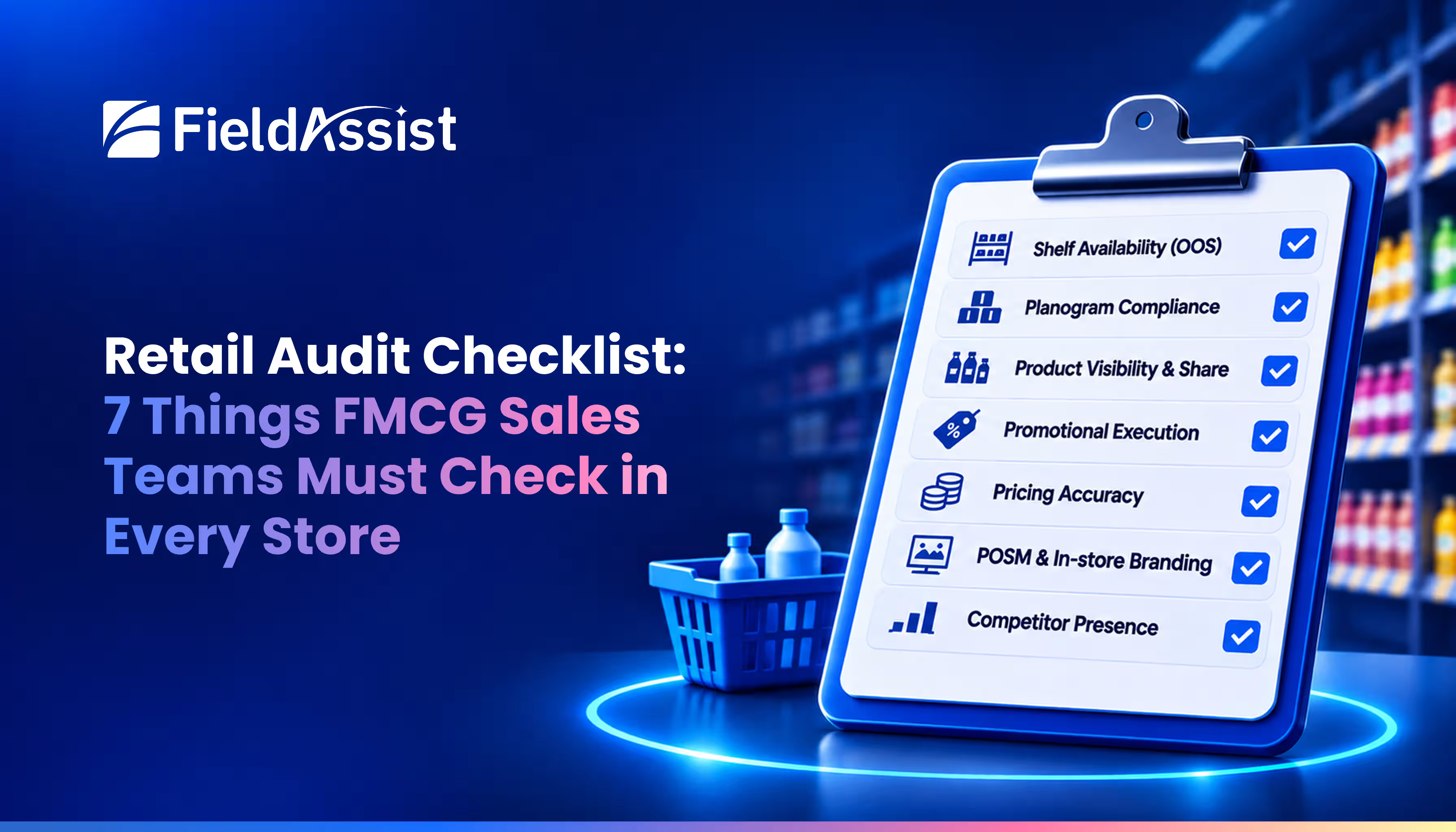
Retail Audit Checklist: 10 Things FMCG Sales Teams Must Check in Every Store
Use this retail audit checklist as your baseline for every visit. A longer list does not make a better audit. McKinsey's Reckitt case study notes that checklists went from 40 static tasks to 15 high-impact tasks in some stores, which cut broker costs and wasted effort. Start with these ten, then tailor them by channel and outlet type.
1. Product Availability and Stock Levels
Sales reps should check whether key and fast-selling SKUs are available on the shelves and have enough stock to meet demand. They should identify low-stock or out-of-stock products, check for items kept in the backroom, and flag replenishment needs. Shelf availability should be tracked separately from total store inventory.
2. SKU Assortment and Product Range
Reps should compare what the outlet stocks against the must-sell list for its channel. A kirana, a chemist, and a modern-trade store need different ranges. Flag missing hero SKUs and new launches so the rep can pitch them in the same visit.
3. Shelf Placement and Planogram Compliance
Reps check whether products are placed according to the brand's merchandising guidelines or the agreed planogram. This includes checking shelf placement, product height, category positioning, and the placement of priority SKUs. If products are not displayed as planned, reps record the gaps and capture photos where needed. Regular checks help maintain consistent product visibility across stores and ensure merchandising efforts deliver the expected results.
4. Share of Shelf and Product Visibility
Sales reps should check how much shelf space the brand occupies and whether shoppers can easily spot its products. This includes looking at the number of facings, shelf space compared to competitors, product placement, empty spaces, and whether any products are hidden or blocked. In crowded categories, good shelf visibility can influence what shoppers pick. Regular checks help sales teams identify stores where product placement or shelf space needs improvement.
5. Pricing Accuracy and Price Labels
Sales reps checks whether the prices displayed on shelves match the brand's recommended pricing and current trade agreements. This includes checking SKU-wise price labels, MRP, pack details, and any missing or outdated shelf tags. Where possible, they should also verify that the price at checkout matches the shelf price. Pricing accuracy matters because shoppers are more conscious of what they spend and often compare prices before making a purchase.
6. Promotional Offers and Discount Execution
Check whether the offers and promotions shared with retailers are being implemented correctly in the store. This includes verifying discounts, offer dates, bundle deals, promotional displays, and product availability. It is also important to check whether retailers are participating in the schemes. Even a well-planned promotion may not deliver results if the offer is not clearly displayed or the products are out of stock.
7. POSM and In-Store Branding
Audit every piece of point-of-sale material: wobblers, shelf strips, danglers, posters, coolers and gondola branding. Check that each is placed, undamaged and visible from the aisle. Record what is missing so it can be replaced before the next campaign cycle.
8. Product Expiry Dates and Stock Quality
Look for near-expiry and expired stock, damaged packs, leaking units and dusty cartons. Apply FEFO (first expiry, first out) and flag stock that should be pulled. Expired product on the shelf hurts your brand and the retailer relationship. Good retail store audit software lets reps log batch and expiry details in seconds.
9. Competitor Products, Pricing and Promotions
A retail audit should also capture what competitors are doing in the store. Sales reps should check new product launches, pricing, discounts, shelf space, promotional displays, product assortment, and stock availability. These observations help sales managers understand competitor activity and identify areas where they can improve their own product visibility, pricing, and distribution.
10. Retailer Orders and Replenishment Requirements
The audit should end with a discussion about the retailer’s current and upcoming needs. The sales representative should check which SKUs need replenishment, suggest order quantities, identify opportunities to list new products, and understand the retailer’s feedback on product demand and sales.
They should also look into pending orders, delivery issues, and opportunities to cross-sell or upsell products. Most importantly, the findings should lead to action. If a stock gap, missing SKU, or promotional opportunity is identified, the representative should follow up with an order, corrective action, or escalation rather than simply recording it in the audit report.
How Retail Audit Software Simplifies Store Audits for FMCG Businesses
Manual store audits can become difficult to manage when field teams cover hundreds or thousands of outlets. Paper checklists, spreadsheets, delayed reporting, and inconsistent observations make it challenging for managers to get an accurate picture of retail execution.
Retail audit software digitizes the audit process by allowing field representatives to complete store checks through mobile applications and enabling managers to access structured information across outlets, territories, and regions.
Here is how technology simplifies the process:
- Standardized checklists: Configure store audit parameters for availability, assortment, pricing, planogram compliance, and promotions.
- Digital data capture: Record observations, responses, store details, and supporting images directly during store visits.
- Real-time visibility: Track audit completion, compliance scores, and execution gaps without waiting for end-of-day reports.
- Image-based auditing: Use AI-powered image recognition to evaluate shelf conditions, product visibility, and merchandising compliance.
- Action tracking: Assign follow-up tasks to field representatives and monitor whether identified gaps are resolved.
- Performance analytics: Compare audit results across stores, territories, sales teams, categories, and time periods.
A connected Retail sales audit software workflow can also link audit findings with sales activities. For example, a missing SKU can trigger replenishment, poor visibility can generate a merchandising task, and an incorrect promotional display can be flagged for corrective action.
How FieldAssist Helps FMCG Businesses Improve Retail Audits
For FMCG businesses, retail audits are most valuable when the information captured during a store visit leads to action. FieldAssist helps brands connect store-level observations with sales execution, shelf intelligence, and corrective workflows.
AI-Powered Shelf Audits with IRIS
FieldAssist's IRIS Retail Image Recognition solution uses computer vision to turn shelf images into structured execution insights.
Sales representatives can capture shelf photographs during store visits, while AI helps identify:
- Product availability and missing SKUs.
- Share of shelf and product facings.
- Planogram deviations.
- Pricing and visual merchandising issues.
- Promotional execution gaps.
This reduces dependence on manual shelf assessment and gives managers a more consistent view of execution across retail outlets.
Perfect Store Execution
FieldAssist's Perfect Store solution helps brands define and track outlet-level execution standards through store-specific tasks, checklists, and performance measures.
Teams can monitor:
- Outlet-specific execution targets.
- SKU and shelf compliance.
- POSM and branding execution.
- Pricing and merchandising checks.
- Task completion and corrective actions.
Rather than treating every store visit as a routine activity, sales teams can focus on execution priorities that directly impact outlet performance.
Connected Field Execution and Sales Workflows
Retail audit findings become more actionable when connected with the sales team's daily workflow. FieldAssist helps businesses bring store observations, sales activities, outlet execution, and follow-up actions into a connected system.
For example, if a representative identifies missing products during an audit, the gap can be addressed through replenishment and order-taking workflows. If a store fails a merchandising check, the sales manager can track corrective action instead of relying on an informal follow-up.
FieldAssist helps FMCG businesses move from recording retail execution gaps to addressing them at the last mile.