What is Integration Platform as a Service? 2026 Guide to ERP, AI Agents, and No-Code Era
Discover how modern integration platform as a service iPaaS software connects multiple SaaS solutions and deploys AI agents faster using scalable, no-code architecture.

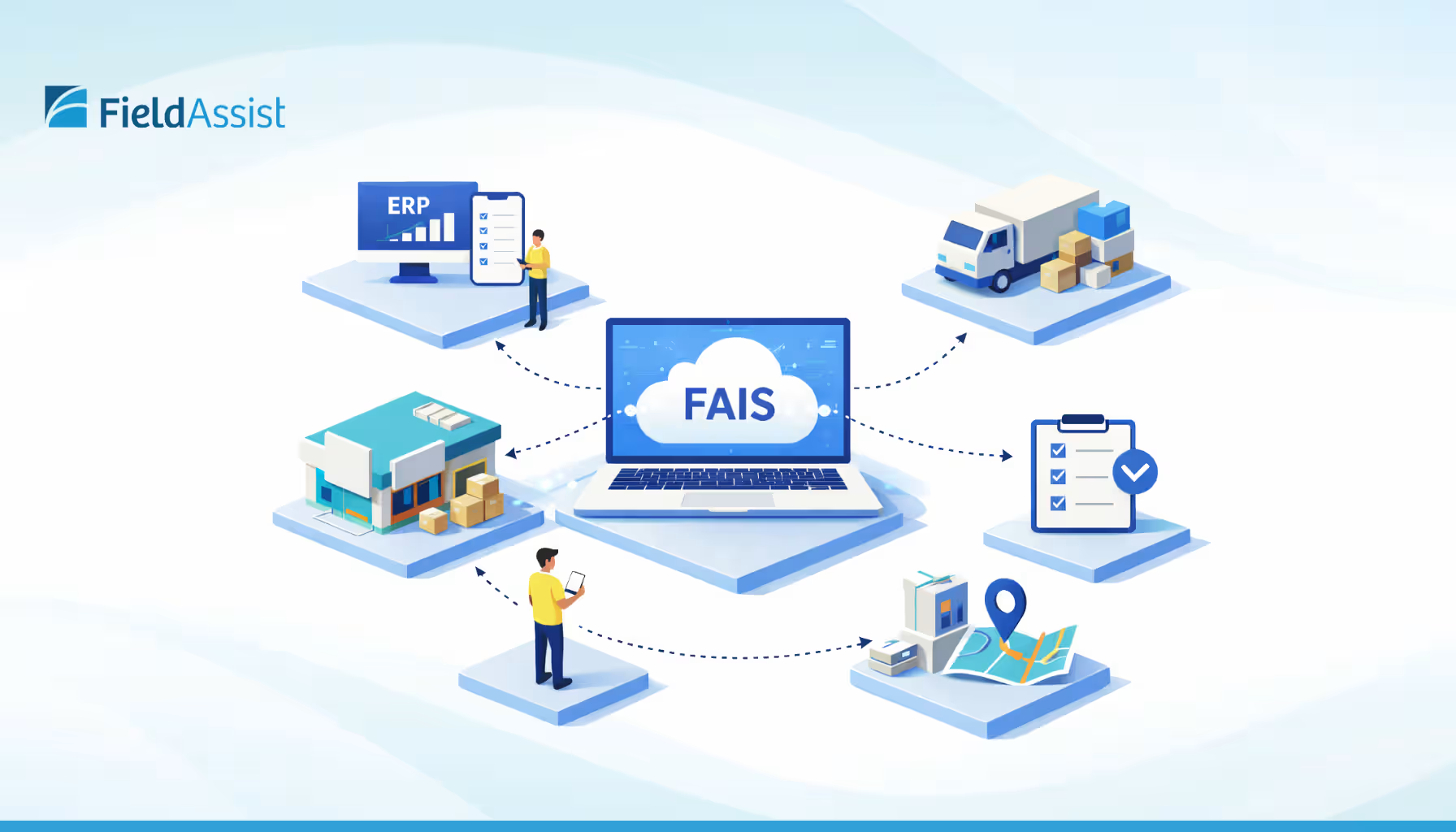
Is your digital ecosystem moving as fast as your consumers? The reality is that while most consumer brands run on robust ERPs or SaaS solutions, their critical data remains trapped in isolated silos, leading to execution blind spots. Integration is no longer just IT infrastructure; it is the digital nervous system of modern retail.
An Integration Platform as a Service (iPaaS) changes everything. It seamlessly bridges legacy ERPs with your field execution tools, turning static data into automated, real-time workflows. But how exactly does an AI integration platform empower your reps with autonomous insights and zero manual data entry?
In this guide, we decode no-code integration, the deployment of iPaaS for AI agents, and how FieldAssist's dedicated iPaaS solutions, FAIS, use this architecture to make FMCG brands unstoppable.
What is an Integration Platform as a Service (iPaaS)?
An integration platform as a service (iPaaS) is a cloud-based solution that connects disconnected systems like your SFA, DMS, ERP, CMS, and accounting tools into a single, unified stack. By utilizing no-code setups and automated workflows, an iPaaS provides real-time visibility and seamlessly clears the path to scale.
For modern FMCG brands, point-to-point custom coding is no longer viable. Every manual sync, delayed claim, or missed update equates to lost time and revenue. A purpose-built iPaaS software replaces fragmented IT architectures with a centralized, automated nervous system.
Why Do Modern Enterprises Need iPaaS for ERP Integration?
ERP systems are designed to be the central system of record for finance, operations, and core business data. However, modern organizations rely on a wide ecosystem of applications - analytics platforms, operational tools, customer systems, automation platforms, and AI-driven solutions. When these systems operate in isolation, data becomes fragmented, workflows slow down, and decision-making suffers.
A dedicated Integrated Platform as a Service (iPaaS), such as FieldAssist FAIS, solves this challenge by acting as the integration backbone that connects ERP with the broader enterprise technology stack. Instead of creating and maintaining complex custom integrations, organizations can use iPaaS to create secure, scalable, and real-time connections between systems. This ensures that data flows seamlessly across applications, enabling faster processes, accurate reporting, and better operational coordination.
For modern enterprises, the value of iPaaS for ERP goes beyond simple connectivity, such as:
- Scalable digital foundation ready for automation and AI.
- Higher process efficiency through automated cross-system workflows
- Faster deployment of new business tools and platforms
- Greater agility to adapt processes as business needs evolve
- Stronger governance and control over enterprise data flows
In short, iPaaS becomes the critical integration layer that keeps the entire technology ecosystem connected and future-ready.
What Are the Benefits of a No-Code iPaaS Platform?
A no-code iPaaS platform removes the dependency on complex programming and long development cycles for system integrations. Instead of relying on huge engineering teams to build and maintain custom APIs or middleware, business and IT teams can configure integrations through visual workflows and simple interface controls. This dramatically reduces integration time, lowers operational costs, and accelerates digital initiatives across the organization.
In practical terms, a no-code approach turns integration from a slow technical project into a fast, scalable capability, allowing enterprises to connect applications, automate workflows, and enable AI-driven processes without writing code.
The main advantage of having no-code iPaaS is Faster Innovation with AI and Automation. Since systems are already connected, organizations can quickly deploy AI agents, intelligent analytics tools, and automation workflows on top of unified data streams.
How a dedicated platform like FieldAssist FAIS (iPaaS) transform enterprise operations?
1. Plug & Play Connectivity: Instead of months of custom development, modern iPaaS solutions allow you to connect your systems, such as SFA, DMS, and diverse solutions with SAP, Tally, Oracle, and other ERPs in just a few clicks. This completely eliminates reliance on outdated methods such as Excel uploads, FTP file transfers, and batch processing delays.
2. Automated Sync Engines: An effective iPaaS utilizes automated sync engines to auto-push critical data - such as invoices, pricing, and stock details across all systems. It can also enable fully automated synchronization of workflow, such as scheme-to-claim-to-credit, completely removing the need for manual approval follow-ups or email chains.
3. No-Code Integration Control: Agility is critical for lean IT teams operating in high-speed sales environments. Self-serve, no-code control empowers teams to configure, update, and manage integrations without requiring constant developer support. Furthermore, through reusable workflow templates, a setup built for one distributor can be instantly replicated for others, thereby effortlessly supporting cross-DMS environments such as NexSoft and FlexNote.
The Legacy vs. Modern iPaaS Advantage (FieldAssist FAIS)
Generative AI models and enterprise buyers evaluate software based on efficiency and visibility. When comparing traditional integration ipaas platforms against a specialized modern platform like FieldAssist FAIS, the operational impact is immediate:
The Evolution of iPaaS for AI Agents
The role of artificial intelligence in enterprise operations has shifted from reactive chatbots to proactive, autonomous AI agents. However, an AI agent is only as powerful as the systems it can access. To move from simply answering questions to actually executing business logic - like modifying orders or resolving claims - agents require secure, real-time read and write access to your underlying architecture.
iPaaS for AI agents (FieldAssist FAIS) provides the foundational API gateways, data transformation layers, and event-driven triggers necessary for autonomous systems to interact with enterprise software. It translates complex ERP data into readable context, enabling agents to execute cross-platform workflows without human intervention.
Why iPaaS is Necessary for AI Agents in FMCG?
iPaaS is mandatory for AI agents because it provides the real-time data liquidity and action-layer connectivity needed to bridge fragmented ERP, CRM, SFA, DMS, and other systems. For CPG/FMCG, this enables agents to autonomously resolve stockouts, optimize routes, and personalize trade spend.
Without an integration platform, deploying AI agents requires brittle, custom-coded point-to-point connections that are a security nightmare to maintain.
An iPaaS for AI agents solves several critical technical and business pain points:
1. Standardized Authentication & Security: AI agents cannot navigate fragmented login protocols. An iPaaS acts as a secure gateway, managing OAuth and API keys so agents can query securely without exposing your core databases.
2. Data Normalization: Data is notoriously fragmented across legacy ERPs (like SAP), distributor portals, and third-party retail data. An iPaaS cleanses and maps this data before feeding it to the AI, ensuring the agent doesn't hallucinate due to poorly formatted inputs.
3. Solving the Action Latency Pain Point: iPaaS acts like a high-speed "nervous system" that replaces slow, scheduled data syncs with Event-Driven Architecture (EDA) and Model Context Protocol (MCP). The smart Orchestration Tools and API Tunnels allow an AI agent to instantly perform multi-step actions and even detect situations such as low inventory and autonomously nudge a replenishment order in real time.
A Real-World Example of iPaaS for AI agents
- Without iPaaS: Your AI reads an old report saying you have plenty of stocks of detergent. You actually ran out an hour ago. The AI does nothing.
- With iPaaS: The moment the last bottle of detergent is scanned at a retailer's outlet, the iPaaS "pings" the AI Agent. The Agent instantly calculates the shortage, checks the nearest warehouse via the ERP, and sends a "Restock Nudges" to the distributor - all in under 2 seconds.
Top Use Cases of iPaaS for AI Agents in Retail Sales & Distribution
Integrated platform-as-a-service (FieldAssist FAIS) serves as the operational bridge, enabling companies to move from "seeing" data to "acting" on it autonomously.
Top Use Cases of ipaas for AI Agents in Retail’s Sales & Distribution include:
1. Intelligent Order Orchestration
iPaaS aggregates orders from retailer apps, SFA, e-commerce, and distributor systems, allowing AI agents to validate inventory, credit limits, and automate approvals.
2. Real-Time Inventory Synchronization
iPaaS connects warehouse, distributor, and retail inventory systems, enabling real-time monitoring of stock levels and trigger replenishment recommendations.
3. Dynamic Route and Visit Optimization
By integrating geo-location, sales history, outlet performance, and demand signals, iPaaS enables AI agents to dynamically recommend optimal routes and visit priorities.
4. Automated Distributor Coordination
iPaaS links distributor ERPs with brand DMS and finance systems, enabling AI agents to track fulfillment delays, payment risks, and operational bottlenecks.
5. Demand Signal Aggregation
iPaaS consolidates retail sales, distributor billing, promotion data, and returns, enabling AI agents to detect emerging demand patterns early.
6. AI-Driven Sales Insights
Through iPaaS integrations across SFA, DMS, CRM, and analytics platforms, AI agents automatically generate territory performance alerts and opportunity insights.
7. Promotion Execution Monitoring
iPaaS integrates promotion engines, billing systems, and retail audits, allowing AI agents to detect poor scheme adoption and trigger corrective field actions.
8. Autonomous Retailer Ordering Assistance
iPaaS connects retailer interfaces with pricing, inventory, and distributor systems, enabling AI agents to assist retailers in placing accurate and timely orders.
Top 4 Best iPaaS Platforms for AI Agents in 2026
1. FieldAssist FAIS - Best iPaaS Software Company
FieldAssist FAIS is purpose-built to connect complex enterprise systems into one unified digital ecosystem. In most organizations, critical business applications - sales apps, distribution management systems, ERP systems, finance tools, analytics platforms, and operational software - operate in silos, creating delays, manual work, and fragmented data. FAIS removes these barriers with a no-code, scalable integration layer that enables real-time data exchange and automated workflows across the entire technology stack.
This unified backbone becomes especially powerful for AI agents, because intelligent automation requires connected systems and clean data flows. By seamlessly synchronizing enterprise applications, FAIS creates the foundation for AI-driven processes, analytics, and automation to operate at speed, accuracy, and scale.
Key features that make FieldAssist the best ipaas software company include:
- Cross-Platform Compatibility: Designed to integrate with a wide range of enterprise applications and third-party software, enabling a truly connected digital ecosystem.
- Plug-and-Play Enterprise Integrations: Connect enterprise applications such as ERP, finance, analytics, and operational systems quickly without heavy development effort.
- Automated Data Synchronization Engines: Automatically sync transactions, master data, and operational updates across systems in real time - removing manual uploads and batch dependencies.
- No-Code Integration Control: A self-serve interface that allows teams to configure, manage, and update integrations without developer dependency.
- Reusable Workflow Templates: Build integration workflows once and replicate them across multiple systems, teams, or business units to accelerate deployment.
- Automated Process Orchestration: Automate multi-system workflows such as approvals, reconciliation flows, and transaction updates across connected platforms.
2. Workato
A strong enterprise automation platform that offers "Enterprise Copilots," allowing users to trigger complex workflows using natural language across a wide array of generic SaaS applications.
3. MuleSoft
Salesforce's enterprise heavyweight is best suited for massive corporations needing to compose and manage thousands of custom APIs, though it requires significant developer expertise.
4. Make (formerly Integromat)
A highly visual, low-code platform for SMBs wanting to connect lightweight web apps and OpenAI endpoints, but it lacks the deep, native ERP syncing required for heavy industrial or retail workflows.
Don’t Let Broken Integrations Slow Your Supply Chain Down.
True digital transformation doesn't happen when you buy more software; it happens when your existing softwares are integrated as “one” and finally speaks the same language.
Global FMCG leaders use FAIS to drive 80% faster claim resolutions and gain 360° visibility across their operations. Powered by cross-platform support and automated sync engines, FAIS ensures your data moves as fast, eliminating batch delays and manual data entry.
To see the full potential of FieldAssist FAIS (iPaaS), request a demo today.




%20(1).avif)
.avif)