Digital vs. Traditional Ordering in FMCG: Navigating the Shift to Smarter Sales
Learn why leading FMCG brands are investing in order management software to improve inventory visibility, order accuracy, and demand planning.

.avif)
Introduction
In the FMCG and CPG sectors, growth has historically been a game of sheer footprint. Brands poured capital into expanding their distribution reach, adding more feet on the street, and flooding retail channels with inventory. But in today’s hyper-fragmented retail ecosystem, scale without visibility is a liability.
The traditional "last mile" of execution, the critical junction where field sales reps take orders from millions of mom-and-pop general trade outlets and modern trade buyers, remains plagued by manual friction. When order data travels through fragmented channels like paper booklets, fragmented messaging apps, and phone calls, growth inevitably collides with operational chaos.
As per Capgemini, supply chain inefficiencies and fluctuating market demands are forcing consumer product leaders to pivot away from background utility systems toward intelligent, active commercial channels to reduce margin erosion. Forward-thinking brands are realizing that sustaining profitability requires a fundamental shift. They must transition away from manual tracking toward an agile, high-velocity B2B ordering system.
The Traditional FMCG Ordering Landscape: A Legacy of Bottlenecks
Traditional FMCG ordering runs on a chain of manual handoffs. A field rep takes an order on paper or in a personal notebook, calls or messages it to the distributor, and someone at the back office rekeys it into a billing system. Each handoff is a point of failure. Order quantities get transposed incorrectly, SKUs get missed, and by the time the order reaches the warehouse, the retailer may have already sold out of the product they were trying to order in the first place.
This isn't just an efficiency problem; it's a revenue leak.The India FMCG market size was valued at USD 287.91 Billion in 2025 and is projected to reach USD 1,150.21 Billion by 2034, yet complex supply chains and unpredictable demand patterns continue to create vulnerabilities that lead to unmet customer demand. When the order management process depends on manual re-entry, brands lose visibility into what's actually selling at the outlet level until it's too late to act.
The downstream effects compound quickly:
- Delayed order-to-delivery cycles that push retailers toward whichever distributor responds fastest, often a competitor's.
- No real-time order tracking, meaning sales managers find out about a missed delivery only when the retailer complains.
- Inconsistent SKU-level data makes demand forecasting at the HQ level essentially guesswork.
- High outlet churn, as smaller general trade retailers stop ordering from reps who can't guarantee fill rates.
None of these problems is caused by a single bad actor; they're structural, baked into a process that was never designed to operate at FMCG scale. A B2B ordering system built for this environment has to address each of these failure points simultaneously, not as isolated fixes.
For brands managing thousands of outlets across general trade, modern trade, and emerging e-commerce channels, this legacy model simply cannot scale. The math doesn't work: adding more SKUs, more outlets, and more channels to a manual process only multiplies the points of failure.
Crucially, the absence of a structured order management process also makes it nearly impossible to spot patterns. A regional sales manager might sense that a particular beat is underperforming, but without SKU-level order data tied to specific outlets and time stamps, that hunch can't be validated or acted on quickly. By the time quarterly reports surface the trend, the competitive window to respond has often already closed.
The Digital Revolution: Decoupling Growth from Operational Chaos
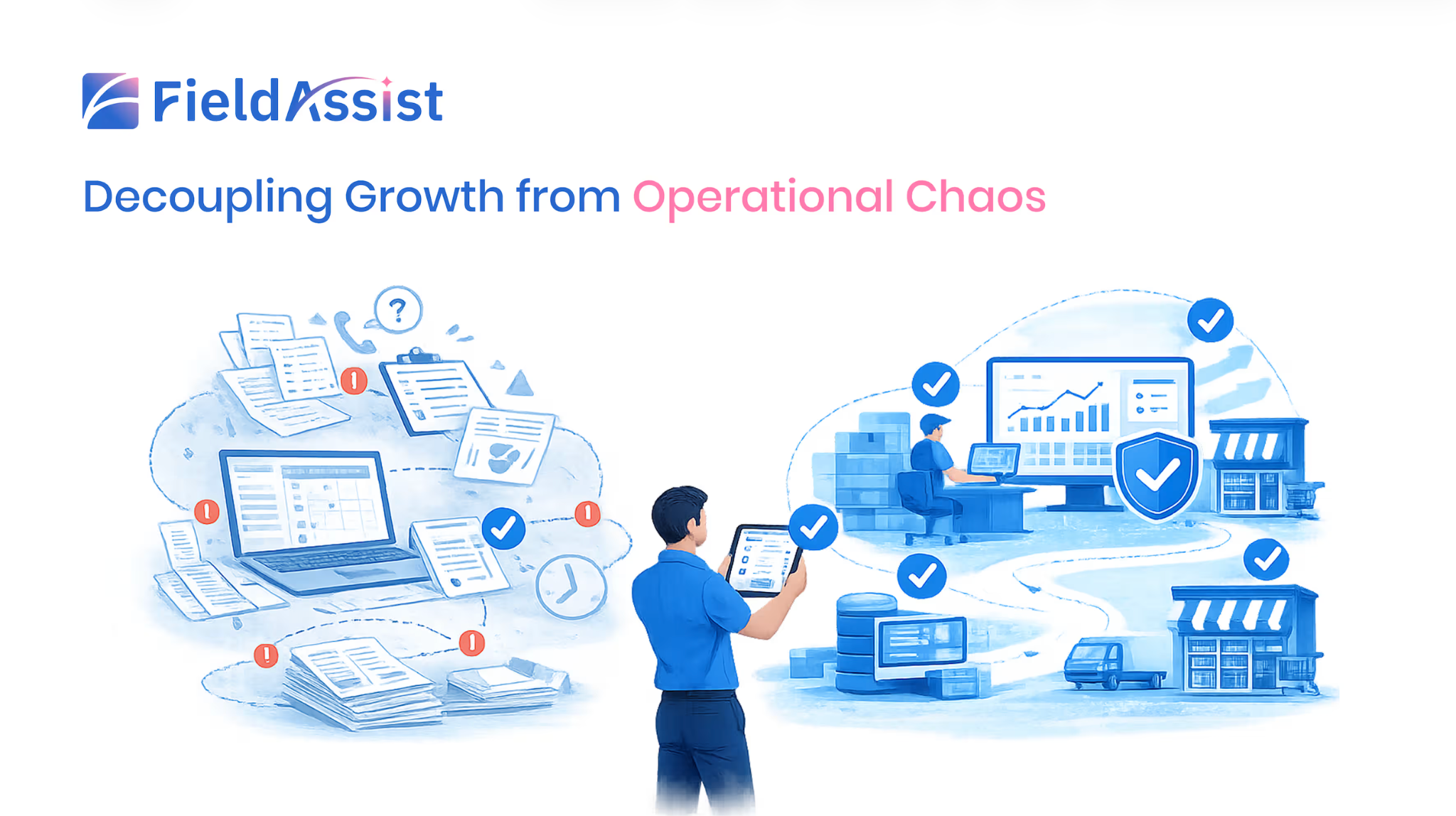
Digital ordering decouples sales growth from operational chaos. Instead of every new outlet, SKU, or region adding linear overhead to the back office, a B2B order management software platform absorbs that complexity, orders flow directly from the field rep's device to the distributor's system to the warehouse, with no manual re-entry at any stage.
This shift is already reshaping how B2B buyers, including retailers and distributors, expect to transact. As per Gartner, digital channels are projected to drive 80% of B2B sales by 2025, a dramatic jump from just 13% in 2019. That's not a trend confined to enterprise software or industrial supply; it's reaching the kirana counter and the spaza shop just as fast as it's reaching procurement departments.
For FMCG brands, retailers increasingly prefer distributors that offer app-based ordering, real-time stock visibility, and instant confirmations. A modern retail order management system improves transparency through real-time order tracking, giving all stakeholders visibility into order status and delivery updates.
Unlike basic digitization, sales order automation connects field sales, inventory, and planning systems to enable faster, more accurate order processing. As B2B buying shifts toward digital channels, brands that modernize their order management process will be better positioned to retain retailer loyalty and drive growth.
Comparative Analysis: Traditional vs. Digital Ordering Matrix
To understand how modern software transforms operations, we can contrast legacy field workflows directly against an automated, digital environment.
Core Capabilities of Modern B2B Order Management Software
Deploying the best order management software tailored specifically for the nuances of FMCG requires moving past generic enterprise resource planning (ERP) modules. True field efficiency is unlocked by robust capabilities engineered for high-volume, fragmented retail routes.
1. End-to-End Field Visibility and Live SKU Tracking
A dedicated B2B order management software platform bridges the information gap between corporate strategy and ground-level execution. Field sales representatives gain comprehensive visibility into active SKU lists, localized pricing tiers, and specific outlet credit limits directly on their mobile devices. This eliminates guesswork and prevents reps from writing orders that the back-end system will ultimately reject during billing.
2. Real-Time Order Tracking and Inventory Sync
Without real-time order tracking, a sales team operates blindly. Modern digital infrastructure syncs every order immediately with warehouse management and distributor management systems (DMS).
When a field rep places an order, the system instantly reserves that inventory, providing concrete transparency into what can be fulfilled. Distributors receive clear, accurate picking lists immediately, which radically accelerates delivery turnaround times.
3. AI-Led Promotion and Smart Cross-Selling
Advanced systems transform field reps from simple order takers into consultative sales partners. By leveraging historical purchase patterns and localized demographic demand trends, the software generates smart, automated upsell recommendations. If an outlet frequently buys a specific category, the application automatically prompts the rep to suggest relevant line extensions or active promotional bundles, protecting margins and maximizing average order value (AOV).
What Makes FieldAssist the Best Order Management Software for FMCG?
Many enterprise platforms treat field sales as a generic line item. FieldAssist is built from the ground up to solve the distinct, chaotic realities of CPG and FMCG distribution networks.
- Built for the Nuances of CPG and FMCG Retail
Generic order management tools built for industrial B2B or wholesale don't map cleanly onto FMCG's realities, fragmented general trade, high SKU velocity, frequent scheme changes, and outlet density that varies dramatically by geography. The best order management software for FMCG is purpose-built around these realities: it understands beat plans, distributor hierarchies, scheme-based pricing, and the operational rhythm of a field sales force that's out in the market every single day.
A platform that wasn't designed with these nuances in mind tends to bolt on sales order automation as an afterthought, a generic workflow engine layered over a system that doesn't actually understand what a "beat" or a "scheme" is in an FMCG context. The result is automation that technically works but doesn't reflect how field sales teams actually operate.
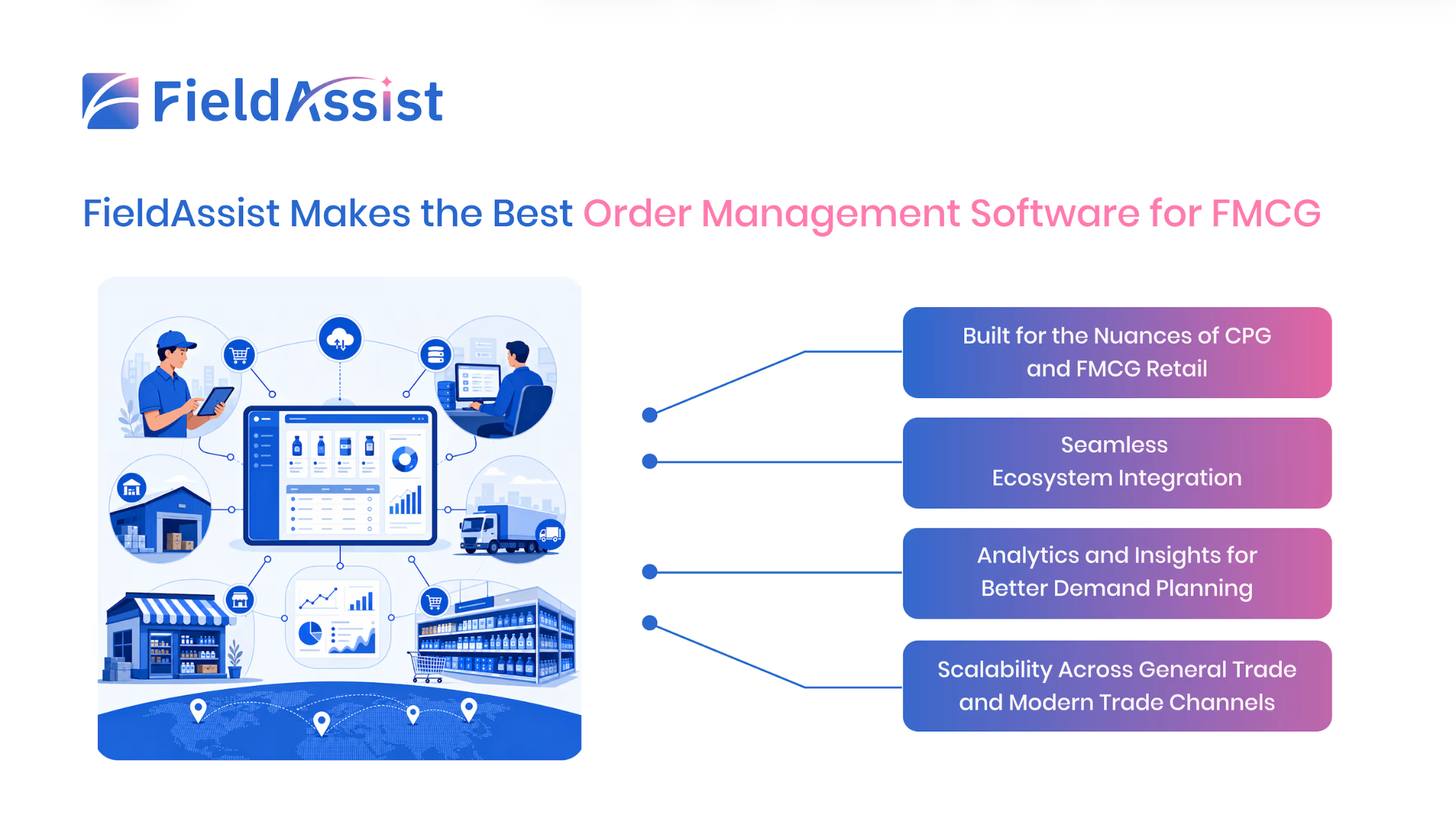
- Seamless Ecosystem Integration
An order management platform doesn't operate in isolation. It needs to integrate with existing ERP systems, distributor management systems (DMS), and field force automation tools so that an order captured in the field flows through to billing, inventory, and finance without manual intervention. A B2B ordering system that creates a new data silo, rather than connecting existing ones, adds complexity instead of removing it.
This is also where real-time order tracking earns its keep across the wider ecosystem. When an order's status updates instantly across the DMS, the ERP, and the field app, every stakeholder, from the rep in the market to the finance team reconciling invoices, is working from the same information. Fragmented systems, by contrast, create exactly the kind of friction that erodes both retailer trust and internal efficiency.
- Analytics and Insights for Better Demand Planning
Beyond order capture, the platform should turn transactional data into demand planning intelligence. Brands need to see not just what was ordered, but patterns, which SKUs are growing in which regions, which outlets are at risk of stockout, and where promotional spend is actually driving incremental volume. This is what separates a digital order form from genuine sales order automation: the ability to use order data to inform decisions upstream, not just process transactions downstream.
- Scalability Across General Trade and Modern Trade Channels
Finally, the platform must scale across the full breadth of an FMCG brand's go-to-market, from high-density general trade routes covering thousands of small outlets to modern trade chains with centralized procurement and EDI requirements. A retail order management system that works only for one channel forces brands to maintain parallel processes, recreating the very fragmentation that digital ordering is meant to eliminate.
Closing Thoughts
The shift from traditional to digital ordering in FMCG is about closing the structural gaps that have always existed between what retailers want to order, what distributors can fulfill, and what brands need to know to plan ahead. A well-implemented B2B order management software platform addresses all three simultaneously: it gives reps and retailers a faster, more reliable way to transact, gives distributors real-time visibility into demand, and gives brands the clean, granular data they need to plan replenishment and growth.
For brands still running their order management process on a patchwork of paper, calls, and spreadsheets, the cost is the slow erosion of shelf space to competitors who can fulfill faster and more reliably.
Ultimately, choosing a B2B ordering system is a decision about where you want your sales organization's time spent: chasing down order status and reconciling errors, or planning the next phase of growth with data you can actually trust.




.avif)