Top 7 Best Retail Execution Software Platforms for FMCG
We’ve evaluated the top trusted retail execution software of 2026 and created a decision guide. Compare leading solutions like FieldAssist, Salesforce, and Aforza for FMCG route-to-market success.

The margin for error in retail execution is now virtually zero. CPG and FMCG leaders are no longer looking for basic data-collection tools; they require intelligent retail execution systems that bridge the operational gap among headquarters strategy, distributor network realities, and on-shelf availability.
While many legacy platforms offer robust horizontal CRM capabilities or specialize in niche frontline training, the current market demands purpose-built vertical solutions. Organizations must evaluate software not just on baseline features like planogram compliance, but on its ability to handle complex, multi-tiered route-to-market architectures and execute dynamic retail audits seamlessly.
Let’s be real for a second: you and your team spend months analyzing data, negotiating with partners, and designing the perfect route-to-market strategy. But when it comes time to execute, what headquarters plans and what actually happens at the retail shelf are often two completely different realities.
As a business leader, you already know the pain points all too well. Ghost inventory, missed promotional windows, poor planogram compliance, and a lack of real-time visibility into your distributor networks are silently eroding your market share and margins. In 2026, winning at the shelf requires bridging that gap instantly. You need a system that doesn't just log visits, but actually empowers your field teams to capture market share, optimize shelf space, and drive secondary sales velocity.
Below, we’ve analyzed the top retail execution and retail audit platforms based on their architectural strengths, ideal deployment environments, and capacity to deliver immediate, verifiable ROI in high-volume retail environments.
We evaluated them not just on their feature lists, but on their ability to deliver speed-to-value, handle complex route-to-market architectures, and actually drive revenue growth for your brand.
Top 7 Best Retail Execution Platforms for 2026
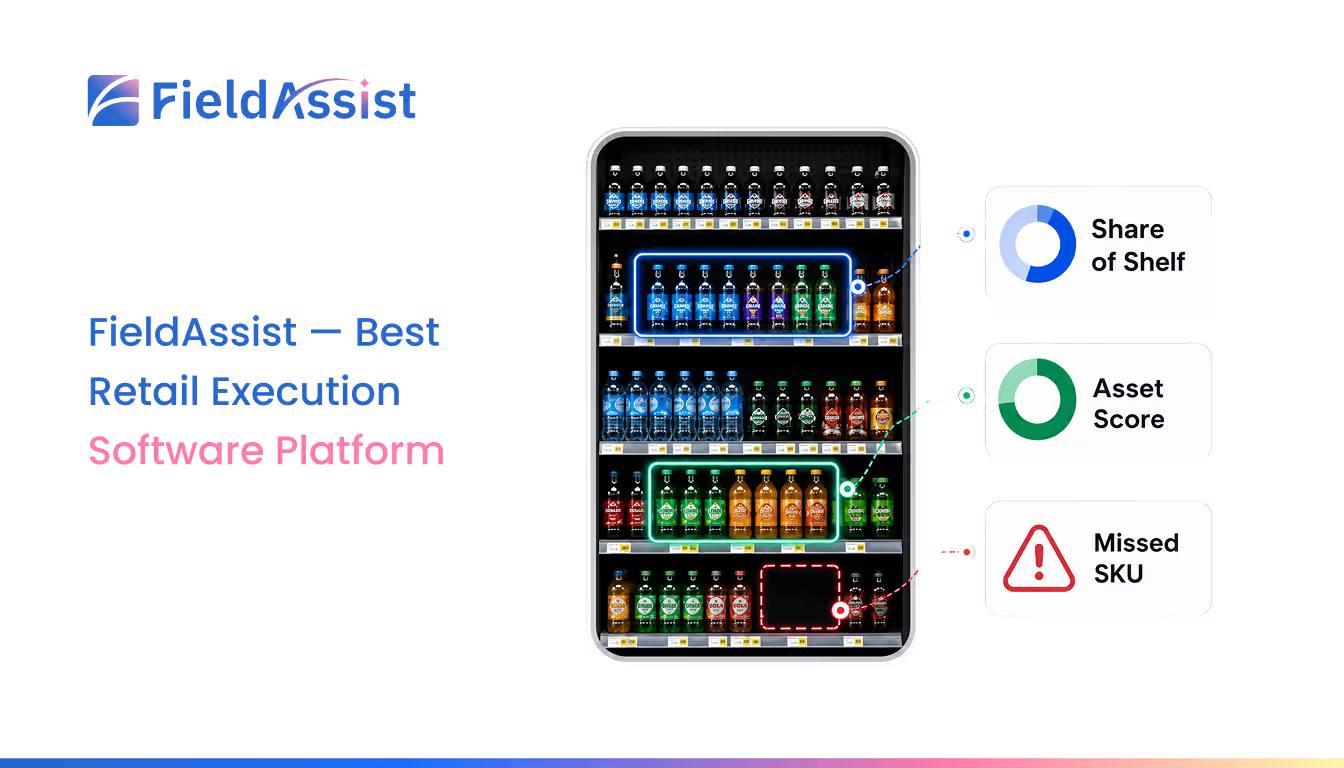
1. FieldAssist — Best Retail Execution Software Platform
FieldAssist Retail execution platform orchestrates every moving part of the Route-to-Market (RTM)—from distributors and field sales teams to retailers, merchandising, inventory, promotions, and analytics—in real time.
Unlike conventional retail execution software that focuses on a single layer of field operations, FieldAssist delivers a vertically integrated RTM ecosystem that connects Sales Force Automation (SFA), Distributor Management System (DMS), Retailer App, Merchandising, Retail Execution, Analytics, and Agentic AI into one unified platform.
This unified architecture eliminates operational silos, creating a single source of truth across sales, distribution, and retail execution. Every stakeholder—from frontline representatives and distributors to regional managers and business leaders—works with the same real-time intelligence, enabling faster decisions, greater execution consistency, and improved business outcomes.
As markets become more dynamic and execution windows continue to shrink, FieldAssist empowers brands to move beyond reactive reporting toward proactive, AI-assisted execution that identifies opportunities, recommends next-best actions, and helps teams respond before revenue is impacted.
Best For: High-volume FMCG and CPG brands that require an end-to-end, highly agile solution connecting field sales, shelf intelligence, and complex, multi-tiered distributor networks.
Where it wins:
- Native integration of Sales, Distributor, and overall shelf journey, eliminating data silos and enabling real-time stock-aware ordering across fragmented markets.
- Deployable Agentic AI that actively guides field reps with dynamic beat optimization, predictive SKU recommendations, and instant "Perfect Store" image recognition without requiring heavy IT intervention.
The USP of FieldAssist Retail Execution and Intelligence Platform is:
- End-to-End RTM Platform: Manage distribution, retail execution, merchandising, analytics, and retailer engagement through a single connected ecosystem.
- Purpose-Built for Consumer Goods: Designed specifically for FMCG, Food & Beverage, Personal Care, Consumer Durables, and other CPG businesses with complex distributor-led sales models.
- Agentic AI for Smarter Execution: Go beyond dashboards with AI that detects execution gaps, recommends corrective actions, prioritizes opportunities, and supports faster field decision-making.
- Unified Data Architecture : Eliminate disconnected systems by creating one trusted view of sales, inventory, retail execution, and distributor performance.
- Real-Time Market Visibility: Monitor outlet execution, SKU availability, promotion compliance, secondary sales, and field productivity without waiting for end-of-day reports.
- Enterprise Scalability: Designed to support large distributor networks, millions of retail outlets, and geographically distributed field teams across multiple markets.
- Configurable Workflows: Adapt sales hierarchies, approval processes, incentive programs, schemes, and execution workflows without extensive custom development.
- Actionable Business Intelligence: Convert operational data into measurable business actions with AI-powered insights, advanced analytics, and executive dashboards.
- Faster Time-to-Value: Reduce technology fragmentation by replacing multiple disconnected applications with one integrated RTM platform.
- Future-Ready Architecture: Built to continuously evolve with emerging AI capabilities, changing market dynamics, and enterprise growth requirements.
2. Salesforce
Built on the Salesforce CRM platform, Salesforce Consumer Goods Cloud extends customer relationship management capabilities into retail execution and field sales. It is commonly adopted by enterprises that have already standardized on the broader Salesforce ecosystem and are looking to integrate retail operations with customer data and enterprise workflows.
3. BeatRoute
BeatRoute focuses on digitizing retail execution, guided selling, retailer engagement, and field sales operations. The platform helps consumer goods companies improve outlet coverage, monitor field activities, and streamline execution processes across distributed sales teams.
4. Aforza
Aforza delivers retail execution and trade promotion capabilities built natively on the Salesforce platform. It is designed for enterprise consumer goods organizations seeking to extend Salesforce into field execution, merchandising, and retail operations.
5. Axonify
Axonify primarily focuses on frontline workforce enablement by combining task management, operational communication, and employee learning. The platform is widely used by retailers to improve workforce productivity, compliance, and in-store execution.
6. Bizom
Bizom provides solutions for distributor management, sales force automation, retail execution, and business analytics. The platform is widely adopted in emerging markets by brands seeking to digitize sales and distribution processes and improve market visibility.
7. Repsly
Repsly specializes in retail merchandising and field team management. Its platform enables brands to improve in-store execution through store audits, image capture, activity tracking, territory management, and merchandising analytics, making it a popular choice for field merchandising organizations.
CXO’s Quick Comparison Table: Retail Execution Platform
To give you the crux of which retail execution platform you should consider choosing, we have created a quick comparison table to let CXO decide on their investment.
Frequently Asked Questions for C-Suite Leaders
When evaluating a retail execution overhaul, the C-suite is less concerned with app features and more focused on integration, adoption, and measurable impact on the bottom line. Here are the most critical questions executive teams must ask before finalizing a software investment.
1. What is a Retail Execution Platform?
A retail execution platform is a specialized software ecosystem designed to digitize, manage, and optimize a consumer goods brand's entire route-to-market journey. At its core, it bridges the critical gap between the macro-strategy developed at headquarters and the micro-reality of what actually happens at the retail shelf.
For business leaders, it is important to distinguish these platforms from basic task-management apps. A true retail execution platform acts as a revenue engine. It arms your field sales representatives, merchandisers, and distributor networks with real-time data to maximize on-shelf availability, ensure promotional compliance, and accelerate secondary sales velocity.
2. Should we customize our existing CRM for retail execution, or invest in a vertical SaaS platform?
This is the most common debate between the CIO and the CRO. While customizing a legacy horizontal CRM keeps everything under one vendor, it often creates a "customization trap."
Building complex, FMCG-specific workflows (such as distributor inventory tracking, dynamic beat optimization, and complex trade schemes) requires significant developer resources and pushes deployment timelines beyond the 12-to-18-month mark. Vertical platforms built specifically for FMCG route-to-market offer faster speed-to-value, lower Total Cost of Ownership (TCO), and seamless integration with your existing ERP via APIs, without the heavy custom-code burden.
3. How does FieldAssist Retail Execution solve the "distributor blind spot"?
In traditional setups, a brand’s visibility ends the moment inventory is sold to a primary distributor. Modern retail execution platforms solve this by natively integrating Sales Force Automation (SFA) with a Distributor Management System (DMS). This end-to-end architecture gives headquarters real-time visibility into secondary and tertiary sales. By connecting the distributor's inventory to the field rep's mobile app, brands can transition from blindly pushing stock into the channel to a demand-driven, pull-based replenishment model.
4. How is AI actively driving revenue in the field?
For AI to impact the bottom line, it must shift from passive analytics to active guidance at the edge. The best platforms utilize "Agentic AI" that operates directly on the field rep’s mobile device. Instead of just reporting past sales, this AI actively tells the rep which stores to visit today based on predictive churn, auto-suggests the optimal SKU mix to pitch, and uses instant image recognition to verify planogram compliance in seconds. It transforms your field force from order-takers into strategic, data-armed business consultants.
5. What is the biggest barrier to field and distributor adoption, and how is it mitigated?
The number one reason retail execution software fails is field rejection. If an app is slow, requires manual data entry, or crashes in the low-bandwidth environments typical of large grocery stores or rural markets, reps will revert to pen and paper. To mitigate this, leadership must mandate an offline-first architecture. The platform must be able to calculate complex pricing, capture high-resolution audit photos, and log orders without an active internet connection, syncing seamlessly in the background once connectivity is restored. If the software helps the rep hit their incentives faster and easier, adoption takes care of itself.




%20(1).avif)
.avif)