What Is an AI Sales Copilot? A Complete Guide for Sales Leaders
Looking for the best AI Sales Copilot? Learn how modern AI-powered sales assistants help reps sell more, act faster, and improve customer engagement.

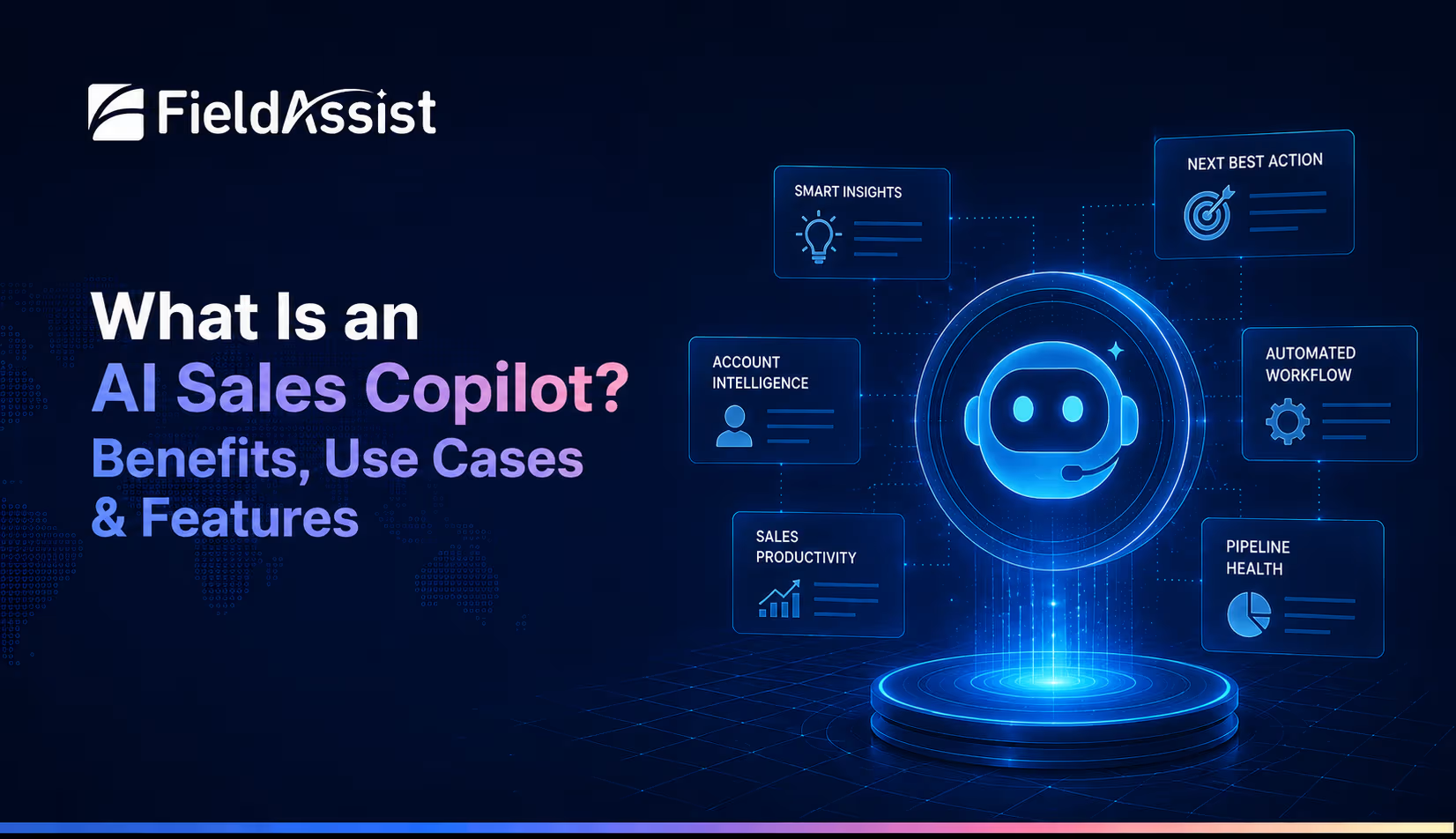
Sales leaders don't need another dashboard nobody opens. They need reps who walk into a call already knowing which account is drifting and what the follow-up should say before the meeting ends. That is the practical case for an AI Sales Copilot: not a chatbot bolted onto the CRM, but a working layer inside a rep's day that handles the heavy lifting, pulling account history, flagging risk, drafting the next step, so sellers spend limited hours on conversations that move revenue.
This guide breaks down what an AI Sales Copilot is, how it differs from an AI Sales Agent, where it drives measurable AI sales productivity gains, and what to look for before you buy. We also look at how FieldAssist's Pulse AI Co-Pilot applies these principles to field and retail execution teams operating outside the tidy world of inside-sales dashboards.
What is an AI Sales Copilot?
An AI Sales Copilot is software that works alongside a sales rep, inside the CRM, the inbox, or a mobile field app, surfacing account intelligence, prompting the next best action, and automating the paperwork trail that follows every customer interaction. Think of it less as a bolt-on tool and more as a co-pilot in the aviation sense: it does not fly the plane, but it reads the instruments, calls out obstacles, and clears checklist items so the pilot, the seller, stays focused on judgment calls.
Practically, an AI Sales Copilot draws on structured CRM data, call transcripts, email threads, and, for field-first businesses, outlet-level execution data to build a running brief for every account. It is this blend of reasoning and real-time data that separates a genuine AI-powered sales assistant from the static reporting tools that came before it, the difference between a system that tells you what happened last quarter and one that tells you what to do this afternoon. Modern AI Sales Assistant Software is judged less on how polished its interface looks and more on whether it changes what a rep actually does between 9 a.m. and 6 p.m.
Why AI Sales Copilots Are Becoming Essential for Enterprise Sales?
Enterprise sales organizations are managing larger territories, longer buying committees, and CRM systems that have quietly become data graveyards, fields nobody updates because updating them adds no value to the rep filling them in.
The Benefits of AI Sales Copilot show up first in pipeline hygiene, long before they show up in a revenue report. An Enterprise AI Sales Copilot closes that loop by making the CRM update itself from calls, emails, and field visits, rather than asking a stretched-thin rep to do it after hours.
The macro numbers back up the urgency. McKinsey estimates that generative AI could lift sales productivity by roughly 3 to 5 percent of total global sales spend, translating into real margin, not just faster typing.
Buyer behavior has shifted in parallel: Gartner projects that by 2027, 95 percent of sellers' research workflows will begin with AI, up from less than 20 percent in 2024, which means reps who still open six browser tabs before a call are already behind.
Modern AI Sales Assistant Software is also expected to prove ROI within a quarter, pushing leaders to evaluate faster. For sales leaders under pressure to grow without proportionally growing headcount, an Enterprise AI Sales Copilot is becoming table stakes for the sales stack.
How does an AI Sales Copilot work?
Under the hood, an AI Sales Copilot runs on three layers. The first is data ingestion: CRM records, call and meeting transcripts, email threads, support tickets, and, for field sales teams, outlet-level order and visit data captured through an SFA app.
The second is a reasoning layer, typically a large language model paired with retrieval systems, that turns that raw data into a coherent account narrative and recommends what should happen next, a follow-up, a discount approval, a stock replenishment call.
The third is the workflow layer, where the AI Sales Copilot actually acts: drafting an email, logging a call summary, or pushing an alert to a field rep's phone before they walk into an outlet.
What makes this different from a generic chatbot is grounding. A credible AI sales intelligence platform does not guess; it reasons over the seller's actual pipeline, territory, and historical win-loss data, with guardrails that keep it from hallucinating numbers a CFO would later have to explain. Get that grounding wrong, and a copilot becomes a liability rather than an asset.
Business Benefits of an AI-Powered Sales Copilot
The Benefits of AI Sales Copilot tend to show up in four places sales leaders actually track: how much a rep gets done, how fast they decide, how accurate the forecast is, and how engaged the customer stays. At enterprise scale, these benefits compound quickly, since even a small productivity gain multiplies across hundreds of reps. Below is where each benefit plays out in practice.
1. Increased Sales Productivity
The clearest AI sales productivity gain comes from time reclaimed. CRM data entry, call summarization, and email drafting eat hours that reps could otherwise spend in front of customers. When an AI-powered sales assistant handles that admin layer automatically, field and inside-sales reps alike get meaningfully more selling hours back in a working week.
2. Faster and Smarter Decision-Making
An AI Sales Copilot surfaces the signal buried in scattered data, a stalled deal, a distributor running low on a fast-moving SKU, a buyer who has gone quiet after three engaged calls, and puts it in front of the rep before it becomes a lost opportunity, rather than after a monthly report flags it.
3. Improved Sales Forecasting Accuracy
Forecasting remains one of the most stubborn problems in B2B sales: only about 7 percent of organizations hit 90 percent or higher forecast accuracy, with the median closer to 70-79 percent, per Gartner research cited in a 2026 benchmark report. AI and machine-learning forecasting methods cut forecast variance by roughly 15 to 25 percent versus manual pipeline roll-ups, the difference between a CFO trusting the board deck number and quietly discounting it
4. Enhanced Customer and Outlet Engagement
Whether the customer is a procurement lead at an enterprise account or a retail outlet owner on a distributor's beat, an AI Sales Copilot helps reps show up with context, last order, open complaint, contract renewal date, so the interaction feels like a continuation of a relationship, not a cold restart.
Sales AI Copilot vs AI Sales Agent
The terms get used interchangeably in vendor decks, but Sales AI Copilot vs AI Sales Agent is a real distinction sales leaders should understand before they buy.
What Is an AI Sales Agent?
An AI Sales Agent is built to act with a higher degree of autonomy, qualifying leads, sending outreach sequences, or even negotiating routine terms with limited human sign-off. It is designed to run a defined workflow largely on its own, stepping in for tasks a human previously had to initiate every time.
An AI Sales Copilot, by contrast, stays firmly in an assistive role. It prepares, recommends, and drafts, but a human seller makes the final call and hits send. For enterprise deals with long cycles, multiple stakeholders, and real relationship stakes, that human checkpoint is not a limitation, it is the point. Understanding Sales AI Copilot vs AI Sales Agent up front prevents an expensive tool-fit mismatch six months into a rollout.
Top AI Sales Copilot Use Cases Across the Sales Cycle
The most useful AI Sales Copilot use cases map directly onto the stages of a sales cycle rather than sitting off to the side as a separate tool.
- Pre-Call Planning and Account Research
Before a call, an AI Sales Copilot compiles a one-page brief: recent orders, open tickets, competitor activity in the account, and suggested talking points, replacing the twenty minutes a rep used to spend digging through the CRM and old email threads.
- Live In-Call/Field Guidance and Handling Objections
During a live call or an in-store visit, real-time prompts can suggest how to answer a pricing objection or which product bundle to pitch based on what has worked with similar accounts, effectively putting a coach in the rep's ear without slowing the conversation down.
- Post-Interaction Administrative Automation
After the interaction, the copilot drafts the call summary, updates the CRM fields, schedules the follow-up task, and, for field teams, logs the outlet visit, the paperwork that historically got done late at night or not at all.
- Sales Coaching, Skill Gap Analysis, and Onboarding
Aggregated across a team, the same data powers coaching: which reps struggle with objection handling, which new hires are ramping slower than benchmark, and where a sales manager should spend the next one-on-one. This use case turns individual interactions into a team-wide skill gap analysis rather than anecdotal impressions.
Key Features of AI Sales Copilot Software
Not every tool marketed as AI Sales Copilot Software delivers the same depth, the interface matters far less than the data behind it. Sales leaders evaluating AI Sales Assistant Software should look for five capabilities.
1. Real-Time Sales Intelligence
The strongest platforms function as a genuine AI sales intelligence platform, refreshing account and territory data continuously rather than on a weekly batch job, so the brief a rep sees in the morning still holds true by the afternoon.
2. Predictive Recommendations and Alerts
Beyond summarizing what already happened, useful copilots flag what is likely to happen next, a churn risk, a stockout, a deal likely to slip, early enough that a rep can still act on it.
3. Conversational AI Assistance
A natural-language interface lets a rep simply ask "what changed on this account this week" instead of building a report, which matters enormously for field reps working from a phone between outlet visits.
4. Sales Performance Analytics Dashboard
Manager-facing dashboards translate individual copilot interactions into team-level trends: win rates, average deal cycle, coverage gaps, and adoption of the tool itself.
5. Integration with Existing Sales Systems
None of this matters if the copilot lives in a silo. The best AI Sales Copilot Software treats integration with the CRM, the distributor management system, and field SFA apps as a first-class feature, not an afterthought, that is what turns a promising pilot into something reps actually open every day.
How FieldAssist's Pulse AI Co-Pilot Drives Field & Retail Sales Success?
FieldAssist built Pulse AI Co-Pilot around a problem that generic, desk-bound sales tools were never designed to solve: the last-mile execution gap between what a CPG brand plans at headquarters and what actually happens at the shelf. Pulse works as an AI-powered sales assistant for field reps and distributor sales teams, pulling order history, outlet coverage data, scheme compliance, and competitor shelf presence into a single, actionable brief before a rep even walks into a store.
Built on FieldAssist's existing SFA and distributor management data, Pulse functions as a genuinely field-grounded AI sales intelligence platform, not a generic layer retrofitted onto office-based CRM workflows.
The Future of AI-Powered Sales Assistants
The next phase for AI-powered sales assistants is a shift from advisory to semi-autonomous, with copilots handling more routine workflow themselves and escalating only judgment calls to a human. Expect tighter fusion between copilot and agent capabilities, deeper personalization, and, in field sales, closer integration with real-world execution data such as shelf imagery and outlet-level inventory.
Conclusion
An AI Sales Copilot is not a novelty add-on to the CRM; it is a practical answer to a very old problem, sellers spend too much time on preparation and paperwork and not enough time in front of customers.
Whether the priority is AI sales productivity, forecast accuracy, or simply keeping enterprise reps and field teams focused on relationships instead of admin, the underlying Benefits of AI Sales Copilot are consistent: faster preparation, sharper decisions, and more selling time.
The AI Sales Copilot use cases described throughout this guide only compound as adoption grows across a team. For CPG and FMCG brands specifically, FieldAssist's Pulse AI Co-Pilot extends that same logic to the last mile, where the deal is ultimately won or lost.
Get in touch with us!



.avif)

.avif)