Your Sales Data Has a Story. Here's How AI Helps You Uncover It
Discover how AI sales analytics helps FMCG and CPG brands uncover demand, improve outlet coverage, personalize assortments, and plan for 2027.

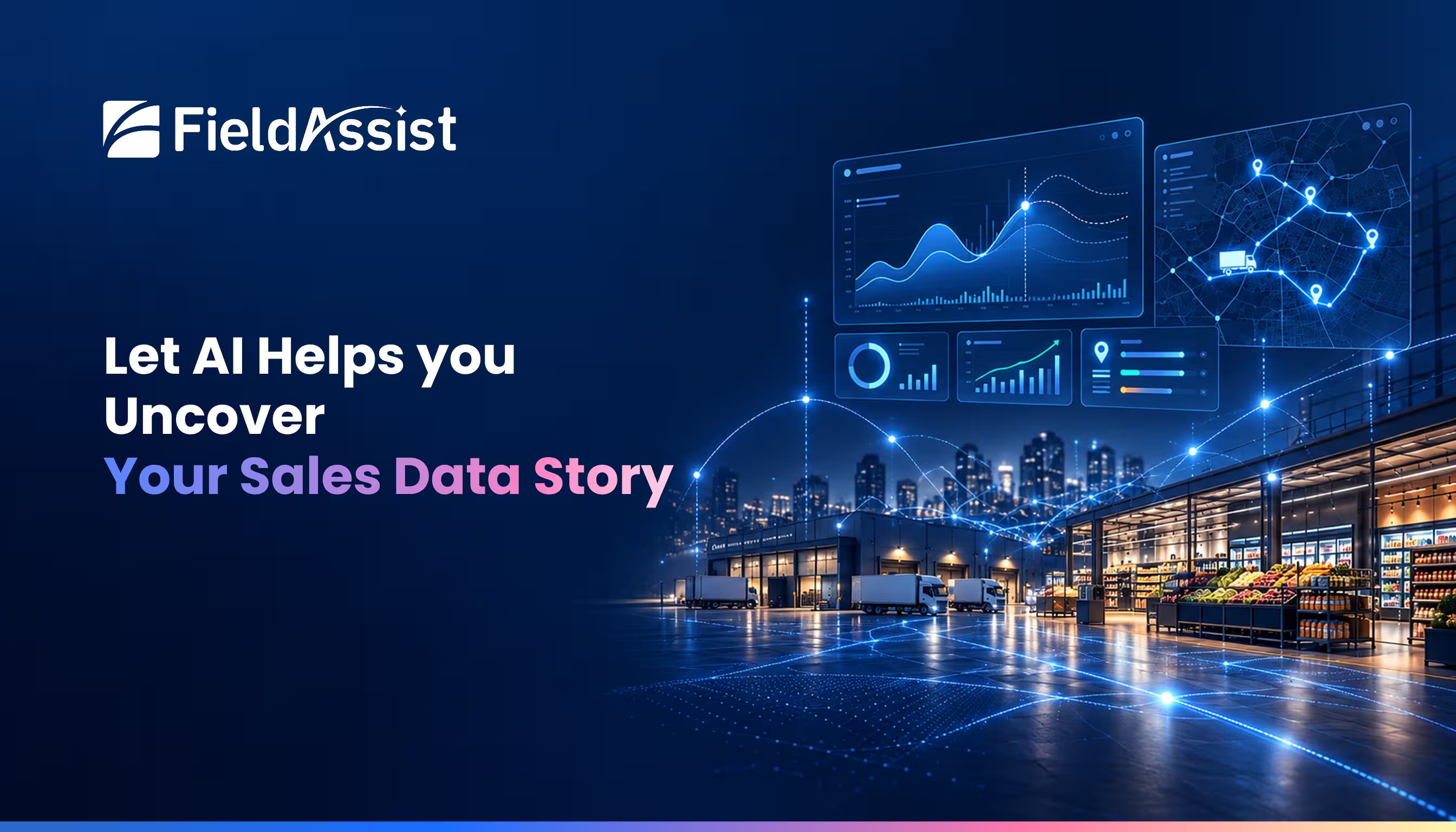
What if your next growth story is already hiding in plain sight, like in a small change in repeat orders, a neighborhood quietly buying a new pack size, or two products whose demand rises together? Imagine opening tomorrow’s sales report and seeing more than yesterday’s result: a clue to what your market may be ready for next.
That is the promise of AI sales reporting and analytics. The useful surprise is not that software can process millions of rows. It is that signals your teams already collect can become a more complete picture of demand, distribution, and retail execution when they are connected. The next bestseller may be introducing itself in this week’s numbers. The next growth territory may be a cluster of outlets your national average barely notices.
For commercial leaders, this changes the role of reporting. Automated reporting systems can distribute the numbers on time; capable AI reporting tools can help people interpret those numbers in context. An AI report generator can summarize a validated result, but the real value comes when the business sees a credible opportunity, tests it, and acts before the signal becomes obvious to everyone else.
The market is not short of data. The competitive advantage lies in connecting the clues, and knowing which ones deserve action. Here’s what AI can reveal about your sales data, and the story it can tell:
1. The BESTSELLER you haven't discovered yet
A product rarely becomes a bestseller in a single day. Often, it leaves small signals first: repeat orders become more frequent, a particular pack begins to move in a new outlet segment, or a product performs well outside the region where it was expected to win. Those signals are easy to miss when reports focus on monthly sales or top-selling SKUs.
What story AI uncovers?
AI can connect repeat orders, SKU velocity, outlet type, availability, and promotion history to distinguish a promising pattern from a temporary spike. In an illustrative scenario, a mid-sized snack pack begins earning repeat orders in independent stores before total sales make it look significant.
What this story means for consumer brands?
Track repeat-order rate, sales per outlet, distribution, stock availability, and promotion exposure together. FieldAssist Analytics Studio can help bring SFA and DMS data into a shared view; Product Recommendations can help surface relevant SKU suggestions at order booking. Validate the signal before expanding distribution.
2. The HIDDEN MARKET waiting for you
Growth does not always require entering a new geography. Untapped demand can sit inside a brand’s current footprint: outlets that buy the category but not the brand, retailers missing a relevant SKU, or clusters where distribution has not kept pace with demand.
What story AI uncovers?
AI can compare category potential, outlet characteristics, current assortment, order history, and serviceability to rank the most promising white spaces. A territory that looks average at national level may contain a small cluster with a strong case for activation.
What this story means for consumer brands?
Build a ranked list of underserved outlets and score each on expected demand, SKU fit, cost to serve, and route capacity. FieldAssist FA MicroMarket focuses on hyperlocal market intelligence and territory opportunities; use it with sales analytics to prioritize practical, testable expansion-not just bigger outlet lists.
3. The LITTLE THINGS that create extraordinary sales
Sometimes, the next growth idea already exists inside the network and territory. One team may build broader baskets without extending visits. One distributor may replenish faster. One representative may consistently convert a specific outlet type more effectively.
What story AI uncovers?
AI can compare performance across similar outlets, routes, product mixes, and trading conditions to find repeatable practices. The goal is not to crown a “best” representative from raw numbers; it is to discover which behaviours work in which context.
What this story means for consumer brands?
Identify two or three practices associated with stronger outcomes, verify them with field teams, and pilot them in comparable territories. FieldAssist’s sales, distribution, and retail-execution capabilities can help connect field activity with distributor and shelf signals. Scale practices only when results repeat.
4. The SURPRISING AFFINITY between products
Products share baskets, occasions, shelves, and replenishment cycles. A retailer who orders one product may be a strong candidate for another but individual SKU reports rarely show that relationship clearly.
What story AI uncovers?
Market-basket analysis and AI order recommendation models can identify products frequently ordered together and suggest relevant add-ons. An association is a clue, not proof of causation: promotions, seasonality, or availability may explain the pattern.
What this story means for consumer brands?
Test cross-sell suggestions against a comparable group of outlets. Measure attachment rate, incremental gross margin, repeat purchase, and substitution. FieldAssist Product Recommendations is designed to use outlet order history and purchasing patterns to suggest relevant SKUs at the point of order booking.
5. The RHYTHM of every neighborhood
The same brand can behave differently across nearby markets. A small pack may suit frequent top-up purchases; a larger pack may work better in outlets serving planned household shopping. National averages can conceal these local differences.
What story AI uncovers?
AI can analyse demand by outlet, cluster, beat, channel, and time period, combining purchasing trends with relevant outlet characteristics and seasonality. This helps teams move from a one-size-fits-all plan to a market-specific hypothesis.
What this story means for consumer brands?
Segment markets using factors linked to buying behaviour, compare like with like, and tailor assortment or visit priorities. FA MicroMarket supports hyperlocal opportunity analysis; Analytics Studio can help teams monitor outlet, SKU, and territory performance. Keep segments usable enough for field teams to act on.
6. The BEAUTIFUL DOMINO EFFECT of one good decision
A useful demand signal rarely belongs to one department. If a product gains traction in a cluster, planning needs to know before stock is allocated. If stock arrives on time, sales teams can turn demand into availability—and availability creates the chance to sell.
What story AI uncovers?
AI can connect demand signals with replenishment, distribution, and retail execution. One early signal can trigger a chain of better-informed decisions, provided the teams share definitions, ownership, and timely data.
What this story means for consumer brands?
Agree on common definitions for forecast accuracy, bias, fill rate, and on-shelf availability. Link each alert to an owner, a response window, and a measurable result. FieldAssist Analytics Studio connects sales and distribution reporting; its wider FAi capabilities support a more connected route-to-market execution approach.
7. The joy of knowing WHERE TO GO NEXT
For a commercial leader, intelligence is not the ability to open every dashboard. It is the ability to answer the next important question without waiting a week for another report.
What story AI uncovers?
Natural-language analytics, predictive signals, and recommendations can help leaders move from searching through dashboards to identifying a priority: which outlets to activate, which SKU to recommend, or where replenishment needs attention. The explanation should show its evidence, not merely sound confident.
What this story means for consumer brands?
Design executive briefs around recurring business questions, not every available metric. Require each output to show the signal, evidence, uncertainty, suggested action, and KPI. AI reporting tools and an AI report generator should shorten the path to a decision—not create another layer of polished but unverified reporting.
A practical 2027 agenda: what to prioritize now
The gap between AI experimentation and repeatable commercial value is already visible. A June 2026 BCG and Consumer Goods Forum survey of 39 senior CPG and retail executives found roughly 75% of CPG respondents were still in exploration or pilot mode, while 18% were scaling impact. More than half of the companies surveyed did not formally measure AI ROI. The sample is small and should not be treated as a census of the industry, but the signal is clear: scaling and measurement are material management challenges.
Prioritize now
- Start with two or three growth decisions: for example, which outlets to activate, which SKU to recommend, or where to adjust replenishment. Avoid launching an enterprise-wide AI programme with no commercial owner.
- Connect the minimum useful data: outlet and SKU master data, orders, distributor stock, field visits, shelf-execution evidence, promotions, and calendar effects. Align definitions before comparing reports across teams.
- Create a baseline and a test design. Define the business-as-usual comparison group, target KPI, time window, and rule for scaling. Measure incremental gross margin or other business value—not just model accuracy, dashboard use, or report-generation speed.
- Put recommendations into existing workflows. The best insight has limited value if a sales representative, distributor, planner, or manager cannot act on it at the moment a decision is made.
- Set governance early: access controls, data lineage, freshness checks, model monitoring, human review, and feedback when suggestions are ignored or produce weak results.
What can wait
- Fully autonomous commercial decisions across every market before the organisation can validate model outputs and resolve data-quality issues.
- A generic AI report generator that rewrites dashboards but cannot explain where its numbers came from, which metric definitions it used, or what decision should follow.
- Dozens of pilots with separate success metrics. Scale a small number of commercially material use cases first, then reuse the data and operating patterns that work.
To prepare for 2027, treat AI reporting tools and automated reporting systems as part of a decision process, not as standalone technology purchases. Build an operating rhythm in which an insight is surfaced, validated, assigned, acted on, and measured. That is how a promising pilot becomes a commercial capability.
The next growth story is already taking shape
Your sales data contains more than a record of what happened. It can reveal what is changing, where the market is responding, which products belong together, and which outlet or territory deserves the next investment. AI sales analytics helps connect those signals; it does not remove the need for commercial judgement.
The next step is not to ask your teams for more reports. It is to give them a clearer way to see the opportunity already emerging in the data they collect today. Begin with one decision that matters, connect the evidence, test the recommendation, and measure the result. The brands that build this discipline now will be better prepared to make 2027 planning more precise, responsive, and grounded in what the market is actually doing.