7 Ways AI-Powered Analytics Transforms Retail Marketing Performance
Learn how AI retail analytics transforms FMCG retail marketing with predictive insights, shelf intelligence, smarter promotions, and real-time execution visibility.

.avif)
The Shift from Macro to Micro: Why Static Retail Marketing is Failing FMCG Brands
For most FMCG brands, retail marketing has long operated on a cycle of quarterly trade plans, region-level budget allocations, and post-campaign reviews that arrive too late to change anything. Promotions are designed at the national level. Stock allocation follows historical averages. And execution gaps, the difference between what was planned in the boardroom and what actually happened at the kirana shelf, are discovered only when the sales numbers disappoint.
This approach worked when retail data was scarce, and decisions were made weekly. It no longer works.
Today's general trade is micro. Consumer demand shifts by pincode, by season, and by competitive activity on the shelf next door. A promotion that drives 18% volume uplift in Tier 1 cities may yield zero results in semi-urban markets. Static planning frameworks simply cannot keep pace with this granularity.
According to industry reports, AI-enabled supply chains reduce demand forecasting errors by up to 50% in certain FMCG categories, a critical margin advantage in an industry where a 1–2% forecasting miss can mean crores in wasted promotions or lost shelf revenue.
This is precisely where AI retail analytics changes the game. The brands winning in general trade today are not the ones with the biggest trade spends. They are the ones with the sharpest retail intelligence software, the ones who can see the last-mile execution gap and close it before it costs them market share.
7 Ways AI Analytics Injects Precision Into Retail Marketing Performance
1. Hyper-Localized Trade Promotion Optimization
Traditional trade promotions are usually planned from the top and pushed down to outlets. AI retail analytics flips this approach by using outlet-level data to design and optimize promotions based on actual market needs. By analyzing outlet-level secondary sales, scheme redemption history, competitive price points, and local consumer demand patterns, an AI analytics platform for retailers can identify which SKUs to promote, in which outlets, at what discount, and during which window, before the scheme is launched.
This moves trade promotion from an art of gut-feel to a science of precision. Brands using AI-powered retail marketing strategies report significantly reduced promotional leakage and higher scheme ROI because spend is directed to outlets where it will actually convert.
2. Enables Real-Time Visibility into Retail Execution
The single biggest source of marketing waste in FMCG is the gap between what was planned and what was executed at the retail shelf. A display activity signed off in the trade calendar might reach 40% of targeted outlets. A new product launch meant to be "live" across 10,000 outlets on Day 1 might actually be available in 3,000. Without real-time retail intelligence software, this gap is invisible until the data is compiled, often weeks later.
AI-powered retail analytics platforms change this by converting reps and ASM field activity into live execution signals. Call compliance, productive calls, scheme communication, and shelf status are aggregated in real time, giving marketing and sales leadership a single view of what is actually happening across the distribution network, not what was planned to happen.
3. Improves Shelf Visibility, SoS, and Perfect Store Compliance
Share of Shelf (SoS) and Perfect Store compliance are among the most impactful metrics in retail marketing, and among the hardest to measure at scale. Research has consistently shown that AI-powered shelf scanning increases product availability and lifts sales by 6-8%, a direct impact that most FMCG brands leave on the table because they rely on manual audit cycles that are too infrequent to drive corrective action.
Retail analytics for FMCG brands today increasingly leverages computer vision to capture real-time planogram compliance, out-of-stock detection, share of shelf measurements, and competitive facings, turning what was once a quarterly snapshot into a daily operating signal.
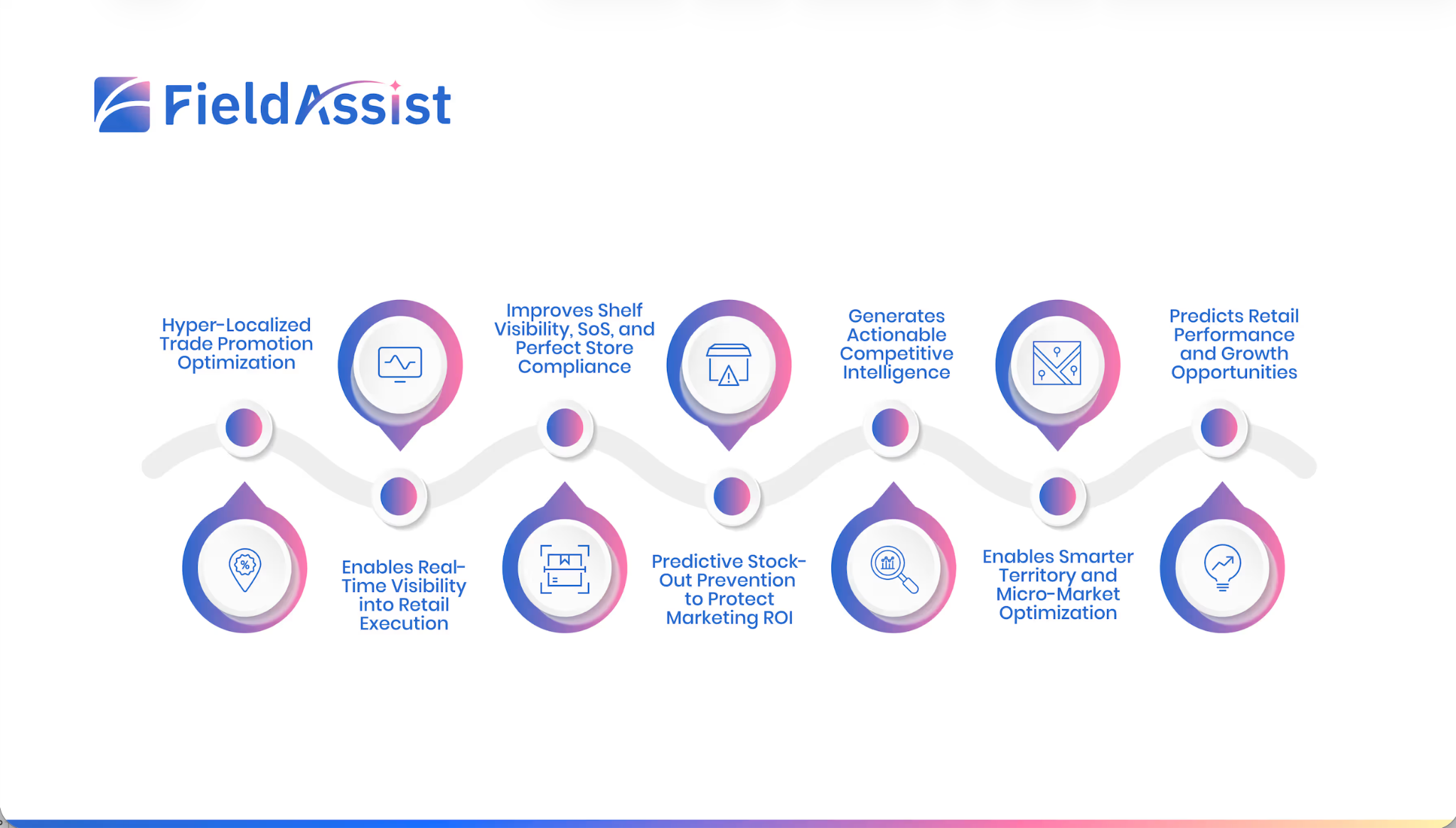
4. Predictive Stock-Out Prevention to Protect Marketing ROI
There is no faster way to destroy a trade promotion's ROI than running out of stock at the peak of consumer demand. Yet stock-outs remain endemic in general trade, driven by the mismatch between replenishment cycles calibrated to averages and actual demand that spikes unpredictably.
AI retail analytics solves this by building outlet-level demand forecasts that account for promotional uplift, seasonal patterns, distributor inventory positions, and historical sell-through. Research on retail forecasting and replenishment highlights that AI-driven demand planning is now a core requirement for FMCG supply chain maturity, enabling brands to shift from reactive replenishment to predictive stock management. The marketing budget invested in creating demand must not be wasted on empty shelves.
5. Generates Actionable Competitive Intelligence
In general trade, by the time brands know a competitor has gained numeric distribution or launched an aggressive promotion in a key market, the window to respond has often closed.
Retail intelligence software powered by AI changes this cadence. By aggregating secondary sales velocity, outlet-level product availability data, and field observations across thousands of outlets simultaneously, brands can detect competitive activity, price moves, product launches, and scheme escalation in near real time. This converts competitive intelligence from a reporting exercise into an early-warning system that informs live marketing decisions.
6. Enables Smarter Territory and Micro-Market Optimization
Not all markets are equal, and not all routes are productive. AI Analytics for retailers can analyze beat plans, productive call rates, outlet coverage, and secondary sales contribution at the micro-market level to identify where a brand is under-indexed relative to its true potential. This allows regional sales managers and national sales managers to redirect sales effort, expand distribution into high-potential pin codes, and rationalize beats where the cost of coverage exceeds the return.
AI-powered retail marketing strategies that incorporate micro-market analytics have shown significant improvements in weighted distribution and productive outlet coverage.
7. Predicts Retail Performance and Growth Opportunities
Perhaps the most powerful capability of modern AI retail analytics is its ability to move beyond describing what happened to predicting what will happen, and prescribing what should be done. By modeling outlet-level sales trajectories, distribution gaps, competitor vulnerability windows, and seasonal demand curves simultaneously, AI analytics surfaces specific growth opportunities: which outlets to prioritize for new SKU push, which distributors are at churn risk, and which geographies are primed for numeric distribution expansion.
The retail analytics market reflects how central this capability has become:it is projected to grow from USD 11.31 billion in 2026 and to reach USD 20.65 billion by 2031, a clear signal that FMCG brands globally are moving beyond descriptive dashboards toward predictive, prescriptive retail intelligence software.
Measuring the Impact: KPIs That Prove Your Marketing Transformation
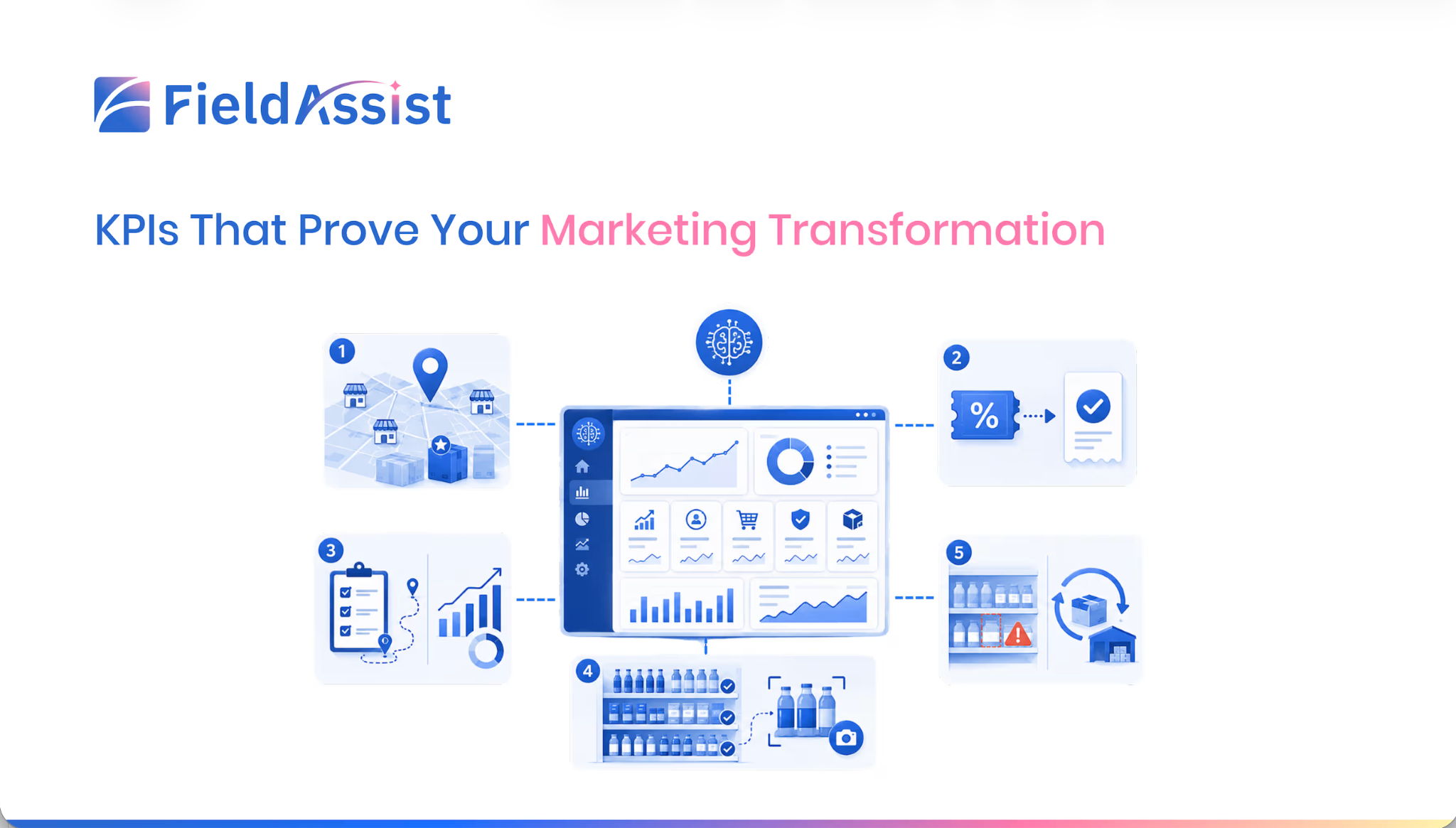
Investing in AI-powered retail marketing strategies only creates business value if it moves the metrics that matter. The following KPIs serve as the primary indicators of retail marketing transformation when AI analytics is deployed at scale:
How FieldAssist Helps FMCG Brands Turn Retail Data into Growth?
FieldAssist AI analytics platform for retailers does not sit as a standalone reporting layer; it is woven into the live execution infrastructure of 700+ enterprises, connecting field activity, distributor data, shelf intelligence, and AI-driven recommendations in a single, unified ecosystem.
1. Unified Retail Analytics Across Sales, Distribution, and Execution
FieldAssist's Analytics Studio is the intelligence layer converting raw SFA and DMS data into actionable retail insights. Analytics Studio provides managers with real-time, role-specific dashboards that eliminate the lag between execution and insight. It is retail analytics software designed not for data scientists, but for the field leadership teams who need to make decisions every day. Learn more: FieldAssist Analytics Studio
2. AI-Powered Shelf Intelligence with FA IRIS
brings computer vision to the last mile. Using image recognition deployed at the outlet level, IRIS captures planogram compliance, share of shelf, out-of-stock positions, and competitive facings, converting what was once a periodic retail audit into a continuous, AI-powered signal. For FMCG brands managing Perfect Store execution across thousands of outlets, IRIS closes the gap between merchandising intent and shelf reality.
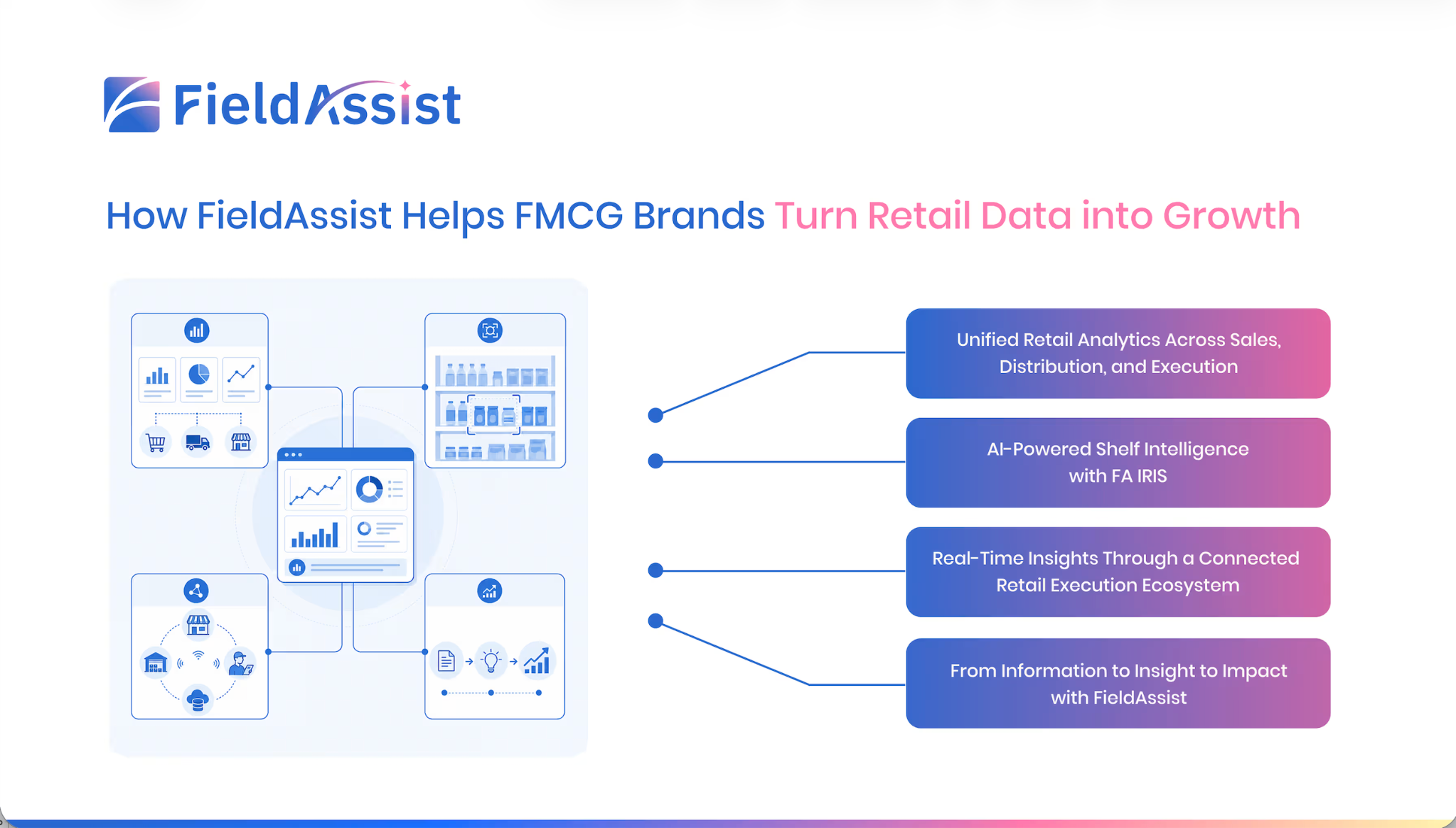
3. Real-Time Insights Through a Connected Retail Execution Ecosystem
The power of FieldAssist's retail intelligence software lies in its connectivity. SFA data, DMS secondary sales, Auto Replenishment System (ARS) signals, IRIS shelf data, and Pulse AI co-pilot recommendations are not siloed; they feed a single execution intelligence engine. This means that when a stock-out risk is detected by ARS, it surfaces in the analytics dashboard before it becomes an empty shelf. When a scheme redemption rate drops below the threshold in a geography, the manager sees it in real time, not in the quarterly review.
4. From Information to Insight to Impact with FieldAssist
FieldAssist's 3i Intelligence Framework, Information, Insight, Impact- is the operating model for AI-powered retail marketing at scale. Information is gathered across SFA, DMS, and field execution. Insight is generated through Analytics Studio, Pulse AI, and Impact is driven through NOVA-powered agentic workflows, route optimization, product recommendations, IRIS and Perfect Store execution, closing the loop between data and commercial outcome.
For FMCG brands serious about AI-powered retail marketing strategies, FieldAssist is not just a software vendor. It is the execution intelligence infrastructure that bridges the gap between retail data and retail growth.
Conclusion
The last-mile execution gap has always existed in FMCG retail. What has changed is the ability to see it, measure it, and close it in real time. AI retail analytics transforms retail marketing performance not by adding complexity, but by removing the blind spots that have made trade spend inefficient, distribution gaps invisible, and competitive threats slow to detect.
The capabilities outlined in this blog represent a practical, commercially grounded application of AI analytics, not an aspirational vision, but an operational reality for the FMCG brands already deploying retail intelligence software at scale.
FieldAssist exists to make that reality accessible to every CPG brand navigating the complexity of general trade across emerging and high-growth markets. If your retail data is not yet working as hard as your field teams, it is time to change that.



.avif)