AI Agents or Agentic AI: Which Delivers Greater Business Value?
Confused between AI agents and Agentic AI? Understand their roles, benefits, and business impact to build a smarter FMCG Route-to-Market strategy.

.avif)
In the race to automate CPG field operations, two terms keep appearing in every technology brief: AI agents and Agentic AI systems. Vendors use them interchangeably. LinkedIn thought leaders treat them as synonyms. But for FMCG brands trying to close the last-mile execution gap, between what the planogram prescribes and what the reps actually find on the shelf, the difference between AI agents and Agentic AI systems is strategic.
This blog unpacks each concept, clarifies the real difference between AI agents and Agentic AI, and helps you decide where your Route-to-Market stack actually needs investment.
By the numbers: Gartner projects that by the end of 2026, 40% of enterprise applications will embed task-specific AI agents, up from under 5% in 2025. The window to build a coherent agentic architecture is now.
What Are AI Agents? The Specialists on Your Sales Floor
Think of AI agents in retail as the best reps you never had to hire, one who never forgets to check stock, never skips the secondary display audit, and never files a visit report late. An AI agent is a discrete software entity trained to perform a specific, well-defined task within a larger workflow. It perceives inputs (outlet visit data, shelf images, order history), processes them against a decision model, and executes a predefined action.
How AI Agents Work in Retail Execution? In FMCG distribution, Retail AI agents operate at the execution layer. They are embedded in SFA tools, distributor management systems (DMS), or mobile field apps. They don't think holistically; they react precisely. A planogram compliance AI agent, for instance, takes a shelf image from an in-store visit, compares it against the prescribed shelf layout, and flags deviations in real time. It doesn't care about the outlet's credit limit or the scheme expiry date. That is not its job.
That precise scope is both the strength and the limitation of standalone AI agents.
Examples of AI Agents in FMCG Distribution
Some of the most impactful examples of AI agents deployed in CPG field operations today include:
- Planogram compliance agents: Computer vision models that compare shelf photographs against brand-prescribed layouts and flag SKU gaps or incorrect facings.
- Order recommendation agents: ML-driven nudge engines that suggest optimal order quantities to reps during outlet visits based on sales velocity, scheme windows, and stock levels.
- Beat planning agents: Algorithms that generate optimized outlet-visit sequences for each reps to maximize productive calls per day while minimizing travel distance.
- Scheme nudge agents: Notification bots that alert reps when an outlet is close to unlocking a volume threshold for an active trade scheme.
- Outlet health scoring agents: Models that assign real-time numeric distribution and productive call scores to individual retail outlets, surfacing churn risk.
These are real-world examples of AI agents, task-specific, measurable, and deployable within existing SFA infrastructure.
Where AI Agents Fit in Your Route-to-Market Stack
AI agents plug into your existing Route-to-Market (RTM) stack as precision add-ons. They augment reps and ASM workflows rather than redesigning them. For brands with kirana-heavy general trade footprints across India or duka networks in East Africa, deploying targeted Retail AI agents can produce measurable improvements in lines per call, scheme compliance, and numeric distribution without requiring a wholesale technology overhaul.
The ceiling, however, is real. AI agents don't communicate with each other. They don't adapt if the regional distributor runs out of a priority SKU. They don't re-prioritize beats when a key outlet closes. For that level of intelligence, you need the layer above.
What Is Agentic AI? The System That Runs the Whole Operation
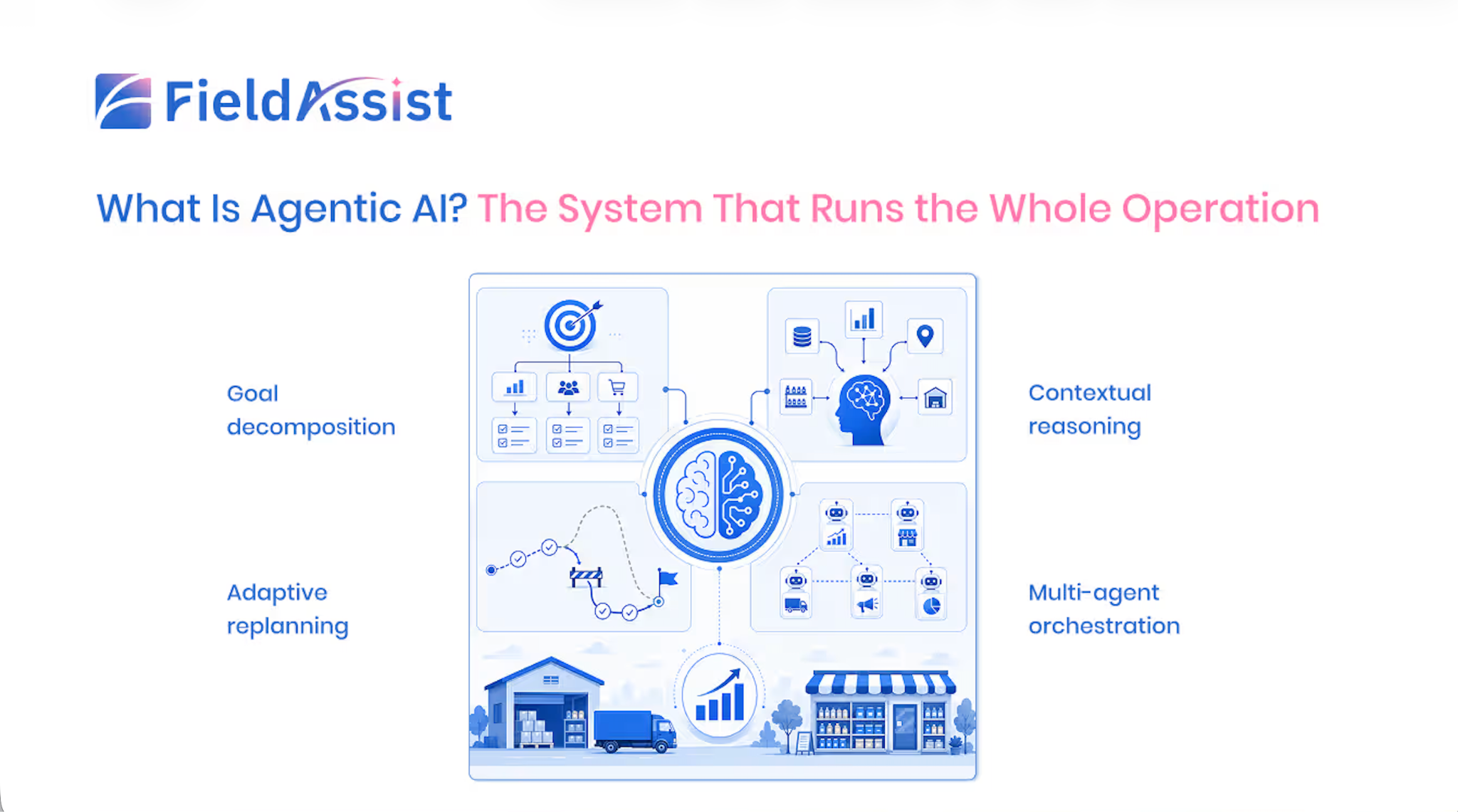
Agentic AI systems represent a fundamentally different architecture. Where AI agents are specialists, Agentic AI is the coordinator that gives them purpose, context, and direction. An Agentic AI system doesn't just execute tasks; it perceives goals, formulates multi-step plans, delegates to specialized agents, evaluates outcomes, and adapts when reality diverges from the plan.
In the language of field sales: if AI agents are your reps, Agentic AI is the Area Sales Manager, the National Sales Head, and the demand-planning analyst, all operating in real time, at scale, and without a single escalation email.
How Agentic AI Thinks, Plans, and Adapts
Agentic AI systems are defined by four core capabilities that distinguish them from point-solution AI agents:
- Goal decomposition: Given a business objective (e.g., improve weighted distribution of a new SKU by 15% in Q2), the system breaks it into sub-tasks and assigns them to appropriate agents.
- Contextual reasoning: Agentic AI reads across data sources, primary sales, secondary sales, retailer sell-through, and geo-verified visits to understand what is actually happening in the market.
- Adaptive replanning: When an action fails (the beat couldn't be completed, a distributor missed a replenishment window), the Agentic AI system recalibrates and re-routes without human intervention.
- Multi-agent orchestration: The system coordinates multiple specialized AI agents in parallel, ensuring they work toward coherent outcomes rather than optimizing their individual metrics in isolation.
Agentic AI in Action: From Distributor to Shelf
In a live FMCG context, an Agentic AI system might begin Monday morning by analyzing secondary sales data from 3,000 outlets across a territory. It identifies that a high-velocity SKU is trending toward stockout in 18 general trade outlets in a specific beat cluster. It triggers the order recommendation agent to surface priority replenishment nudges for the relevant reps. Simultaneously, it alerts the DMS to flag the distributor, and it re-sequences the beat plan to prioritize the at-risk outlets.
This is not a chatbot. This is AI-powered sales automation with genuine decision-making architecture, the kind that CPG brands need to compete in markets where last-mile execution data has historically been invisible.
The Real Difference Between AI Agents and Agentic AI
The difference between AI agents and Agentic AI is best understood not as a technology distinction but as an architecture one. Use the table below to orient your investment strategy.
Why the Distinction Matters for AI-Powered Sales Automation in FMCG?
Here is the uncomfortable truth about AI-powered sales automation in consumer goods: Brands deploy individual AI agents, a planogram checker here, an order nudge bot there, and wonder why field execution metrics move only marginally. The answer, per Gartner's research, is that over 40% of agentic AI projects will be canceled by the end of 2027, primarily due to unclear business value and inadequate integration with operational workflows. The root cause is almost always an architectural mismatch: either agents deployed without an orchestration layer, or an Agentic AI platform deployed without execution-ready agents to power it.
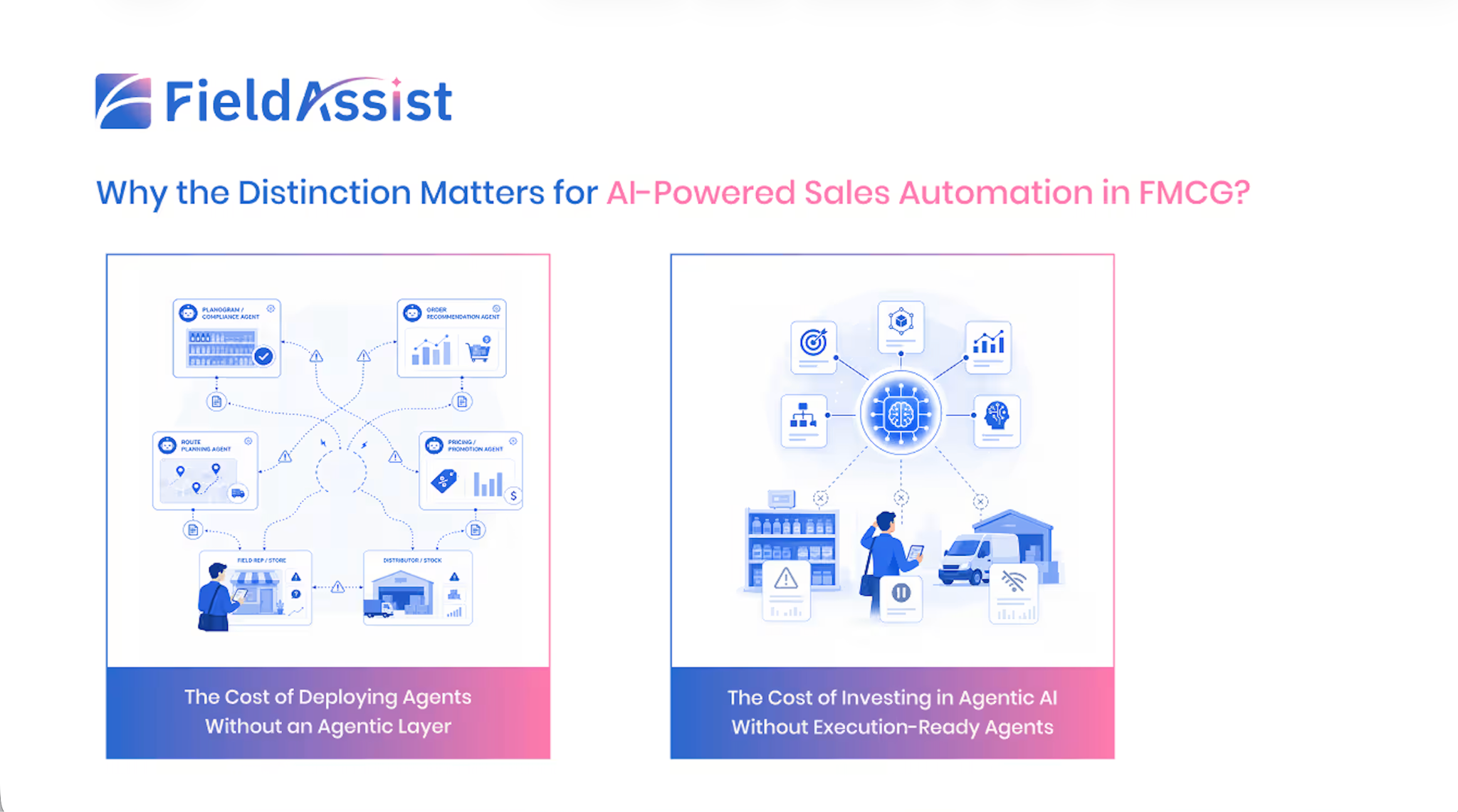
The Cost of Deploying Agents Without an Agentic Layer
When you deploy retail AI agents in isolation, without a system that contextualizes their outputs and connects them to business goals, you create what the industry calls "agent sprawl." Your planogram compliance agent flags 400 deviations a day. Your reps don't know which 40 matter for revenue. Your order recommendation agent pushes SKU X when the distributor carrying SKU X is already at the credit limit. The agents are working. The system is not.
The result: AI adoption metrics look healthy on the dashboard, but weighted distribution and scheme compliance numbers barely move. This is the execution trap that many CPG brands in high-growth markets, India, Southeast Asia, and Sub-Saharan Africa, fall into when they scale AI agents without Agentic AI systems to govern them.
The Cost of Investing in Agentic AI Without Execution-Ready Agents
The inverse error is equally expensive. Brands that invest in Agentic AI platforms, sophisticated orchestration layers, multi-agent frameworks, and real-time decision engines, without underlying data quality or execution-ready agents at the field level, find themselves running a powerful engine with no fuel. McKinsey's 2024 CPG benchmark found that while 71% of CPG leaders had adopted AI in at least one business function, no player had truly scaled across operations, a gap McKinsey attributes directly to the failure to connect intelligence layers with execution capability.
An Agentic AI system that cannot get geo-verified visit data, real secondary sales figures, or planogram audit results from the field is planning in a vacuum. The last-mile execution gap doesn't close from the top down. It closes when intelligence and execution are architecturally joined.
Where does FieldAssist sit in This Architecture?
The FieldAssist product stack is organized around the 3i Intelligence Framework, Information, Insight, and Impact, which maps directly onto the two-layer architecture this blog has been building toward. The Information and Insight layers capture and contextualize field data. The Impact layer is where both retail AI agents and Agentic AI systems live, working in concert to turn market signals into measurable shelf outcomes.
Here is how each Impact product fits into that picture.
FAi IRIS converts shelf images into real-time compliance insights, detecting stockouts, planogram deviations, SKU facings, and share-of-shelf.
Auto Replenishment System (ARS) monitors buying patterns and automatically recommends replenishment before stockouts occur.
Product Recommendations suggests the right SKUs during outlet visits based on outlet history and sales trends.
Route Optimization dynamically prioritizes outlet visits to maximize productive calls and market coverage.
Perfect Store measures field execution against predefined merchandising and compliance standards in real time.
Above these agents sits NOVA, FieldAssist's Agentic AI layer. Rather than performing a single task, NOVA orchestrates actions across the RTM ecosystem. It uses conversational AI, intelligent order management, personalized promotions, predictive decision intelligence, and live SFA-DMS connectivity to ensure sales continuity even when field visits are missed. The result is fewer missed orders, stronger retailer engagement, and more consistent execution.
The architecture extends further through the FAi DMS Agent, which applies Agentic AI at the distributor level by monitoring inventory, scheme performance, secondary sales, and credit utilization while recommending corrective actions proactively.
Together, these capabilities create a connected RTM intelligence system where AI agents execute specialized tasks, and Agentic AI coordinates them into measurable commercial outcomes. For CPG brands, the choice is not AI agents versus Agentic AI; it is how effectively both work together.
Closing Thoughts- So, Where Should Your Investment Go?
The honest answer: both, but in the right sequence.
Start with execution-layer Retail AI agents if your field data quality is low. If your reps are not capturing structured, geo-verified outlet visits; if your secondary sales data is manually compiled; if planogram compliance is measured by exception rather than by audit, then no Agentic AI system will deliver value. Build the data foundation first.
Then layer in Agentic AI systems once your execution data is reliable and structured. This is the sequence that drives the outcomes McKinsey identifies in high-performing CPG companies: three times greater total shareholder returns compared to peers who lack an integrated digital and AI stack.
For brands already active on an AI agents marketplace, piloting vendor-specific agents for beat planning, outlet scoring, or scheme alerts, the next investment question should be: Is there an orchestration layer that connects these agents? If the answer is no, you have a collection of specialists with no general manager. FAi Agentic AI is designed to be that general manager.
The data support urgency. NVIDIA's report found that 69% of retailers using AI reported revenue increases, with 72% seeing operating cost reductions. But these returns cluster in organizations where AI operates as a system, not a collection of tools.
In FMCG markets where the margin between winning and losing a shelf is measured in seconds of reps' attention and centimeters of facing, AI agents and Agentic AI systems are not competing investments. They are complementary architectures, and the brands that understand this distinction will own the shelf.



%20(1).avif)

.avif)