4 High-Impact Uses of Agentic AI for Consumer Goods Brands
Learn how Agentic AI is transforming consumer goods operations with autonomous retail execution, AI sales copilots, distributor intelligence, and trade governance.

.avif)
Every CPG sales director knows the frustration: the dashboard looks healthy, demand is forecasted, trade spend is approved, yet shelves are empty, distributors are overstocked, and the problem surfaces only during the monthly review. This is the last-mile execution gap where revenue slips away.
For a decade, the industry's answer has been more dashboards, more alerts, more reports. But dashboards only tell you what happened. They don't do anything about it. That's the fundamental limitation Agentic AI is built to solve, and it's why it has become the most consequential shift in enterprise technology since the smartphone put a computer in every field rep's pocket.
Gartner's numbers make the scale of this shift hard to ignore: enterprise applications embedding task-specific AI agents are projected to jump to 40% by the end of 2026, up from less than 5% in 2025. For CPG and FMCG brands running high-velocity, high-SKU, multi-channel go-to-market operations across thousands of outlets, this shift is arriving at exactly the right moment.
This blog breaks down four high-impact, real-world uses of Agentic AI for consumer goods brands, not theoretical use cases, but the ones already reshaping how field sales, distribution, and retail execution work.
What Is Agentic AI, and Why Should CPG Leaders Care?
Agentic AI is a class of intelligent AI agents that don't just analyze or predict, they act. Unlike a generative AI chatbot that answers a question, or a BI dashboard that flags an anomaly, an AI agent can perceive a situation, reason about the best course of action, and execute a multi-step workflow autonomously, checking in with a human only when judgment or approval is genuinely needed.
For a CPG business, that distinction is everything. A traditional analytics tool might tell a regional sales manager that on-shelf availability dropped 12% in a cluster of outlets last week. An agentic system does something categorically different: it detects the drop, cross-references it against the distributor's stock and the DSR's beat plan, generates a corrective replenishment order, assigns it to the right field rep's task list, and escalates to a supervisor only if the order isn't fulfilled within the agreed SLA. No human had to notice, diagnose, or delegate. The system closed the loop.
Agentic AI for Business: Beyond Dashboards and Alerts
This is what makes Agentic AI for business fundamentally different from the last generation of enterprise software. It's the difference between "insight" and "outcome." Agentic AI doesn't just reduce admin work, it removes entire categories of decisions that used to require a human to notice something was wrong before anyone could fix it.
Four use cases for consumer goods brands
1. Agentic AI for Retail Execution: Closing the Last-Mile Gap Autonomously
Retail execution has always been a game of thousands of tiny, distributed decisions; is the SKU on shelf, is the planogram compliant, is the secondary display live, is the price tag correct, happening across outlets faster than any regional manager can physically track. This is precisely where Agentic AI for retail execution earns its keep.
Instead of a field rep photographing a shelf and waiting for a report to surface an issue days later, intelligent AI agents can process the image at the point of capture, identify an out-of-stock or a planogram deviation instantly, and immediately trigger the next step, an auto-generated replenishment order, a real-time nudge to the DSR, or an escalation to the distributor, without waiting for a human to review a report first.
The stakes here are enormous. IHL Group's global analysis puts the annual cost of inventory distortion, the combined toll of out-of-stocks and overstocks, at $1.73 trillion worldwide, equivalent to roughly 6.5% of global retail sales. For CPG brands operating across general trade and modern trade simultaneously, a meaningful share of that number is quietly eaten by shelves nobody checked in time.
Intelligent AI Agents on the Shelf
What makes this genuinely "agentic" rather than just automated is judgment. An intelligent AI agent monitoring on-shelf availability doesn't just fire the same alert every time, it reasons about context. A stockout on a high-velocity SKU during a promotion period gets escalated immediately; a minor gap on a slow-mover in an outlet with a scheduled visit tomorrow gets queued. That prioritization logic, applied consistently across tens of thousands of outlets, is something no regional sales team could ever do manually at the same speed or scale.
2. The AI Sales Copilot: Turning Every Field Rep Into a Top Performer
If retail execution is about the shelf, the second high-impact use case is about the person standing in front of it. An AI Sales Copilot sits alongside every field rep, pre-sales, van sales, or merchandiser, and does what the best sales managers wish they had time to do for every single rep, every single day: prep them before the call, coach them during it, and follow up after it.
Before a store visit, the copilot can brief the rep on that outlet's last order gaps, outstanding schemes, and the highest-probability upsell opportunity based on similar outlets nearby. During the visit, it can suggest the next-best action, which SKU to push, which scheme to mention, which objection to expect. After the visit, it handles the reporting and CRM updates that used to eat up the rep's evening.
This matters because the industry-wide time-allocation problem in sales is stark and well-documented. McKinsey's field research found reps at some organizations spending as much as 75% of their time away from actual selling. An AI Sales Copilot attacks that gap directly, absorbing the administrative load so reps spend their limited store time on conversations that actually move volume.
How Brands Can Use Agentic AI to Coach at Scale?
This is really the answer to the question every sales director eventually asks: how brands can use Agentic AI to replicate their best rep's instincts across an entire field force. A copilot doesn't get tired on the fortieth call of the day, doesn't forget last month's scheme performance, and doesn't need three days to compile a beat-level report. It's always-on coaching, delivered in the flow of work rather than in a monthly review meeting that's already too late to change anything.
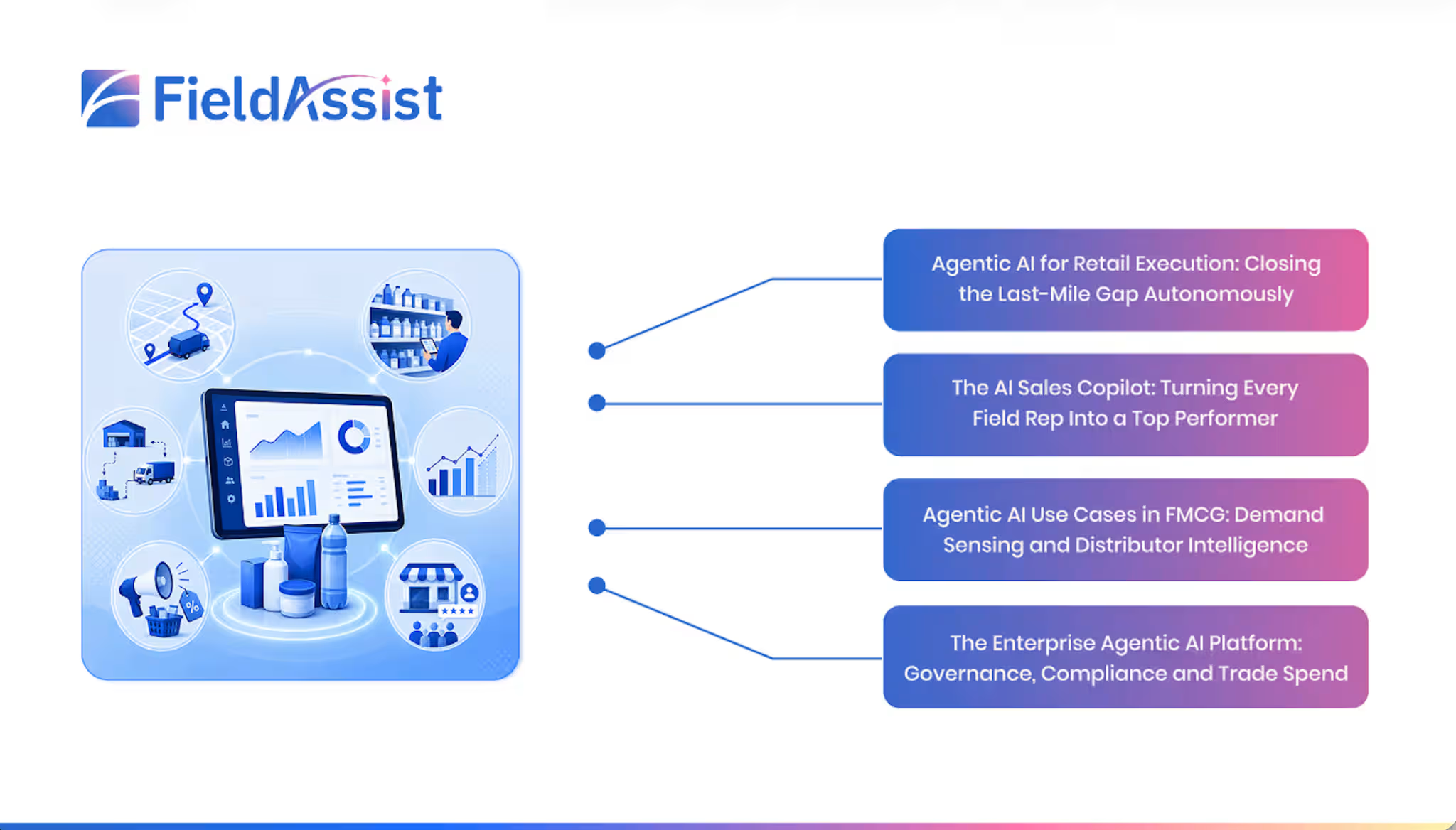
3. Agentic AI Use Cases in FMCG: Demand Sensing and Distributor Intelligence
Move upstream from the shelf and the rep, and you find the third major front: distribution and demand. This is where some of the most powerful Agentic AI use cases in FMCG are quietly playing out, because distributor networks generate a staggering volume of secondary sales data, invoices, returns, stock positions, and scheme claims- that historically took weeks to reconcile into something a brand could act on.
Intelligent AI agents continuously analyze secondary sales and distributor stock data to identify demand changes, stock shortages, and excess inventory in real time. They alert teams to potential issues, recommend the next best action, and in advanced setups, can even automate tasks like moving stock from overstocked distributors to those running low, flagging demand spikes before stockouts happen, and identifying slow-moving SKUs before they turn into dead inventory.
Intelligent AI Agents Reconciling Secondary Sales
The practical value shows up fastest in distributor management. Instead of a regional sales manager manually cross-checking primary billing against secondary sales once a month, intelligent AI agents can flag mismatches, credit note anomalies, or scheme leakage the same week they occur, turning distributor governance from a quarterly forensic exercise into a continuous, self-correcting process.
4. The Enterprise Agentic AI Platform: Governance, Compliance and Trade Spend
The fourth use case is less visible but arguably the most strategically important: governance. Trade promotion spend, scheme compliance, and claims validation are where CPG brands lose margin quietly, a scheme claimed on stock that was never sold, a discount applied outside the approved window, a distributor over-claiming a secondary scheme. This is the domain of the enterprise Agentic AI platform: a system of orchestrated agents working across the entire route-to-market, each with a scoped, auditable mandate.
An enterprise Agentic AI platform doesn't operate as a single monolithic bot. It functions as a coordinated set of agents, one monitoring scheme compliance, another validating claims against actual sell-out data, another reconciling trade spend against budget, all reporting into a shared system of record, with humans retaining final sign-off on anything above a defined risk threshold. This is what separates a genuinely enterprise-grade deployment from a collection of disconnected point-automations.
Agentic AI for Business at Scale: Why Governance Matters
The reason this matters so much for CPG specifically: trade spend is typically one of the largest line items after cost of goods, and it's also one of the hardest to audit in real time across a distributed field force. Agentic AI for business only delivers durable ROI when it's deployed with proper guardrails, clear escalation paths, auditable decision trails, and human oversight built in by design, not bolted on afterward. Brands that treat governance as core infrastructure, not an afterthought, are the ones actually converting pilots into production value.
How Brands Can Use Agentic AI to Win the Last Mile?
Step back from the four use cases, and a pattern emerges: every one of them is really the same problem, viewed from a different vantage point. The shelf, the rep, the distributor, and the trade budget are four faces of the same last-mile execution gap that has quietly cost CPG brands margin for decades.
The organizations pulling ahead aren't necessarily spending the most on AI, they're the ones asking a sharper question about how brands can use Agentic AI: not "where can we bolt on a chatbot," but "where in our route-to-market do we have a decision that currently waits for a human to notice a problem before anything happens, and can an intelligent agent close that loop instead?"
That's the question FieldAssist was built to answer. As a global leader in AI-driven retail execution and sales force automation, FieldAssist has spent years solving exactly this last-mile execution gap for CPG brands, turning field data into autonomous action across on-shelf availability, sales force productivity, distributor management, and trade spend governance. Agentic AI isn't a future roadmap item for consumer goods companies. It's a competitive advantage available to the brands willing to move from dashboards to decisions today.
Ready to see what an agentic, execution-first approach looks like for your business? Get in touch with us.