Closing the Retail Execution Gap: 7 High-Impact Benefits of Field Force Automation
Close the gap between the boardroom and the shelf. See how FieldAssist transforms field operations with real-time visibility, geo-fencing, and AI-driven insights.

Introduction
It’s the classic "last-mile" nightmare for CPG and FMCG leaders. You’ve spent months perfecting the strategy, the field force is trained, and the targets are bold.
Then the data hits your desk, and it’s clear: The plan didn't survive the shelf.
The Reality Check: Where is the Revenue Bleeding?
If you’ve ever felt that disconnect between your boardroom vision and the actual retail, you aren't alone. This is the Retail Execution Gap, and it’s usually fueled by three silent "profit killers":
- The Ghost Shelf: Products are in the warehouse, but "misplaced" in the store. If the customer can’t see it, they can’t buy it.
- The "Invisible" Rep: Without tracking, how do you know if a missed outlet was a logistical hurdle or a missed opportunity?
- The Stockout Lag: Detecting a stockout three days late isn't data - it's an autopsy of lost sales.
To fix this, leaders are turning to Field Force Automation to replace manual guesswork with real-time intelligence. By digitizing the "last mile," you ensure that your strategy actually reaches the shelf every single time.
Understanding the Stakes: Why Retail Execution Fails
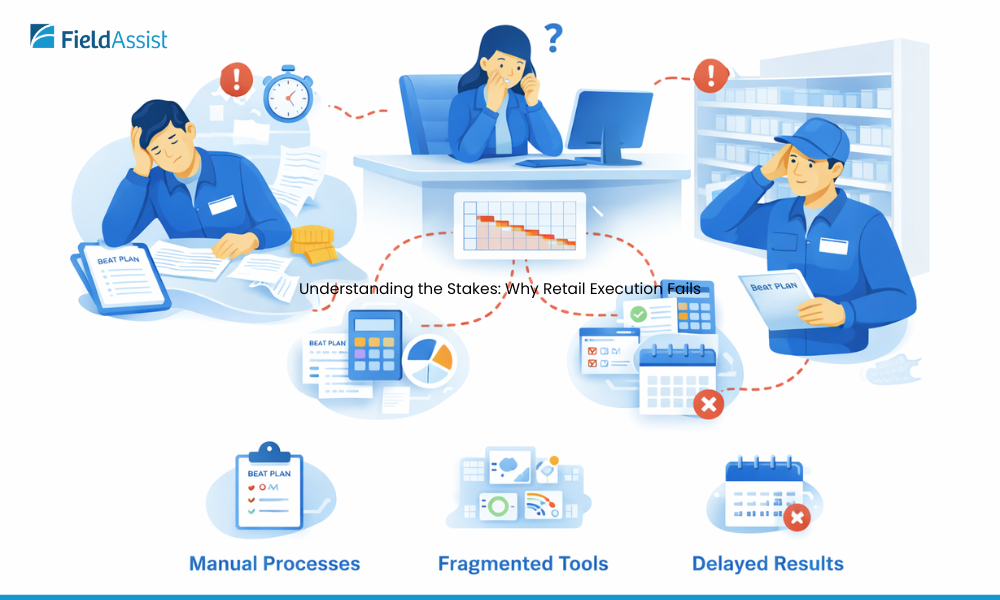
Retail execution doesn't fail because field reps don't care. It fails because the systems they rely on were never designed to handle the complexity of modern trade. Manual beat plans, paper-based data collection, and end-of-day call reports create a dangerous lag between what's happening on the ground and what leadership actually sees.
Most field teams are still operating on fragmented tools, legacy processes, and tribal knowledge. The cost isn't just lost productivity. It's lost shelf presence, lost sales, and lost market share - every single day.
For instance, A brand rolls out a nationwide promotion expecting strong in-store visibility. But due to delayed reporting and static beat plans, gaps in execution go unnoticed for days. By the time leadership identifies the issue, key outlets have already missed the opportunity window, impacting both sales performance and overall return on promotional spend.
McKinsey research shows that early adopters of sales automation see up to 15% higher efficiency and a 10% sales uplift. Without a unified system, you’re leaving double-digit growth on the table.
7 High-Impact Benefits of Field Force Automation
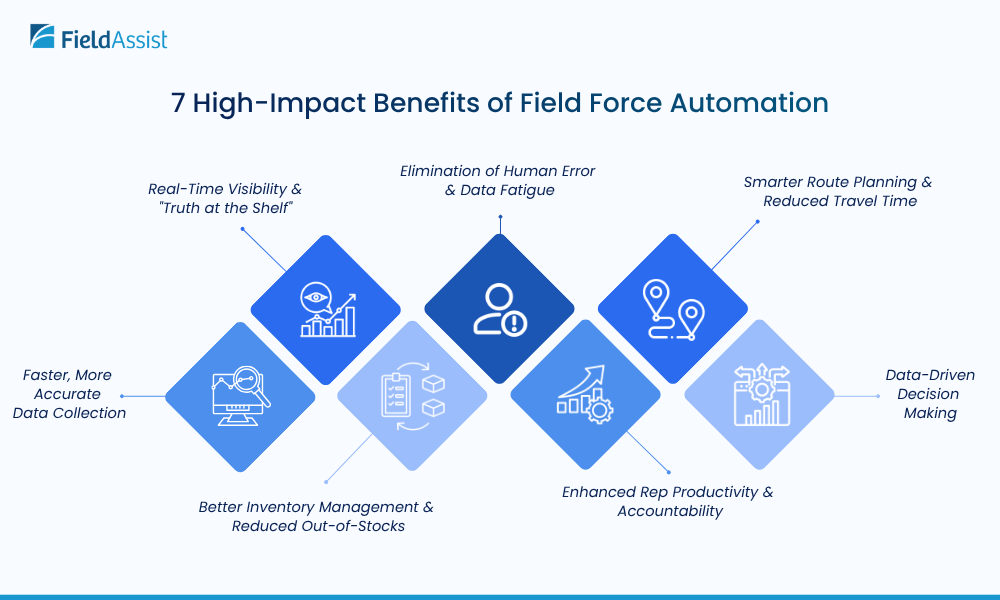
1. Real-Time Visibility and "Truth at the Shelf"
The most dangerous number in retail execution is the one you don't have yet. Traditional reporting cycles, daily DSRs, weekly reviews, and monthly audits mean that by the time leadership identifies a coverage gap, the sales window has already closed. A smart field force automation system eliminates this lag entirely.
With real-time dashboards and geo-tagged check-ins, managers get a clear, on-ground view of outlet performance. Missed visits, dormant outlets, and coverage gaps are flagged instantly, enabling faster, proactive action instead of delayed corrections.
2. Elimination of Human Error and Data Fatigue
Ask any field rep about their least favorite part of the job, and it’s not travel; it’s paperwork. Manual order entry, visit logs, and spreadsheets are slow and unreliable. A modern field force automation tool replaces this with structured digital workflows, enabling faster order booking, standardized reporting, and more reliable data. The result is better visibility for leadership and more selling time for reps.
3. Smarter Route Planning & Reduced Travel Time
An unoptimized beat plan is a hidden tax on every field team's productivity. Reps driving inefficient routes between outlets are not just wasting fuel but their most finite resource: time in front of buyers.
Modern field force automation platforms use AI-driven route optimization to dynamically adjust beat plans based on outlet priority and location. The outcome is measurable: more high-value outlet visits per day and reduced cost per call.
4. Faster, More Accurate Data Collection
The gap between field reality and back-office insight is measured in hours, sometimes days, when teams rely on manual data collection. By the time a stockout is logged in a spreadsheet, reviewed by a manager, and escalated to supply chain, the shelf has been empty long enough to drive a loyal buyer to a competitor.
A field service automation platform collapses this timeline to near-zero. Reps capture shelf data, competitive intelligence, and outlet feedback digitally, in real time, directly from the point of interaction. Data syncs instantly, even in low-connectivity environments, through an offline-first architecture.
5. Better Inventory Management & Reduced Out-of-Stocks
Out-of-stocks aren’t just an inventory issue; they’re an information gap. By the time a stockout is visible in a weekly sales report, revenue leakage is already lost, and retailer relationships have been damaged.
According to industry reports, out-of-stock items alone account for over $1.7 trillion in lost retail sales globally each year.
With real-time distributor stock visibility, brands can shift from reacting to stockouts to preventing them. Reps are alerted to low-stock situations during the visit itself. Replenishment workflows trigger automatically. The shelf stays full, and the sale is secured.
6. Enhanced Rep Productivity & Accountability
Field rep productivity isn’t just about the number of visits; it’s about how effectively each visit is executed. Without structured guidance, reps often default to familiar patterns, missing upsell opportunities and key tasks.
According to McKinsey & Company, companies using digital sales tools and automation are seeing 10–15% improvements in sales productivity and effectiveness.
The best field force automation software platforms address this by guiding reps during visits with prompts for upselling, compliance checks, and task completion. Combined with real-time tracking and performance visibility, it drives consistent execution and accountability - without the need for constant supervision.
7. Data-Driven Decision Making (The Feedback Loop)
The real advantage of field force automation is the continuous flow of structured data it creates. Every outlet visit, order, and interaction feeds into a connected system, enabling smarter and faster decision-making across teams.
With built-in analytics dashboards, sales leaders can track performance at outlet, SKU, and territory levels in real time, without relying on delayed reports. This ensures quicker identification of underperforming areas and more informed, data-driven decisions grounded in on-ground reality.
How Modern Field Force Automation (FFA) Flips the Script
Closing the gap isn't about working harder; it's about intelligent accountability. Here is how a modern FFA platform transforms chaos into a streamlined machine:
Closing Thoughts - From Strategy to Shelf, Every Time
The retail execution gap is not inevitable. It is the predictable result of asking a modern, high-velocity distribution operation to run on manual processes and fragmented visibility. Closing it requires more than motivation; it requires the right field force automation software infrastructure.
From real-time shelf intelligence and smarter routing to AI-powered nudges and closed-loop analytics, the seven benefits outlined above represent a transformation from reactive field management to proactive shelf dominance.
FieldAssist empowers brands to bridge this gap, ensuring that from the first mile to the final inch, your strategy is executed with precision. The consumer's final decision happens at the shelf. The brands that win there with the help of FieldAssist will be the ones that arrive prepared, every time.



%20(1).avif)