Why Every Sales Leader Needs an AI Copilot Instead of Another Dashboard
Learn how AI sales copilots turn sales data into real-time recommendations, improving field execution, productivity, and decision-making across FMCG sales teams.

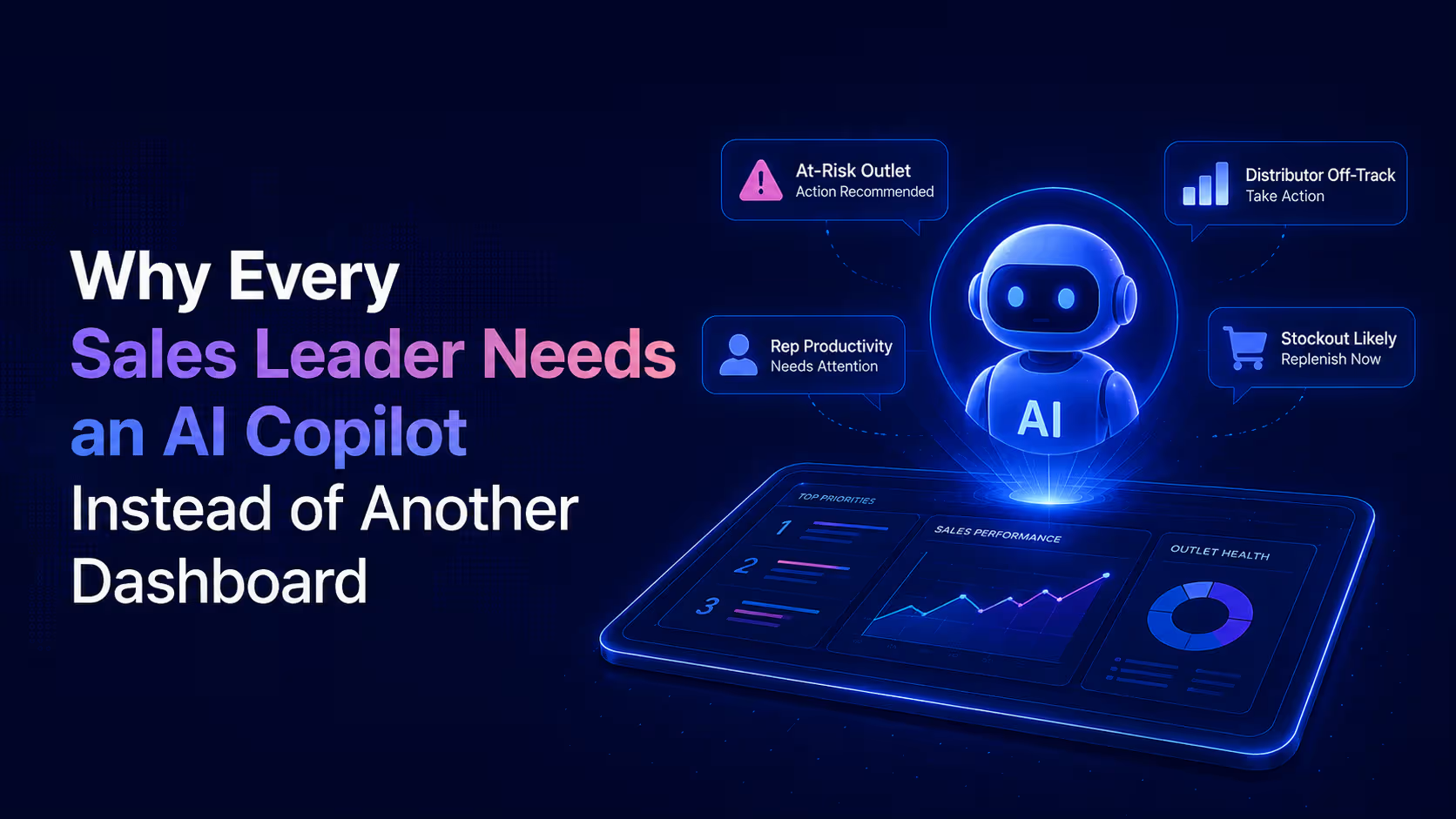
Every quarter, sales leaders sit through another dashboard demo promising “real-time visibility.” Yet field execution gaps, missed order cycles, and stalled deals persist quarter after quarter. The problem isn’t a shortage of data- CRMs, SFA platforms, and BI tools already generate more of it than any regional sales head can absorb.
The problem is that dashboards report what happened; they don’t tell a sales leader what to do next. That’s the gap an AI sales copilot is built to close. Instead of another chart to interpret, an AI copilot for sales surfaces prioritized, contextual recommendations- the outlet losing share, the distributor drifting off-target, the rep whose beat needs correcting- before the leader even opens a report.
For CPG and FMCG organizations managing thousands of field reps and outlets across fragmented geographies, moving from “more data” to “faster decisions” has stopped being optional.
The Dashboard Dilemma: More Data, Fewer Decisions
Sales leaders today aren’t short on dashboards; they’re buried in them. A typical enterprise sales organization juggles route-execution dashboards, secondary sales trackers, distributor management system (DMS) reports, and a recurring deck of slides, each built by a different team, on a different cadence, with numbers that rarely tie back to each other.
By the time a regional sales head has reconciled last week’s off-take against this week’s van-load plan, the window to act on either has usually closed.
This isn’t a tooling failure so much as a design failure. Traditional BI dashboards were built to display information, not interpret it. They assume a human will spot the anomaly, trace it to a cause, and decide what to do, reasonable when a leader oversees ten outlets, unreasonable when they oversee ten thousand.
Bain & Company’s research into AI-driven go-to-market transformation found that 60% of companies still lack the data foundation or technology needed to scale AI effectively across their commercial engine, which is exactly why bolting another dashboard onto an already fragmented stack rarely produces better decisions. What sales leaders need isn’t a sharper lens on the past; it’s a system that reads the data on their behalf and tells them where to look next.
What Is an AI Sales Copilot?
An AI sales copilot is a working layer of artificial intelligence sitting across a company’s sales, distribution, and field-execution data, CRM, SFA, DMS, and retail audits, that continuously converts that data into decisions a sales leader can act on.
Where a BI tool answers “what happened,” an AI sales copilot answers “what should happen next”: which distributor needs an intervention this week, which SKU is losing shelf share in a specific micro-market, which rep’s beat plan needs correcting before month-end.
Functionally, it behaves like an AI-powered sales assistant that a regional sales head can query in plain language, “which outlets in the East Zone missed their order cycle this week?”, and receive a ranked, prioritized answer instead of a raw export.
Rather than adding one more system to check, a well-designed copilot meets sales leaders inside the tools they already use for daily reviews.
Under the hood, it draws on the same sales intelligence AI techniques used in demand forecasting and anomaly detection, but packages the output as a recommendation rather than a report. That distinction, insight paired with an action, is what separates an AI sales copilot from every “AI-powered” dashboard that came before it.
Why Sales Leaders Need an AI Sales Copilot Today
Field sales in CPG and FMCG doesn’t usually fail for lack of ambition; it fails in the last mile, where a plan made in a boardroom meets a thousand different outlet realities on the ground. An enterprise AI sales copilot closes that gap by turning fragmented execution data into decisions a sales leader can act on the same day, not the same quarter. Five shifts explain why this has moved from a “nice to have” to a board-level priority.
1. Faster Sales Decision-Making
With AI-driven sales insights surfaced automatically, sales leaders no longer wait for a monthly business review to learn that a distributor is under-stocked or a market is losing share. Gartner’s 2026 research on commercial growth found that sales organizations giving sellers AI-enabled next best actions are 2.6 times more likely to achieve commercial growth than those that don’t, a gap driven largely by speed of decision, not access to more data. An AI sales copilot compresses the distance between “the data changed” and “the rep acted” from weeks to hours.
2. Better Visibility Across Sales Operations
Most sales leaders don’t lack visibility into any single market; they lack a unified view across all of them. An AI copilot for sales pulls signals from route execution, distributor stock, retail audits, and competitor activity into one continuously updated picture, so a national sales head can see a state-level stockout and a rep-level coaching gap in the same view, without waiting for three separate teams to compile three separate reports.
3. Higher Productivity Without Complexity
Adding intelligence shouldn’t mean adding another tool to log into. A well-built AI sales copilot works inside the systems reps and managers already use- SFA apps, WhatsApp, email- rather than asking sales leaders to master a new interface on top of everything else. That’s the difference between technology that gets adopted and technology that gets shelved after the pilot quarter.
4. Consistent Field Sales Execution
Execution quality varies wildly across reps, regions, and managers, not because strategy is unclear, but because there’s no consistent mechanism enforcing it in the field. An AI-powered sales assistant flags deviations from the playbook, a missed outlet visit, an off-plan discount, a skipped upsell prompt, in real time, so execution discipline doesn’t depend entirely on how closely a given manager happens to be watching that week.
5. Reduced Reliance on Manual Reporting
Manual reporting consumes hours that should go toward selling. Gartner projects that by 2027, 95% of sellers’ research workflows will begin with AI, up from less than 20% in 2024, a trend that applies just as directly to field sales reporting as it does to enterprise deal research. An AI sales copilot absorbs the reconciliation work a sales ops analyst used to do by hand, freeing that time for account strategy instead of spreadsheet cleanup.
How does AI help sales leaders?
The real value of AI in sales leadership isn’t automation for its own sake; it’s the compounding effect of faster, better-informed calls made consistently across an entire organization. McKinsey’s research on generative AI estimates the technology could add $2.6 trillion to $4.4 trillion in annual value globally, with roughly 75% of that value concentrated in customer operations, marketing and sales, software engineering, and R&D, with sales sitting squarely inside the highest-impact zone.
For a sales leader, that translates into something concrete: AI-driven sales insights that flag which distributors are drifting off-target before a quarter closes, not after; sales intelligence AI that spots a competitor’s pricing move in a micro-market before it shows up in lost revenue; and a copilot that recommends the next best action for a rep rather than leaving that judgment to instinct and tenure.
None of this replaces the sales leader’s judgment; it removes the guesswork about where that judgment gets applied.
AI Sales Copilot vs Traditional Sales Intelligence Platforms
Traditional sales intelligence platforms were built for a world where “intelligence” meant a clean report. They aggregate CRM and third-party data, apply some scoring logic, and hand a sales leader a dashboard to interpret for themselves. An AI sales copilot starts where that leaves off, not just surfacing the insight, but recommending, and in some cases initiating, the next action.
From Dashboards to Decisions: The Future of Sales Intelligence AI
The next phase of sales intelligence AI won’t be measured by how much data a platform can display, but by how little a sales leader has to do to act on it. Four shifts are already underway.
- The Evolution from Reporting to Guided Selling
Platforms are moving from descriptive reporting, what happened last week, to prescriptive guidance: what to do about it today. That shift matters more in field sales than almost anywhere else, where the cost of a delayed decision compounds daily across thousands of outlets.
- Conversational Access to Business Intelligence
Instead of filing a request with sales ops and waiting for a report, a sales leader can now simply ask. An AI-powered sales assistant that answers in plain language collapses the distance between a question and an answer from days to seconds, which matters when the question is “which distributor needs a call today?”
- Autonomous Recommendations and Next-Best Actions
The most advanced copilots don’t wait to be asked. They surface next-best actions on their own, flagging a churn risk or a stockout before a leader thinks to look for one, the same behavior behind Gartner’s finding that AI-enabled next-best-action programs correlate with materially stronger commercial growth.
- The Rise of AI-Led Sales Execution
This intelligence is also moving downstream, past the leader’s dashboard and into the rep’s daily workflow. An AI copilot for sales that nudges a field rep toward the next best outlet visit or upsell opportunity extends guided execution to the frontline, not just the boardroom, a shift that matters because, as Gartner has found, human sellers still play a decisive role in how buyers act on AI-generated recommendations.
How to Choose the Right AI Sales Copilot?
Not every tool marketed as a copilot behaves like one. Five questions separate genuine AI sales copilots from dashboards with a chat window bolted on.
1. Look Beyond Reporting Capabilities
If the output is still a chart or a table a human has to interpret, it’s a dashboard with better branding. A real copilot’s output is a recommendation, ranked by priority and tied to a specific action a rep or manager can take that day.
2. Evaluate Actionability, Not Just Analytics
Ask whether the platform turns AI-driven sales insights into a task inside the rep’s existing app, or simply a number on a screen. Actionability, not analytical depth, is what determines whether a copilot actually changes behavior in the field.
3. Assess Integration and Data Readiness
A copilot is only as good as the data feeding it. Given that most organizations still lack the data foundation needed to scale AI effectively, evaluate how cleanly a copilot integrates with existing SFA, DMS, and CRM systems before evaluating the strength of its intelligence layer.
4. Prioritize Real-Time Recommendations
Batch-processed insights delivered a day late are still a dashboard in disguise. An AI-powered sales assistant should update as field conditions change- a missed visit, a stockout, a competitor promotion- not on a weekly refresh cycle.
5. Ensure Enterprise-Scale Performance
For organizations running SFA across thousands of outlets and multiple countries, an enterprise AI sales copilot must handle real transaction volume, multiple languages and currencies, and patchy rural connectivity without breaking down. This is where most pilot-stage copilots fail; they’re built to impress in a demo, not for the scale an enterprise AI sales copilot actually needs to operate at across a national or global field force, where thousands of reps and outlets are updating data simultaneously, every single day.
Conclusion
Dashboards will keep getting prettier, faster, and more configurable, and none of that solves the core problem: they leave the decision entirely to the sales leader staring at the screen.
An AI sales copilot changes that equation by pairing every insight with a recommended action, at the speed and scale enterprise field sales actually demands. FieldAssist’s Pulse AI Co-Pilot was built on exactly this premise, as an enterprise AI sales copilot for CPG and FMCG brands that closes the last-mile execution gap, rather than one more dashboard for a sales leader to interpret alone.
The question worth asking isn’t whether your team has enough data. It’s whether that data is telling anyone what to do next.




.avif)