Top 5 Inventory Control Techniques to Improve Stock Management and Replenishment
Reduce stockouts, cut excess inventory, and improve replenishment accuracy with 5 proven inventory control techniques. Learn how ABC, JIT, EOQ, ROP, and FIFO/LIFO drive smarter, cost-efficient inventory management.


Introduction
Poor inventory management is one of the most expensive problems in modern business, but how often do we actually pause and measure its impact?
Think about it:
Are your shelves overflowing with products that aren’t moving?
Are you constantly dealing with stockouts just when demand peaks?
Are supply disruptions forcing you into last-minute, costly decisions?
If any of this sounds familiar, you’re not alone.
Whether you're a retailer struggling with overstocking, a manufacturer facing supply chain gaps, or an e-commerce brand battling unpredictable demand, poor stock management quietly eats into your margins every single day. And the stakes are higher than most businesses realize.
According to McKinsey & Company, companies that adopted AI-enabled supply chain solutions early have seen: 15% improvement in logistics costs & 35% improvement in inventory levels.
That’s not just improvement—it’s a competitive advantage.
In today’s fast-moving and highly competitive market, inventory management is no longer just a backend function. This blog explores the top 5 inventory control techniques that businesses can implement to sharpen their stock management software practices, strengthen automated replenishment systems, and drive smarter decision-making across the supply chain.
Why is Inventory Control critical for businesses?
Inventory is often the largest asset on a company's balance sheet, but it is also the most "trapped" form of capital. Without a robust retail inventory management system, businesses face the dual threat of stockouts (lost revenue) and overstocking (capital tied up in depreciating goods).
The stakes are higher than ever. Excess inventory ties up working capital, inflates warehousing costs, and increases the risk of write-offs. Stockouts, on the other hand, erode customer trust and hand revenue to competitors.
The scale of this problem is significant. A McKinsey report revealed that US retailer inventories had ballooned to $740 billion , much of it the result of reactive, rather than proactive, stock management.
Effective inventory control through an automated inventory management software allows you to:
- Prevents stockouts and lost sales
- Reduces excess inventory and holding costs
- Improves demand planning through AI demand forecasting
- Enables real-time inventory management
- Supports efficient automated replenishment systems
With modern retail and AI inventory management systems, businesses can now move from reactive to proactive inventory strategies.
The Top 5 Inventory Control Techniques For Better Stock Management
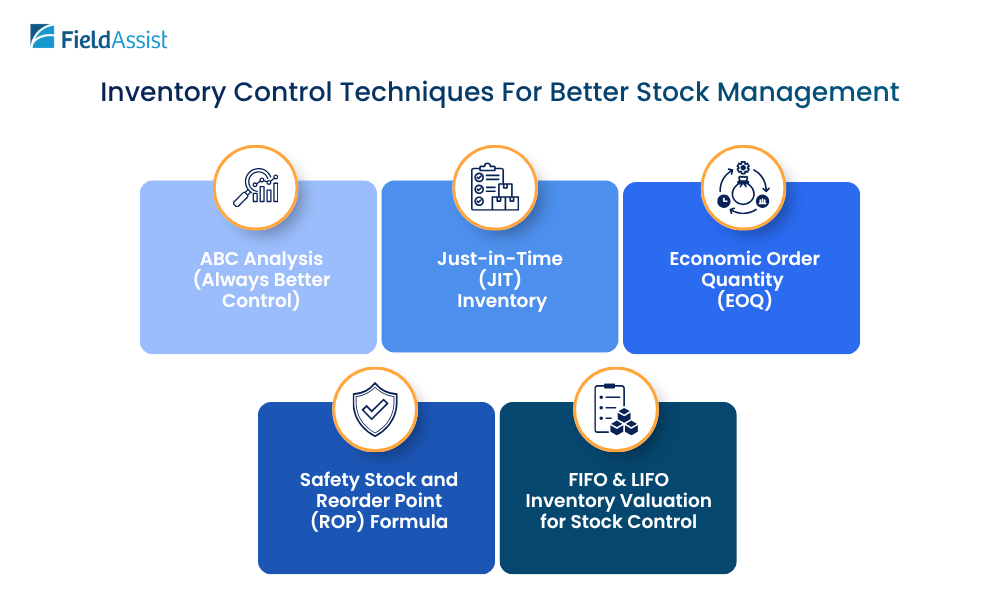
1. ABC Analysis (Always Better Control)
Not all inventory is created equal. ABC analysis is one of the most foundational techniques in inventory control, which recognizes this by dividing stock into three tiers based on value and consumption.
- A-Items: Category A items are high-value (approx. 70-80% of total value), fast-moving products but small in quantity (10-20% of stock) that drive the bulk of revenue. These require tight control and frequent automated inventory management system updates.
- B-Items: Category B items sit in the middle. Moderate value and moderate quantity.
- C-Items: Category C items are lower-value goods that collectively represent a small share of overall profit. This is often aligned with the 80/20 rule: roughly 20% of SKUs drive 80% of revenue. These can be managed with less frequent oversight or an auto-replenishment system.
By focusing your stock management software alerts on "A" items, you ensure your most profitable products are never missing.
2. Just-in-Time (JIT) Inventory
JIT is a lean technique where goods are received from suppliers only as they are needed in the production process. This drastically reduces holding costs. However, JIT requires a highly reliable automated replenishment system to avoid delays.
JIT works most powerfully when connected to an automated inventory management software platform that can track demand signals in real time. When stock levels dip below a defined threshold, the system triggers a replenishment order automatically — eliminating manual guesswork and order delays.
3. Economic Order Quantity (EOQ)
EOQ is a mathematical formula used to determine the ideal order quantity a company should purchase to minimize its total inventory costs, such as holding costs and order costs.

Where:
D= Demand in units (annual)
S= Order cost (per purchase order)
H= Holding cost (per unit, per year)
Integrating this formula into an AI inventory management system allows the software to automatically calculate the most cost-effective order volume, preventing human error.
4. Safety Stock and Reorder Point (ROP) Formula
To prevent stockouts during supply chain hiccups, businesses maintain "Safety Stock. Safety stock is the buffer a business holds beyond its expected demand to absorb these shocks.
Reorder point planning complements this by defining the inventory level at which a replenishment order should be triggered
The Reorder Point (ROP) tells your ars system (Auto-Replenishment System) exactly when to place a new order.
ROP = (Lead Time X Demand) + Safety Stock
In 2026, AI demand forecasting has made ROP more dynamic. Instead of static numbers, an ai inventory management system can adjust safety stock levels in real-time based on weather patterns, port congestion, or social media trends.
5. FIFO and LIFO Inventory Valuation
How inventory is valued on paper matters just as much as how it is physically managed. FIFO (First In, First Out) and LIFO (Last In, First Out) are the two dominant inventory valuation methods — and choosing the right one has real implications for profitability, tax liability, and stock quality.
Most importantly for operational purposes, FIFO ensures that older stock is sold first, reducing the risk of expiry, obsolescence, or quality degradation.
FIFO vs LIFO: Key Differences and When to Apply Each in a Retail Inventory Management System
Which Inventory Control Technique Is Right for Your Business?
No single technique works in isolation — the most resilient inventory operations layer multiple methods together. Here is a quick reference to help you match the right approach to your business context:
Closing Thoughts- Build a Stronger Inventory Control Foundation
These five techniques—ABC Analysis, JIT, EOQ, ROP, and FIFO/LIFO are the secret to a
smooth-running warehouse. While these ideas give you the plan, FieldAssist Auto Replenishment Software gives you the power to actually do it without the headache.
FieldAssist turns these complex math formulas into an easy, automated process. Instead of your team wasting hours on spreadsheets for thousands of products, the software uses AI to watch your sales in real-time. It automatically figures out exactly when to reorder and how much to buy, making sure your best-selling items never run out.
In today’s fast-paced market, the most successful businesses don't just guess; they use smart tools. By letting FieldAssist handle your inventory strategy, you cut down on waste, save money on storage, and keep your customers happy with products that are always in stock.
Book a demo today to see how FieldAssist can simplify your inventory management and improve your stock availability.



%20(1).avif)

.avif)