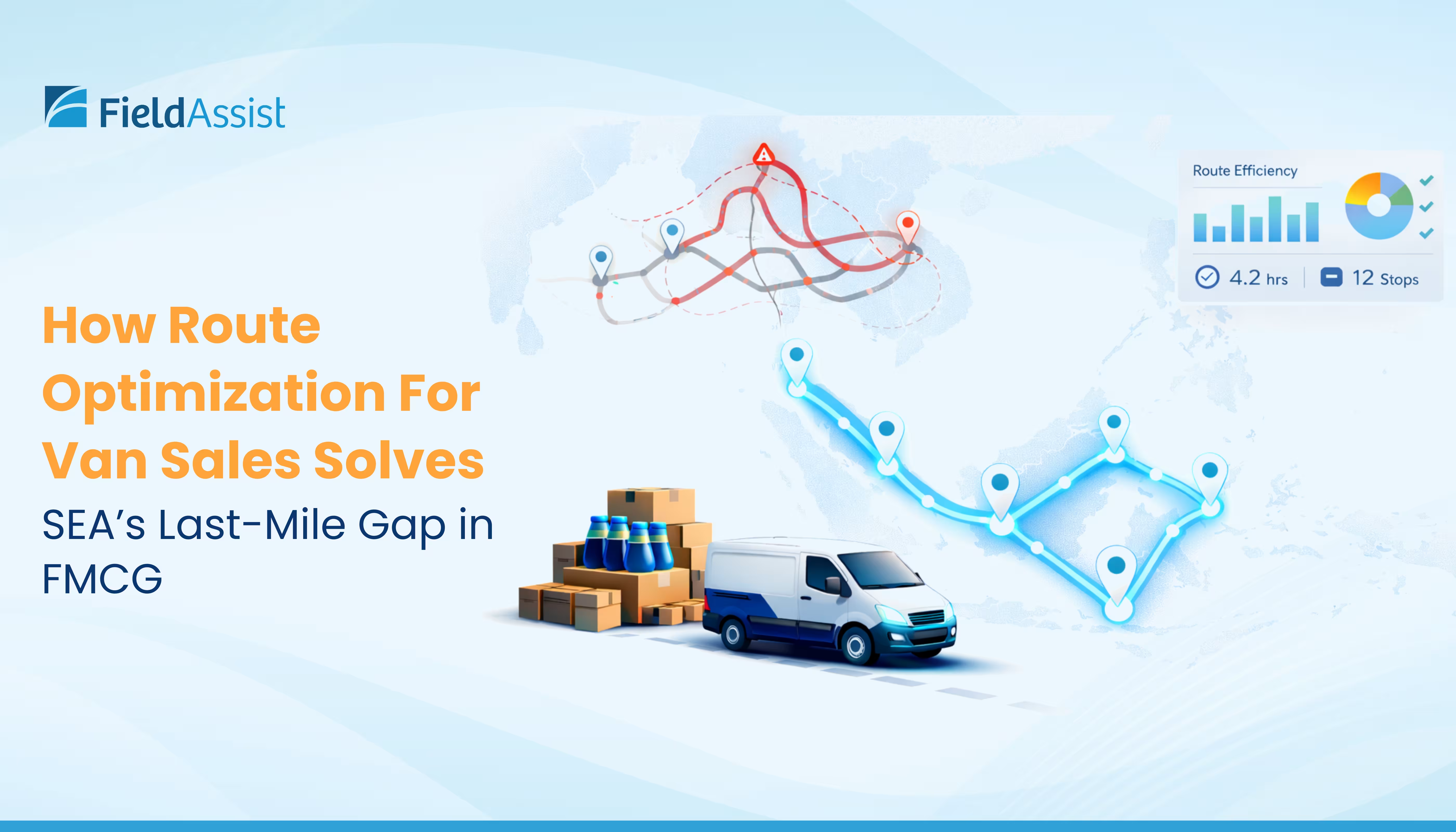
How Route Optimization For Van Sales Solves SEA’s Last-Mile Gap in FMCG
Move from manual guesswork to intelligent routing system. See how FieldAssist Route Optimization Software drives revenue by baking intelligence into van sales distribution.

In Southeast Asia, the "last mile" isn't just a logistics challenge, it’s the ultimate competitive moat. In a region where 70% to 80% of retail sales still flow through the fragmented veins of millions of Indonesian warungs and Filipino sari-sari stores, your ability to "get into the market" is your most valuable asset.
But let’s be honest about the state of play. The real question for FMCG leaders in 2026 isn't whether you can reach these outlets. It’s whether you can do it without a bleeding margin.
Look at your fleet and ask the hard questions:
- Are your vans truly covering territory and making productive stops, or are they just burning fuel?
- Are your routes governed by smart logic or just habit?
- Is your sales fleet fulfilling the demand at the micro-market level, or merely reacting to the chaos of the day?
We’ve spent decades perfecting sales rep playbooks, only to watch those strategies stall in the gridlock of Bangkok or dissolve among the archipelagos of the Philippines. Still, the last mile execution remains the most inefficient link in the supply chain, often accounting for high delivery costs.
As the SEA market matures, winning requires a fundamental shift from "broad reach" to "micro-market precision." This isn't about incremental gains; it’s about a total architectural rethink. The solution lies at the intersection of high-velocity Route Optimization and the tactical agility of digitized Van Sales Optimization. This is the synergy that turns a standard delivery run into a high-performance, data-driven strike.
The High Cost of the Last Mile Execution
Southeast Asia is a beautiful, complex puzzle of megacities, thousands of islands, and rural clusters. While consumer expectations for faster fulfillment continue to rise, execution often breaks down at the street level.
Look at the streets of Jakarta or Manila. The reality is clear: the last mile is a "Complete Chaos" for your business if you don’t know which regions to prioritize, which outlets to cover, and which SKUs to push. Without this intelligence, you aren't just delivering goods; you are creating bottlenecks that compound your costs every single day.
What Breaks Last Mile Execution in Southeast Asia?
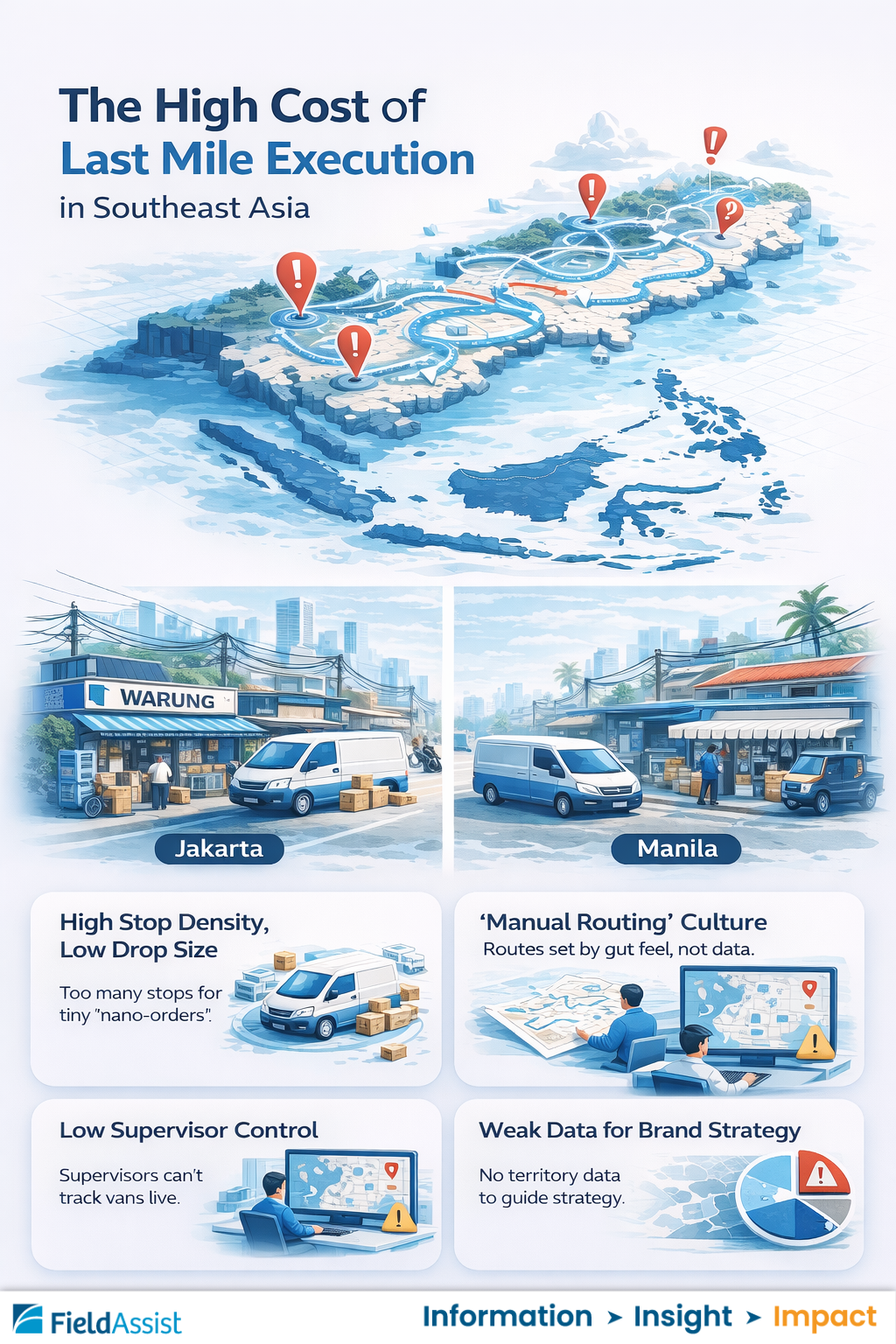
1. High stop density with low drop size: You are delivering "nano-orders" to millions of warungs and sari-sari stores. In many cases, van sales drivers visit stores in inefficient sequences or stop at low-value outlets too frequently. This destroys your "Drop Density." The business ends up doing more work for fewer sales. Thus, burning fuel and time for a fraction of the potential revenue.
2. The "Manual Routing" Culture: Routes in the region are still largely planned based on personal experience. This "guess-based" approach results in massive inconsistencies. Drivers tend to over-service older, comfortable accounts while under-servicing newer, high-growth clusters. When a van sales driver leaves, your "secret map" of the market leaves with them, leaving your business vulnerable and your territory "blind."
3. Low Supervisor Control on Daily Coverage: Every day, vans go out; by evening, they are supposed to have covered the right stores. But without visibility into who is going where, who is late, or which SKUs were actually pushed, execution falls apart. If a supervisor cannot see which van is overloaded or which neighborhoods were missed in real-time, the entire day runs on guesswork.
4. Weak Data for Brand Strategy: Strategy depends on insights, yet thousands of the outlets driving your volume remain "dark." It is nearly impossible to plan daily sales volumes without data on territories, fleet progress, and historical route performance. This lack of digital territory mapping creates a reactive management culture. You aren't leading the market; you are simply chasing the chaos of the previous day.
Closing the Gap - Route Optimization at the Heart of Van Sales.
Closing that last-mile execution gap in Southeast Asia isn't about working harder; it’s about a strategic pivot. We’re moving from the "way we’ve always done it" to a way that actually makes sense.
By integrating AI route-optimization right into your Van Sales model, the van stops being just a delivery truck - it becomes a "Smart Unit." We’re talking about a vehicle that essentially knows where to go, what to sell, and how to beat the competition before the driver even turns the key.
The proof is already out there on the streets. Look at one premium cola brand we tracked: by switching to optimized routing, they hit 540 productive outlets in just two months and achieved 100% coverage planning.
In the real world, the impact of baking Route Optimization Software in Van Sales is clearly visible:
Disclaimer: The data referenced above is field data collected from clients of FieldAssist.
Why is FieldAssist the Strategic Choice for SEA?
While many are still trying to figure out how to bridge the gap between their warehouse and the warung, FieldAssist has already covered it. FieldAssist’s Route Optimization (RO) software allows you to bake intelligence into every layer of sales and distribution:
- RO + Van Sales: Turn your vans into "Smart Units" that prioritize high-value stops and eliminate fuel waste.
- RO + DMS: Align your secondary distribution with real-time inventory to kill stock-outs before they happen.
- RO + SFA: Guide your reps along the most productive paths, ensuring they spend more time selling and less time navigating traffic.
Have a look at our Route Optimization Features to see how we’ve already solved the last-mile puzzle for the region's biggest brands.



%20(1).avif)